


Severn crossing

Encyclopedia

River Severn
The River Severn is the longest river in Great Britain, at about , but the second longest on the British Isles, behind the River Shannon. It rises at an altitude of on Plynlimon, Ceredigion near Llanidloes, Powys, in the Cambrian Mountains of mid Wales...
estuary between England and Wales. The two crossings are:
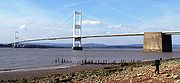
- The Severn BridgeSevern BridgeThe Severn Bridge is a suspension bridge spanning the River Severn between South Gloucestershire, just north of Bristol, England, and Monmouthshire in South Wales, via Beachley, a peninsula between the River Severn and River Wye estuary. It is the original Severn road crossing between England and...
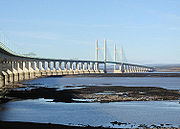
- The Second Severn CrossingSecond Severn CrossingThe Second Severn Crossing is a bridge which carries the M4 motorway over the River Severn between England and Wales, inaugurated on 5 June 1996 by HRH The Prince of Wales to augment the traffic capacity of the original Severn Bridge built in 1966...
The first motorway suspension bridge
Suspension bridge
A suspension bridge is a type of bridge in which the deck is hung below suspension cables on vertical suspenders. Outside Tibet and Bhutan, where the first examples of this type of bridge were built in the 15th century, this type of bridge dates from the early 19th century...
was inaugurated on 8 September 1966, and the newer cable-stayed bridge
Cable-stayed bridge
A cable-stayed bridge is a bridge that consists of one or more columns , with cables supporting the bridge deck....
, a few miles to the south, was inaugurated on 5 June 1996. The Second Severn Crossing marks the upper limit of the Severn Estuary
Severn Estuary
The Severn Estuary is the estuary of the River Severn, the longest river in Great Britain. Its high tidal range means it has been at the centre of discussions in the UK regarding renewable energy.-Geography:...
.
The two Severn crossings are regarded as the main crossing points from England into South Wales. Prior to 1966 road traffic between the southern counties of Wales and the southern counties of England either had to travel via Gloucester
Gloucester
Gloucester is a city, district and county town of Gloucestershire in the South West region of England. Gloucester lies close to the Welsh border, and on the River Severn, approximately north-east of Bristol, and south-southwest of Birmingham....
or take the Aust Ferry
Aust Ferry
Aust Ferry or Beachley Ferry was a ferry service that operated across the River Severn between Aust and Beachley both in Gloucestershire, England. Before the Severn Bridge opened in 1966, it provided a daily service for road traffic crossing between the West Country and South Wales...
, which ran roughly along the line of the Severn Bridge, from Old Passage near Aust
Aust
Aust is a small village in South Gloucestershire, England, the historical site of the eastern terminal of the Aust Ferry crossing route over the River Severn between England and Wales, believed to have been used in Roman times as a continuation of Icknield Street which led from Eastern England...
to Beachley
Beachley
Beachley is a village in Gloucestershire, England, near the border with Wales. It is located on a peninsula at the junction between the Rivers Wye and Severn, where the Severn Bridge ends and the smaller secondary bridge for the River Wye begins. The tidal drop here is one of the highest in the UK...
. The ferry ramps at Old Passage and Beachley are still visible.
Tolls are collected on both crossings from vehicles travelling in a westward direction only. , the toll for a car is £5.70.
Railway crossings
The Severn TunnelSevern Tunnel
The Severn Tunnel is a railway tunnel in the United Kingdom, linking South Gloucestershire in the west of England to Monmouthshire in south Wales under the estuary of the River Severn....
, carrying mainline trains under the Severn, follows a very similar route to the Second Severn Crossing.
From 1879 until its collapse in 1960 the Severn Railway Bridge
Severn Railway Bridge
The Severn Railway Bridge was a crossing across the River Severn between Sharpness and Lydney, Gloucestershire. It was badly damaged in an accident involving river barges in 1960 and demolished in 1970.-Construction:...
also carried trains across the Severn from Sharpness
Sharpness
Sharpness is an English port in Gloucestershire, one of the most inland in Britain, and eighth largest in the South West. It is on the River Severn at , at a point where the tidal range, though less than at Avonmouth downstream , is still large .The village of Sharpness is pronounced with the...
to Lydney
Lydney
Lydney is a small town and civil parish in the English county of Gloucestershire. It is located on the west bank of the River Severn, close to the Forest of Dean. The town lies on the A48 road, next to the Lydney Park gardens with its Roman temple in honour of Nodens.-Transport:The Severn Railway...
.
Future
A proposed Severn BarrageSevern Barrage
The Severn Barrage refers to a range of ideas for building a barrage from the English coast to the Welsh coast over the Severn tidal estuary. Ideas for damming or barraging the Severn estuary have existed since the 19th century. The building of such a barrage would be a huge engineering feat,...
could constitute a third crossing if one is ever built. It has been suggested that such a crossing could carry a road crossing. Until recently, a rail link over a barrage had been ruled out because it would contain a huge set of shipping locks that the rails would need to traverse. It has since been suggested that a rail bridge could carry smaller, modern trains over the locks, so a rail link is possible.
However, a report by the Department of Transport as part of the 2008-2010 Severn Tidal Power feasibilty study carried out by the Department for Energy and Climate Change, concluded that there was not any current need for new transport links, either by road or rail. Given that the UK Government opted not to pursue a tidal scheme in the Severn Estuary following the completion of the feasibility study, the chances of a third crossing anytime in the near future seem doubtful.
External links
- Severn River Crossing PLC, the bridges' operating company.