

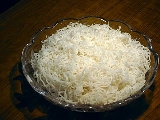
Sevai

Encyclopedia
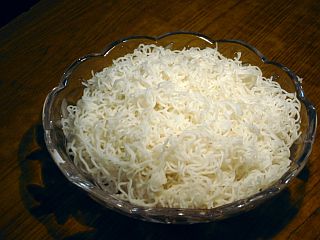
Sevai or Santhakai is a type of rice noodles
popular in Southern India, particularly Tamil Nadu
(Kongunadu region) and Karnataka
. Santhakai is made out of other food grains like wheat
, ragi
, etc. also are increasingly becoming popular.
Sevai/Santhakai is distinctly different from its cousin idiappam in the sense of input material, making process, and post-extrusion recipes. Sevai is popular as a breakfast/dinner food and is considered easily digestible as it can be made with less or no oil, and it is steamed.
grains
. It is also prepared from a dried Sevai packs (or rice sticks) like the instant ones in the Asian grocery stores. Traditionally, making of sevai at home consists of the following steps (with minor variations based on location and family customs):
, corn starch, etc.
Instant rice noodles have other additives like Wheat gluten
, Guar gum
, edible starch
, etc.
. it is called 'Shavige' in Kannada. People also loosely use the terms idiappam and semiya (vermicelli
) for Sevai, even though these foods are different from Sevai in several aspects. In Tamil, these are written சந்தகை, சந்தவம், சந்தவை.
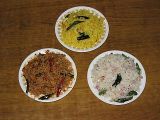 Sevai is often flavoured with Lemon, Tamarind
, Tomato, Coconut,curd etc. and tastes best when served warm. Popular accompaniments for plain sevai are sweetened coconut milk
, banana sugar and ghee, more-kuzhambu, several vegetable kormas and mutton/chicken/fish korma
.
Rice noodles
Rice noodles are noodles that are made from rice. Their principal ingredients are rice flour and water. However, sometimes other ingredients such as tapioca or corn starch are also added in order to improve the transparency or increase the gelatinous and chewy texture of the noodles.Rice noodles...
popular in Southern India, particularly Tamil Nadu
Tamil Nadu
Tamil Nadu is one of the 28 states of India. Its capital and largest city is Chennai. Tamil Nadu lies in the southernmost part of the Indian Peninsula and is bordered by the union territory of Pondicherry, and the states of Kerala, Karnataka, and Andhra Pradesh...
(Kongunadu region) and Karnataka
Karnataka
Karnataka , the land of the Kannadigas, is a state in South West India. It was created on 1 November 1956, with the passing of the States Reorganisation Act and this day is annually celebrated as Karnataka Rajyotsava...
. Santhakai is made out of other food grains like wheat
Wheat
Wheat is a cereal grain, originally from the Levant region of the Near East, but now cultivated worldwide. In 2007 world production of wheat was 607 million tons, making it the third most-produced cereal after maize and rice...
, ragi
Finger millet
Eleusine coracana, commonly Finger millet , also known as African millet or Ragi is an annual plant widely grown as a cereal in the arid areas of Africa and Asia. E...
, etc. also are increasingly becoming popular.
Sevai/Santhakai is distinctly different from its cousin idiappam in the sense of input material, making process, and post-extrusion recipes. Sevai is popular as a breakfast/dinner food and is considered easily digestible as it can be made with less or no oil, and it is steamed.
Making of Sevai
Sevai/Santhakai is mostly made fresh starting from riceRice
Rice is the seed of the monocot plants Oryza sativa or Oryza glaberrima . As a cereal grain, it is the most important staple food for a large part of the world's human population, especially in East Asia, Southeast Asia, South Asia, the Middle East, and the West Indies...
grains
Food grain
thumb|150px|Barleythumb|150px|LentilGrains are small, hard, dry seeds harvested for human food or animal feed Agronomists also call the plants producing such seeds grains or grain crops....
. It is also prepared from a dried Sevai packs (or rice sticks) like the instant ones in the Asian grocery stores. Traditionally, making of sevai at home consists of the following steps (with minor variations based on location and family customs):
- Soaking of parboiled rice in cold water for about 3 hours
- Grinding of soaked rice using a wet grinderWet grinderA wet grinder is a grinder used with water. Wet grinders have a wide application in industry, workshops, and commercial and domestic kitchens throughout Africa and Asia...
into a fine paste - Making of dumplings from the rice paste and steaming the chunks (at least three variations are known in this step as follows)
- Sautéeing the paste into doughDoughDough is a paste made out of any cereals or leguminous crops by mixing flour with a small amount of water and/or other liquid. This process is a precursor to making a wide variety of foodstuffs, particularly breads and bread-based items , flatbreads, noodles, pastry, and similar items)...
, make dumplings (also called kozhukkottais, steam the same on a idli vessel - pour the paste into moulds of the idli vessel and steam the same
- Sautéeing the paste into dough, make dumplings, drop the same into boiling water and through cook
- Sautéeing the paste into dough
- Pressing of cooked dumplings into fine strands using a type of Sevai press
Composition of Sevai
Home made Sevai is often made from 100% rice (with water and salt, of course) where as dry rice sticks may often have some additives like tapiocaTapioca
Tapioca is a starch extracted Manihot esculenta. This species, native to the Amazon, Brazil, Colombia, Venezuela, Cuba, Puerto Rico, Haiti, the Dominican Republic, Honduras, and most of the West Indies, is now cultivated worldwide and has many names, including cassava, manioc, aipim,...
, corn starch, etc.
Instant rice noodles have other additives like Wheat gluten
Wheat gluten (food)
Wheat gluten, also called seitan , wheat meat, mock duck, gluten meat, or simply gluten, is a food made from the gluten of wheat...
, Guar gum
Guar gum
Guar gum, also called guaran, is a galactomannan. It is primarily the ground endosperm of guar beans. The guar seeds are dehusked, milled and screened to obtain the guar gum. It is typically produced as a free-flowing, pale, off-white-colored, coarse to fine ground powder.-Production:Guar gum is an...
, edible starch
Starch
Starch or amylum is a carbohydrate consisting of a large number of glucose units joined together by glycosidic bonds. This polysaccharide is produced by all green plants as an energy store...
, etc.
Other names of Sevai
Sevai is called Santhakai in the western parts of Tamil NaduTamil Nadu
Tamil Nadu is one of the 28 states of India. Its capital and largest city is Chennai. Tamil Nadu lies in the southernmost part of the Indian Peninsula and is bordered by the union territory of Pondicherry, and the states of Kerala, Karnataka, and Andhra Pradesh...
. it is called 'Shavige' in Kannada. People also loosely use the terms idiappam and semiya (vermicelli
Vermicelli
Vermicelli is a traditional type of pasta round in section that is thicker than spaghetti.-Vermicelli thickness comparison:In USA, the National Pasta Association, founded in 1904, lists, together with various spelling mistakes, vermicelli as a thinner type of spaghetti.-History in Italy:In...
) for Sevai, even though these foods are different from Sevai in several aspects. In Tamil, these are written சந்தகை, சந்தவம், சந்தவை.
Foods prepared with Sevai
Tamarind
Tamarind is a tree in the family Fabaceae. The genus Tamarindus is monotypic .-Origin:...
, Tomato, Coconut,curd etc. and tastes best when served warm. Popular accompaniments for plain sevai are sweetened coconut milk
Coconut milk
Coconut milk is the water that comes from the grated meat of a coconut. The colour and rich taste of the milk can be attributed to the high oil content. In many parts of the world, the term coconut milk is also used to refer to coconut water, the naturally occurring liquid found inside the hollow...
, banana sugar and ghee, more-kuzhambu, several vegetable kormas and mutton/chicken/fish korma
Korma
Korma is a dish originating in South Asia or Central Asia which can be made with yoghurt, cream, nut and seed pastes or coconut milk; it is usually considered a type of curry...
.