

Sejongno

Encyclopedia
Jongno-gu
Jongno-gu is a gu, or district, in central Seoul, South Korea. It takes its name from a major local street, Jongno, which means "Bell Street". Jongno-gu has been the center of the city for 600 years, since where the Joseon dynasty established its capital city...
in downtown Seoul. It is named after King Sejong
Sejong the Great of Joseon
Sejong the Great was the fourth king of the Joseon Dynasty of Korea. During his regency, he reinforced Korean Confucian policies and executed major legal amendments . He also used the creation of Hangul and the advancement of technology to expand his territory...
. The street is only 600 meters in length, but thanks to its central location it is of great symbolic importance. It points north to Gwanaksan
Gwanaksan
Gwanaksan is a small mountain in southern Seoul, South Korea. Portions lie in the Gwanak-gu and Geumcheon-gu districts of Seoul; other portions lie in the neighboring cities of Anyang and Gwacheon....
and Bukhansan (Mountains), and the Joseon Dynasty
Joseon Dynasty
Joseon , was a Korean state founded by Taejo Yi Seong-gye that lasted for approximately five centuries. It was founded in the aftermath of the overthrow of the Goryeo at what is today the city of Kaesong. Early on, Korea was retitled and the capital was relocated to modern-day Seoul...
palace, Gyeongbokgung
Gyeongbokgung
Gyeongbokgung, also known as Gyeongbokgung Palace or Gyeongbok Palace, is a royal palace located in northern Seoul, South Korea. First constructed in 1394 and reconstructed in 1867, it was the main and largest palace of the Five Grand Palaces built by the Joseon Dynasty...
. To either side of the street rests the Public Prosecutors Office, Sejong Center
Sejong Center
Sejong Center for the Performing Arts is the largest arts and cultural complex in Seoul, South Korea. It has an interior area of 53,202m². It is situated in the center of the capital, on Sejongno, a main road that cuts through the capital city of the Joseon Dynasty. The center took 4 years to...
, Kyobo Life
Kyobo Life
Kyobo Life Insurance Co, Ltd. is a South Korean life insurance company headquartered in Seoul, Korea, formerly known as Daehan Education Insurance...
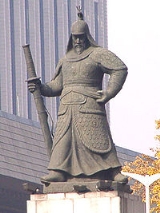
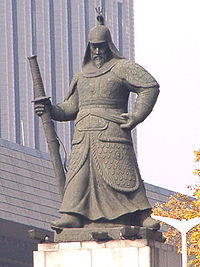
Insurance, the U.S. Embassy, Donga Ilbo Headquarters and other numerous landmarks of Seoul. At the very crossroads, stands the statue of the Admiral
Admiral
Admiral is the rank, or part of the name of the ranks, of the highest naval officers. It is usually considered a full admiral and above vice admiral and below admiral of the fleet . It is usually abbreviated to "Adm" or "ADM"...
Yi Sun-sin
Yi Sun-sin
Yi Sun-shin was a Korean naval commander, famed for his victories against the Japanese navy during the Imjin war in the Joseon Dynasty, and is well-respected for his exemplary conduct on and off the battlefield not only by Koreans, but by Japanese Admirals as well...
, the naval war hero of Korea.
It was customary for the Korean Marines who are about to graduate their 2 years of service, to congregate in front of Lee's statue and swear allegiance. This was stopped due to creating immense traffic congestions to the 8 lane street of Sejongno.
At the northern end of Sejongno sits Gwanghwamun
Gwanghwamun
Gwanghwamun is the main and largest gate of Gyeongbokgung Palace, located in Seoul, South Korea. As a landmark and symbol of Seoul's long history as the capital city during the Joseon Dynasty, the gate has gone through multiple periods of destruction and disrepair...
, the gate at the entrance to Gyeongbokgung. The name Gwanghwamun is also commonly used to refer to the intersection at the southern end of Sejongno.
In addition to the US embassy in Seoul, Sejongno is the centre of diplomacy in South Korea. Many countries, including Australia, New Zealand, Taiwan, etc. are centred near Sejongno
Major building and visitor attractions
- GyeongbokgungGyeongbokgungGyeongbokgung, also known as Gyeongbokgung Palace or Gyeongbok Palace, is a royal palace located in northern Seoul, South Korea. First constructed in 1394 and reconstructed in 1867, it was the main and largest palace of the Five Grand Palaces built by the Joseon Dynasty...
- GwanghwamunGwanghwamunGwanghwamun is the main and largest gate of Gyeongbokgung Palace, located in Seoul, South Korea. As a landmark and symbol of Seoul's long history as the capital city during the Joseon Dynasty, the gate has gone through multiple periods of destruction and disrepair...
- Government Complex, Seoul
- Sejong CenterSejong CenterSejong Center for the Performing Arts is the largest arts and cultural complex in Seoul, South Korea. It has an interior area of 53,202m². It is situated in the center of the capital, on Sejongno, a main road that cuts through the capital city of the Joseon Dynasty. The center took 4 years to...
- Ministry of Culture and TourismMinistry of Culture and TourismThe Ministry of Culture, Sports and Tourism of the Republic of Korea is a central government agency responsible for the areas of tourism, culture, art, religion, and sports. It has two vice ministers, three assistant ministers, one commission, and over 60 divisions...
- Embassy of the United States in SeoulEmbassy of the United States in SeoulThe Embassy of the United States in Seoul is the embassy of the United States in the Republic of Korea , in the capital city of Seoul. The embassy is charged with diplomacy and South Korea–United States relations...
- Ministry of Information and CommunicationMinistry of Information and CommunicationThe Ministry of Information and Communication or MIC is a ministry of the government of South Korea. Its headquarters are located in Jongno-gu, central Seoul. The current minister is Rho Jun-hyong, who began serving in March 2006.-External links:*...
- KTKorea TelecomKT Corporation is a South Korean integrated wired/wireless telecommunication service provider. KT has an information & communications business, and has the largest portion of the South Korean local telephone and high-speed Internet business...
- Kyobo Life Insurance Building, Kyobo Book CentreKyobo Book CentreThe Kyobo Book Centre or Kyobo Mungo , is the largest and most famous book store in South Korea. It boasts ten stores in seven cities, the most famous one being its Main Store, or Gwanghwamun-jum in Seoul, which is located right under the Kyobo Building, situated at Number 1, Jong-ro 1 Street...
- National Palace Museum of KoreaNational Palace Museum of KoreaNational Palace Museum of Korea is a national museum of South Korea located in Gyeongbokgung Palace, Seoul.-History:The museum first began as the "Korean Imperial Museum", which was established on September, 1908 and was originally located in Changgyeonggung Palace. On November of the following...
- Ilmin Museum of ArtIlmin Museum of ArtIlmin Museum of Art is a private art museum of South Korea, located on Sejongno street in Jongno-gu, a central district of Seoul, known for exhibiting mainly Korean art...
Transportation links
Gwanghwamun StationGwanghwamun Station
Gwanghwamun Station is a station on the Seoul Subway Line 5 in South Korea. It is not the closest subway station to the actual gate of Gwanghwamun, for which it is named. It is located next to the U.S. Embassy in Seoul....
, which is on Subway Line 5
Seoul Subway Line 5
Seoul Subway Line 5 of the Seoul Metropolitan Rapid Transit Corporation, dubbed the purple line, is a long line crossing from the west to the east across the Seoul National Capital Area, South Korea...
, is located at the southern end of Sejongno. Gyeongbokgung Station, which is served by Subway Line 3
Seoul Subway Line 3
Seoul Subway Line 3 of the Seoul Metropolitan Subway is an operation system which connects Goyang, northwestern Seoul to the city center, Gangnam, and southeastern Seoul. Construction began in 1980, and most of the current line opened over two stages in 1985, along with Brother subway Line 4...
, has entrances near the northern end of Sejongno.
See also
- Roads and expressways in South KoreaRoads and expressways in South KoreaExpressways in South Korea were originally numbered in order of construction. Since August 24, 2001, they have been numbered in a scheme somewhat similar to that of the Interstate Highway System in the United States; the icons of the South Korean highways are similar to the US red, white and...
- Transportation in South KoreaTransportation in South KoreaTransportation in South Korea is provided by extensive networks of railways, highways, bus routes, ferry services and air routes that criss-cross the country.-History:...
- List of Korea-related topics