
See Also

Seafloor spreading

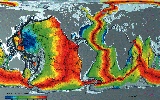
Seafloor spreading is a part of the theory of plate tectonics Plate tectonics

Plate tectonics is a theory [i] of geology [i] developed to explain the observed evidence for large sca ... 

; it is the process by which continental drift occurs. This mechanism, which is a more accurate version of Alfred Wegener Alfred Wegener

Alfred Lothar Wegener was a German [i] interdisciplinary scientist, who became famous for his th ... 

's original drift of continent Continent

A continent is a large continuous landmass [i]. ... 

s that "plow" through the sea, was proposed by Harry Hess from Princeton University Princeton University

Princeton University is a coeducation [i]al private university [i] located in Princeton, New Jersey [i]. ... 

 in the 1960s 1960s

The 1960s decade [i] refers to the years from 1960 [i] to 1969 [i], inclusive. ... 

. This phenomenon is known to be caused by convection Convection

Convection is the transfer of potential energy, for example heat [i], by currents within liquids and gas ... 

 currents in the plastic, very weak upper mantle, or asthenosphere.

Discussions

  Discussion Features

   Ask a question about 'Seafloor spreading'

   Start a new discussion about 'Seafloor spreading'

   Answer questions about 'Seafloor spreading'

   'Seafloor spreading' discussion forum


Encyclopedia


Seafloor spreading is a part of the theory of plate tectonics Plate tectonics

Plate tectonics is a theory [i] of geology [i] developed to explain the observed evidence for large sca ... 

; it is the process by which continental drift occurs. This mechanism, which is a more accurate version of Alfred Wegener Alfred Wegener

Alfred Lothar Wegener was a German [i] interdisciplinary scientist, who became famous for his th ... 

's original drift of continent Continent

A continent is a large continuous landmass [i]. ... 

s that "plow" through the sea, was proposed by Harry Hess from Princeton University Princeton University

Princeton University is a coeducation [i]al private university [i] located in Princeton, New Jersey [i]. ... 

 in the 1960s 1960s

The 1960s decade [i] refers to the years from 1960 [i] to 1969 [i], inclusive. ... 

. This phenomenon is known to be caused by convection Convection

Convection is the transfer of potential energy, for example heat [i], by currents within liquids and gas ... 

 currents in the plastic, very weak upper mantle, or asthenosphere.

Incipient spreading

In the general case, sea floor spreading starts as a rift Rift

In geology [i], a rift is a place where the Earth's crust [i] and lithosphere [i] are being pulled ... 

 in a continental land mass Plate tectonics

Plate tectonics is a theory [i] of geology [i] developed to explain the observed evidence for large sca ... 

, similar to the Red Sea-East Africa Rift Great Rift Valley

The Great Rift Valley is a vast geographical and geological feature that runs north to south for some 5,... 

 System today. The process starts with heating at the base of the continental crust which causes it to become more plastic and less dense. Because less dense objects rise in relation to more dense objects, the area being heated becomes a broad dome . As the crust bows upward, fractures occur that gradually grow into rifts. The typical rift system consists of three rift arms at approximately 120 degree angles. These areas are named triple junction Triple junction

A triple junction is the point where the boundaries between three tectonic plate [i]s, and three plate m... 

s and can be found in several places across the world today.

Early spreading

If spreading continues past the incipient stage described above, two of the rift arms will open while the third arm stops opening and becomes a 'failed rift'. As the two active rifts continue to open, eventually the continental crust is attenuated as far as it will stretch. At this point basaltic oceanic crust begins to form between the separating continental fragments. When one of the rifts opens into the existing ocean, the rift system is flooded with seawater and becomes a new sea. The Red Sea is an example of a new arm of the sea. The East Africa rift was thought to be a "failed" arm that was opening somewhat more slowly than the other two arms, but in 2005 the Ethiopian Afar Geophysical Lithospheric Experiment reported that in the Afar region last September, a 60 km fissure opened as wide as eight meters. During this period of initial flooding the new sea is sensitive to changes in climate and eustasy. As a result the new sea will evaporate several times before the elevation of the rift valley has been lowered to the point that the sea becomes stable. During this period of evaporation large evaporite deposits will be made in the rift valley. Later these deposits have the potential to become hydrocarbon seals and are of particular interest to petroleum geologists.

Sea floor spreading can stop at any time in the process, but if it continues far enough to the point that the continent is completely severed, then a new ocean basin is created. The Red Sea has not yet completely split Arabia from Africa, but a similar feature can be found on the other side of Africa that has broken completely free. South America once fit into the area of the Niger Delta. The Niger River has formed in the failed rift arm of the triple junction.

Continued spreading and subduction

The new oceanic crust is quite hot relative to old oceanic crust, so the new oceanic basin is shallower than older oceanic basins. Since the diameter of the earth remains relatively constant despite the production of new crust a mechanism must exist by which crust is also destroyed. The destruction of oceanic crust occurs at subduction Subduction

In geology [i], a subduction zone is an area on Earth [i] where two tectonic plate [i]s... 

 zones where oceanic crust is forced under either continental crust or oceanic crust. Today, the Atlantic basin is actively spreading at the Mid-Atlantic Ridge. Only a small portion of the oceanic crust produced in the Atlantic is subducted. However, the plates making up the Pacific Ocean are experiencing subduction along many of their boundaries which causes the volcanic activity in what has been termed the Ring of Fire. The Pacific is also home to one of the world's most active spreading centres with spreading rates of up to 13 cm/yr. The Mid-Atlantic Ridge is a "" slow spreading centre while the EPR is used as an example of fast spreading. The differences in spreading rates affect not only the geometries of the ridges but also the geochemistry of the basalts that are produced.

Since the new oceanic basins are shallower than the old oceanic basins, the total capacity of the world's ocean basins decreases during times of active sea floor spreading. During the opening of the Atlantic Ocean, sea level was so high that a Western Interior Seaway Western Interior Seaway

The Western Interior Seaway, also called the Cretaceous Seaway and the North American Inland Se... 

 formed across North America from the Gulf of Mexico to the Arctic Ocean.

Debate and search for mechanism

At the Mid-Atlantic Ridge Mid-Atlantic Ridge

The Mid-Atlantic Ridge is a mostly underwater mountain range [i] of the Atlantic Ocean [i] and Arctic Ocean [i] ... 

 , material from the upper mantle Mantle

A Mantle is a piece of clothing, similar to a robe [i] but open on the front side and often sleeveless. ... 

 rises through the faults between oceanic plates to form new crust as the plates move away from each other, a phenomenon first observed as continental drift. When Alfred Wegener Alfred Wegener

Alfred Lothar Wegener was a German [i] interdisciplinary scientist, who became famous for his th ... 

 first presented a hypothesis of continental drift in 1912, conservative geologists, especially in North America, demanded to know where the motive force could possibly lie. Discoveries of the earth's great fiery welts, like the mid-Atlantic Ridge and the East Pacific Rise East Pacific Rise

The East Pacific Rise is a long north-south welt of seafloor spreading [i] under the eastern Pacific Ocean [i] ... 

 have provided the explanation.

It is still a matter of some debate whether seafloor spreading is driven primarily by the force of rising magma at these locations, or if it is driven by the force of sinking magma elsewhere and these upwellings are merely a side effect. It is likely however that some seafloor spreading is driven by active upwelling and some by passive upwelling.

See also

  • Divergent boundary
  • Mid-ocean ridge Mid-ocean ridge

    A mid-ocean ridge or mid-oceanic ridge is an underwater mountain [i] range, formed by plate tectonics [i] ... 


External links