


SeaGen

Encyclopedia

Tidal stream generator
A tidal stream generator, often referred to as a tidal energy converter is a machine that extracts energy from moving masses of water, in particular tides, although the term is often used in reference to machines designed to extract energy from run of river or tidal estuarine sites...
generator
Electrical generator
In electricity generation, an electric generator is a device that converts mechanical energy to electrical energy. A generator forces electric charge to flow through an external electrical circuit. It is analogous to a water pump, which causes water to flow...
. It is four times more powerful than any other tidal stream generator in the world.
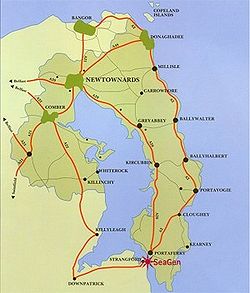
The first SeaGen generator was installed in Strangford Narrows between Strangford
Strangford
Strangford is a small village at the mouth of Strangford Lough in County Down, Northern Ireland. It had a population of 475 people at the 2001 Census.On the other side of the lough is Portaferry and there is a ferry service between the two villages...
and Portaferry
Portaferry
Portaferry is a small town in County Down, Northern Ireland, at the southern end of the Ards Peninsula, near the Narrows at the entrance to Strangford Lough. It had a population of 2,467 people in the 2001 Census. It has an aquarium and is well-known for the annual Galway Hookers Regatta. It hosts...
in Northern Ireland
Northern Ireland
Northern Ireland is one of the four countries of the United Kingdom. Situated in the north-east of the island of Ireland, it shares a border with the Republic of Ireland to the south and west...
in April 2008 and was connected to the grid in July 2008. It generates 1.2 MW for between 18 and 20 hours a day while the tides are forced in and out of Strangford Lough
Strangford Lough
Strangford Lough, sometimes Strangford Loch, is a large sea loch or inlet in County Down, Northern Ireland. It is separated from the Irish Sea by the Ards Peninsula. The name Strangford is derived ; describing the fast-flowing narrows at its mouth...
through the Narrows. Strangford Lough was also the site of the very first known tide mill
Tide mill
A tide mill is a water mill driven by tidal rise and fall. A dam with a sluice is created across a suitable tidal inlet, or a section of river estuary is made into a reservoir. As the tide comes in, it enters the mill pond through a one way gate, and this gate closes automatically when the tide...
in the world, the Nendrum Monastery mill
Nendrum Monastery mill
The Nendrum Monastery mill was a tide mill on an island in Strangford Lough in Northern Ireland. It is the earliest excavated tide mill, dating from 787. Its millstones are 830mm in diameter and the horizontal wheel is estimated to have developed 7/8HP at its peak. Remains of an earlier mill dated...
where remains dating from 787
787
Year 787 was a common year starting on Monday of the Julian calendar. The denomination 787 for this year has been used since the early medieval period, when the Anno Domini calendar era became the prevalent method in Europe for naming years.- Europe :* Conall succeeds Drest as king of the...
have been excavated.
Background

Marine Current Turbines
Marine Current Turbines Ltd is a United Kingdom-based company which is developing tidal stream generators.MCT was founded in 2000 to develop ideas of tidal power developed by Peter Fraenkel, who had previously been a founder partner of IT Power, a consultancy established to further the...
, the developer of SeaGen, demonstrated first prototype of tidal stream generator in 1994 with a 15 kilowatt system in Loch Linnhe
Loch Linnhe
Loch Linnhe is a sea loch on the west coast of Scotland....
, off the west coast of Scotland
Scotland
Scotland is a country that is part of the United Kingdom. Occupying the northern third of the island of Great Britain, it shares a border with England to the south and is bounded by the North Sea to the east, the Atlantic Ocean to the north and west, and the North Channel and Irish Sea to the...
. In May 2003, the prototype for SeaGen, 'SeaFlow', was installed off the coast of Lynmouth
Lynmouth
Lynmouth is a village in Devon, England, on the north edge of Exmoor.The village straddles the confluence of the West Lyn and East Lyn rivers, in a gorge below Lynton, to which it is connected by the Lynton and Lynmouth Cliff Railway....
, North Devon
North Devon
North Devon is the northern part of the English county of Devon. It is also the name of a local government district in Devon. Its council is based in Barnstaple. Other towns and villages in the North Devon District include Braunton, Fremington, Ilfracombe, Instow, South Molton, Lynton and Lynmouth...
, England. Seaflow was a single rotor turbine which generated 300 kW but was not connected to the grid. SeaFlow was the world's first offshore tidal generator, and remained the world's largest until SeaGen was installed.
Technology
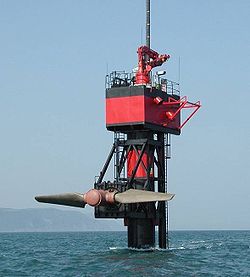
SeaGen generator weighs 300 tonnes. It consists of twin axial-flow rotors of 16 metres (52.5 ft) in diameter, each driving a generator through a gearbox like a hydro-electric or wind turbine. These turbines have a patented feature by which the rotor blades can be pitched through 180 degrees allowing them to operate in both flow directions – on ebb and flood tides. The power units of each system are mounted on arm-like extensions either side of a tubular steel monopile some 3 metres (9.8 ft) in diameter and the arms with the power units can be raised above the surface for safe and easy maintenance access. The SeaGen was built at BelfastBelfast
Belfast is the capital of and largest city in Northern Ireland. By population, it is the 14th biggest city in the United Kingdom and second biggest on the island of Ireland . It is the seat of the devolved government and legislative Northern Ireland Assembly...
's Harland and Wolff
Harland and Wolff
Harland and Wolff Heavy Industries is a Northern Irish heavy industrial company, specialising in shipbuilding and offshore construction, located in Belfast, Northern Ireland....
's shipyards.
Environmental impact
Problems
During the commissioning of the system a software error caused the blades of one of the turbines to be damaged. This has left the turbine operating at half power until autumn 2008. The incident is being investigated and MCT is confident that it will not happen again.Full power operation was finally achieved on 18 Dec 2008.