


Saros cycle

Encyclopedia
The saros is a period of 223 synodic months (approximately 6585.3213 days, or nearly 18 years 11 days), that can be used to predict eclipse
s of the Sun
and Moon
. One saros after an eclipse, the Sun, Earth
, and Moon return to approximately the same relative geometry, and a nearly identical eclipse will occur, in what is referred to as an eclipse cycle
. A sar is one half of a saros.
A series of eclipses that are separated by one saros is called a saros series.
(ancient Babylonian astronomers) in the last several centuries BC, and was later known to Hipparchus
, Pliny
and Ptolemy
, but under different names. The Sumerian/Babylonian word "šár" was one of the ancient Mesopotamian units of measurement
and as a number appears to have had a value of 3600. The name "saros" was first given to the eclipse cycle by Edmond Halley
in 1691, who took it from the Suda
, a Byzantine
lexicon of the 11th century. The information in the Suda in turn was derived directly or otherwise from the Chronicle of Eusebius of Caesarea, which quoted Berossus
. Although Halley's naming error was pointed out by Guillaume Le Gentil
in 1756, the name continues to be used.
) or the Earth must be located between the Sun and Moon (for a lunar eclipse
). This can happen only when the Moon is new
or full
, respectively, and repeat occurrences of these lunar phase
s are controlled by the Moon's synodic period, which is about 29.53 days. Most of the times during a full and new moon, however, the shadow of the Earth or Moon falls to the north or south of the other body. Thus, if an eclipse is to occur, the three bodies must also be nearly in a straight line. This condition occurs only when a full or new Moon passes close to the ecliptic plane
(during an eclipse season
) which is the case around the time when it passes through one of the two nodes
of its orbit (the ascending or descending node). The period of time for two successive passes through the ecliptic plane at the same node is given by the draconic month, which is 27.21 days. So the conditions of an eclipse are met when the new or full moon is near one of the nodes, which occurs every 5 or 6 months (the Sun, being in conjunction or opposition to the Moon, is also at a node of the Moon's orbit at that time - this happens twice in an eclipse year). However, if two eclipses are to have the same appearance and duration, then also the distance between the Earth and Moon, as well as the Earth and Sun, must be the same for both events. The time it takes the Moon to orbit the Earth once and return to the same distance is given by the anomalistic month, which has a period of 27.55 days.
The origin of the saros comes from the recognition that 223 synodic months is approximately equal to 242 draconic months, which is approximately equal to 239 anomalistic months (this approximation is good to within about 2 hours). After one saros, the Moon will have completed roughly an integer number of synodic, draconic, and anomalistic months, and the Earth-Sun-Moon geometry will be nearly identical: the Moon will have the same phase, be at the same node, and have the same distance from the Earth. In addition, because the saros is close to 18 years in length (about 11 days longer), the earth will be nearly the same distance from the sun, and tilted to it in nearly the same orientation (same season). If one knew the date of an eclipse, then one saros later, a nearly identical eclipse should occur. Note that during this 18-year cycle, about 40 other solar and lunar eclipses take place, but with a somewhat different geometry. Note also that the saros (18.03 years) is not equal to an integer number of revolutions of the Moon with respect to the fixed stars (sidereal month of 27.32 days). Therefore, even though the relative geometry of the Earth-Sun-Moon system will be nearly identical after a saros, the Moon will be in a different position with respect to the stars. This is due to the fact that the orbit of the Moon precesses
.
A complication with the saros is that its period is not an integer number of days, but contains a multiple of ⅓ of a day. Thus, as a result of the Earth's rotation, for each successive saros, an eclipse will occur about 8 hours later in the day. In the case of an eclipse of the Sun, this means that the region of visibility will shift westward by 120°, or one third of the way around the globe, and the two eclipses will thus not be visible from the same place on Earth. In the case of an eclipse of the Moon, the next eclipse might still be visible from the same location as long as the Moon is above the horizon. However, if one waits three saros, the local time of day of an eclipse will be nearly the same. This period of three saros (54 years 1 month, or almost 19756 full days), is known as a triple saros or exeligmos
(Greek
: "turn of the wheel").
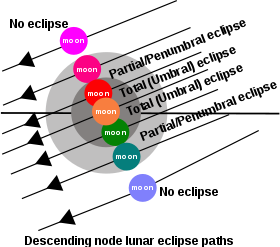 The saros is based on the recognition that 223 synodic months approximately equal to 242 draconic months and 239 anomalistic months. However, as this relationship is not perfect, the geometry of two eclipses separated by one saros will differ slightly. In particular, the place where the Sun and Moon come in conjunction shifts westward by about 0.5° with respect to the Moon's nodes every saros, and this gives rise to a series of eclipses, called a saros series, that slowly change in appearance.
Each saros series starts with a partial eclipse (Sun first enters the end of the node), and each successive saros the path of the Moon is shifted either northward (when near the descending node) or southward (when near the ascending node). At some point, eclipses are no longer possible and the series terminates (Sun leaves the beginning of the node). Arbitrary dates were established by compilers of eclipse statistics. These extreme dates are 2000 BCE and 3000 CE. Saros series, of course, went on before and will continue after these dates. Since the first eclipse of 2000 BCE was not the first in its saros, it is necessary to extend the saros series numbers backwards beyond 0 to negative numbers to accommodate eclipses occurring in the years following 2000 BCE. The saros -13 is the first saros to appear in these data. For solar eclipses the statistics for the complete saros series within the era between 2000 BCE and 3000 CE are given in this article's references. It takes between 1226 and 1550 years for the members of a saros series to traverse the Earth's surface from north to south (or vice-versa). These extremes allow from 69 to 87 eclipses in each series (most series have 71 or 72 eclipses). From 39 to 59 (mostly about 43) eclipses in a given series will be central (that is, total, annular, or hybrid annular-total). At any given time, approximately 40 different saros series will be in progress.
Saros series are numbered according to the type of eclipse (solar or lunar) and whether they occur at the Moon's ascending or descending node. Odd numbers are used for solar eclipses occurring near the ascending node, whereas even numbers are given to descending node solar eclipses. For lunar eclipses, this numbering scheme is somewhat random. The ordering of these series is determined by the time at which each series peaks, which corresponds to when an eclipse is closest to one of the lunar nodes. For solar eclipses, (in 2003) the 39 series numbered between 117 and 155 are active, whereas for lunar eclipses, there are now 41 active saros series.
As an example of a single saros series, the accompanying table gives the dates of some of the 72 lunar eclipses for saros series 131. This eclipse series began in AD 1427 with a partial eclipse at the southern edge of the Earth's shadow when the Moon was close to its descending node. Each successive saros, the Moon's orbital path is shifted northward with respect to the Earth's shadow, with the first total eclipse occurring in 1950. For the following 252 years, total eclipses occur, with the central eclipse being predicted to occur in 2078. The first partial eclipse after this is predicted to occur in the year 2220, and the final partial eclipse of the series will occur in 2707. The total lifetime of the lunar saros series 131 is 1280 years.
Because of the ⅓ fraction of days in a saros, the visibility of each eclipse will differ for an observer at a given locale. For the lunar saros series 131, the first total eclipse of 1950 had its best visibility for viewers in Eastern Europe and the Middle East because mid-eclipse was at 20:44 UT. The following eclipse in the series occurred approximately 8 hours later in the day with mid-eclipse at 4:47 UT, and was best seen from North America and South America. The third total eclipse occurred approximately 8 hours later in the day than the second eclipse with mid-eclipse at 12:43 UT, and had its best visibility for viewers in the Western Pacific, East Asia, Australia and New Zealand. This cycle of visibility repeats from the initiation to termination of the series, with minor variations.
For a similar example for solar saros see solar saros 136
.
Eclipse
An eclipse is an astronomical event that occurs when an astronomical object is temporarily obscured, either by passing into the shadow of another body or by having another body pass between it and the viewer...
s of the Sun
Sun
The Sun is the star at the center of the Solar System. It is almost perfectly spherical and consists of hot plasma interwoven with magnetic fields...
and Moon
Moon
The Moon is Earth's only known natural satellite,There are a number of near-Earth asteroids including 3753 Cruithne that are co-orbital with Earth: their orbits bring them close to Earth for periods of time but then alter in the long term . These are quasi-satellites and not true moons. For more...
. One saros after an eclipse, the Sun, Earth
Earth
Earth is the third planet from the Sun, and the densest and fifth-largest of the eight planets in the Solar System. It is also the largest of the Solar System's four terrestrial planets...
, and Moon return to approximately the same relative geometry, and a nearly identical eclipse will occur, in what is referred to as an eclipse cycle
Eclipse cycle
Eclipses may occur repeatedly, separated by certain intervals of time: these intervals are called eclipse cycles. The series of eclipses separated by a repeat of one of these intervals is called an eclipse series.- Eclipse conditions :...
. A sar is one half of a saros.
A series of eclipses that are separated by one saros is called a saros series.
History
The earliest discovered historical record of the saros is by the ChaldeansNeo-Babylonian Empire
The Neo-Babylonian Empire or Second Babylonian Empire was a period of Mesopotamian history which began in 626 BC and ended in 539 BC. During the preceding three centuries, Babylonia had been ruled by their fellow Akkadian speakers and northern neighbours, Assyria. Throughout that time Babylonia...
(ancient Babylonian astronomers) in the last several centuries BC, and was later known to Hipparchus
Hipparchus
Hipparchus, the common Latinization of the Greek Hipparkhos, can mean:* Hipparchus, the ancient Greek astronomer** Hipparchic cycle, an astronomical cycle he created** Hipparchus , a lunar crater named in his honour...
, Pliny
Pliny the Elder
Gaius Plinius Secundus , better known as Pliny the Elder, was a Roman author, naturalist, and natural philosopher, as well as naval and army commander of the early Roman Empire, and personal friend of the emperor Vespasian...
and Ptolemy
Ptolemy
Claudius Ptolemy , was a Roman citizen of Egypt who wrote in Greek. He was a mathematician, astronomer, geographer, astrologer, and poet of a single epigram in the Greek Anthology. He lived in Egypt under Roman rule, and is believed to have been born in the town of Ptolemais Hermiou in the...
, but under different names. The Sumerian/Babylonian word "šár" was one of the ancient Mesopotamian units of measurement
Ancient Mesopotamian units of measurement
Ancient Mesopotamian units of measurement originated in the loosely organized city-states of Early Dynastic Sumer. The units themselves grew out of the tradition of counting tokens used by the Neolithic cultural complex of the Near East. The counting tokens were used to keep accounts of personal...
and as a number appears to have had a value of 3600. The name "saros" was first given to the eclipse cycle by Edmond Halley
Edmond Halley
Edmond Halley FRS was an English astronomer, geophysicist, mathematician, meteorologist, and physicist who is best known for computing the orbit of the eponymous Halley's Comet. He was the second Astronomer Royal in Britain, following in the footsteps of John Flamsteed.-Biography and career:Halley...
in 1691, who took it from the Suda
Suda
The Suda or Souda is a massive 10th century Byzantine encyclopedia of the ancient Mediterranean world, formerly attributed to an author called Suidas. It is an encyclopedic lexicon, written in Greek, with 30,000 entries, many drawing from ancient sources that have since been lost, and often...
, a Byzantine
Byzantine
Byzantine usually refers to the Roman Empire during the Middle Ages.Byzantine may also refer to:* A citizen of the Byzantine Empire, or native Greek during the Middle Ages...
lexicon of the 11th century. The information in the Suda in turn was derived directly or otherwise from the Chronicle of Eusebius of Caesarea, which quoted Berossus
Berossus
Berossus was a Hellenistic-era Babylonian writer, a priest of Bel Marduk and astronomer writing in Greek, who was active at the beginning of the 3rd century BC...
. Although Halley's naming error was pointed out by Guillaume Le Gentil
Guillaume Le Gentil
Guillaume Joseph Hyacinthe Jean-Baptiste Le Gentil de la Galaisière was a French astronomer.-Biography:...
in 1756, the name continues to be used.
Description
The saros, a period of 6585.322 days (14 normal years + 4 leap years + 11.322 days, or 13 normal years + 5 leap years + 10.322 days), is useful for predicting the times at which nearly identical eclipses will occur, and derives from three periodicities of the lunar orbit: the synodic month, the draconic month, and the anomalistic month. For an eclipse to occur, either the Moon must be located between the Earth and Sun (for a solar eclipseSolar eclipse
As seen from the Earth, a solar eclipse occurs when the Moon passes between the Sun and the Earth, and the Moon fully or partially blocks the Sun as viewed from a location on Earth. This can happen only during a new moon, when the Sun and the Moon are in conjunction as seen from Earth. At least...
) or the Earth must be located between the Sun and Moon (for a lunar eclipse
Lunar eclipse
A lunar eclipse occurs when the Moon passes behind the Earth so that the Earth blocks the Sun's rays from striking the Moon. This can occur only when the Sun, Earth, and Moon are aligned exactly, or very closely so, with the Earth in the middle. Hence, a lunar eclipse can only occur the night of a...
). This can happen only when the Moon is new
New moon
In astronomical terminology, the new moon is the lunar phase that occurs when the Moon, in its monthly orbital motion around Earth, lies between Earth and the Sun, and is therefore in conjunction with the Sun as seen from Earth...
or full
Full moon
Full moon lunar phase that occurs when the Moon is on the opposite side of the Earth from the Sun. More precisely, a full moon occurs when the geocentric apparent longitudes of the Sun and Moon differ by 180 degrees; the Moon is then in opposition with the Sun.Lunar eclipses can only occur at...
, respectively, and repeat occurrences of these lunar phase
Lunar phase
A lunar phase or phase of the moon is the appearance of the illuminated portion of the Moon as seen by an observer, usually on Earth. The lunar phases change cyclically as the Moon orbits the Earth, according to the changing relative positions of the Earth, Moon, and Sun...
s are controlled by the Moon's synodic period, which is about 29.53 days. Most of the times during a full and new moon, however, the shadow of the Earth or Moon falls to the north or south of the other body. Thus, if an eclipse is to occur, the three bodies must also be nearly in a straight line. This condition occurs only when a full or new Moon passes close to the ecliptic plane
Plane of the ecliptic
The plane of the ecliptic is the plane of the Earth's orbit around the Sun. It is the primary reference plane when describing the position of bodies in the Solar System, with celestial latitude being measured relative to the ecliptic plane. In the course of a year, the Sun's apparent path through...
(during an eclipse season
Eclipse season
Eclipse seasons are the only times during a year eclipses can occur, due to the 5° inclination of the moon's orbit. Each season lasts for approximately 33 days and repeats just short of six months, thus there are always two full eclipse seasons each year. 2 to 3 eclipses always occur each eclipse...
) which is the case around the time when it passes through one of the two nodes
Lunar node
The lunar nodes are the orbital nodes of the Moon, that is, the points where the orbit of the Moon crosses the ecliptic . The ascending node is where the moon crosses to the north of the ecliptic...
of its orbit (the ascending or descending node). The period of time for two successive passes through the ecliptic plane at the same node is given by the draconic month, which is 27.21 days. So the conditions of an eclipse are met when the new or full moon is near one of the nodes, which occurs every 5 or 6 months (the Sun, being in conjunction or opposition to the Moon, is also at a node of the Moon's orbit at that time - this happens twice in an eclipse year). However, if two eclipses are to have the same appearance and duration, then also the distance between the Earth and Moon, as well as the Earth and Sun, must be the same for both events. The time it takes the Moon to orbit the Earth once and return to the same distance is given by the anomalistic month, which has a period of 27.55 days.
The origin of the saros comes from the recognition that 223 synodic months is approximately equal to 242 draconic months, which is approximately equal to 239 anomalistic months (this approximation is good to within about 2 hours). After one saros, the Moon will have completed roughly an integer number of synodic, draconic, and anomalistic months, and the Earth-Sun-Moon geometry will be nearly identical: the Moon will have the same phase, be at the same node, and have the same distance from the Earth. In addition, because the saros is close to 18 years in length (about 11 days longer), the earth will be nearly the same distance from the sun, and tilted to it in nearly the same orientation (same season). If one knew the date of an eclipse, then one saros later, a nearly identical eclipse should occur. Note that during this 18-year cycle, about 40 other solar and lunar eclipses take place, but with a somewhat different geometry. Note also that the saros (18.03 years) is not equal to an integer number of revolutions of the Moon with respect to the fixed stars (sidereal month of 27.32 days). Therefore, even though the relative geometry of the Earth-Sun-Moon system will be nearly identical after a saros, the Moon will be in a different position with respect to the stars. This is due to the fact that the orbit of the Moon precesses
Lunar precession
Precession is the rotation of a plane with respect to a reference plane. The orbit of the Moon has two important such precessional motions....
.
A complication with the saros is that its period is not an integer number of days, but contains a multiple of ⅓ of a day. Thus, as a result of the Earth's rotation, for each successive saros, an eclipse will occur about 8 hours later in the day. In the case of an eclipse of the Sun, this means that the region of visibility will shift westward by 120°, or one third of the way around the globe, and the two eclipses will thus not be visible from the same place on Earth. In the case of an eclipse of the Moon, the next eclipse might still be visible from the same location as long as the Moon is above the horizon. However, if one waits three saros, the local time of day of an eclipse will be nearly the same. This period of three saros (54 years 1 month, or almost 19756 full days), is known as a triple saros or exeligmos
Exeligmos
An exeligmos is a period of 54 years, 33 days that can be used to predict successive eclipses with similar properties and location. For a solar eclipse, every exeligmos a solar eclipse of similar characteristics will occur close to the eclipse before it...
(Greek
Greek language
Greek is an independent branch of the Indo-European family of languages. Native to the southern Balkans, it has the longest documented history of any Indo-European language, spanning 34 centuries of written records. Its writing system has been the Greek alphabet for the majority of its history;...
: "turn of the wheel").
Saros series
Each saros series starts with a partial eclipse (Sun first enters the end of the node), and each successive saros the path of the Moon is shifted either northward (when near the descending node) or southward (when near the ascending node). At some point, eclipses are no longer possible and the series terminates (Sun leaves the beginning of the node). Arbitrary dates were established by compilers of eclipse statistics. These extreme dates are 2000 BCE and 3000 CE. Saros series, of course, went on before and will continue after these dates. Since the first eclipse of 2000 BCE was not the first in its saros, it is necessary to extend the saros series numbers backwards beyond 0 to negative numbers to accommodate eclipses occurring in the years following 2000 BCE. The saros -13 is the first saros to appear in these data. For solar eclipses the statistics for the complete saros series within the era between 2000 BCE and 3000 CE are given in this article's references. It takes between 1226 and 1550 years for the members of a saros series to traverse the Earth's surface from north to south (or vice-versa). These extremes allow from 69 to 87 eclipses in each series (most series have 71 or 72 eclipses). From 39 to 59 (mostly about 43) eclipses in a given series will be central (that is, total, annular, or hybrid annular-total). At any given time, approximately 40 different saros series will be in progress.
Saros series are numbered according to the type of eclipse (solar or lunar) and whether they occur at the Moon's ascending or descending node. Odd numbers are used for solar eclipses occurring near the ascending node, whereas even numbers are given to descending node solar eclipses. For lunar eclipses, this numbering scheme is somewhat random. The ordering of these series is determined by the time at which each series peaks, which corresponds to when an eclipse is closest to one of the lunar nodes. For solar eclipses, (in 2003) the 39 series numbered between 117 and 155 are active, whereas for lunar eclipses, there are now 41 active saros series.
Example: Lunar saros 131
| May 10, 1427 (Julian calendar Julian calendar The Julian calendar began in 45 BC as a reform of the Roman calendar by Julius Caesar. It was chosen after consultation with the astronomer Sosigenes of Alexandria and was probably designed to approximate the tropical year .The Julian calendar has a regular year of 365 days divided into 12 months... ) |
First penumbral (southern edge of shadow) |
| ...6 intervening penumbral eclipses omitted... | |
| July 25, 1553 (Julian calendar) |
First partial |
| ...19 intervening partial eclipses omitted... | |
| March 22, 1932 March 1932 lunar eclipse A partial lunar eclipse took place on March 22, 1932.... Final partial |
12:32 UT |
| April 2, 1950 April 1950 lunar eclipse A total lunar eclipse took place on April 2, 1950.-Saros series:The next occurrence was on April 13, 1968. The previous occurrence was March 22, 1932.... First total |
20:44 UT  |
| April 13, 1968 April 1968 lunar eclipse A total lunar eclipse took place on April 13, 1968, the first of two total eclipses in 1968, the second being on October 6.-Visibility:It was visible from North and South America, as well as Africa and western Europe.... |
04:47 UT |
| April 24, 1986 April 1986 lunar eclipse A total lunar eclipse took place on April 24, 1986.-Visibility :It is seen rising over eastern Asia, the Pacific Ocean, and western North America and South America, the eclipse is also seen setting over the whole of Europe, Africa and Western Asia... |
12:43 UT |
| May 4, 2004 May 2004 lunar eclipse A total lunar eclipse took place on May 4, 2004, the first of two total lunar eclipses in 2004, the second being on October 28, 2004.- Visibility :... |
20:30 UT |
| May 16, 2022 May 2022 lunar eclipse A total lunar eclipse will take place on May 16, 2022, the first of two total lunar eclipses in 2022, the second being on November 8.-Visibility:... First central |
04:11 UT  |
| May 26, 2040 May 2040 lunar eclipse A total lunar eclipse will take place on May 26, 2040. The moon will pass through the center of the Earth's shadow.-Visibility:It will be completely visible over Australia and the Pacific, seen rising over Eastern Asia, and setting over North and South America.-Lunar year series :This eclipse is... |
11:45 UT |
| June 6, 2058 June 2058 lunar eclipse A total lunar eclipse will take place on June 6, 2058. The moon will pass through the center of the Earth's shadow.- External links :... |
19:14 UT |
| June 17, 2076 June 2076 lunar eclipse A total lunar eclipse will take place on June 17, 2076. The moon will pass through the center of the Earth's shadow.... Central |
02:37 UT  |
| ...6 intervening total eclipses omitted... | |
| September 3, 2202 Last total |
05:59 UT |
| September 13, 2220 First partial |
|
| ...18 intervening partial eclipses omitted... | |
| April 9, 2563 | Last partial umbral |
| ...7 intervening penumbral eclipses omitted... | |
| July 7, 2707 | Last penumbral (northern edge of shadow) |
As an example of a single saros series, the accompanying table gives the dates of some of the 72 lunar eclipses for saros series 131. This eclipse series began in AD 1427 with a partial eclipse at the southern edge of the Earth's shadow when the Moon was close to its descending node. Each successive saros, the Moon's orbital path is shifted northward with respect to the Earth's shadow, with the first total eclipse occurring in 1950. For the following 252 years, total eclipses occur, with the central eclipse being predicted to occur in 2078. The first partial eclipse after this is predicted to occur in the year 2220, and the final partial eclipse of the series will occur in 2707. The total lifetime of the lunar saros series 131 is 1280 years.
Because of the ⅓ fraction of days in a saros, the visibility of each eclipse will differ for an observer at a given locale. For the lunar saros series 131, the first total eclipse of 1950 had its best visibility for viewers in Eastern Europe and the Middle East because mid-eclipse was at 20:44 UT. The following eclipse in the series occurred approximately 8 hours later in the day with mid-eclipse at 4:47 UT, and was best seen from North America and South America. The third total eclipse occurred approximately 8 hours later in the day than the second eclipse with mid-eclipse at 12:43 UT, and had its best visibility for viewers in the Western Pacific, East Asia, Australia and New Zealand. This cycle of visibility repeats from the initiation to termination of the series, with minor variations.
For a similar example for solar saros see solar saros 136
Solar Saros 136
Solar Saros 136 is currently producing the longest total solar eclipses. It produced the 6 longest total eclipses of the 20th century, 3 of them over 7 minutes long. It also produced the longest total eclipse of the 21st century at 6 min 39 sec, and overall will produce the centuries 3 longest...
.
Relationship between lunar and solar saros (sar)
After a given lunar or solar eclipse, after 9 years and 5.5 days (a half saros) an eclipse will occur that is lunar instead of solar, or vice versa, with similar properties. For example if the moon's penumbra partially covers the southern limb of the earth during a solar eclipse, 9 years and 5.5 days later a lunar eclipse will occur in which the moon is partially covered by the southern limb of the earth's penumbra. Likewise, 9 years and 5.5 days after a total solar eclipse occurs, a total lunar eclipse will also occur. This 9 year period is referred to as a sar. It includes 111.5 synodic months, or 111 synodic months plus one fortnight. The fortnight accounts for the alternation between solar and lunar eclipse. For a visual example see this chart (each row is one sar apart).See also
- List of Saros series for lunar eclipses
- Eclipse cycleEclipse cycleEclipses may occur repeatedly, separated by certain intervals of time: these intervals are called eclipse cycles. The series of eclipses separated by a repeat of one of these intervals is called an eclipse series.- Eclipse conditions :...
- Solar eclipseSolar eclipseAs seen from the Earth, a solar eclipse occurs when the Moon passes between the Sun and the Earth, and the Moon fully or partially blocks the Sun as viewed from a location on Earth. This can happen only during a new moon, when the Sun and the Moon are in conjunction as seen from Earth. At least...
- Lunar eclipseLunar eclipseA lunar eclipse occurs when the Moon passes behind the Earth so that the Earth blocks the Sun's rays from striking the Moon. This can occur only when the Sun, Earth, and Moon are aligned exactly, or very closely so, with the Earth in the middle. Hence, a lunar eclipse can only occur the night of a...
- Metonic cycleMetonic cycleIn astronomy and calendar studies, the Metonic cycle or Enneadecaeteris is a period of very close to 19 years which is remarkable for being very nearly a common multiple of the solar year and the synodic month...
External links
- NASA - Eclipses and the Saros
- NASA - Catalog of Lunar Eclipses in Saros 0
- NASA - Lunar Eclipses of Saros Series 1 to 180
- NASA - Solar Eclipses of Saros Series 0 to 180
- NASA - Summary of Lunar Eclipses in Saros Series -20 to 183
- NASA - Summary of Solar Eclipses in Saros Series -13 to 190
- Search among the 11,898 solar eclipses over five millennium and display interactive maps
- Search among the 12,064 lunar eclipses over five millennium and display interactive maps
- Eclipses and the Saros Cycle
- Eclipse Search -- here one can search 5,000 years of eclipse data by type, magnitude, Saros number or simply by year.
- Saros series 131 table