


Sapieha Palace in Vilnius

Encyclopedia

Palace
A palace is a grand residence, especially a royal residence or the home of a head of state or some other high-ranking dignitary, such as a bishop or archbishop. The word itself is derived from the Latin name Palātium, for Palatine Hill, one of the seven hills in Rome. In many parts of Europe, the...
in Sapiegos str., Antakalnis
Antakalnis
Antakalnis is an eldership in the Vilnius city municipality, Lithuania. Antakalnis is one of the oldest historical suburbs of Vilnius City. It is located in the eastern section of Vilnius, along the right bank of the Neris River...
district of Vilnius
Vilnius
Vilnius is the capital of Lithuania, and its largest city, with a population of 560,190 as of 2010. It is the seat of the Vilnius city municipality and of the Vilnius district municipality. It is also the capital of Vilnius County...
, Lithuania
Lithuania
Lithuania , officially the Republic of Lithuania is a country in Northern Europe, the biggest of the three Baltic states. It is situated along the southeastern shore of the Baltic Sea, whereby to the west lie Sweden and Denmark...
. It is the only surviving of several palaces formerly belonging to the Sapieha
Sapieha
The Sapieha is a Polish-Lithuanian princely family descending from the medieval boyars of Smolensk. The family acquired great influence in the sixteenth century.-History:...
family in the city.
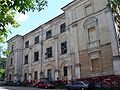
The palace, ordered by the Great Hetman of Lithuania Jan Kazimierz Sapieha the Younger
Jan Kazimierz Sapieha the Younger
Jan Kazimierz Sapieha the Younger was a Grand Hetman of Lithuania since 1682. He held the title of a Duke since 1700. In 1681 he became Field Hetman of Lithuania, the following year he also became the voivode of Vilnius....
was built in Baroque style
Baroque architecture
Baroque architecture is a term used to describe the building style of the Baroque era, begun in late sixteenth century Italy, that took the Roman vocabulary of Renaissance architecture and used it in a new rhetorical and theatrical fashion, often to express the triumph of the Catholic Church and...
in 1691-1697 in the place of former wooden mansion of Lew Sapieha
Lew Sapieha
Lew Sapieha . He was born in Astrouna , near Vitsebsk, Belarus. He became Great Secretary of the Grand Duchy of Lithuania in 1580, Great Clerk of the Grand Duchy in 1581, Court Chancellor of the GDL in 1585, Grand Chancellor of the GDL from 1589 until 1623, Voivode of Vilnius in 1621, Great...
(who died here in 1633). The palace was designed by Giovanni Pietro Perti and decorated with fresco
Fresco
Fresco is any of several related mural painting types, executed on plaster on walls or ceilings. The word fresco comes from the Greek word affresca which derives from the Latin word for "fresh". Frescoes first developed in the ancient world and continued to be popular through the Renaissance...
s by Michelangelo Palloni
Michelangelo Palloni
Michelangelo Palloni was an Italian painter of the Baroque period, who worked in the Polish-Lithuanian Commonwealth from 1674 onward....
. The piano nobile
Piano nobile
The piano nobile is the principal floor of a large house, usually built in one of the styles of classical renaissance architecture...
has initially displayed Dutch
Netherlands
The Netherlands is a constituent country of the Kingdom of the Netherlands, located mainly in North-West Europe and with several islands in the Caribbean. Mainland Netherlands borders the North Sea to the north and west, Belgium to the south, and Germany to the east, and shares maritime borders...
tiles and mosaic
Mosaic
Mosaic is the art of creating images with an assemblage of small pieces of colored glass, stone, or other materials. It may be a technique of decorative art, an aspect of interior decoration, or of cultural and spiritual significance as in a cathedral...
s representing blazon
Blazon
In heraldry and heraldic vexillology, a blazon is a formal description of a coat of arms, flag or similar emblem, from which the reader can reconstruct the appropriate image...
s, churches, castles, and palaces owned or built by the Sapiehas. Originally, the palace had multi-floor arcades
Arcade (architecture)
An arcade is a succession of arches, each counterthrusting the next, supported by columns or piers or a covered walk enclosed by a line of such arches on one or both sides. In warmer or wet climates, exterior arcades provide shelter for pedestrians....
on its sides, which were later built up to gain more space inside the building.
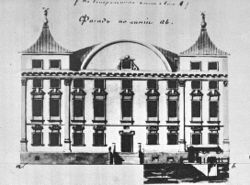
In 1809 the palace was acquired by the Russian government and restructured (according to Józef Poussier's design) into a military hospital in 1843. Much of the rich interior was destroyed throughout the 19th century. The exterior of the palace was restored only in 1927-1928 and the building housed University
Vilnius University
Vilnius University is the oldest university in the Baltic states and one of the oldest in Eastern Europe. It is also the largest university in Lithuania....
's ophthalmology
Ophthalmology
Ophthalmology is the branch of medicine that deals with the anatomy, physiology and diseases of the eye. An ophthalmologist is a specialist in medical and surgical eye problems...
institute until World War II
World War II
World War II, or the Second World War , was a global conflict lasting from 1939 to 1945, involving most of the world's nations—including all of the great powers—eventually forming two opposing military alliances: the Allies and the Axis...
. Since the war it has been used as military hospital again and fell into disrepair. Today the complex houses the Sapiega Hospital .
The palace is surrounded by the remains of the 17th-century formal park, with parterre
Parterre
A parterre is a formal garden construction on a level surface consisting of planting beds, edged in stone or tightly clipped hedging, and gravel paths arranged to form a pleasing, usually symmetrical pattern. Parterres need not have any flowers at all...
s, ponds, and avenues. The impressive Baroque gate secures the entrance to the park from the Antakalnis street and the other gate is in the opposite side of the park, near the palace. Both of them have been recently restored.