


Santo Spirito di Firenze

Encyclopedia
Florence
Florence is the capital city of the Italian region of Tuscany and of the province of Florence. It is the most populous city in Tuscany, with approximately 370,000 inhabitants, expanding to over 1.5 million in the metropolitan area....
, Italy
Italy
Italy , officially the Italian Republic languages]] under the European Charter for Regional or Minority Languages. In each of these, Italy's official name is as follows:;;;;;;;;), is a unitary parliamentary republic in South-Central Europe. To the north it borders France, Switzerland, Austria and...
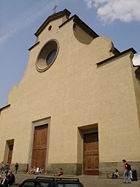
. Usually referred to simply as Santo Spirito, it is located in the Oltrarno
Oltrarno
The Oltrarno is a quarter of Florence, Italy. The name means beyond the Arno ; it is located south of the River Arno. It contains part of the historic center of Florence and many notable sites such as the church Santo Spirito di Firenze, Palazzo Pitti, Belvedere, and Piazzale Michelangelo.-...
quarter, facing the square with the same name. The building on the interior is one of the pre-eminent examples of Renaissance architecture
Renaissance architecture
Renaissance architecture is the architecture of the period between the early 15th and early 17th centuries in different regions of Europe, demonstrating a conscious revival and development of certain elements of ancient Greek and Roman thought and material culture. Stylistically, Renaissance...
.
History
Filippo Brunelleschi
Filippo Brunelleschi was one of the foremost architects and engineers of the Italian Renaissance. He is perhaps most famous for inventing linear perspective and designing the dome of the Florence Cathedral, but his accomplishments also included bronze artwork, architecture , mathematics,...
began designs for the new building as early as 1428. After his death in 1446, the works were carried on by his followers Antonio Manetti
Antonio Manetti
Antonio Manetti was an Italian mathematician and architect from Florence. He was also the biographer of the architect Filippo Brunelleschi....
, Giovanni da Gaiole, and Salvi d'Andrea; the latter was also responsible for the construction of the cupola.
Unlike S. Lorenzo
Basilica di San Lorenzo di Firenze
The Basilica di San Lorenzo is one of the largest churches of Florence, Italy, situated at the centre of the city’s main market district, and the burial place of all the principal members of the Medici family from Cosimo il Vecchio to Cosimo III...
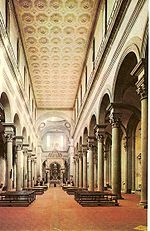
, where Brunelleschi’s ideas were thwarted, here, his ideas were carried through with some degree of fidelity, at least in the ground plan and up to the level of the arcades
Arcade (architecture)
An arcade is a succession of arches, each counterthrusting the next, supported by columns or piers or a covered walk enclosed by a line of such arches on one or both sides. In warmer or wet climates, exterior arcades provide shelter for pedestrians....
. The Latin cross plan is so designed to maximize the legibility of the grid. The contrast between nave
Nave
In Romanesque and Gothic Christian abbey, cathedral basilica and church architecture, the nave is the central approach to the high altar, the main body of the church. "Nave" was probably suggested by the keel shape of its vaulting...
and transept
Transept
For the periodical go to The Transept.A transept is a transverse section, of any building, which lies across the main body of the building. In Christian churches, a transept is an area set crosswise to the nave in a cruciform building in Romanesque and Gothic Christian church architecture...
that caused such difficulty at S. Lorenzo was here also avoided. The side chapels, in the form of niche
Niche (architecture)
A niche in classical architecture is an exedra or an apse that has been reduced in size, retaining the half-dome heading usual for an apse. Nero's Domus Aurea was the first semi-private dwelling that possessed rooms that were given richly varied floor plans, shaped with niches and exedras;...
s all the same size (forty in all), run along the entire perimeter of the space.
Brunelleschi's facade
Facade
A facade or façade is generally one exterior side of a building, usually, but not always, the front. The word comes from the French language, literally meaning "frontage" or "face"....
was never built and left blank. In 1489, a columned vestibule and octagonal sacristy
Sacristy
A sacristy is a room for keeping vestments and other church furnishings, sacred vessels, and parish records.The sacristy is usually located inside the church, but in some cases it is an annex or separate building...
, designed by Simone del Pollaiolo
Simone del Pollaiolo
Simone del Pollaiolo is a well known Florentine architect who was commonly known as Il Cronaca .Pollaiolo was born in Florence, he had two famous brothers Antonio and Piero Benci who had the nickname Pollaiuolo or Pollaiolo .Simone was later given his nickname Il Cronaca...
, known as Il Cronaca, and Giuliano da Sangallo
Giuliano da Sangallo
Giuliano da Sangallo was an Italian sculptor, architect and military engineer active during the Italian Renaissance.He was born in Florence. His father Francesco Giamberti was a woodworker and architect, much employed by Cosimo de Medici, and his brother Antonio da Sangallo the Elder and nephew...
respectively, were built to the left of the building. A door was opened up in a chapel to make the connection to the church.
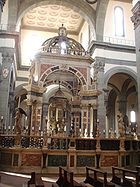
A Baroque
Baroque
The Baroque is a period and the style that used exaggerated motion and clear, easily interpreted detail to produce drama, tension, exuberance, and grandeur in sculpture, painting, literature, dance, and music...
baldachin
Baldachin
A baldachin, or baldaquin , is a canopy of state over an altar or throne. It had its beginnings as a cloth canopy, but in other cases it is a sturdy, permanent architectural feature, particularly over high altars in cathedrals, where such a structure is more correctly called a ciborium when it is...
with polychrome marbles was added by Giovanni Battista Caccini
Giovanni Battista Caccini
Giovanni Battista Caccini was an Italian sculptor from Florence, who worked in a classicising style in the later phase of Mannerism....
and Gherardo Silvani
Gherardo Silvani
Gherardo Silvani was an Italian architect and sculptor, active mainly in Florence and other sites in Tuscany during the Baroque period....
over the high altar, in 1601. The church remained undecorated until the 18th century, when the walls were plastered. The inner façade is by Salvi d'Andrea, and has still the original glass window with the Pentecost designed by Pietro Perugino
Pietro Perugino
Pietro Perugino , born Pietro Vannucci, was an Italian Renaissance painter of the Umbrian school, who developed some of the qualities that found classic expression in the High Renaissance...
. The bell tower (1503) was designed by Baccio d'Agnolo
Baccio D'Agnolo
Baccio D'Agnolo , born Bartolomeo Baglioni, was an Italian woodcarver, sculptor and architect from Florence."Baccio"'is an abbreviation of Bartolomeo, and "d'Agnolo" refers to Angelo, his father's name...
.
The exterior of the building was restored in 1977-78.
Chapel frescoes
Francesco Botticini
Francesco di Giovanni Botticini was an Italian Early Renaissance painter. He studied under Cosimo Rosselli and Andrea del Verrocchio. He was born in Florence in 1446 and is mostly remembered for his painting entitled "Assumption of the Virgin"; he died in 1498...
. The Corbinelli chapels works are by Andrea Sansovino
Andrea Sansovino
Andrea dal Monte Sansovino or Andrea Contucci del Monte San Savino was an Italian sculptor active during the High Renaissance...
, Cosimo Rosselli
Cosimo Rosselli
Cosimo Rosselli was an Italian painter of the Quattrocento, active mainly in his birthplace of Florence.-Biography:Born in Florence, at the age of fourteen he became a pupil of Neri di Bicci, and in 1460 he worked as assistant to his cousin Bernardo di Stefano Rosselli...
and Donnino and Agnolo del Mazziere.
In the chapels of the transept are frescoes by Filippino Lippi
Filippino Lippi
Filippino Lippi was an Italian painter working during the High Renaissance in Florence, Italy.-Biography:...
. Also in the transept is a choir from which the Frescobaldi
Frescobaldi
The Frescobaldi are a prominent Florentine noble family that have been involved in the political, sociological, and economic history of Tuscany since the Middle Ages;. Originating in the Val di Pesa in the Chianti, they appear holding important posts in Florence in the twelfth century...
Marquisses could participate to the rites without being seen by the crowd.
The sacristy, accessed through a doorway in what would have been the left sixth chapel preceded by a monumental vestibule by Simone del Pollaiolo
Simone del Pollaiolo
Simone del Pollaiolo is a well known Florentine architect who was commonly known as Il Cronaca .Pollaiolo was born in Florence, he had two famous brothers Antonio and Piero Benci who had the nickname Pollaiuolo or Pollaiolo .Simone was later given his nickname Il Cronaca...
, was designed by Giuliano da Sangallo
Giuliano da Sangallo
Giuliano da Sangallo was an Italian sculptor, architect and military engineer active during the Italian Renaissance.He was born in Florence. His father Francesco Giamberti was a woodworker and architect, much employed by Cosimo de Medici, and his brother Antonio da Sangallo the Elder and nephew...
in 1489, and has an octagonal plan. It is home to a devotional painting of St. Fiacre curing the Sick (1597) by Alessandro Allori
Alessandro Allori
Alessandro di Cristofano di Lorenzo del Bronzino Allori was an Italian portrait painter of the late Mannerist Florentine school....
(1596) commissioned by Christine of Lorraine, Grand Duke Ferdinando I de' Medici's wife.
Chapels of Santo Spirito
| Side | Chapel | Artworks |
|---|---|---|
| R | 1 (nave near facade) | Disputa by Pier Francesco Foschi Pier Francesco Foschi Pier Francesco Foschi was an Italian painter active in Florence in a Mannerist style. He was pupil of Andrea del Sarto and assisted Pontormo with his frescoes at Careggi in 1536. He completed 3 altarpieces, commissioned in 1540–1545 for the church of Santo Spirito in Florence: an Immaculate... |
| R | 2 | Copy of Michelangelo’s Pietà (1549) by Nanni di Baccio Bigio Nanni di Baccio Bigio Nanni di Baccio Bigio, a pseudonym of Giovanni Lippi , was an Italian architect of the 16th century.Nanni was described as a "versatile" architect, who had originally set out to be a sculptor working under Raffaello da Montelupo. After arriving in Rome, he made a good copy of Michelangelo's Pietà... |
| R | 3 | St. Niccolò da Tolentino by Nanni Unghero; flanking angels by Franciabigio Franciabigio Franciabigio was an Italian painter of the Florentine Renaissance. His true name may have been Francesco di Cristofano, however he also is referred to as either Marcantonio Franciabigio or Francia Bigio.... |
| R | 4 | Expulsion of the Money Changers from Temple (1572) by Giovanni Stradano |
| R | 5 | Coronation of the Virgin (c. 1694) by Alessandro Gherardini Alessandro Gherardini Alessandro Gherardini was an Italian painter of the Baroque period, active mainly in Florence.He was the pupil of the painter Alessandro Rossi. Among his pupils was Sebastiano Galeotti. In Florence, he painted a Crucifixion for the Monastery of the Augustines adjacent to Santa Maria dei Candeli;... |
| R | 6 | Martyrdom of St. Stephen (1602) by Domenico Passignano Domenico Passignano Domenico Passignano , born Cresti or Crespi, was an Italian painter of a late-Renaissance or Contra-Maniera style that emerged in Florence towards the end of the 16th century.- Biography :... |
| R | 7 | Tobias and Angel (1698) by Giovanni Baratta Giovanni Baratta Giovanni Baratta was an Italian sculptor of the Baroque period. Born in Carrara, but active in Florence and Livorno. He was a pupil of Giovanni Battista Foggini. He has sculptures in Church of S. Ferdinando in Livorno. He is the nephew of Francisco Baratta the elder, who worked in the studio of... |
| R | 9 (transept) | Transfiguration by Pier Francesco Foschi Pier Francesco Foschi Pier Francesco Foschi was an Italian painter active in Florence in a Mannerist style. He was pupil of Andrea del Sarto and assisted Pontormo with his frescoes at Careggi in 1536. He completed 3 altarpieces, commissioned in 1540–1545 for the church of Santo Spirito in Florence: an Immaculate... |
| R | 10 (transept) | Madonna del Soccorso (15th century) |
| R | 11 (transept) | Altar by Bernardo Buontalenti Bernardo Buontalenti Bernardo Buontalenti, byname of Bernardo Delle Girandole was an Italian stage designer, architect, theatrical designer, military engineer and artist.-Biography:Buontalenti was born in Florence.... |
| R | 12 (transept) | Madonna and Child with Saints and Nerli Family Donors (1488) by Filippino Lippi Filippino Lippi Filippino Lippi was an Italian painter working during the High Renaissance in Florence, Italy.-Biography:... |
| R | 13 (transept) | Copy of Perugino’s Pietro Perugino Pietro Perugino , born Pietro Vannucci, was an Italian Renaissance painter of the Umbrian school, who developed some of the qualities that found classic expression in the High Renaissance... Apparition of the Virgin to St. Bernard by Felice Ficherelli Felice Ficherelli Felice Ficherelli was an Italian painter of the Baroque period, born in San Gimignano and active mainly in Tuscany. Among Ficherelli's early patrons was Conte Bardi, who persuaded Felice to move to Florence and to study with the painter Jacopo da Empoli. Empoli's influence is evident in the... |
| R | 14 | Marble sarcophagus (c. 1457) by Antonio Rossellino Antonio Rossellino Antonio Gamberelli , nicknamed Antonio Rossellino for the colour of his hair, was an Italian sculptor. His older brother, from whom he received his formal training, was the painter Bernardo Rossellino.... |
| R | 15 (apse) | Madonna with SS. John Evangelist & Jerome (early 16th century) |
| R | 16 (apse) | Madonna with child & 4 saints (c. 1340) by Maso di Banco Maso di Banco Maso di Banco was an Italian painter of the 14th century, who worked in Florence, Italy. He was a pupil of Giotto di Bondone. Maso's name and work are known to us from the autobiography of Lorenzo Ghiberti, I Commentari, which identifies frescoes in the chapel of the Holy Confessors at Santa... |
| L | 18 (apse) | Martyrdom of the ten thousand (1574) by Alessandro Allori Alessandro Allori Alessandro di Cristofano di Lorenzo del Bronzino Allori was an Italian portrait painter of the late Mannerist Florentine school.... with altarpiece of St. Lucy with two angels (c. 1460) attributed to Neri di Bicci Neri di Bicci Neri di Bicci was an Italian painter of the Renaissance. A prolific painter of mainly religious themes, he was active mainly in Florence and in the medium of tempera. His father was Bicci di Lorenzo. His grandfather, Lorenzo di Bicci was also a painter in Florence, a pupil of Spinello... |
| L | 1 (nave) | Resurrection by Pier Francesco Foschi Pier Francesco Foschi Pier Francesco Foschi was an Italian painter active in Florence in a Mannerist style. He was pupil of Andrea del Sarto and assisted Pontormo with his frescoes at Careggi in 1536. He completed 3 altarpieces, commissioned in 1540–1545 for the church of Santo Spirito in Florence: an Immaculate... |
| L | 2 | Copy of Michelangelo’s Christ (1579) by Taddeo Landini Taddeo Landini Taddeo Landini was an Italian sculptor and architect of the Renaissance period, active mainly in Florence and Rome. He was born in Florence and died in Rome.... |
| L | 5 | Madonna, St. Anne, and other saints by Michele Tosini Michele Tosini Michele Tosini was an Italian painter of the Renaissance and Mannerist period, who worked in Florence.He apprenticed initially with Lorenzo di Credi and Antonio del Ceraiolo, but then moved into the studio of Ridolfo Ghirlandaio, from whom he acquired the name Michele di Ridolfi or Michele... |
| L | 8 | Madonna enthroned with SS Lawrence, Giovanni Gualberto, Catherine, & Bernard by follower of Fra Bartolomeo |
| L | 9 (transept) | Way to Calvary by Michele Tosini Michele Tosini Michele Tosini was an Italian painter of the Renaissance and Mannerist period, who worked in Florence.He apprenticed initially with Lorenzo di Credi and Antonio del Ceraiolo, but then moved into the studio of Ridolfo Ghirlandaio, from whom he acquired the name Michele di Ridolfi or Michele... ; window Doubting Thomas attributed to Bartolomeo di Giovanni Bartolomeo di Giovanni Bartolom[m]eo di Giovanni, also known as Alunno di Domenico for his relation to his master Domenico Ghirlandaio, was an early Renaissance Italian painter of the Florentine School who was active from about 1488 until his death in 1501... |
| L | 10 (transept) | Madonna Enthroned with Saints (1505) by Raffaellino del Garbo Raffaellino del Garbo Raffaellino del Garbo was a Florentine painter of the early Renaissance.His real name was Raffaello Capponi; Del Garbo was a nickname, bestowed upon him seemingly from the graceful nicety of his earlier works. He has also been called Raffaello de Florentia, and Raffaello de Carolis or Karli... with altarpiece of St. Lawrence distributing alms by Jacopo del Sellaio |
| L | 11 (transept) | Madonna Enthroned with Angels and Saints Bartholemew and Nicholas by Raffaellino del Garbo Raffaellino del Garbo Raffaellino del Garbo was a Florentine painter of the early Renaissance.His real name was Raffaello Capponi; Del Garbo was a nickname, bestowed upon him seemingly from the graceful nicety of his earlier works. He has also been called Raffaello de Florentia, and Raffaello de Carolis or Karli... |
| L | 12 (transept) | Trinity adored by Saints Catherine and Mary Magdalene (c. 1485) by Francesco Granacci Francesco Granacci Francesco Granacci was an Italian painter of the Renaissance.Born at Villamagna di Volterra, he trained in Florence in the studio of Domenico Ghirlandaio, and was employed painting frescoes for San Marco on commission of Lorenzo de'Medici... |
| L | 13 (transept) | Corbinelli altar (1492) by Andrea Sansovino Andrea Sansovino Andrea dal Monte Sansovino or Andrea Contucci del Monte San Savino was an Italian sculptor active during the High Renaissance... |
| L | 14 (transept) | Madonna Enthroned and Child with Saints (1482) by Cosimo Rosselli, altarpiece of Doubting Thomas attributed to Neri di Bicci Neri di Bicci Neri di Bicci was an Italian painter of the Renaissance. A prolific painter of mainly religious themes, he was active mainly in Florence and in the medium of tempera. His father was Bicci di Lorenzo. His grandfather, Lorenzo di Bicci was also a painter in Florence, a pupil of Spinello... |
| L | 15 (transept) | St. Monica Establishes the Rule of Augustinian Nuns (1483) attributed to Botticini |
| L | 16 (transept) | Madonna and Child and Saints attributed to Raffaellino del Garbo Raffaellino del Garbo Raffaellino del Garbo was a Florentine painter of the early Renaissance.His real name was Raffaello Capponi; Del Garbo was a nickname, bestowed upon him seemingly from the graceful nicety of his earlier works. He has also been called Raffaello de Florentia, and Raffaello de Carolis or Karli... |
| L | 15 (apse) | Nativity by a follower of Domenico Ghirlandaio Domenico Ghirlandaio Domenico Ghirlandaio was an Italian Renaissance painter from Florence. Among his many apprentices was Michelangelo.-Early years:Ghirlandaio's full name is given as Domenico di Tommaso di Currado di Doffo Bigordi... |
| L | 16 (apse) | Annunciation (late 15th century) |
| L | 18 (apse) | Christ and the Adultress (1577) by Alessandro Allori Alessandro Allori Alessandro di Cristofano di Lorenzo del Bronzino Allori was an Italian portrait painter of the late Mannerist Florentine school.... |
Michelangelo's Crucifix
Michelangelo Buonarroti when he was seventeen years old could make anatomical studies on the corpses coming from the convent's hospital; in exchange, he sculpted a wooden crucifixCrucifix (Michelangelo)
Two different crucifixes, or strictly wooden corpus figures for crucifixes, are attributed to the High Renaissance master Michelangelo, although neither is universally accepted as his...
which was placed over the high altar. Today the crucifix is in the octagonal sacristy that can be reached from the left, west aisle of the church.
The cloisters and the Cenacolo
The convent had two cloisters, called Chiostro dei Morti and Chiostro Grande ("Cloister of the Dead" and "Grand Cloister"). The first takes its name from the great number of tombstone decorating its walls, and was built around 1600 by Alfonso ParigiAlfonso Parigi
Alfonso Parigi the Younger was an Italian architect and scenographer, the son of Giulio Parigi.He worked mainly in Florence, beginning at a very early age as his father's assistant...
. The latter was constructed in 1564-1569 by Bartolomeo Ammannati in a classicistic style.
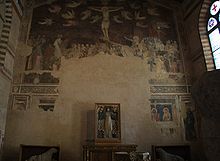
The former convent also contains the great refectory (Cenacolo di Santo Spirito) with a large fresco portraying the Crucifixion over a fragmentary Last Supper, both attributed to Andrea Orcagna
Andrea Orcagna
Andrea di Cione di Arcangelo , better known as Orcagna, was an Italian painter, sculptor, and architect active in Florence. A student of Andrea Pisano as well as Giotto di Bondone, his younger brothers Jacopo di Cione and Nardo di Cione were also artists...
(1360–1365). It is one of the rare examples of Late Gothic Art which can still be seen in Florence. The room also boasts a collection of sculptures from the 11th-15th centuries, including two low reliefs by Donatello
Donatello
Donato di Niccolò di Betto Bardi , also known as Donatello, was an early Renaissance Italian artist and sculptor from Florence...
, a high relief by Jacopo della Quercia
Jacopo della Quercia
Jacopo della Quercia was an Italian sculptor of the Italian Renaissance, a contemporary of Brunelleschi, Ghiberti and Donatello. He is considered a precursor of Michelangelo.-Biography:...
(Madonna with Child) and two marble sculptures by Tino da Camaino (1320–1322).