


Basilica di San Lorenzo di Firenze

Encyclopedia
The Basilica di San Lorenzo (Basilica
of St Lawrence) is one of the largest churches of Florence
, Italy
, situated at the centre of the city’s main market district, and the burial place of all the principal members of the Medici family from Cosimo il Vecchio to Cosimo III. It is one of several churches that claim to be the oldest in Florence; when it was consecrated in 393
it stood outside the city walls. For three hundred years it was the city's cathedral
before the official seat of the bishop was transferred to Santa Reparata
. San Lorenzo was also the parish church of the Medici
family. In 1419, Giovanni di Bicci de' Medici
offered to finance a new church to replace the eleventh-century Romanesque
rebuilding. Filippo Brunelleschi
, the leading Renaissance
architect of the first half of the fifteenth century, was commissioned to design it, but the building, with alterations, was not completed until after his death. The church is part of a larger monastic complex that contains other important architectural works: the Old Sacristy by Brunelleschi; the Laurentian Library
by Michelangelo
; the New Sacristy based on Michelangelo's designs; and the Medici Chapels by Matteo Nigetti
.
, S. Lorenzo has a complicated building history. Even though it was built – at least partially - under the direction of Filippo Brunelleschi
, it is not purely of his design. The project was begun around 1419, but lack of funding slowed down the construction and forced changes to the original design. By the early 1440s, only the sacristy (now called the Old Sacristy) had been worked on as that and not the church was being paid for by the Medici
. In 1442, the Medici stepped in to take over financial responsibility of the church as well. Brunelleschi died, however, in 1446 and the job was handed over either to Antonio Manetti
or to Michelozzo
; scholars are not certain. Though the building was “completed” in 1459 in time for a visit to Florence by Pius II, the chapels along the right-hand aisles were still being built in the 1480s and 90s.
By the time the building was done, many aspects of its layout, not to mention detailing, no longer corresponded to the original plan. The principal difference is that Brunelleschi had envisioned the chapels along the side aisles to be deeper, and to be much like the chapel
s in the transept
, the only part of the building that is known to have been designed by Brunelleschi.
There are significant problems in the design, most, however, occur at the level of detail. Already Giorgio Vasari
thought that the columns along the nave should have been elevated on plinths. That the pilasters along the wall of the side aisles rest on a floor that is three steps higher than the nave, is also considered an error.
S. Lorenzo is often compared with Santo Spirito
, also in Florence. Santo Spirito, which Brunelleschi began somewhat later, is considered to have been constructed more or less in conformity with his ideas, even though Brunelleschi died before most of it was built.
gave Michelangelo the commission to design a façade in white Carrara
marble in 1518. Michelangelo made a wooden model, which shows how he adjusted the classical proportions of the facade
, drawn to scale, after the ideal proportions of the human body, to the greater height of the nave. The work remained unbuilt. Michelangelo did, however, design and build the internal facade, seen from the nave
looking back toward the entrances. It comprises three doors between two pilasters with garlands of oak and laurel and a balcony on two Corinthian
columns.
In recent years, the association of “Friends of the Elettrice Palatina” and the Comune of Florence re-visited the question of completing the outer facade according to Michelangelo's designs. To assist with the public debate, a computerized reconstruction was projected onto the plain brick facade in February 2007. As yet, no decision has been made on the project.
The campanile
dates from 1740.
, or Old Sacristy
, that was designed by Brunelleschi and that is the oldest part of the present church and the only part completed in Brunelleschi's lifetime; it contains the tombs of several members of the Medici family.
It was composed of a sphere on top of a cube; the cube acting as the human world and the sphere the heavens.
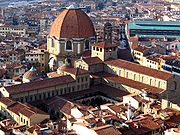 The most celebrated and grandest part of San Lorenzo are the Cappelle Medicee (Medici Chapels) in the apse
. The Medici
were still paying for it when the last member of the family, Anna Maria Luisa de' Medici
, died in 1743. Almost fifty lesser members of the family are buried in the crypt
. The final design (1603-1604) was by Bernardo Buontalenti
, based on models of Alessandro Pieroni and Matteo Nigetti
. Above is the Cappella dei Principi (Chapel of the Princes), a great but awkwardly domed octagonal hall where the grand dukes themselves are buried. The style shows Mannerist
eccentricities in its unusual shape, broken cornices, and asymmetrically sized windows. In the interior, the ambitious decoration with colored marbles overwhelms the attempts at novel design (Wittkower, R. p. 126). At its centre was supposed to be the Holy Sepulchre itself, although attempts to buy and then steal it from Jerusalem failed.
Basilica
The Latin word basilica , was originally used to describe a Roman public building, usually located in the forum of a Roman town. Public basilicas began to appear in Hellenistic cities in the 2nd century BC.The term was also applied to buildings used for religious purposes...
of St Lawrence) is one of the largest churches of Florence
Florence
Florence is the capital city of the Italian region of Tuscany and of the province of Florence. It is the most populous city in Tuscany, with approximately 370,000 inhabitants, expanding to over 1.5 million in the metropolitan area....
, Italy
Italy
Italy , officially the Italian Republic languages]] under the European Charter for Regional or Minority Languages. In each of these, Italy's official name is as follows:;;;;;;;;), is a unitary parliamentary republic in South-Central Europe. To the north it borders France, Switzerland, Austria and...
, situated at the centre of the city’s main market district, and the burial place of all the principal members of the Medici family from Cosimo il Vecchio to Cosimo III. It is one of several churches that claim to be the oldest in Florence; when it was consecrated in 393
393
Year 393 was a common year starting on Saturday of the Julian calendar. At the time, it was known as the Year of the Consulship of Augustus and Augustus...
it stood outside the city walls. For three hundred years it was the city's cathedral
Cathedral
A cathedral is a Christian church that contains the seat of a bishop...
before the official seat of the bishop was transferred to Santa Reparata
Santa Reparata (Florence)
Santa Reparata is the former cathedral of Florence, Italy. Its name refers to Saint Reparata, an early virgin martyr who is the co-patron saint of Florence.- History :...
. San Lorenzo was also the parish church of the Medici
Medici
The House of Medici or Famiglia de' Medici was a political dynasty, banking family and later royal house that first began to gather prominence under Cosimo de' Medici in the Republic of Florence during the late 14th century. The family originated in the Mugello region of the Tuscan countryside,...
family. In 1419, Giovanni di Bicci de' Medici
Giovanni di Bicci de' Medici
Giovanni di Bicci de' Medici was an Italian banker, the first historically relevant member of Medici family of Florence, and the founder of the Medici bank...
offered to finance a new church to replace the eleventh-century Romanesque
Romanesque architecture
Romanesque architecture is an architectural style of Medieval Europe characterised by semi-circular arches. There is no consensus for the beginning date of the Romanesque architecture, with proposals ranging from the 6th to the 10th century. It developed in the 12th century into the Gothic style,...
rebuilding. Filippo Brunelleschi
Filippo Brunelleschi
Filippo Brunelleschi was one of the foremost architects and engineers of the Italian Renaissance. He is perhaps most famous for inventing linear perspective and designing the dome of the Florence Cathedral, but his accomplishments also included bronze artwork, architecture , mathematics,...
, the leading Renaissance
Renaissance
The Renaissance was a cultural movement that spanned roughly the 14th to the 17th century, beginning in Italy in the Late Middle Ages and later spreading to the rest of Europe. The term is also used more loosely to refer to the historical era, but since the changes of the Renaissance were not...
architect of the first half of the fifteenth century, was commissioned to design it, but the building, with alterations, was not completed until after his death. The church is part of a larger monastic complex that contains other important architectural works: the Old Sacristy by Brunelleschi; the Laurentian Library
Laurentian Library
The Laurentian Library is a historical library in Florence, Italy, containing a repository of more than 11,000 manuscripts and 4,500 early printed books...
by Michelangelo
Michelangelo
Michelangelo di Lodovico Buonarroti Simoni , commonly known as Michelangelo, was an Italian Renaissance painter, sculptor, architect, poet, and engineer who exerted an unparalleled influence on the development of Western art...
; the New Sacristy based on Michelangelo's designs; and the Medici Chapels by Matteo Nigetti
Matteo Nigetti
Matteo Nigetti was an Italian architect and sculptor. He is considered the most important Baroque architect in Florence....
.
History
Though considered a milestone in the development of Renaissance architectureRenaissance architecture
Renaissance architecture is the architecture of the period between the early 15th and early 17th centuries in different regions of Europe, demonstrating a conscious revival and development of certain elements of ancient Greek and Roman thought and material culture. Stylistically, Renaissance...
, S. Lorenzo has a complicated building history. Even though it was built – at least partially - under the direction of Filippo Brunelleschi
Filippo Brunelleschi
Filippo Brunelleschi was one of the foremost architects and engineers of the Italian Renaissance. He is perhaps most famous for inventing linear perspective and designing the dome of the Florence Cathedral, but his accomplishments also included bronze artwork, architecture , mathematics,...
, it is not purely of his design. The project was begun around 1419, but lack of funding slowed down the construction and forced changes to the original design. By the early 1440s, only the sacristy (now called the Old Sacristy) had been worked on as that and not the church was being paid for by the Medici
Medici
The House of Medici or Famiglia de' Medici was a political dynasty, banking family and later royal house that first began to gather prominence under Cosimo de' Medici in the Republic of Florence during the late 14th century. The family originated in the Mugello region of the Tuscan countryside,...
. In 1442, the Medici stepped in to take over financial responsibility of the church as well. Brunelleschi died, however, in 1446 and the job was handed over either to Antonio Manetti
Antonio Manetti
Antonio Manetti was an Italian mathematician and architect from Florence. He was also the biographer of the architect Filippo Brunelleschi....
or to Michelozzo
Michelozzo
thumb|250px|[[Palazzo Medici]] in Florence.Michelozzo di Bartolomeo Michelozzi was an Italian architect and sculptor.-Biography:...
; scholars are not certain. Though the building was “completed” in 1459 in time for a visit to Florence by Pius II, the chapels along the right-hand aisles were still being built in the 1480s and 90s.
By the time the building was done, many aspects of its layout, not to mention detailing, no longer corresponded to the original plan. The principal difference is that Brunelleschi had envisioned the chapels along the side aisles to be deeper, and to be much like the chapel
Chapel
A chapel is a building used by Christians as a place of fellowship and worship. It may be part of a larger structure or complex, such as a church, college, hospital, palace, prison or funeral home, located on board a military or commercial ship, or it may be an entirely free-standing building,...
s in the transept
Transept
For the periodical go to The Transept.A transept is a transverse section, of any building, which lies across the main body of the building. In Christian churches, a transept is an area set crosswise to the nave in a cruciform building in Romanesque and Gothic Christian church architecture...
, the only part of the building that is known to have been designed by Brunelleschi.
The building in Renaissance architecture
Despite its history, the building is seen as one of the great examples of the new style. Its more notable features include:- the attempt to create a proportional relationship between nave and aisle (aisle bays are square whereas nave bays are 2X1.
- the articulation of the structure in pietra serena (Italian: “dark stone”).
- the use of an integrated system of column, arches, entablatures.
- a clear relationship between column and pilaster, the latter meant to be read as a type of embedded pier.
- the use of proper proportions for the height of the columns
- the use of spherical segments in the vaults of the side aisles.
There are significant problems in the design, most, however, occur at the level of detail. Already Giorgio Vasari
Giorgio Vasari
Giorgio Vasari was an Italian painter, writer, historian, and architect, who is famous today for his biographies of Italian artists, considered the ideological foundation of art-historical writing.-Biography:...
thought that the columns along the nave should have been elevated on plinths. That the pilasters along the wall of the side aisles rest on a floor that is three steps higher than the nave, is also considered an error.
S. Lorenzo is often compared with Santo Spirito
Santo Spirito di Firenze
The Basilica of Santa Maria del Santo Spirito is a church in Florence, Italy. Usually referred to simply as Santo Spirito, it is located in the Oltrarno quarter, facing the square with the same name...
, also in Florence. Santo Spirito, which Brunelleschi began somewhat later, is considered to have been constructed more or less in conformity with his ideas, even though Brunelleschi died before most of it was built.
Outer and inner facades
The Medici pope Leo XPope Leo X
Pope Leo X , born Giovanni di Lorenzo de' Medici, was the Pope from 1513 to his death in 1521. He was the last non-priest to be elected Pope. He is known for granting indulgences for those who donated to reconstruct St. Peter's Basilica and his challenging of Martin Luther's 95 Theses...
gave Michelangelo the commission to design a façade in white Carrara
Carrara
Carrara is a city and comune in the province of Massa-Carrara , notable for the white or blue-grey marble quarried there. It is on the Carrione River, some west-northwest of Florence....
marble in 1518. Michelangelo made a wooden model, which shows how he adjusted the classical proportions of the facade
Facade
A facade or façade is generally one exterior side of a building, usually, but not always, the front. The word comes from the French language, literally meaning "frontage" or "face"....
, drawn to scale, after the ideal proportions of the human body, to the greater height of the nave. The work remained unbuilt. Michelangelo did, however, design and build the internal facade, seen from the nave
Nave
In Romanesque and Gothic Christian abbey, cathedral basilica and church architecture, the nave is the central approach to the high altar, the main body of the church. "Nave" was probably suggested by the keel shape of its vaulting...
looking back toward the entrances. It comprises three doors between two pilasters with garlands of oak and laurel and a balcony on two Corinthian
Corinthian order
The Corinthian order is one of the three principal classical orders of ancient Greek and Roman architecture. The other two are the Doric and Ionic. When classical architecture was revived during the Renaissance, two more orders were added to the canon, the Tuscan order and the Composite order...
columns.
In recent years, the association of “Friends of the Elettrice Palatina” and the Comune of Florence re-visited the question of completing the outer facade according to Michelangelo's designs. To assist with the public debate, a computerized reconstruction was projected onto the plain brick facade in February 2007. As yet, no decision has been made on the project.
The campanile
Campanile
Campanile is an Italian word meaning "bell tower" . The term applies to bell towers which are either part of a larger building or free-standing, although in American English, the latter meaning has become prevalent.The most famous campanile is probably the Leaning Tower of Pisa...
dates from 1740.
Old Sacristy
Opening off the north transept is the square, domed space, the Sagrestia VecchiaSagrestia Vecchia
The Sagrestia Vecchia, or Old Sacristy, is a Christian building in Florence, Italy, one of the most important monuments of the early Italian Renaissance architecture. It is accessed from the inside of San Lorenzo off the left transept...
, or Old Sacristy
Sacristy
A sacristy is a room for keeping vestments and other church furnishings, sacred vessels, and parish records.The sacristy is usually located inside the church, but in some cases it is an annex or separate building...
, that was designed by Brunelleschi and that is the oldest part of the present church and the only part completed in Brunelleschi's lifetime; it contains the tombs of several members of the Medici family.
It was composed of a sphere on top of a cube; the cube acting as the human world and the sphere the heavens.
New Sacristy
Opposite it in the south transept is the Sagrestia Nuova (New Sacristy), begun in 1520 by Michelangelo, who also designed the Medici tombs within. The new sacristy was composed of three registers, the topmost topped by a coffered pendantive dome. The articulation of the interior walls can be described as early examples of Renaissance Mannerism, see Michelangelo's Ricetto in the Laurentian Library. The combination of pietra serena pillasters on the lower register is carried through to the second facade; however, in Mannerist fashion, architectural elements 'seem impossible,' creating suspense and tension that is evident in this example. Michelangelo's sculptural elements, to be used on the tombs themselves, was left undone. A difficult person to work with, Michelangelo refused to direct the completion of the new sacristy.Cappelle Medicee
Apse
In architecture, the apse is a semicircular recess covered with a hemispherical vault or semi-dome...
. The Medici
Medici
The House of Medici or Famiglia de' Medici was a political dynasty, banking family and later royal house that first began to gather prominence under Cosimo de' Medici in the Republic of Florence during the late 14th century. The family originated in the Mugello region of the Tuscan countryside,...
were still paying for it when the last member of the family, Anna Maria Luisa de' Medici
Anna Maria Luisa de' Medici
Anna Maria Luisa de' Medici was the last scion of the House of Medici. A patron of the arts, she bequeathed the Medici's large art collection, including the contents of the Uffizi, Palazzo Pitti and the Medicean villas, which she inherited upon her brother Gian Gastone's death in 1737, and her...
, died in 1743. Almost fifty lesser members of the family are buried in the crypt
Crypt
In architecture, a crypt is a stone chamber or vault beneath the floor of a burial vault possibly containing sarcophagi, coffins or relics....
. The final design (1603-1604) was by Bernardo Buontalenti
Bernardo Buontalenti
Bernardo Buontalenti, byname of Bernardo Delle Girandole was an Italian stage designer, architect, theatrical designer, military engineer and artist.-Biography:Buontalenti was born in Florence....
, based on models of Alessandro Pieroni and Matteo Nigetti
Matteo Nigetti
Matteo Nigetti was an Italian architect and sculptor. He is considered the most important Baroque architect in Florence....
. Above is the Cappella dei Principi (Chapel of the Princes), a great but awkwardly domed octagonal hall where the grand dukes themselves are buried. The style shows Mannerist
Mannerism
Mannerism is a period of European art that emerged from the later years of the Italian High Renaissance around 1520. It lasted until about 1580 in Italy, when a more Baroque style began to replace it, but Northern Mannerism continued into the early 17th century throughout much of Europe...
eccentricities in its unusual shape, broken cornices, and asymmetrically sized windows. In the interior, the ambitious decoration with colored marbles overwhelms the attempts at novel design (Wittkower, R. p. 126). At its centre was supposed to be the Holy Sepulchre itself, although attempts to buy and then steal it from Jerusalem failed.
Works of art
- Bronzino (frescoFrescoFresco is any of several related mural painting types, executed on plaster on walls or ceilings. The word fresco comes from the Greek word affresca which derives from the Latin word for "fresh". Frescoes first developed in the ancient world and continued to be popular through the Renaissance...
of The Martyrdom of St Lawrence in the north aisle) - Desiderio da SettignanoDesiderio da SettignanoDesiderio da Settignano, real name Desiderio de Bartolomeo di Francesco detto Ferro was an Italian sculptor active during the Renaissance.-Biography:...
(Pala del Sacramento, tabernacleChurch tabernacleA tabernacle is the fixed, locked box in which, in some Christian churches, the Eucharist is "reserved" . A less obvious container, set into the wall, is called an aumbry....
in the south aisle) - DonatelloDonatelloDonato di Niccolò di Betto Bardi , also known as Donatello, was an early Renaissance Italian artist and sculptor from Florence...
(two bronze pulpits, his last works; friezeFriezethumb|267px|Frieze of the [[Tower of the Winds]], AthensIn architecture the frieze is the wide central section part of an entablature and may be plain in the Ionic or Doric order, or decorated with bas-reliefs. Even when neither columns nor pilasters are expressed, on an astylar wall it lies upon...
, reliefReliefRelief is a sculptural technique. The term relief is from the Latin verb levo, to raise. To create a sculpture in relief is thus to give the impression that the sculpted material has been raised above the background plane...
s, tondiTondo (art)A tondo is a Renaissance term for a circular work of art, either a painting or a sculpture. The word derives from the Italian rotondo, "round." The term is usually not used in English for small round paintings, but only those over about 60 cm in diameter, thus excluding many round portrait...
and bronze doors in the Sagrestia Vecchia) - Antonio del Pollaiuolo (wooden crucifix in the south transept chapel)
- Fra Filippo Lippi (altarpiece of the Annunciation in the north transept chapel)
- Rosso FiorentinoRosso FiorentinoGiovanni Battista di Jacopo , known as Rosso Fiorentino , or Il Rosso, was an Italian Mannerist painter, in oil and fresco, belonging to the Florentine school.-Biography:...
(Marriage of the VirginMarriage of the VirginThe Marriage of the Virgin is the subject in Christian art depicting the marriage of the Virgin Mary and Saint Joseph. The marriage is not mentioned in the canonical Gospels but is covered in several apocryphal sources, and later redactions, notably the 14th century compilation the Golden Legend...
in one of the south aisle chapels) - Verrocchio (tomb of Giovanni and Piero de Medici in the Sagrestia Vecchia)
Funerary monuments
- Bernardo CenniniBernardo CenniniBernardo Cennini was an Italian goldsmith, sculptor and early printer of Florence. As a sculptor he was among the assistants to Lorenzo Ghiberti in the long project producing the second pair of doors— the Doors of Paradise— for the Battistero di San Giovanni. He produced the first book printed at...
(goldsmith and printer) (south transept) - DonatelloDonatelloDonato di Niccolò di Betto Bardi , also known as Donatello, was an early Renaissance Italian artist and sculptor from Florence...
(north transept) - Francesco LandiniFrancesco LandiniFrancesco degli Organi, Francesco il Cieco, or Francesco da Firenze, called by later generations Francesco Landini or Landino was an Italian composer, organist, singer, poet and instrument maker...
(south aisle) - Niccolò Martelli (north transept)
- Cosimo de' MediciCosimo de' MediciCòsimo di Giovanni degli Mèdici was the first of the Medici political dynasty, de facto rulers of Florence during much of the Italian Renaissance; also known as "Cosimo 'the Elder'" and "Cosimo Pater Patriae" .-Biography:Born in Florence, Cosimo inherited both his wealth and his expertise in...
(in front of the high altar) - Cosimo I de' Medici (Cappella dei Principi)
- Cosimo II de' Medici (Cappella dei Principi)
- Cosimo III de' Medici (Cappella dei Principi)
- Ferdinando I de' Medici (Cappella dei Principi)
- Ferdinando II de' Medici (Cappella dei Principi)
- Ferdinando III de' MediciFerdinando III de' MediciFerdinando III de' Medici was the elder son of Cosimo III de' Medici, Grand Duke of Tuscany, and Marguerite Louise d'Orléans. Ferdinando was heir to the Grand Duchy of Tuscany, with the title Grand Prince, from his father's accession in 1670 until his death in 1713. He is remembered today...
(crypt) - Francesco I de' Medici (Cappella dei Principi)
- Giovanni di Bicci de' MediciGiovanni di Bicci de' MediciGiovanni di Bicci de' Medici was an Italian banker, the first historically relevant member of Medici family of Florence, and the founder of the Medici bank...
(Sagrestia Vecchia) - Giovanni di Cosimo de' MediciGiovanni di Cosimo de' MediciGiovanni de' Medici was an Italian banker and patron of arts.Born in Florence, he was the son of Cosimo de' Medici the Elder and Contessina de' Bardi, and brother to Piero the Gouty....
(Sagrestia Vecchia) - Giuliano di Lorenzo de' MediciGiuliano di Lorenzo de' MediciGiuliano di Lorenzo de' Medici was an Italian nobleman, one of three sons of Lorenzo the Magnificent.-Biography:He was born in Florence, Italy. His brothers were Piero and Giovanni de' Medici....
(Sagrestia Nuova) - Giuliano di Piero de' MediciGiuliano di Piero de' MediciGiuliano de' Medici was the second son of Piero de' Medici and Lucrezia Tornabuoni. As co-ruler of Florence, with his brother Lorenzo the Magnificent, he complemented his brother's image as the "patron of the arts" with his own image as the handsome, sporting, "golden boy."-Death:As the opening...
(Sagrestia Nuova) - Lorenzo I de' Medici (Sagrestia Nuova)
- Lorenzo II de' Medici (Sagrestia Nuova)
- Piero di Cosimo de' MediciPiero di Cosimo de' MediciPiero di Cosimo de' Medici , , was the de facto ruler of Florence from 1464 to 1469, during the Italian Renaissance. He was the father of Lorenzo the Magnificent and Giuliano de' Medici-Biography:Piero was born in Florence, the son of Cosimo de' Medici the Elder and Contessina de' Bardi...
(Sagrestia Vecchia) - Nicolas StenoNicolas StenoNicolas Steno |Latinized]] to Nicolaus Steno -gen. Nicolai Stenonis-, Italian Niccolo' Stenone) was a Danish pioneer in both anatomy and geology. Already in 1659 he decided not to accept anything simply written in a book, instead resolving to do research himself. He is considered the father of...
- John HunterJohn HunterJohn Hunter may refer to:* John Hunter , former bishop of Kimberley and Kuruman* John Hunter , Canadian Liberal MP for Parkdale, 1949–1957...
Further reading
- Peter Barenboim, "Michelangelo Drawings: Key to the Medici Chapel Interpretation", Moscow, Letny Sad, 2006, ISBN 5-98856-016-4
- Peter Barenboim, Sergey Shiyan, Michelangelo: Mysteries of Medici Chapel, SLOVO, Moscow, 2006. ISBN 5-85050-852-2
- Edith Balas, "Michelangelo's Medici Chapel: a new Interpretation", Philadelphia, 1995
- James Beck, Antonio Paolucci, Bruno Santi, "Michelangelo. The Medici Chapel", London, New York, 2000
- Vasari, Giorgio. Filippo Di Ser Brunelesco: Giorgio Vasari's Lives of the Artistshttp://www.fordham.edu/halsall/basis/vasari/vasari5.htm
- "Church of San Lorenzo." Insecula. 31 Jan. 2007http://www.insecula.com/us/salle/MS03586.html
- Touring Club Italiano, Guida d'Italia: Firenze e dintorni