

SN 1987A

Encyclopedia
Supernova
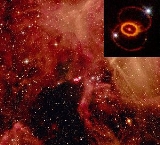
A supernova is a stellar explosion that is more energetic than a nova. It is pronounced with the plural supernovae or supernovas. Supernovae are extremely luminous and cause a burst of radiation that often briefly outshines an entire galaxy, before fading from view over several weeks or months...
in the outskirts of the Tarantula Nebula
Tarantula Nebula
The Tarantula Nebula is an H II region in the Large Magellanic Cloud . It was originally thought to be a star, but in 1751 Nicolas Louis de Lacaille recognized its nebular nature....
in the Large Magellanic Cloud
Large Magellanic Cloud
The Large Magellanic Cloud is a nearby irregular galaxy, and is a satellite of the Milky Way. At a distance of slightly less than 50 kiloparsecs , the LMC is the third closest galaxy to the Milky Way, with the Sagittarius Dwarf Spheroidal and Canis Major Dwarf Galaxy lying closer to the center...
, a nearby dwarf galaxy
Dwarf galaxy
A dwarf galaxy is a small galaxy composed of up to several billion stars, a small number compared to our own Milky Way's 200-400 billion stars...
. It occurred approximately 51.4 kiloparsecs
Parsec
The parsec is a unit of length used in astronomy. It is about 3.26 light-years, or just under 31 trillion kilometres ....
from Earth
Earth
Earth is the third planet from the Sun, and the densest and fifth-largest of the eight planets in the Solar System. It is also the largest of the Solar System's four terrestrial planets...
, approximately 168,000 light-year
Light-year
A light-year, also light year or lightyear is a unit of length, equal to just under 10 trillion kilometres...
s, close enough that it was visible to the naked eye
Naked eye
The naked eye is a figure of speech referring to human visual perception unaided by a magnifying or light-collecting optical device, such as a telescope or microscope. Vision corrected to normal acuity using corrective lenses is considered "naked"...
. It could be seen from the Southern Hemisphere. It was the closest observed supernova since SN 1604
SN 1604
Supernova 1604, also known as Kepler's Supernova, Kepler's Nova or Kepler's Star, was a supernova that occurred in the Milky Way, in the constellation Ophiuchus. , it is the last supernova to have been unquestionably observed in our own galaxy, occurring no farther than 6 kiloparsecs or about...
, which occurred in the Milky Way
Milky Way
The Milky Way is the galaxy that contains the Solar System. This name derives from its appearance as a dim un-resolved "milky" glowing band arching across the night sky...
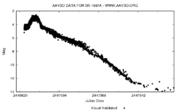
itself. The light from the supernova reached Earth on February 23, 1987. As it was the first supernova discovered in 1987, it was labeled "1987A". Its brightness peaked in May with an apparent magnitude
Apparent magnitude
The apparent magnitude of a celestial body is a measure of its brightness as seen by an observer on Earth, adjusted to the value it would have in the absence of the atmosphere...
of about 3 and slowly declined in the following months. It was the first opportunity for modern astronomers
Astronomy
Astronomy is a natural science that deals with the study of celestial objects and phenomena that originate outside the atmosphere of Earth...
to see a supernova up close and observations have provided much insight into core-collapse supernovae. Voyager 2, then enroute to Neptune, was able to observe the supernova with its cameras.
It was discovered by Ian Shelton
Ian Shelton
Ian Keith Shelton is a Canadian astronomer famous for discovering SN 1987A, the first modern supernova close and bright enough to be visible to the naked eye.He received his B.Sc...
and Oscar Duhalde at the Las Campanas Observatory
Las Campanas Observatory
Las Campanas Observatory is an astronomical observatory owned and operated by the Carnegie Institution for Science It was established in 1969 and remains the primary observing site of that institution. The headquarters is located in La Serena, Chile and the observatory is in the southern Atacama...
in Chile
Chile
Chile ,officially the Republic of Chile , is a country in South America occupying a long, narrow coastal strip between the Andes mountains to the east and the Pacific Ocean to the west. It borders Peru to the north, Bolivia to the northeast, Argentina to the east, and the Drake Passage in the far...
on February 24, 1987, and within the same 24 hours independently by Albert Jones
Albert F. A. L. Jones
Albert F. A. L. Jones is a New Zealand amateur astronomer, and a prolific variable star and comet observer, a member of the Variable Star Section and the Comet Section of the Royal Astronomical Society of New Zealand.-Life:...
in New Zealand
New Zealand
New Zealand is an island country in the south-western Pacific Ocean comprising two main landmasses and numerous smaller islands. The country is situated some east of Australia across the Tasman Sea, and roughly south of the Pacific island nations of New Caledonia, Fiji, and Tonga...
. On March 4–12, 1987 it was observed from space by Astron
Astron (spacecraft)
Astron was a Soviet spacecraft launched on 23 March 1983 at 12:45:06 UTC, using Proton launcher, which was designed to fulfill an astrophysics mission. It was based on the Venera spacecraft design and was operational for six years as the largest ultraviolet space telescope during its lifetime...
, the largest ultraviolet
Ultraviolet
Ultraviolet light is electromagnetic radiation with a wavelength shorter than that of visible light, but longer than X-rays, in the range 10 nm to 400 nm, and energies from 3 eV to 124 eV...
space telescope
Space observatory
A space observatory is any instrument in outer space which is used for observation of distant planets, galaxies, and other outer space objects...
of that time.
The X-ray
X-ray astronomy
X-ray astronomy is an observational branch of astronomy which deals with the study of X-ray observation and detection from astronomical objects. X-radiation is absorbed by the Earth's atmosphere, so instruments to detect X-rays must be taken to high altitude by balloons, sounding rockets, and...
, optical
Visible-light astronomy
Visible-light astronomy encompasses a wide variety of observations via telescopes that are sensitive in the range of visible light...
and radio emissions from 1987A grew brighter because its shock wave had crashed into a dense cloud of gas and dust.
Progenitor
Four days after the event was recorded, the progenitor star was tentatively identified as Sanduleak -69° 202, a blue supergiantBlue supergiant
Blue supergiants are supergiant stars of spectral type O or B.They are extremely hot and bright, with surface temperatures of 30,000-50,000 K. They typically have 10 to 50 solar masses on the Hertzsprung-Russell diagram, and can have radii up to about 25 solar radii...
.
This was an unexpected identification, because at the time a blue supergiant was not considered a possibility for a supernova event in existing models of high mass stellar evolution. Many models of the progenitor have attributed the color to its chemical composition, particularly the low levels of heavy elements, among other factors. There has been some speculation that the star may have merged with a companion star
Binary star
A binary star is a star system consisting of two stars orbiting around their common center of mass. The brighter star is called the primary and the other is its companion star, comes, or secondary...
prior to the supernova. It is of note that the supernova of the blue giant Sanduleak -69° 202 was about one-tenth as luminous as the average observed type II supernova
Type II supernova
A Type II supernova results from the rapid collapse and violent explosion of a massive star. A star must have at least 9 times, and no more than 40–50 times the mass of the Sun for this type of explosion. It is distinguished from other types of supernova by the presence of hydrogen in its spectrum...
, which is associated with the denser makeup of the star. Since blue supergiant supernovae are not as bright as those generated by red supergiants, we would not expect to see as many of them, and so they might not be as rare or unusual as previously thought.
Neutrino emissions
Approximately three hours before the visible light from SN 1987A reached the Earth, a burst of neutrinoNeutrino
A neutrino is an electrically neutral, weakly interacting elementary subatomic particle with a half-integer spin, chirality and a disputed but small non-zero mass. It is able to pass through ordinary matter almost unaffected...
s was observed at three separate neutrino observatories
Neutrino detector
A neutrino detector is a physics apparatus designed to study neutrinos. Because neutrinos are only weakly interacting with other particles of matter, neutrino detectors must be very large in order to detect a significant number of neutrinos. Neutrino detectors are often built underground to isolate...
. This is likely due to neutrino emission (which occurs simultaneously with core collapse) preceding the emission of visible light (which occurs only after the shock wave reaches the stellar surface).
At 7:35 a.m. Universal time
Universal Time
Universal Time is a time scale based on the rotation of the Earth. It is a modern continuation of Greenwich Mean Time , i.e., the mean solar time on the Prime Meridian at Greenwich, and GMT is sometimes used loosely as a synonym for UTC...
, Kamiokande II detected 11 antineutrinos, IMB
Irvine-Michigan-Brookhaven (detector)
IMB, the Irvine-Michigan-Brookhaven detector, was a nucleon decay experiment and neutrino observatory located in a Morton Salt company's Fairport mine on the shore of Lake Erie in the United States. It was a joint venture of the University of California, Irvine, the University of Michigan, and...
8 antineutrinos and Baksan
Baksan Neutrino Observatory
The Baksan Neutrino Observatory is a scientific laboratory of INR RAS located in the Baksan gorge in the Caucasus mountains in Russia. It started operations in 1977, becoming the first such observatory in the USSR...
5 antineutrinos, in a burst lasting less than 13 seconds. Approximately three hours earlier, the Mont Blanc
Mont Blanc
Mont Blanc or Monte Bianco , meaning "White Mountain", is the highest mountain in the Alps, Western Europe and the European Union. It rises above sea level and is ranked 11th in the world in topographic prominence...
liquid scintillator detected a five-neutrino burst, but this is generally not believed to be associated with SN 1987A.
Although the actual neutrino count was only 24, it was a significant rise from the previously-observed background level. This was the first time neutrinos emitted from a supernova had been observed directly, which marked the beginning of neutrino astronomy
Neutrino astronomy
Neutrino astronomy is the branch of astronomy that observes astronomical objects with neutrino detectors in special observatories. Nuclear reactions in stars and supernova explosions produce very large numbers of neutrinos, a very few of which may be detected by a neutrino telescope...
. The observations were consistent with theoretical supernova models in which 99% of the energy of the collapse is radiated away in neutrinos. The observations are also consistent with the models' estimates of a total neutrino count of 1058 with a total energy of 1046 joules.
The neutrino measurements allowed upper bounds on neutrino mass and charge, as well as the number of flavors of neutrinos and other properties. For example, the data show that within 5% confidence, the rest mass of the electron neutrino is at most 16 eV.
The data suggests that the total number of neutrino flavors is at most 8 but other observations and experiments give tighter estimates. Many of these results have since been confirmed or tightened by other neutrino experiments such as more careful analysis of solar neutrinos and atmospheric neutrinos as well as experiments with artificial neutrino sources.
Missing neutron star?
SN 1987A appears to be a core-collapse supernova, which should result in a neutron starNeutron star
A neutron star is a type of stellar remnant that can result from the gravitational collapse of a massive star during a Type II, Type Ib or Type Ic supernova event. Such stars are composed almost entirely of neutrons, which are subatomic particles without electrical charge and with a slightly larger...
given the size of the original star. Indeed, the neutrino data indicate that a compact object did form at the star's core. However, since the supernova first became visible, astronomers have been searching for the collapsed core but have not detected it. The Hubble Space Telescope
Hubble Space Telescope
The Hubble Space Telescope is a space telescope that was carried into orbit by a Space Shuttle in 1990 and remains in operation. A 2.4 meter aperture telescope in low Earth orbit, Hubble's four main instruments observe in the near ultraviolet, visible, and near infrared...
has taken images of the supernova regularly since August 1990, but, so far, the images have shown no evidence of a neutron star. A number of possibilities for the 'missing' neutron star are being considered, although none is clearly favored. The first is that the neutron star is enshrouded in dense dust clouds so that it cannot be seen. Another is that a pulsar
Pulsar
A pulsar is a highly magnetized, rotating neutron star that emits a beam of electromagnetic radiation. The radiation can only be observed when the beam of emission is pointing towards the Earth. This is called the lighthouse effect and gives rise to the pulsed nature that gives pulsars their name...
was formed, but with either an unusually large or small magnetic field. It is also possible that large amounts of material fell back on the neutron star, so that it further collapsed into a black hole
Black hole
A black hole is a region of spacetime from which nothing, not even light, can escape. The theory of general relativity predicts that a sufficiently compact mass will deform spacetime to form a black hole. Around a black hole there is a mathematically defined surface called an event horizon that...
. Neutron stars and black holes often give off light when material falls onto them. If there is a compact object in the supernova remnant, but no material to fall onto it, it could be very dim and therefore avoid detection. Other scenarios have also been considered, such as if the collapsed core became a quark star
Quark star
A quark star or strange star is a hypothetical type of exotic star composed of quark matter, or strange matter. These are ultra-dense phases of degenerate matter theorized to form inside particularly massive neutron stars....
.
Interaction with circumstellar material
The three bright rings around SN 1987A are material from the stellar windStellar wind
A stellar wind is a flow of neutral or charged gas ejected from the upper atmosphere of a star. It is distinguished from the bipolar outflows characteristic of young stars by being less collimated, although stellar winds are not generally spherically symmetric.Different types of stars have...
of the progenitor. These rings were ionized by the ultraviolet flash from the supernova explosion, and consequently began emitting in various emission lines. These rings did not "turn on" until several months after the supernova, and the turn-on process can be very accurately studied through spectroscopy. The rings are large enough for their angular size to be measured accurately: the inner ring is 0.808 arcseconds in radius. Using the distance light must have traveled to light up the inner ring as the base of a right angle triangle, and the angular size as seen from the Earth for the local angle, one can use basic trigonometry to calculate the distance to SN1987A, which is about 168,000 light-years. The material from the explosion is catching up with the material expelled during its red giant phase and heating it, so we observe ring structures around the star.
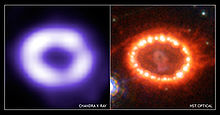
Around 2001 the expanding (>7000 km/s) supernova ejecta collided with the inner ring. This caused its heating and generation of X-rays—the X-ray flux from the ring increased by 3 times between 2001 and 2009. A part of the X-ray radiation, which is absorbed by the dense ejecta close to the center, is responsible for a comparable increase in the optical flux from the supernova remnant in 2001–2009. This increase of the brightness of the remnant reversed the trend observed before 2001, when the optical flux was decreasing due to decay of 44Ti isotope.
See also
- List of supernovae
- History of supernova observationHistory of supernova observationThe known history of supernova observation goes back to 185 CE, when supernova SN 185 appeared, the oldest appearance of a supernova recorded by humankind...
- List of supernova remnants
- List of supernova candidates
External links
- Picture of Supernova 1987A
- AAVSO: More information on the discovery of SN 1987A
- Rochester Astronomy discovery timeline
- Light echoes from Sn1987a, Movie with real images by the group EROS2
- Animation of light echoes from SN1987A
- Supernova 1987A, by Richard McCray (astrophysicist, University of Colorado at Boulder)
- SN 1987A at ESA/Hubble
- Supernova 1987A, WIKISKY.ORG
- More information at Phil Plait's Bad Astronomy site