

Russulaceae

Encyclopedia
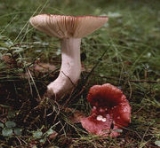
The Russulaceae are a family
of fungi in the order Russulales
. According to a 2008 estimate, the family contains 1243 species. Its species typically have fruit bodies
with friable, chalk-like stalks
, that break with a distinct crack, somewhat like a carrot but with porous flesh (see below). Microscopically, the cells are not all long thin hypha
e, which would provide strength and more fibrous appearance when broken. Instead, the flesh contains also many large spherical cells ("sphaerocysts"), which give rise to the macroscopic consistency.
:
Other genera in the Russulaceae include Boidinia
, Cystangium
, Multifurca
, and Pseudoxenasma
.
, with that of Suillus variegatus
, a member of the Boletaceae
.
and Russula are subject to parasitization by the Lobster mushroom
(Hypomyces lactifluorum). This ascomycete replaces the flesh of the host mushroom, rendering it into a choice edible, though it can be peppery if the host is a species like Lactarius piperatus
. These fungi may also be parasitized by the Indian Pipe, a myco-heterotrophic plant that lacks chlorophyll.
Family (biology)
In biological classification, family is* a taxonomic rank. Other well-known ranks are life, domain, kingdom, phylum, class, order, genus, and species, with family fitting between order and genus. As for the other well-known ranks, there is the option of an immediately lower rank, indicated by the...
of fungi in the order Russulales
Russulales
The Russulales are an order of the Agaricomycetes,...
. According to a 2008 estimate, the family contains 1243 species. Its species typically have fruit bodies
Basidiocarp
In fungi, a basidiocarp, basidiome or basidioma , is the sporocarp of a basidiomycete, the multicellular structure on which the spore-producing hymenium is borne. Basidiocarps are characteristic of the hymenomycetes; rusts and smuts do not produce such structures...
with friable, chalk-like stalks
Stipe (mycology)
thumb|150px|right|Diagram of a [[basidiomycete]] stipe with an [[annulus |annulus]] and [[volva |volva]]In mycology a stipe refers to the stem or stalk-like feature supporting the cap of a mushroom. Like all tissues of the mushroom other than the hymenium, the stipe is composed of sterile hyphal...
, that break with a distinct crack, somewhat like a carrot but with porous flesh (see below). Microscopically, the cells are not all long thin hypha
Hypha
A hypha is a long, branching filamentous structure of a fungus, and also of unrelated Actinobacteria. In most fungi, hyphae are the main mode of vegetative growth, and are collectively called a mycelium; yeasts are unicellular fungi that do not grow as hyphae.-Structure:A hypha consists of one or...
e, which would provide strength and more fibrous appearance when broken. Instead, the flesh contains also many large spherical cells ("sphaerocysts"), which give rise to the macroscopic consistency.
Genera
The family is dominated by two well-known generaGenus
In biology, a genus is a low-level taxonomic rank used in the biological classification of living and fossil organisms, which is an example of definition by genus and differentia...
:
- The genus RussulaRussulaAround 750 worldwide species of mycorrhizal mushrooms compose the genus Russula. They are typically common, fairly large, and brightly colored - making them one of the most recognizable genera among mycologists and mushroom collectors...
, sometimes known as brittlegills, comprises around 750 species, the majority of which are quite difficult to identify. They have splitting gills and do not exude a milky substance at cut surfaces, contrarily to the genus LactariusLactariusLactarius is a genus of mushroom-producing fungi. The genus, collectively known commonly as milk-caps, are characterized by the fact that they exude a milky fluid if cut or damaged...
. There are several edible species (Russula vescaRussula vescaRussula vesca, known by the common names of bare-toothed Russula or the flirt, is a basidiomycete mushroom of the genus Russula.- Taxonomy :...
, Russula virescensRussula virescensRussula virescens is a basidiomycete mushroom of the genus Russula, and is commonly known as the green-cracking Russula, the quilted green Russula, or the green brittlegill. It can be recognized by its distinctive pale green cap covered with darker green patches, its crowded white gills, and its...
or Russula aurataRussula aurataRussula aurea, commonly known as the gilded brittlegill, is an uncommon species of mushroom found in deciduous woodland in Europe in summer and early autumn...
).
- The genus LactariusLactariusLactarius is a genus of mushroom-producing fungi. The genus, collectively known commonly as milk-caps, are characterized by the fact that they exude a milky fluid if cut or damaged...
, or milk-caps, characterised by caps and stalks that exude a milky substance ("latexLatexLatex is the stable dispersion of polymer microparticles in an aqueous medium. Latexes may be natural or synthetic.Latex as found in nature is a milky fluid found in 10% of all flowering plants . It is a complex emulsion consisting of proteins, alkaloids, starches, sugars, oils, tannins, resins,...
") when pressed or cut and lactiferous, gloeoplerous hyphaHyphaA hypha is a long, branching filamentous structure of a fungus, and also of unrelated Actinobacteria. In most fungi, hyphae are the main mode of vegetative growth, and are collectively called a mycelium; yeasts are unicellular fungi that do not grow as hyphae.-Structure:A hypha consists of one or...
e, is a large genus of mycorrhizaMycorrhizaA mycorrhiza is a symbiotic association between a fungus and the roots of a vascular plant....
l fungi. When cut, the mushroom exudes a kind of milky liquid. This liquid may be orange, red, lilac, white or yellow, and may develop its final colour only after exposure to air. Certain ones, such as L. deliciosusLactarius deliciosusLactarius deliciosus, commonly known as the Saffron milk cap, Red pine mushroom, is one of the best known members of the large milk-cap genus Lactarius in the order Russulales...
are edible and delicious, appreciated in Mediterranean areas.
Other genera in the Russulaceae include Boidinia
Boidinia
Boidinia is a genus of fungi in the Russulaceae family. The genus is widely distributed, and contains 10 species....
, Cystangium
Cystangium
Cystangium is a genus of fungi in the Russulaceae family. The genus contains 32 species that are distributed in Australia and South America. Cystangium was described by American mycologists Rolf Singer and Alexander H...
, Multifurca
Multifurca
Multifurca is a genus of fungi in the Stereaceae family. The genus contains five species distributed in the U.S., India, Thailand, and New Caledonia....
, and Pseudoxenasma
Pseudoxenasma
Pseudoxenasma is a genus of fungi in the Russulaceae family. The genus is monotypic, and contains the single species Pseudoxenasma verrucisporum, found in Sweden....
.
Distinctive flesh consistency
Due to the presence of large spherical cells which can be seen under the microscope, an important characteristic to distinguish the Russulaceae from other types of mushrooms is the consistency of the stipe. In Russula and Lactarius, this breaks like the flesh of an apple, whilst in most other families it only breaks into fibres. The pictures compare the broken stipe of a Lactarius vellereusLactarius vellereus
Lactarius vellereus, commonly known as the fleecy milk-cap, is a very large fungus in the milk-cap genus Lactarius. It is one of the two most common milk-caps found with beech trees, with the other being L. subdulcis.-Description:...
, with that of Suillus variegatus
Suillus variegatus
Suillus variegatus, commonly called the velvet bolete or variegated bolete, is a species of edible mushroom in the genus Suillus. Like all bolete-like species it has tubes, and pores, instead of gills under its cap. The mushroom forms a mycorrhizal relationship with pine and occurs in North America...
, a member of the Boletaceae
Boletaceae
Boletaceae are a family of mushrooms, primarily characterized by developing their spores in small pores on the underside of the mushroom, instead of gills, as are found in agarics. Nearly as widely distributed as agarics, they include the Cep or King Bolete , much sought after by mushroom hunters...
.
Parasites
Members of both LactariusLactarius
Lactarius is a genus of mushroom-producing fungi. The genus, collectively known commonly as milk-caps, are characterized by the fact that they exude a milky fluid if cut or damaged...
and Russula are subject to parasitization by the Lobster mushroom
Lobster mushroom
Lobster mushroom is not a mushroom, but rather a parasitic ascomycete that grows on mushrooms, turning them a reddish orange color that resembles the outer shell of a cooked lobster. It colonizes members of the genera Lactarius and Russula, such as Russula brevipes and Lactarius piperatus in...
(Hypomyces lactifluorum). This ascomycete replaces the flesh of the host mushroom, rendering it into a choice edible, though it can be peppery if the host is a species like Lactarius piperatus
Lactarius piperatus
Lactarius piperatus, commonly known as the peppery milk-cap is a semi-edible basidiomycete fungus of the genus Lactarius. Despite being edible, it is not recommended due to its poor taste, though can be used as seasoning when dried. The fruiting body is a creamy-white mushroom which is...
. These fungi may also be parasitized by the Indian Pipe, a myco-heterotrophic plant that lacks chlorophyll.