


Royal Academy of Fine Arts Antwerp

Encyclopedia
Art
Art is the product or process of deliberately arranging items in a way that influences and affects one or more of the senses, emotions, and intellect....
academy
Academy
An academy is an institution of higher learning, research, or honorary membership.The name traces back to Plato's school of philosophy, founded approximately 385 BC at Akademia, a sanctuary of Athena, the goddess of wisdom and skill, north of Athens, Greece. In the western world academia is the...
located in Antwerp, Belgium
Belgium
Belgium , officially the Kingdom of Belgium, is a federal state in Western Europe. It is a founding member of the European Union and hosts the EU's headquarters, and those of several other major international organisations such as NATO.Belgium is also a member of, or affiliated to, many...
. It is one of the oldest of its kind in Europe. It was founded in 1663 by David Teniers the Younger
David Teniers the Younger
David Teniers the Younger was a Flemish artist born in Antwerp, the son of David Teniers the Elder. His son David Teniers III and his grandson David Teniers IV were also painters...
, painter to the Archduke Leopold Wilhelm and Don Juan of Austria. Teniers was master of the Guild of St Luke — which embraced arts and some handicrafts — and petitioned Philip IV of Spain
Philip IV of Spain
Philip IV was King of Spain between 1621 and 1665, sovereign of the Spanish Netherlands, and King of Portugal until 1640...
, then master of the Spanish Netherlands, to grant a royal charter to establish a Fine Arts Academy in Antwerp.
19th century
The Royal Academy developed into an internationally acclaimed institute for Fine Arts, Architecture and Design. From the nineteenth century on, the academy attracted young artists from abroad. Irish, German, Dutch, Polish artists looking for a solid classical training found their way to Antwerp.Under the direction of Gustave Wappers (1803-1874) and his registrar Hendrik Conscience
Hendrik Conscience
Henri "Hendrik" Conscience was a Belgian writer. He was a pioneer in writing in Dutch after the secession from the Netherlands in 1830 left Belgium a mostly French speaking country....
the academy faced significant restructuring. The academy's significant art collection was exhibited in its own gallery space. By 1890 this gallery would develop into the Royal Museum of Fine Arts (Dutch; Koninklijk Museum voor Schone Kunsten) and would move to its current location in Antwerp.
In 1880 a promising young artist Henry Van de Velde enrolled at the Antwerp Academy. He would become one of the pioneering 20th century architects and designers. IIn 1885 and 1886 Vincent Van Gogh
Vincent van Gogh
Vincent Willem van Gogh , and used Brabant dialect in his writing; it is therefore likely that he himself pronounced his name with a Brabant accent: , with a voiced V and palatalized G and gh. In France, where much of his work was produced, it is...
was also to spend a short time at the Antwerp academy, prior to his departure to France.
In 1885, King Leopold II
Leopold II of Belgium
Leopold II was the second king of the Belgians. Born in Brussels the second son of Leopold I and Louise-Marie of Orléans, he succeeded his father to the throne on 17 December 1865 and remained king until his death.Leopold is chiefly remembered as the founder and sole owner of the Congo Free...
commissioned the establishment of the National Higher Institute for Fine Arts Antwerp (Nationaal Hoger Instituut voor Schone Kunsten) as a unique post graduate program, inspired by the Ecole des Beaux-Arts in Paris
École Nationale Supérieure des Beaux-Arts
The École Nationale Supérieure des Beaux-arts is the distinguished National School of Fine Arts in Paris, France.The École des Beaux-arts is made up of a vast complex of buildings located at 14 rue Bonaparte, between the quai Malaquais and the rue Bonaparte, in the heart of Saint-Germain-des-Près,...
.
20th and 21st centuries
In 1946 the Architecture program became an independent institute, The National Higher Institute of Architecture.Another key moment in the history of the academy would be 1963. A unique new course ‘Fashion Design’ started. This course was moderately successful from the beginning, but became world leading in the early eighties. “The Antwerp Six
Antwerp Six
The Antwerp Six refers to a group of influential avant garde fashion designers who graduated from Antwerp's Royal Academy of Fine Arts between 1980-1981. At the Academy they were taught by Linda Loppa. The fashion collective presented a distinct, radical vision for fashion during the 1980s that...
” with Dirk Bikkembergs
Dirk Bikkembergs
Dirk Bikkembergs is a Belgian fashion designer.-Early life and designer career:Dirk Bikkembergs was born in Cologne, Germany, In 1982, Bikkembergs graduated, together with other Belgian designers Ann Demeulemeester, Dries van Noten, Dirk van Saene, Walter van Beirendonck and Marina Yee...
, Walter Van Beirendonck
Walter Van Beirendonck
Walter Van Beirendonck is a Belgian fashion designer. He graduated in 1980 from the Royal Arts Academy in Antwerp. Together with Dirk Van Saene, Dries van Noten, Ann Demeulemeester, Marina Yee and Dirk Bikkembergs they became known as the Antwerp Six.Since 1983, he issues his own collections...
, Marina Yee, Dries Van Noten
Dries van Noten
Dries Van Noten is a Belgian fashion designer and an eponymous fashion brand. In 2005, the New York Times described him "one of fashion's most cerebral designers"...
, Dirk Van Saene and Ann Demeulemeester
Ann Demeulemeester
Ann Demeulemeester is a fashion designer whose eponymous label 'Ann Demeulemeester' is mainly showcased at the annual Paris Fashion Week.-Early life:...
were hot issue in the media. Stylistically extremely diverse, these young friends had a huge impact on the contemporary fashion scene. The fashion program attracted more and more talents from all over the globe. With over 130 students it's by far the largest program in the visual arts and design department.
In 1995 the Flemish higher educational system faced a radical metamorphosis. The Antwerp Academy and the Henry Van de Velde Institute were included as faculties in a bigger college structure, The University College of Antwerp (Dutch; “Hogeschool Antwerpen”). The Higher Institute of Fine Arts was destined to develop into a separate entity.
[Een tempel bouwen voor de muzen, een korte geschiedenis van de Antwerpse Academie by Jan Lampo, April 1995]
[1885/1985 een eeuw Nationaal Hoger Instituut voo Schone Kunsten te Antwerpen by L.Theo van Looj, 1985/411/7]
The Academy nowadays offers three distinctive programs: Visual Arts and Design, Conservation studies and a one year dedicated teachers training. A body of 540 students (of whom 230 international) work in the four main buildings located in the heart of the city: Mutsaardstraat (Photography, Silversmithing/Jewelry, Theatre Costume Design and Fine Arts), Nationale Straat (fashion) and Keizerstraat (graphic design).
Nurse of Painters
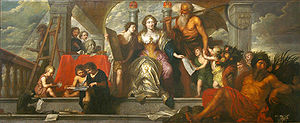
Theodoor Boeyermans
Theodoor Boeyermans was a Flemish Baroque painter from Antwerp who painted classicizing works informed by the tradition of Peter Paul Rubens. In addition he made numerous altarpieces for Flemish churches, group portraits, and allegories. Boeyermans's work also shares a close affinity with his...
(1665; 188 x 454 cm), promotes the city's recent artistic past. Portraits of Peter Paul Rubens and Anthony van Dyck
Anthony van Dyck
Sir Anthony van Dyck was a Flemish Baroque artist who became the leading court painter in England. He is most famous for his portraits of Charles I of England and his family and court, painted with a relaxed elegance that was to be the dominant influence on English portrait-painting for the next...
watch over students as they practise the arts. At the centre is the allegorical Antverpia pictorum nutrix ("Antwerp, nurse of painters"). Chronos
Chronos
In Greek mythology, Chronos in pre-Socratic philosophical works is said to be the personification of time. His name in Greek means "time" and is alternatively spelled Chronus or Khronos.Chronos was imagined as an incorporeal god, serpentine in form, with three heads—those of a man, a bull, and...
accompanies other young students who present their artwork. The river god
River God
River God is a novel by author Wilbur Smith. It tells the story of the talented eunuch slave Taita, his life in Egypt, the flight of Taita along with the Egyptian populace from the Hyksos invasion, and their eventual return. The novel can be grouped together with Wilbur Smith's other books on...
Scaldis, a personification of Antwerp's river Scheldt
Scheldt
The Scheldt is a 350 km long river in northern France, western Belgium and the southwestern part of the Netherlands...
, symbolises with his cornucopia
Cornucopia
The cornucopia or horn of plenty is a symbol of abundance and nourishment, commonly a large horn-shaped container overflowing with produce, flowers, nuts, other edibles, or wealth in some form...
the wealth and bounty of the city's artistic heritage.
Notable students
- Lawrence Alma-TademaLawrence Alma-TademaLawrence Alma-Tadema, OM, RA was a Dutch painter.Born in Dronrijp, the Netherlands, and trained at the Royal Academy of Antwerp, Belgium, he settled in England in 1870 and spent the rest of his life there...
- Willis Seaver AdamsWillis Seaver AdamsWillis Seaver Adams was a landscape painter who studied under James Abbott McNeill Whistler. He studied at the Royal Academy of Fine Arts in Antwerp, Belgium and was part of the Tonalism movement, which took place in the late 19th century....
- Nicaise de KeyserNicaise de KeyserNicaise de Keyser , was a Belgian painter of portraits and historical tableaux.He received his painting tuition at the Antwerp Academy of Fine Arts under Joseph Jacobs and Bree, before leaving for Italy in 1839...
- Pieter Franciscus DierckxPieter Franciscus DierckxPieter Franciscus Dierckx was a Belgian impressionist painter.He was a student at the art academy in Antwerp and at the higher institute in Antwerp...
- Frans-Andries DurletFrans-Andries DurletFrans-Andries aka François André or Franciscus Andreas Durlet, was a Belgian architect, sculptor and printmaker....
- Floris JespersFloris JespersFloris Jespers was a Belgian Avant-garde painter.After his graduation from the Antwerp Academy of Fine Arts, he hooked up with the poet Paul Van Ostaijen and joined the Antwerp avant-garde movement of the 1920s...
- Jef LambeauxJef LambeauxJef Lambeaux was a Belgian sculptor born in Antwerp. He studied at the Antwerp Academy of Fine Arts, and was a pupil of Jean Geefs. His first work, War, was exhibited in 1871, and was followed by a long series of humorous groups, including Children dancing, Say Good Morning, The Lucky Number and;...
- Jef NysJef NysJozef "Jef" Nys was a Belgian comic book creator. He was best known for his comic strip Jommeke.-Biography:...
- PanamarenkoPanamarenkoPanamarenko is a prominent assemblagist in Belgian sculpture. Famous for his work with airplanes as theme; none of which are able nor constructed to actually leave the ground....
- Luc TuymansLuc TuymansLuc Tuymans is a contemporary artist who lives and works in Antwerp, Belgium. Tuymans is considered one of the most influential painters working today. His signature figurative paintings transform mediated film, television, and print sources into examinations of history and memory.-Life:Tuymans...
- Henry Van de VeldeHenry van de VeldeHenry Clemens Van de Velde was a Belgian Flemish painter, architect and interior designer. Together with Victor Horta and Paul Hankar he could be considered one of the main founders and representatives of Art Nouveau in Belgium...
- Vincent van GoghVincent van GoghVincent Willem van Gogh , and used Brabant dialect in his writing; it is therefore likely that he himself pronounced his name with a Brabant accent: , with a voiced V and palatalized G and gh. In France, where much of his work was produced, it is...
- Piet VerhaertPiet VerhaertPiet Verhaert was a Belgian painter, a member of les XX-Description:Painter and etcher of townscapes, interiors, figures and portraits. Also a notable painter of decorative panels. Trained at the Academy of Antwerp, originally studying sculpting but switched to painting. Travelled to The...
- Michel Marie Charles VerlatMichel Marie Charles VerlatMichel Marie Charles Verlat was a Belgian painter from Antwerp. He was a pupil of Nicaise de Keyser, and studied at the Antwerp Academy....
- George Edmund ButlerGeorge Edmund ButlerGeorge Edmund Butler was a landscape and portrait painter specializing in oils and watercolours.-Early life:Born 15 January 1872 in Southampton, England, George Edmund Butler emigrated to Wellington, New Zealand with his parents, Joseph Cawte Butler and Jane Tiller, in 1883...
- Kris Van AsscheKris Van AsscheKris Van Assche is a Belgian fashion designer. He studied at the Antwerp Royal Academy of Fine Arts, in Antwerp from 1994 to 1998. After graduating he moved to Paris in 1998. He was immediately appointed at Yves Saint Laurent as Hedi Slimane’s first assistant for the Rive Gauche Homme line. The...
- Willy Vanderperre
- Olivier Rizzo
External links
- Artesis.be, Official website of the Royal Academy of Fine Arts (in Dutch)