


Roman Jakobson

Encyclopedia
Roman Osipovich Jakobson (October 11, 1896, Moscow
– July 18, 1982, Boston
) was a Russia
n linguist
and literary theorist
.
As a pioneer of the structural analysis
of language
, which became the dominant trend of twentieth-century linguistics, Jakobson was among the most influential linguists
of the century. Influenced by the work of Ferdinand de Saussure
, Jakobson developed, with Nikolai Trubetzkoy
, techniques for the analysis of sound systems in languages, inaugurating the discipline of phonology
. He went on to apply the same techniques of analysis to syntax
and morphology
, and controversially proposed that they be extended to semantics
(the study of meaning in language). He made numerous contributions to Slavic linguistics, most notably two studies of Russian case and an analysis of the categories of the Russian verb. Drawing on insights from Charles Sanders Peirce's semiotics
, as well as from communication theory
and cybernetics
, he proposed methods for the investigation of poetry
, music
, the visual arts
, and cinema
.
Through his decisive influence on Claude Lévi-Strauss
and Roland Barthes
, among others, Jakobson became a pivotal figure in the adaptation of structural analysis to disciplines beyond linguistics, including anthropology
and literary theory
; this generalization of Saussurean methods, known as "structuralism
", became a major post-war intellectual movement in Europe and the United States. Meanwhile, though the influence of structuralism declined during the 1970s, Jakobson's work has continued to receive attention in linguistic anthropology
, especially through the ethnography of communication developed by Dell Hymes
and the semiotics of culture developed by Jakobson's former student Michael Silverstein
.
and then in the Historical-Philological Faculty of Moscow University. As a student he was a leading figure of the Moscow Linguistic Circle
and took part in Moscow
's active world of avant-garde
art and poetry. The linguistics of the time was overwhelmingly neogrammarian
and insisted that the only scientific study of language was to study the history and development of words across time (the diachronic approach, in Saussure's terms). Jakobson, on the other hand, had come into contact with the work of Ferdinand de Saussure
, and developed an approach focused on the way in which language's structure served its basic function (synchronic approach) – to communicate information between speakers. Jakobson was also well known for his critique of the emergence of sound in film.
as a member of the Soviet diplomatic mission to continue his doctoral studies. He immersed himself both into the academic and cultural life of pre-war Czechoslovakia and established close relationships with a number of Czech poets and literary figures. He became profesor at Masaryk University
in 1933. He also made an impression on Czech academics with his studies of Czech verse. In 1926, together with Vilém Mathesius
and others he became one of the founders of the "Prague school
" of linguistic theory (other members included Nikolai Trubetzkoi, René Wellek
, Jan Mukařovský
). There his numerous works on phonetics helped continue to develop his concerns with the structure and function of language. Jakobson's universalizing structural-functional theory of phonology
, based on a markedness
hierarchy of distinctive features, was the first successful solution of a plane of linguistic analysis according to the Saussurean hypotheses. (This theory achieved its most canonical exposition in a book co-authored with Morris Halle
.) This mode of analysis has been since applied to the plane of Saussurean sense by his protégé Michael Silverstein
in a series of foundational articles in functionalist linguistic typology.
daringly via Berlin for Denmark
, where he was associated with the Copenhagen linguistic circle, and such thinkers as Louis Hjelmslev
. As the war advanced west, he fled to Norway, then was smuggled in a coffin by the Norwegian underground (with his wife, Czech anthropologist Svatava Pirkova, disguised as a peasant woman) over the border to Sweden, where he continued his work at the Karolinska Hospital (with works on aphasia and language competence). When Swedish colleagues feared for a possible German occupation, he managed to leave on a private yacht, together with Ernst Cassirer
(the former rector of Hamburg University) to New York City
to become part of the wider community of intellectual émigrés who fled there.
, still closely associated with the Czech emigree community during that period. At the École libre des hautes études
, a sort of Francophone university-in-exile, he met and collaborated with Claude Lévi-Strauss
, who would also become a key exponent of structuralism
. He also made the acquaintance of many American linguists and anthropologists
, such as Franz Boas
, Benjamin Whorf
, and Leonard Bloomfield
. When the American authorities considered "repatriating" him to Europe, it was Franz Boas who actually saved his life. After the war, he became a consultant to the International Auxiliary Language Association
, which would present Interlingua
in 1951.
In 1949 Jakobson moved to Harvard University
, where he remained until retirement. In his last decade he maintained an office at the Massachusetts Institute of Technology
, where he was an honorary Professor Emeritus. In the early 1960s Jakobson shifted his emphasis to a more comprehensive view of language and began writing about communication sciences as a whole.
process:
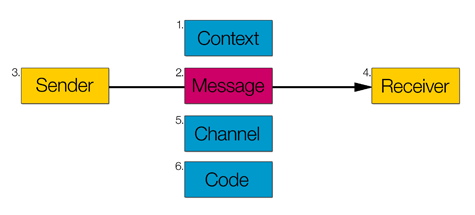 Functions
1 referential (= contextual information)
2 aesthetic (= auto-reflection)
3 emotive (= self-expression)
4 conative (= vocative or imperative addressing of receiver)
5 phatic (= checking channel working)
6 metalingual (= checking code working)
One of the six functions is always the dominant function in a text and usually related to the type of text. In poetry, the dominant function is the poetic function: the focus is on the message itself. The true hallmark of poetry is according to Jakobson "the projection of the principle of equivalence from the axis of selection to the axis of combination". [The exact and complete explanation of this principle is beyond the scope of this article.] Very broadly speaking, it implies that poetry successfully combines and integrates form and function, that poetry turns the poetry of grammar into the grammar of poetry, so to speak. A famous example of this principle is the political slogan "I like Ike." Jakobson's theory of communicative functions was first published in "Closing Statements: Linguistics and Poetics" (in Thomas A. Sebeok, Style In Language, Cambridge Massachusetts, MIT Press, 1960, pp. 350–377).
, markedness
, and linguistic universals. The three concepts are tightly intertwined: typology is the classification of languages in terms of shared grammatical features (as opposed to shared origin), markedness is (very roughly) a study of how certain forms of grammatical organization are more "natural" than others, and linguistic universals is the study of the general features of languages in the world. He also influenced Nicolas Ruwet
's paradigmatic analysis
.
Jakobson has also influenced Friedemann Schulz von Thun
s four sides model
, as well as Michael Silverstein
's metapragmatic linguistics, the psychoanalysis of Jacques Lacan
, and philosophy of Giorgio Agamben
.
Moscow
Moscow is the capital, the most populous city, and the most populous federal subject of Russia. The city is a major political, economic, cultural, scientific, religious, financial, educational, and transportation centre of Russia and the continent...
– July 18, 1982, Boston
Boston
Boston is the capital of and largest city in Massachusetts, and is one of the oldest cities in the United States. The largest city in New England, Boston is regarded as the unofficial "Capital of New England" for its economic and cultural impact on the entire New England region. The city proper had...
) was a Russia
Russia
Russia or , officially known as both Russia and the Russian Federation , is a country in northern Eurasia. It is a federal semi-presidential republic, comprising 83 federal subjects...
n linguist
Linguistics
Linguistics is the scientific study of human language. Linguistics can be broadly broken into three categories or subfields of study: language form, language meaning, and language in context....
and literary theorist
Literary theory
Literary theory in a strict sense is the systematic study of the nature of literature and of the methods for analyzing literature. However, literary scholarship since the 19th century often includes—in addition to, or even instead of literary theory in the strict sense—considerations of...
.
As a pioneer of the structural analysis
Structural Linguistics
Structural linguistics is an approach to linguistics originating from the work of Swiss linguist Ferdinand de Saussure. De Saussure's Course in General Linguistics, published posthumously in 1916, stressed examining language as a static system of interconnected units...
of language
Language
Language may refer either to the specifically human capacity for acquiring and using complex systems of communication, or to a specific instance of such a system of complex communication...
, which became the dominant trend of twentieth-century linguistics, Jakobson was among the most influential linguists
Linguistics
Linguistics is the scientific study of human language. Linguistics can be broadly broken into three categories or subfields of study: language form, language meaning, and language in context....
of the century. Influenced by the work of Ferdinand de Saussure
Ferdinand de Saussure
Ferdinand de Saussure was a Swiss linguist whose ideas laid a foundation for many significant developments in linguistics in the 20th century. He is widely considered one of the fathers of 20th-century linguistics...
, Jakobson developed, with Nikolai Trubetzkoy
Nikolai Trubetzkoy
Prince Nikolai Sergeyevich Trubetzkoy was a Russian linguist and historian whose teachings formed a nucleus of the Prague School of structural linguistics. He is widely considered to be the founder of morphophonology...
, techniques for the analysis of sound systems in languages, inaugurating the discipline of phonology
Phonology
Phonology is, broadly speaking, the subdiscipline of linguistics concerned with the sounds of language. That is, it is the systematic use of sound to encode meaning in any spoken human language, or the field of linguistics studying this use...
. He went on to apply the same techniques of analysis to syntax
Syntax
In linguistics, syntax is the study of the principles and rules for constructing phrases and sentences in natural languages....
and morphology
Morphology (linguistics)
In linguistics, morphology is the identification, analysis and description, in a language, of the structure of morphemes and other linguistic units, such as words, affixes, parts of speech, intonation/stress, or implied context...
, and controversially proposed that they be extended to semantics
Semantics
Semantics is the study of meaning. It focuses on the relation between signifiers, such as words, phrases, signs and symbols, and what they stand for, their denotata....
(the study of meaning in language). He made numerous contributions to Slavic linguistics, most notably two studies of Russian case and an analysis of the categories of the Russian verb. Drawing on insights from Charles Sanders Peirce's semiotics
Semiotics
Semiotics, also called semiotic studies or semiology, is the study of signs and sign processes , indication, designation, likeness, analogy, metaphor, symbolism, signification, and communication...
, as well as from communication theory
Communication theory
Communication theory is a field of information and mathematics that studies the technical process of information and the human process of human communication.- History :- Origins :...
and cybernetics
Cybernetics
Cybernetics is the interdisciplinary study of the structure of regulatory systems. Cybernetics is closely related to information theory, control theory and systems theory, at least in its first-order form...
, he proposed methods for the investigation of poetry
Poetry
Poetry is a form of literary art in which language is used for its aesthetic and evocative qualities in addition to, or in lieu of, its apparent meaning...
, music
Music
Music is an art form whose medium is sound and silence. Its common elements are pitch , rhythm , dynamics, and the sonic qualities of timbre and texture...
, the visual arts
Visual arts
The visual arts are art forms that create works which are primarily visual in nature, such as ceramics, drawing, painting, sculpture, printmaking, design, crafts, and often modern visual arts and architecture...
, and cinema
Film
A film, also called a movie or motion picture, is a series of still or moving images. It is produced by recording photographic images with cameras, or by creating images using animation techniques or visual effects...
.
Through his decisive influence on Claude Lévi-Strauss
Claude Lévi-Strauss
Claude Lévi-Strauss was a French anthropologist and ethnologist, and has been called, along with James George Frazer, the "father of modern anthropology"....
and Roland Barthes
Roland Barthes
Roland Gérard Barthes was a French literary theorist, philosopher, critic, and semiotician. Barthes' ideas explored a diverse range of fields and he influenced the development of schools of theory including structuralism, semiotics, existentialism, social theory, Marxism, anthropology and...
, among others, Jakobson became a pivotal figure in the adaptation of structural analysis to disciplines beyond linguistics, including anthropology
Anthropology
Anthropology is the study of humanity. It has origins in the humanities, the natural sciences, and the social sciences. The term "anthropology" is from the Greek anthrōpos , "man", understood to mean mankind or humanity, and -logia , "discourse" or "study", and was first used in 1501 by German...
and literary theory
Literary theory
Literary theory in a strict sense is the systematic study of the nature of literature and of the methods for analyzing literature. However, literary scholarship since the 19th century often includes—in addition to, or even instead of literary theory in the strict sense—considerations of...
; this generalization of Saussurean methods, known as "structuralism
Structuralism
Structuralism originated in the structural linguistics of Ferdinand de Saussure and the subsequent Prague and Moscow schools of linguistics. Just as structural linguistics was facing serious challenges from the likes of Noam Chomsky and thus fading in importance in linguistics, structuralism...
", became a major post-war intellectual movement in Europe and the United States. Meanwhile, though the influence of structuralism declined during the 1970s, Jakobson's work has continued to receive attention in linguistic anthropology
Linguistic anthropology
Linguistic anthropology is the interdisciplinary study of how language influences social life. It is a branch of anthropology that originated from the endeavor to document endangered languages, and has grown over the past 100 years to encompass almost any aspect of language structure and...
, especially through the ethnography of communication developed by Dell Hymes
Dell Hymes
Dell Hathaway Hymes was a sociolinguist, anthropologist, and folklorist whose work dealt primarily with languages of the Pacific Northwest. He was one of the first to call the fourth subfield of anthropology "linguistic anthropology" instead of "anthropological linguistics"...
and the semiotics of culture developed by Jakobson's former student Michael Silverstein
Michael Silverstein
Michael Silverstein is a professor of anthropology, linguistics, and psychology at the University of Chicago. He is a theoretician of semiotics and linguistic anthropology. Over the course of his career he has drawn together research on linguistic pragmatics, sociolinguistics, language ideology,...
.
Life and work
Jakobson was born in Russia to a well-to-do family of Jewish descent, and he developed a fascination with language at a very young age. He studied at the Lazarev Institute of Oriental LanguagesLazarev Institute of Oriental Languages
The Lazarev Institute of Oriental Languages, established in 1815, was a Moscow school specializing in Caucasian language and culture, particularly that of Armenia, and the cultural center of the Armenian diaspora in Russia. Many Russian scholars specializing in Transcaucasia received their...
and then in the Historical-Philological Faculty of Moscow University. As a student he was a leading figure of the Moscow Linguistic Circle
Moscow linguistic circle
The Moscow linguistic circle was a group of important thinkers in semiotics, literary theory, and linguistics active in Moscow from 1915 to ca. 1924. Its members included Roman Jakobson, Grigory Vinokur, and Petr Bogatyrev. The group was a counterpart to the St...
and took part in Moscow
Moscow
Moscow is the capital, the most populous city, and the most populous federal subject of Russia. The city is a major political, economic, cultural, scientific, religious, financial, educational, and transportation centre of Russia and the continent...
's active world of avant-garde
Avant-garde
Avant-garde means "advance guard" or "vanguard". The adjective form is used in English to refer to people or works that are experimental or innovative, particularly with respect to art, culture, and politics....
art and poetry. The linguistics of the time was overwhelmingly neogrammarian
Neogrammarian
The Neogrammarians were a German school of linguists, originally at the University of Leipzig, in the late 19th century who proposed the Neogrammarian hypothesis of the regularity of sound change...
and insisted that the only scientific study of language was to study the history and development of words across time (the diachronic approach, in Saussure's terms). Jakobson, on the other hand, had come into contact with the work of Ferdinand de Saussure
Ferdinand de Saussure
Ferdinand de Saussure was a Swiss linguist whose ideas laid a foundation for many significant developments in linguistics in the 20th century. He is widely considered one of the fathers of 20th-century linguistics...
, and developed an approach focused on the way in which language's structure served its basic function (synchronic approach) – to communicate information between speakers. Jakobson was also well known for his critique of the emergence of sound in film.
In Czechoslovakia
1920 was a year of political upheaval in Russia, and Jakobson relocated to PraguePrague
Prague is the capital and largest city of the Czech Republic. Situated in the north-west of the country on the Vltava river, the city is home to about 1.3 million people, while its metropolitan area is estimated to have a population of over 2.3 million...
as a member of the Soviet diplomatic mission to continue his doctoral studies. He immersed himself both into the academic and cultural life of pre-war Czechoslovakia and established close relationships with a number of Czech poets and literary figures. He became profesor at Masaryk University
Masaryk University
Masaryk University is the second largest university in the Czech Republic, a member of the Compostela Group and the Utrecht Network. Founded in 1919 in Brno as the third Czech university , it now consists of nine faculties and 42,182 students...
in 1933. He also made an impression on Czech academics with his studies of Czech verse. In 1926, together with Vilém Mathesius
Vilém Mathesius
Vilém Mathesius was a Czech linguist and literary historian, a scholar of English and Czech literature. His cousin was Bohumil Mathesius....
and others he became one of the founders of the "Prague school
Prague linguistic circle
The Prague school or the Prague linguistic circle was an influential group of literary critics and linguists in Prague. Its proponents developed methods of structuralist literary analysis during the years 1928–1939. It has had significant continuing influence on linguistics and semiotics...
" of linguistic theory (other members included Nikolai Trubetzkoi, René Wellek
René Wellek
René Wellek was a Czech-American comparative literary critic. Like Erich Auerbach, Wellek was an eminent product of the Central European philological tradition and was known as a vastly erudite and "fair-minded critic of critics."René Wellek was born and raised in Vienna, speaking Czech and German...
, Jan Mukařovský
Jan Mukarovský
Jan Mukařovský was a Czech literary and aesthetic theorist.He was professor at the Charles University of Prague. He is well known for his association with early structuralism as well as with the Prague Linguistic Circle, and for his development of the ideas of Russian formalism...
). There his numerous works on phonetics helped continue to develop his concerns with the structure and function of language. Jakobson's universalizing structural-functional theory of phonology
Phonology
Phonology is, broadly speaking, the subdiscipline of linguistics concerned with the sounds of language. That is, it is the systematic use of sound to encode meaning in any spoken human language, or the field of linguistics studying this use...
, based on a markedness
Markedness
Markedness is a specific kind of asymmetry relationship between elements of linguistic or conceptual structure. In a marked-unmarked relation, one term of an opposition is the broader, dominant one...
hierarchy of distinctive features, was the first successful solution of a plane of linguistic analysis according to the Saussurean hypotheses. (This theory achieved its most canonical exposition in a book co-authored with Morris Halle
Morris Halle
Morris Halle , is a Latvian-American Jewish linguist and an Institute Professor and professor emeritus of linguistics at the Massachusetts Institute of Technology...
.) This mode of analysis has been since applied to the plane of Saussurean sense by his protégé Michael Silverstein
Michael Silverstein
Michael Silverstein is a professor of anthropology, linguistics, and psychology at the University of Chicago. He is a theoretician of semiotics and linguistic anthropology. Over the course of his career he has drawn together research on linguistic pragmatics, sociolinguistics, language ideology,...
in a series of foundational articles in functionalist linguistic typology.
Escapes before the war
Jakobson escaped from Prague at the start of WWIIWorld War II
World War II, or the Second World War , was a global conflict lasting from 1939 to 1945, involving most of the world's nations—including all of the great powers—eventually forming two opposing military alliances: the Allies and the Axis...
daringly via Berlin for Denmark
Denmark
Denmark is a Scandinavian country in Northern Europe. The countries of Denmark and Greenland, as well as the Faroe Islands, constitute the Kingdom of Denmark . It is the southernmost of the Nordic countries, southwest of Sweden and south of Norway, and bordered to the south by Germany. Denmark...
, where he was associated with the Copenhagen linguistic circle, and such thinkers as Louis Hjelmslev
Louis Hjelmslev
Louis Hjelmslev was a Danish linguist whose ideas formed the basis of the Copenhagen School of linguistics. Born into an academic family , Hjelmslev studied comparative linguistics in Copenhagen, Prague and Paris...
. As the war advanced west, he fled to Norway, then was smuggled in a coffin by the Norwegian underground (with his wife, Czech anthropologist Svatava Pirkova, disguised as a peasant woman) over the border to Sweden, where he continued his work at the Karolinska Hospital (with works on aphasia and language competence). When Swedish colleagues feared for a possible German occupation, he managed to leave on a private yacht, together with Ernst Cassirer
Ernst Cassirer
Ernst Cassirer was a German philosopher. He was one of the major figures in the development of philosophical idealism in the first half of the 20th century...
(the former rector of Hamburg University) to New York City
New York City
New York is the most populous city in the United States and the center of the New York Metropolitan Area, one of the most populous metropolitan areas in the world. New York exerts a significant impact upon global commerce, finance, media, art, fashion, research, technology, education, and...
to become part of the wider community of intellectual émigrés who fled there.
Career in USA
In NY began teaching at The New SchoolThe New School
The New School is a university in New York City, located mostly in Greenwich Village. From its founding in 1919 by progressive New York academics, and for most of its history, the university was known as the New School for Social Research. Between 1997 and 2005 it was known as New School University...
, still closely associated with the Czech emigree community during that period. At the École libre des hautes études
École libre des hautes études
The École Libre des Hautes Études was a sort of university-in-exile for French academics in New York during the Second World War. It was chartered by the French and Belgian governments-in-exile and located at the New School for Social Research...
, a sort of Francophone university-in-exile, he met and collaborated with Claude Lévi-Strauss
Claude Lévi-Strauss
Claude Lévi-Strauss was a French anthropologist and ethnologist, and has been called, along with James George Frazer, the "father of modern anthropology"....
, who would also become a key exponent of structuralism
Structuralism
Structuralism originated in the structural linguistics of Ferdinand de Saussure and the subsequent Prague and Moscow schools of linguistics. Just as structural linguistics was facing serious challenges from the likes of Noam Chomsky and thus fading in importance in linguistics, structuralism...
. He also made the acquaintance of many American linguists and anthropologists
Anthropology
Anthropology is the study of humanity. It has origins in the humanities, the natural sciences, and the social sciences. The term "anthropology" is from the Greek anthrōpos , "man", understood to mean mankind or humanity, and -logia , "discourse" or "study", and was first used in 1501 by German...
, such as Franz Boas
Franz Boas
Franz Boas was a German-American anthropologist and a pioneer of modern anthropology who has been called the "Father of American Anthropology" and "the Father of Modern Anthropology." Like many such pioneers, he trained in other disciplines; he received his doctorate in physics, and did...
, Benjamin Whorf
Benjamin Whorf
In studying the cause of a fire which had started under the conditions just described, Whorf concluded that it was thinking of the "empty" gasoline drums as "empty" in the meaning described in the first definition above, that is as "inert," which led to a fire he investigated...
, and Leonard Bloomfield
Leonard Bloomfield
Leonard Bloomfield was an American linguist who led the development of structural linguistics in the United States during the 1930s and the 1940s. His influential textbook Language, published in 1933, presented a comprehensive description of American structural linguistics...
. When the American authorities considered "repatriating" him to Europe, it was Franz Boas who actually saved his life. After the war, he became a consultant to the International Auxiliary Language Association
International Auxiliary Language Association
The International Auxiliary Language Association was founded in 1924 to "promote widespread study, discussion and publicity of all questions involved in the establishment of an auxiliary language, together with research and experiment that may hasten such establishment in an intelligent manner and...
, which would present Interlingua
Interlingua
Interlingua is an international auxiliary language , developed between 1937 and 1951 by the International Auxiliary Language Association...
in 1951.
In 1949 Jakobson moved to Harvard University
Harvard University
Harvard University is a private Ivy League university located in Cambridge, Massachusetts, United States, established in 1636 by the Massachusetts legislature. Harvard is the oldest institution of higher learning in the United States and the first corporation chartered in the country...
, where he remained until retirement. In his last decade he maintained an office at the Massachusetts Institute of Technology
Massachusetts Institute of Technology
The Massachusetts Institute of Technology is a private research university located in Cambridge, Massachusetts. MIT has five schools and one college, containing a total of 32 academic departments, with a strong emphasis on scientific and technological education and research.Founded in 1861 in...
, where he was an honorary Professor Emeritus. In the early 1960s Jakobson shifted his emphasis to a more comprehensive view of language and began writing about communication sciences as a whole.
The communication functions
Based on the Organon-Model by Karl Bühler, Jakobson distinguishes six communication functions, each associated with a dimension of the communicationCommunication
Communication is the activity of conveying meaningful information. Communication requires a sender, a message, and an intended recipient, although the receiver need not be present or aware of the sender's intent to communicate at the time of communication; thus communication can occur across vast...
process:
1 referential (= contextual information)
2 aesthetic (= auto-reflection)
3 emotive (= self-expression)
4 conative (= vocative or imperative addressing of receiver)
5 phatic (= checking channel working)
6 metalingual (= checking code working)
One of the six functions is always the dominant function in a text and usually related to the type of text. In poetry, the dominant function is the poetic function: the focus is on the message itself. The true hallmark of poetry is according to Jakobson "the projection of the principle of equivalence from the axis of selection to the axis of combination". [The exact and complete explanation of this principle is beyond the scope of this article.] Very broadly speaking, it implies that poetry successfully combines and integrates form and function, that poetry turns the poetry of grammar into the grammar of poetry, so to speak. A famous example of this principle is the political slogan "I like Ike." Jakobson's theory of communicative functions was first published in "Closing Statements: Linguistics and Poetics" (in Thomas A. Sebeok, Style In Language, Cambridge Massachusetts, MIT Press, 1960, pp. 350–377).
Legacy
Jakobson's three principal ideas in linguistics play a major role in the field to this day: linguistic typologyLinguistic typology
Linguistic typology is a subfield of linguistics that studies and classifies languages according to their structural features. Its aim is to describe and explain the common properties and the structural diversity of the world's languages...
, markedness
Markedness
Markedness is a specific kind of asymmetry relationship between elements of linguistic or conceptual structure. In a marked-unmarked relation, one term of an opposition is the broader, dominant one...
, and linguistic universals. The three concepts are tightly intertwined: typology is the classification of languages in terms of shared grammatical features (as opposed to shared origin), markedness is (very roughly) a study of how certain forms of grammatical organization are more "natural" than others, and linguistic universals is the study of the general features of languages in the world. He also influenced Nicolas Ruwet
Nicolas Ruwet
Nicolas Ruwet was a linguist, literary critic and musical analyst. He was involved with the development of generative grammar.Ruwet was born in Saive in Belgium and studied philology in Liège...
's paradigmatic analysis
Paradigmatic analysis
Paradigmatic analysis is the analysis of paradigms embedded in the text rather than of the surface structure of the text which is termed syntagmatic analysis. Paradigmatic analysis often uses commutation tests, i.e...
.
Jakobson has also influenced Friedemann Schulz von Thun
Friedemann Schulz von Thun
Friedemann Schulz von Thun is a German psychologist and expert for interpersonal communication and intrapersonal communication. Schulz von Thun worked as a professor of psychology at the University of Hamburg until his retirement on 30 Sep. 2009...
s four sides model
Four sides model
The four-sides model is a communication model by Friedemann Schulz von Thun. According to this model every news has four messages. The four sides of the news are fact, self-revealing, relationship, and appeal.- Relationship :The communication square describes the multi-layered structure of human...
, as well as Michael Silverstein
Michael Silverstein
Michael Silverstein is a professor of anthropology, linguistics, and psychology at the University of Chicago. He is a theoretician of semiotics and linguistic anthropology. Over the course of his career he has drawn together research on linguistic pragmatics, sociolinguistics, language ideology,...
's metapragmatic linguistics, the psychoanalysis of Jacques Lacan
Jacques Lacan
Jacques Marie Émile Lacan was a French psychoanalyst and psychiatrist who made prominent contributions to psychoanalysis and philosophy, and has been called "the most controversial psycho-analyst since Freud". Giving yearly seminars in Paris from 1953 to 1981, Lacan influenced France's...
, and philosophy of Giorgio Agamben
Giorgio Agamben
Giorgio Agamben is an Italian political philosopher best known for his work investigating the concepts of the state of exception and homo sacer....
.