
All Topics  
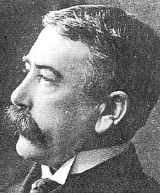
Ferdinand de Saussure

 
Ferdinand De Saussure

   Email Print
   Bookmark   Link


Ferdinand de Saussure


Ferdinand de Saussure (November 26, 1857 – February 22, 1913) was a Swiss
Switzerland

Switzerland is a landlocked Swiss Alps country of roughly 7.7 million people in Western Europe with an area of 41,285 km?. Switzerland is a federal republic consisting of 26 states called Cantons of Switzerland....
 linguist
Linguistics

Linguistics is the science study of natural language. Linguistics encompasses a number of sub-fields. An important topical division is between the study of language structure and the study of Meaning ....
 whose ideas laid a foundation for many significant developments in linguistics
Linguistics

Linguistics is the science study of natural language. Linguistics encompasses a number of sub-fields. An important topical division is between the study of language structure and the study of Meaning ....
 in the 20th century. Saussure is widely considered the 'father' of 20th-century linguistics, and his ideas have had a monumental impact on literary and cultural theory and interpretation.

inand Mongin de Saussure, born in Geneva
Geneva

Geneva is the second-most-populous city in Switzerland and is the most populous city of Romandie . Situated where the Rh?ne River exits Lake Geneva , it is the capital of the Canton of Geneva....
 in 1857, showed early signs of considerable talent and intellectual ability.


Discussion
Ask a question about 'Ferdinand de Saussure'
Start a new discussion about 'Ferdinand de Saussure'
Answer questions from other users
Full Discussion Forum


Recent Posts


Encyclopedia


Ferdinand de Saussure (November 26, 1857 – February 22, 1913) was a Swiss
Switzerland

Switzerland is a landlocked Swiss Alps country of roughly 7.7 million people in Western Europe with an area of 41,285 km?. Switzerland is a federal republic consisting of 26 states called Cantons of Switzerland....
 linguist
Linguistics

Linguistics is the science study of natural language. Linguistics encompasses a number of sub-fields. An important topical division is between the study of language structure and the study of Meaning ....
 whose ideas laid a foundation for many significant developments in linguistics
Linguistics

Linguistics is the science study of natural language. Linguistics encompasses a number of sub-fields. An important topical division is between the study of language structure and the study of Meaning ....
 in the 20th century. Saussure is widely considered the 'father' of 20th-century linguistics, and his ideas have had a monumental impact on literary and cultural theory and interpretation.

Biography

Ferdinand Mongin de Saussure, born in Geneva
Geneva

Geneva is the second-most-populous city in Switzerland and is the most populous city of Romandie . Situated where the Rh?ne River exits Lake Geneva , it is the capital of the Canton of Geneva....
 in 1857, showed early signs of considerable talent and intellectual ability. After a year of studying Latin
Latin

Latin is an Italic language, historically spoken in Latium and Ancient Rome. Through the Military history of the Roman Empire, Latin spread throughout the Mediterranean and a large part of Europe....
, Greek
Greek language

Greek is an Indo-European languages native to the southern Balkan peninsula, the language of the Greek people. It forms an independent branch within Indo-European....
, Sanskrit
Sanskrit

Sanskrit is a historical Indo-Aryan language, one of the liturgical languages of Hinduism and Buddhism, and one of the 22 official languages of India....
, and a variety of courses at the University of Geneva
University of Geneva

The University of Geneva is a university in Geneva, Switzerland.Founded by John Calvin in 1559 as a Theology seminary that also taught law, it remained focused on theology until the 17th century, when it became a center for the Enlightenment scholarship....
, he commenced graduate work at the University of Leipzig
University of Leipzig

The University of Leipzig , located in Leipzig in the Free State of Saxony, Germany, is one of the oldest University in Europeand currently the List_of_universities_in_Germany#Universities_by_age university in Germany....
 in 1876. Two years later at 21 years Saussure studied for a year at Berlin
Berlin

Berlin is the Capital of Germany city and one of sixteen States of Germany of Germany. With a population of 3.4 million within its city limits, Berlin is the country's largest city....
, where he wrote his only full-length work, Mémoire sur le système primitif des voyelles dans les langues indo-européenes (Thesis on the Primitive Vowel System in Indo-European Languages). He returned to Leipzig and was awarded his doctorate in 1880. Soon afterwards he relocated to Paris
Paris

Paris is the Capital of France and the country's largest city. It is situated on the river Seine, in northern France, at the heart of the ?le-de-France Regions of France ....
, where he would lecture on ancient and modern languages. He taught in Paris for 11 years before returning to Geneva in 1891. Saussure lectured on Sanskrit and Indo-European at the University of Geneva for the remainder of his life. It was not until 1906 that Saussure began teaching the Course of General Linguistics that would consume the greater part of his attention until his death in 1913.

Contributions to linguistics

"When Chomsky’s name is long forgotten, Saussure will be remembered" - Lewis Glinert, PhD, professor of linguistics, Dartmouth College
Dartmouth College

Dartmouth College is a private university, coeducational university located in Hanover, New Hampshire, New Hampshire. Incorporated as "Trustees of Dartmouth College,"...


Course in General Linguistics


Saussure's most influential work, Course in General Linguistics (Cours de linguistique générale), was published posthumously in 1916 by former students Charles Bally
Charles Bally

Charles Bally was a French linguistics from the Geneva School. He lived from 1865 to 1947 and was, like Ferdinand de Saussure, from Switzerland....
 and Albert Sechehaye on the basis of notes taken from Saussure's lectures at the University of Geneva. The Course became one of the seminal linguistics works of the 20th century, not primarily for the content (many of the ideas had been anticipated in the works of other 19th century linguists), but rather for the innovative approach that Saussure applied in discussing linguistic phenomena.

Its central notion is that language may be analyzed as a formal system
Formal system

In logic, a formal system consists of a formal language together with a deductive system which consists of a set of inference rules and/or axioms....
 of differential elements, apart from the messy dialectics of real-time production and comprehension. Examples of these elements include the notion of the linguistic sign
Sign (linguistics)

There are many models of the linguistic sign . A classic model is the one by the Swiss linguist Ferdinand de Saussure. According to him, language is made up of signs and every sign has two sides:...
, the signifier, the signified, and the referent.

In 1996, a manuscript of Saussure's was discovered in his house in Geneva. This text was published as Writings in General Linguistics, and offers significant clarifications of the Course.

Laryngeal theory

While a student, Saussure published an important work in Indo-European
Indo-European studies

Indo-European studies is a field of linguistics dealing with Indo-European languages, both current and extinct. Its goal is to amass information about the hypothetical proto-language from which all of these languages are descended, a language dubbed Proto-Indo-European language , and its speakers, the Proto-Indo-Europeans, including their soc...
 philology
Philology

Philology, derived from the Greek language considers both morphology and Meaning in linguistic expression, combining linguistics and literary studies....
 that proposed the existence of a class of sounds in Proto-Indo-European
Proto-Indo-European language

The Proto-Indo-European language is the unattested, linguistic reconstruction common ancestor of the Indo-European languages, spoken by the Proto-Indo-Europeans....
 called sonant coefficients. The Danish scholar Hermann Möller
Hermann Möller

Hermann M?ller was a Denmark linguist noted for his work in favor of a genetic relationship between the Indo-European languages and Semitic languages language family....
 suggested that these might actually be laryngeal consonants, leading to what is now known as the laryngeal theory
Laryngeal theory

The laryngeal theory is a generally accepted theory of historical linguistics which proposes the existence of a set of three consonant sounds known as "laryngeals" that appear in most current reconstructions of the Proto-Indo-European language ....
. It has been argued that the problem Saussure encountered, of trying to explain how he was able to make systematic and predictive hypotheses from known linguistic data to unknown linguistic data, stimulated his development of structuralism. Saussure's predictions about the existence of sonant coefficients/laryngeals and their evolution proved a resounding success when the Hittite texts
Hittite texts

The corpus of texts written in the Hittite language is indexed by the Catalogue des Textes Hittites . Studies of selected texts are published in the StBoT series....
 were discovered and deciphered, some 20 years later.

Legacy

The impact of Saussure's ideas on the development of linguistic theory in the first half of the 20th century cannot be overstated. Two currents of thought emerged independently of each other, one in Europe, the other in America. The results of each incorporated the basic notions of Saussurian thought in forming the central tenets of structural linguistics
Structuralism

Structuralism is an approach to the human sciences that attempts to analyze a specific field as a complex system of interrelated parts. It began in linguistics with the work of Ferdinand de Saussure....
. In Europe, the most important work was being done by the Prague School
Prague linguistic circle

The Prague Linguistic Circle or "Prague school" was an influential group of literary critics and linguisticss in Prague. Its proponents developed methods of semiotic literary criticism during the years 1928–1939....
. Most notably, Nikolay Trubetzkoy and Roman Jakobson
Roman Jakobson

Roman Osipovich Jakobson, , was a Russian linguist and literary critic, associated with the Russian Formalism school. He became one of the most influential linguistics of the 20th century by pioneering the development of structuralism of language, poetry, and art....
 headed the efforts of the Prague School in setting the course of phonological theory
Phonology

Phonology is the systematic use of sound to encode meaning in any spoken human language, or the field of linguistics studying this use. Just as a language has syntax and vocabulary, it also has a phonology in the sense of a sound system....
 in the decades following 1940. Jakobson's universalizing structural-functional theory of phonology, based on a markedness
Markedness

Markedness is a Linguistics concept that developed out of the Prague School. A marked form is a non-basic or less natural form. An unmarked form is a basic, default form....
 hierarchy of distinctive features, was the first successful solution of a plane of linguistic analysis according to the Saussurean hypotheses. Elsewhere, Louis Hjelmslev
Louis Hjelmslev

Louis Hjelmslev was a Denmark linguistics whose ideas formed the basis of the The Copenhagen school of linguistics. Born into an academic family, Hjelmslev studied comparative linguistics in Copenhagen, Prague and Paris ....
 and the Copenhagen School
Copenhagen School

The Copenhagen School is a term given to "schools" of theory originating in Copenhagen, Denmark. In at least four different scientific disciplines a theoretical approach originating in Copenhagen has been so influential that they have been dubbed "the Copenhagen School"...
 proposed new interpretations of linguistics from structuralist theoretical frameworks. In America, Saussure's ideas informed the distributionalism of Leonard Bloomfield
Leonard Bloomfield

Leonard Bloomfield was an United States linguistics, whose influence dominated the development of structuralism#Structuralism in linguistics in America between the 1930s and the 1950s....
 and the post-Bloomfieldian Structuralism of those scholars guided by and furthering the practices established in Bloomfield's investigations and analyses of language, such as Eugene Nida
Eugene Nida

Eugene A. Nida is the developer of the dynamic equivalence Bible translation theory....
, Bernard Bloch
Bernard Bloch

----Bernard Bloch, Bachelor of Arts, Master's degree, Doctor of Philosophy, was an United States linguistics.He is one of the Post-Bloomfield school linguists....
, George L. Trager
George L. Trager

George Leonard Trager was an American linguistics. He was born March 22, 1906, in Newark, New Jersey; he died on August 31, 1992, in Pasadena, California....
, Rulon S. Wells III, Charles Hockett, and through Zellig Harris
Zellig Harris

Zellig Sabbetai Harris was a renowned American linguistics, mathematical syntactician, and methodologist of science. Originally a Semitic languages, he is best known for his work in Structuralism#Structuralism in linguistics and discourse analysis and for the discovery of transformational structure in language, all achieved in the first 10 y...
, the young Noam Chomsky
Noam Chomsky

Avram Noam Chomsky is an United States linguistics, philosopher, cognitive science, political activist, author, and lecturer. He is an Institute Professor emeritus and professor emeritus of linguistics at the Massachusetts Institute of Technology....
. In addition to Chomsky's theory of Transformational grammar
Transformational grammar

In linguistics, a transformational grammar, or transformational-generative grammar , is a generative grammar, especially of a natural language, that has been developed in a Noam Chomsky tradition....
, other contemporary developments of structuralism include Kenneth Pike's theory of tagmemics
Tagmemics

Tagmemics is a linguistic theory developed by Kenneth L. Pike in his book Language in Relation to a Unified Theory of the Structure of Human Behavior, 3 vol....
, Sidney Lamb's theory of stratificational grammar, and Michael Silverstein
Michael Silverstein

Michael Silverstein is a professor of anthropology, linguistics, and psychology at the University of Chicago. He has studied Indigenous Australian languages and Indigenous_languages_of_the_Americas#Greenland.2C_Canada_.26_USA....
's work.

Outside linguistics, the principles and methods employed by structuralism were soon adopted by scholars and literary critics, such as Roland Barthes
Roland Barthes

Roland Barthes was a France literary theory, philosopher, critic, and Semiotics. Barthes's work extended over many fields and he influenced the development of schools of theory including structuralism, semiotics, existentialism, social theory, Marxism and post-structuralism....
, Jacques Lacan
Jacques Lacan

Jacques-Marie-?mile Lacan was a France psychoanalyst and psychiatrist who made prominent contributions to psychoanalysis, philosophy, and literary theory....
, and Claude Lévi-Strauss
Claude Lévi-Strauss

Claude L?vi-Strauss is a French anthropologist....
, and implemented in their respective areas of study. However, their expansive interpretations of Saussure's theories, which contained ambiguities to begin with, and their application of those theories to non-linguistic fields of study such as sociology
Sociology

Sociology is a branch of the social sciences that uses systematic methods of Empiricism and critical theory to develop and refine a body of knowledge about human social structure and activity, sometimes with the goal of applying such knowledge to the pursuit of social welfare....
 or anthropology
Anthropology

Anthropology is the study of humans and humanity in its totality. Anthropology has origins in the natural sciences, and the humanities. In Great Britain it was originally divided into physical anthropology and cultural anthropology, which itself was divided into archaeology, technology, ethnology and sociology ....
, led to theoretical difficulties and proclamations of the end of structuralism in those disciplines.

Quotations

  • "A sign
    Sign (semiotics)

    In semiotics, a sign is "something that stands for something else, to someone in some capacity". It may be understood as a discrete unit of Meaning , and includes words, images, gestures, scents, tastes, textures, sounds – essentially all of the ways in which information can be communicated as a message by any sentient, reasoning m...
     is the basic unit of language (a given language at a given time). Every language is a complete system of signs. Parole (the speech of an individual) is an external manifestation of language."
  • "A linguistic system is a series of differences of sounds combined with a series of differences of ideas."
  • "The connection between the signifier and the signified is arbitrary."
  • "In language there are only differences, and no positive terms"
  • "Speaking of linguistic law in general is like trying to pin down a ghost"


Works

  • Saussure, Ferdinand de. (2002) Écrits de linguistique générale (edition prepared by Simon Bouquet and Rudolf Engler), Paris: Gallimard. ISBN 2-07-076116-9. English translation: Writings in General Linguistics, Oxford: Oxford University Press. (2006) ISBN 0-19-926144-X.
This volume is based on the manuscript of Saussure's "book on general linguistics", found in 1996 in Geneva. Saussure often mentioned the existence of such a manuscript, but it was thought to have been lost for a long time. With this new textual source, new light is shed on the work of Saussure. In particular, new elements appear that call for a revision of the legacy of Saussure, and call into question the reconstruction of his thought by his students in the Course in General Linguistics
Course in General Linguistics

Course in General Linguistics is the influential book compiled by Charles Bally and Albert Sechehaye, that is based on notes taken from Ferdinand de Saussure's lectures at the University of Geneva between the years 1906 and 1911....
 (1916).
  • (1878) Mémoire sur le système primitif des voyelles dans les langues indo-européenes (Memoir on the Primitive System of Vowels in Indo-European Languages), Leipzig: Teubner. ( in Gallica Program, Bibliothèque nationale de France
    Bibliothèque nationale de France

    The Biblioth?que nationale de France is the National library of France, located in Paris. It is intended to be the repository of all that is published in France....
    ).
  • (1916) Cours de linguistique générale, ed. C. Bally and A. Sechehaye, with the collaboration of A. Riedlinger, Lausanne and Paris: Payot; trans. W. Baskin, Course in General Linguistics, Glasgow: Fontana/Collins, 1977.
  • (1993) Saussure’s Third Course of Lectures in General Linguistics (1910–1911): Emile Constantin ders notlarindan, Language and Communication series, volume. 12, trans. and ed. E. Komatsu and R. Harris, Oxford: Pergamon.


See also

  • Leonard Bloomfield
    Leonard Bloomfield

    Leonard Bloomfield was an United States linguistics, whose influence dominated the development of structuralism#Structuralism in linguistics in America between the 1930s and the 1950s....
  • Linguistics
    Linguistics

    Linguistics is the science study of natural language. Linguistics encompasses a number of sub-fields. An important topical division is between the study of language structure and the study of Meaning ....
  • Neogrammarians
  • Roman Jakobson
    Roman Jakobson

    Roman Osipovich Jakobson, , was a Russian linguist and literary critic, associated with the Russian Formalism school. He became one of the most influential linguistics of the 20th century by pioneering the development of structuralism of language, poetry, and art....
  • Structuralism
    Structuralism

    Structuralism is an approach to the human sciences that attempts to analyze a specific field as a complex system of interrelated parts. It began in linguistics with the work of Ferdinand de Saussure....


External links

  • : an article in the The Times Literary Supplement
    The Times Literary Supplement

    The Times Literary Supplement is a weekly literary review published in London by News International, a subsidiary of News Corporation....
     by John E. Joseph, November 14, 2007
  • , published by Texto, .
  • by Elmer G. Wiens.