
All Topics  
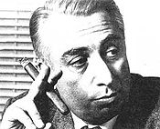
Roland Barthes

 
Roland Barthes

   Email Print
   Bookmark   Link


Roland Barthes


Roland Barthes (November 12, 1915 – March 25, 1980) was a French
France

France , officially the French Republic , is a country whose Metropolitan France is located in Western Europe and that also comprises various Overseas departments and territories of France....
 literary theorist
Literary theory

Literary theory in a strict sense is the systematic study of the nature of literature and of the methods for analyzing literature. However, literary scholarship since the 19th century often includes?in addition to, or even instead of literary theory in the strict sense?considerations of intellectual history, moral philosophy, social prophecy,...
, philosopher, critic
Critic

The word critic comes from the Greek language ' , "able to discern", which in turn derives from the word ' , meaning a person who offers reasoned judgment or analysis, value judgment, interpretation, or observation....
, and semiotician
Semiotics

'Semiotics, also called semiotic studies or semiology, is the study of sign processes , or signification and communication, sign and symbols, both individually and grouped into sign systems....
. Barthes's work extended over many fields and he influenced the development of schools of theory including structuralism
Structuralism

Structuralism is an approach to the human sciences that attempts to analyze a specific field as a complex system of interrelated parts. It began in linguistics with the work of Ferdinand de Saussure....
, semiotics
Semiotics

'Semiotics, also called semiotic studies or semiology, is the study of sign processes , or signification and communication, sign and symbols, both individually and grouped into sign systems....
, existentialism
Existentialism

Existentialism is a term that has been applied to the work of a number of nineteenth and twentieth century philosophers who, despite profound doctrinal differences, took the human subject — not merely the thinking subject, but the acting, feeling, living human individual and his or her conditions of existence — as a starting point...
, social theory
Social theory

Social theory is the use of theoretical frameworks to study and interpret social structures and phenomena within a particular school of thought....
, Marxism
Marxism

Marxism is the political philosophy and practice derived from the work of Karl Marx and Friedrich Engels. Marxism holds at its core a Marxist analysis of Critique of capitalism and a theory of social change....
 and post-structuralism
Post-structuralism

Post-structuralism encompasses the intellectual developments of continental philosophy and critical theory who wrote with tendencies of French philosophy#20th century....
.

nd Barthes was born on November 12 1915 in the town of Cherbourg
Cherbourg-Octeville

Cherbourg-Octeville is a Communes of France in the Manche Departments of France in Normandy in northwestern France.It was formed when the city of Cherbourg absorbed Octeville on February 28, 2000, and was officially renamed Cherbourg-Octeville....
 in Normandy
Normandy

Normandy is a geographical region corresponding to the former Duchy of Normandy. It is situated along the coast of France south of the English Channel between Brittany and Picardy and comprises territory in northern France and the Channel Islands....
. He was the son of naval officer Louis Barthes, who was killed in a battle in the North Sea before his son was one year old.


Discussion
Ask a question about 'Roland Barthes'
Start a new discussion about 'Roland Barthes'
Answer questions from other users
Full Discussion Forum


Encyclopedia


Roland Barthes (November 12, 1915 – March 25, 1980) was a French
France

France , officially the French Republic , is a country whose Metropolitan France is located in Western Europe and that also comprises various Overseas departments and territories of France....
 literary theorist
Literary theory

Literary theory in a strict sense is the systematic study of the nature of literature and of the methods for analyzing literature. However, literary scholarship since the 19th century often includes?in addition to, or even instead of literary theory in the strict sense?considerations of intellectual history, moral philosophy, social prophecy,...
, philosopher, critic
Critic

The word critic comes from the Greek language ' , "able to discern", which in turn derives from the word ' , meaning a person who offers reasoned judgment or analysis, value judgment, interpretation, or observation....
, and semiotician
Semiotics

'Semiotics, also called semiotic studies or semiology, is the study of sign processes , or signification and communication, sign and symbols, both individually and grouped into sign systems....
. Barthes's work extended over many fields and he influenced the development of schools of theory including structuralism
Structuralism

Structuralism is an approach to the human sciences that attempts to analyze a specific field as a complex system of interrelated parts. It began in linguistics with the work of Ferdinand de Saussure....
, semiotics
Semiotics

'Semiotics, also called semiotic studies or semiology, is the study of sign processes , or signification and communication, sign and symbols, both individually and grouped into sign systems....
, existentialism
Existentialism

Existentialism is a term that has been applied to the work of a number of nineteenth and twentieth century philosophers who, despite profound doctrinal differences, took the human subject — not merely the thinking subject, but the acting, feeling, living human individual and his or her conditions of existence — as a starting point...
, social theory
Social theory

Social theory is the use of theoretical frameworks to study and interpret social structures and phenomena within a particular school of thought....
, Marxism
Marxism

Marxism is the political philosophy and practice derived from the work of Karl Marx and Friedrich Engels. Marxism holds at its core a Marxist analysis of Critique of capitalism and a theory of social change....
 and post-structuralism
Post-structuralism

Post-structuralism encompasses the intellectual developments of continental philosophy and critical theory who wrote with tendencies of French philosophy#20th century....
.

Life

Roland Barthes was born on November 12 1915 in the town of Cherbourg
Cherbourg-Octeville

Cherbourg-Octeville is a Communes of France in the Manche Departments of France in Normandy in northwestern France.It was formed when the city of Cherbourg absorbed Octeville on February 28, 2000, and was officially renamed Cherbourg-Octeville....
 in Normandy
Normandy

Normandy is a geographical region corresponding to the former Duchy of Normandy. It is situated along the coast of France south of the English Channel between Brittany and Picardy and comprises territory in northern France and the Channel Islands....
. He was the son of naval officer Louis Barthes, who was killed in a battle in the North Sea before his son was one year old. His mother, Henriette Barthes, and his aunt and grandmother raised him in the French little village of Urt and the city of Bayonne
Bayonne

name= BayonneFile:Bayonne.jpgView of Grand Bayonne across the Adour|r?gion=Aquitaine|d?partement=Pyr?n?es-Atlantiques...
. When Barthes was nine, his family moved to Paris
Paris

Paris is the Capital of France and the country's largest city. It is situated on the river Seine, in northern France, at the heart of the ?le-de-France Regions of France ....
 and it was there that he would grow to manhood (though his attachment to his provincial roots would remain strong throughout his life).

Barthes showed great promise as a student and spent the period from 1935 to 1939 at the Sorbonne
Sorbonne

The name Sorbonne is commonly used to refer to the historic University of Paris in Paris, France or one of its successor institutions , but this is a recent usage, and "Sorbonne" has actually been used with different meanings over the centuries....
, earning a licence in classical letters. Unfortunately, he was also plagued by ill health throughout this period, suffering from tuberculosis
Tuberculosis

Tuberculosis is a common and often deadly infectious disease caused by mycobacterium, mainly Mycobacterium tuberculosis . Tuberculosis usually attacks the lungs but can also affect the central nervous system, the lymphatic system, the circulatory system, the genitourinary system, the gastrointestinal system, bones, joints, and even the...
 that often had to be treated in the isolation of sanatoria
Sanatorium

A sanatorium is a medical facility for long-term illness, typically tuberculosis. A distinction is sometimes made between "sanitarium" and "sanatorium" ....
. His repeated physical breakdowns disrupted his academic career, affecting his studies and his ability to take certain qualifying examinations. However, it also kept him out of military service during World War II
World War II

World War II, or the Second World War , was a global military conflict which involved a Participants in World War II, including all of the great powers, organised into two opposing military alliances: the Allies of World War II and the Axis powers....
, and, while being kept out of the major French universities meant he had to travel a great deal for teaching positions, Barthes later professed an intentional avoidance of major degree-awarding universities throughout his career.

His life from 1939 to 1948 was largely spent obtaining a license in grammar and philology
Philology

Philology, derived from the Greek language considers both morphology and Meaning in linguistic expression, combining linguistics and literary studies....
, publishing his first papers, taking part in a medical study and continuing to struggle with his health. In 1948 he returned to purely academic work, gaining numerous short-term positions at institutes in France
France

France , officially the French Republic , is a country whose Metropolitan France is located in Western Europe and that also comprises various Overseas departments and territories of France....
, Romania
Romania

Romania is a country located in Southeastern Europe Central Europe, North of the Balkan Peninsula, on the Lower Danube, within and outside the Carpathian Mountains, bordering on the Black Sea....
 and Egypt
Egypt

Egypt is a country mainly in North Africa, with the Sinai Peninsula forming a land bridge in Western Asia. Covering an area of about , Egypt borders the Mediterranean Sea to the north, the Gaza Strip and Israel to the northeast, the Red Sea to the east, Sudan to the south and Libya to the west....
. During this time he contributed to the leftist Parisian paper Combat, out of which grew his first full length work Writing Degree Zero (1953). In 1952 Barthes was able to settle at the Centre National de la Recherche Scientifique
Centre national de la recherche scientifique

The National Centre for Scientific Research is the largest governmental research organisation in France and the largest fundamental science agency in Europe....
 when he studied lexicology
Lexicology

is that part of linguistics which studies words, their nature and meaning, words' elements, relations between words , words groups and the whole lexicon....
 and sociology
Sociology

Sociology is a branch of the social sciences that uses systematic methods of Empiricism and critical theory to develop and refine a body of knowledge about human social structure and activity, sometimes with the goal of applying such knowledge to the pursuit of social welfare....
. During his seven-year period there he began writing a popular series of bimonthly essays for the magazine Les Lettres Nouvelles, in which he dismantled myths of popular culture (gathered in the Mythologies collection published in 1957).

Barthes spent the early 60s exploring the fields of semiology and structuralism
Structuralism

Structuralism is an approach to the human sciences that attempts to analyze a specific field as a complex system of interrelated parts. It began in linguistics with the work of Ferdinand de Saussure....
, chairing various faculty positions around France, and continuing to produce more full-length studies. Many of his works challenged traditional academic views of literary criticism and of specific, renowned figures of literature. His unorthodox thinking led to a conflict with another French thinker, Raymond Picard
Raymond Picard

Raymond Picard was an author, prominent Sorbonne professor and Jean Racine scholar noted for his scathing tract "Nouvelle critique ou nouvelle imposture?" , which was aimed at the "subjective" analytical approach of Roland Barthes and other non-traditional approaches by writers of the so called "French New Criticism", including Lucien Goldma...
, who attacked the French New Criticism (a label with which he inaccurately identified Barthes) for being obscure and disrespectful to the culture’s literary roots. Barthes' rebuttal in Criticism and Truth (1966) accused the old, bourgeois criticism of being unconcerned with the finer points of language and capable of selective ignorance towards challenging concepts of theories like Marxism
Marxism

Marxism is the political philosophy and practice derived from the work of Karl Marx and Friedrich Engels. Marxism holds at its core a Marxist analysis of Critique of capitalism and a theory of social change....
.

By the late 1960s Barthes had established a reputation. He traveled to America
United States

The United States of America is a Federal government constitutional republic comprising U.S. state and a federal district. The country is situated mostly in central North America, where its Contiguous United States and Washington, D.C., the Capital districts and territories, lie between the Pacific Ocean and Atlantic Oceans, Borders of the U...
 and Japan
Japan

Japan is an island country in East Asia. Located in the Pacific Ocean, it lies to the east of the Sea of Japan, People's Republic of China, North Korea, South Korea and Russia, stretching from the Sea of Okhotsk in the north to the East China Sea and Taiwan in the south....
, delivering a presentation at Johns Hopkins University
Johns Hopkins University

The Johns Hopkins University, commonly referred to as Hopkins or JHU, is a private university research university located in Baltimore, Maryland, Maryland, United States....
, and producing his best known work, the 1967 essay “The Death of the Author”
Death of the Author

"Death of the Author" is an essay by the French literary critic Roland Barthes that was first published in the American journal Aspen . The essay later appeared in an anthology of his essays, Image-Music-Text , a book that also included "From Work To Text"....
, which, in light of the growing influence of Jacques Derrida
Jacques Derrida

Jacques Derrida was a France philosophy born in Algeria, who is known as the founder of deconstruction, which was originally a translation of a Heideggerian term from Being and Time, also translated as 'De-structuring'....
's deconstructionist theory, would prove to be a transitional piece investigating the logical ends of structuralist thought. Barthes continued to contribute with Philippe Sollers
Philippe Sollers

Philippe Sollers is a French writer and critic. In 1960 he founded the avant garde journal Tel Quel , published by Seuil, which ran until 1982....
 to the avant-garde
Avant-garde

Avant-garde means "advance guard" or "vanguard". The adjective form is used in English, to refer to people or works that are experimental or innovative, particularly with respect to art, culture, and politics....
 literary magazine Tel Quel
Tel Quel

Tel Quel was an avant-garde journal for literature, founded in 1960 in Paris by Philippe Sollers and Jean-Edern Hallier....
, which was very much concerned with the kinds of theory being developed in his work. In 1970 Barthes produced what many consider to be his most prodigious work, the dense critical reading of Balzac’s Sarrasine
Sarrasine

Sarrasine is a novella written by Honor? de Balzac. It was published in 1830 , and is part of his La Com?die Humaine.Commentary ...
 entitled S/Z
S/Z

S/Z, published in 1970, is Roland Barthes's structuralism of "Sarrasine", the short story by Honor? de Balzac. Barthes methodically moves through the text of the story, denoting where and how different codes of meaning function....
. Throughout the 70s Barthes continued to develop his literary criticism, pursuing new ideals of textuality
Textualism

Textualism is a Legal formalism theory of statutory interpretation, holding that a statute's ordinary meaning should govern its interpretation, as opposed to inquiries into non-textual sources such as the Intentionalism of the legislature in passing the law, the Purposive theory, or substantive questions of the justice and rectitude of the la...
 and novelistic neutrality through his works.

In 1977 he was elected to the chair of Sémiologie Littéraire at the Collège de France
Collège de France

The Coll?ge de France is a higher education and research establishment located in Paris, France, in the 5th arrondissement, or Latin Quarter, across the street from the historical campus of La Sorbonne at the intersection of Rue Saint-Jacques and Rue des Ecoles....
. In the same year his mother, to whom he had been devoted, died, aged 85. They had lived together for 60 years. The loss of the woman who had raised and cared for him was a serious blow. He had often written about photography
Photography

Photography is the process, activity and art of creating still or moving by recording radiation on a sensitive medium, such as a photographic film, or an ....
, but his last major work, Camera Lucida, was partly an essay about the nature of photography and partly a meditation on photographs of Henriette Barthes. Although the book contains many reproductions of photographs, none of them are of Barthes' mother.

On 25 February 1980, after leaving a lunch party held by François Mitterrand
François Mitterrand

Fran?ois Maurice Adrien Marie Mitterrand served as President of France from 1981 to 1995, elected as representative of the French Socialist Party ....
, Barthes was struck by a laundry van while walking home through the streets of Paris. He succumbed to his injuries a month later and died on 25 March.

Works and ideas


Early works


Barthes' earliest work was very much a reaction to the trend of existentialist philosophy that was prominent during the 1940s, specifically towards the figurehead of existentialism Jean-Paul Sartre
Jean-Paul Sartre

Jean-Paul Charles Aymard Sartre , commonly known simply as Jean-Paul Sartre , was a French existentialism philosopher, playwright, novelist, screenwriter, political activist, biographer, and literary criticism....
. In his work What Is Literature?
What is literature?

What is literature? is a 1947 book by Jean-Paul Sartre. The book is divided into three topics of discussion:# Sartre condemns the bourgeoisie as being devoid of culture....
 (1947) Sartre finds himself to be disenchanted with both established forms of writing, and more experimental avant-garde
Avant-garde

Avant-garde means "advance guard" or "vanguard". The adjective form is used in English, to refer to people or works that are experimental or innovative, particularly with respect to art, culture, and politics....
 forms, which he feels alienate readers. Barthes’ response is to try to find what can be considered unique and original in writing. He determines in Writing Degree Zero (1953) that language and style are both matters that appeal to conventions, and are thus not purely creative. Rather, form, or what Barthes calls ‘writing’, the specific way an individual chooses to manipulate conventions of style for a desired effect, is the unique and creative act. One’s form is vulnerable to becoming a convention once it has been made available to the public. This means that being creative is an ongoing process of continual change and reaction. He saw Albert Camus
Albert Camus

Albert Camus was an Algerian-born France author, Philosophy, and journalist who won the Nobel Prize in 1957. He is often associated with existentialism, but Camus refused this label....
’s The Stranger
The Stranger (novel)

The Stranger, The Outsider, , by Albert Camus, is one of the most famous French novels of the twentieth century and is among the best literary expositions of the absurdity of human existence in an indifferent universe....
 as an ideal example of this notion for its sincere lack of any embellishment or flair.

In Michelet, a critical look at the work of French historian Jules Michelet
Jules Michelet

Jules Michelet was a France historian. He was born in Paris to a family with Huguenot traditions....
, Barthes continues to develop these notions and apply them to broader fields. He explains that Michelet’s views of history and society are obviously flawed, but that in studying his works one should not seek to learn from Michelet’s claims. Rather, one should maintain a critical distance and learn from his errors. Understanding how and why his thinking is flawed will show more about his period of history than his own observations. Similarly, Barthes felt avant-garde
Avant-garde

Avant-garde means "advance guard" or "vanguard". The adjective form is used in English, to refer to people or works that are experimental or innovative, particularly with respect to art, culture, and politics....
 writing should be praised for maintaining just such a distance between its audience and its work. By maintaining an obvious artificiality rather than making claims to great subjective truths, avant-garde writers assure their audiences maintain an objective perspective in reading their work. In this sense, Barthes believed that art should be critical and interrogate the world rather than seek to explain it like Michelet would.

Semiotics and myth


Barthes' many monthly contributions that made up Mythologies (1957) would often interrogate pieces of cultural material to expose how bourgeois society used them to assert its values upon others. For instance, portrayal of wine in French society as a robust and healthy habit would be a bourgeois ideal perception contradicted by certain realities (i.e. that wine can be unhealthy and inebriating). He found semiotics
Semiotics

'Semiotics, also called semiotic studies or semiology, is the study of sign processes , or signification and communication, sign and symbols, both individually and grouped into sign systems....
, the study of signs
Sign (semiotics)

In semiotics, a sign is "something that stands for something else, to someone in some capacity". It may be understood as a discrete unit of Meaning , and includes words, images, gestures, scents, tastes, textures, sounds – essentially all of the ways in which information can be communicated as a message by any sentient, reasoning m...
, useful in these interrogations. Barthes explained that these bourgeois cultural myths were second-order signs, or connotation
Connotation (semiotics)

In semiotics, connotation arises when the denotation relationship between a signifier and its signified is inadequate to serve the needs of the community....
s. A picture of a full, dark bottle is a sign, a signifier relating to a signified: a fermented, alcoholic beverage - wine. However, the bourgeois take this signified and apply their own emphasis to it, making ‘wine’ a new signifier, this time relating to a new signified: the idea of healthy, robust, relaxing wine. Motivations for such manipulations vary from a desire to sell products to a simple desire to maintain the status quo. These insights brought Barthes very much in line with similar Marxist theory.

In The Fashion System Barthes showed how this adulteration of signs could easily be translated into words. In this work he explained how in the fashion world any word could be loaded with idealistic bourgeois emphasis. Thus, if popular fashion says that a ‘blouse’ is ideal for a certain situation or ensemble, this idea is immediately naturalized and accepted as truth, even though the actual sign could just as easily be interchangeable with ‘skirt’, ‘vest’ or any number of combinations. In the end Barthes' Mythologies became absorbed into bourgeois culture, as he found many third parties asking him to comment on a certain cultural phenomenon, being interested in his control over his readership. This turn of events caused him to question the overall utility of demystifying culture for the masses, thinking it might be a fruitless attempt, and drove him deeper in his search for individualistic meaning in art.

Structuralism and its limits


As Barthes' work with structuralism
Structuralism

Structuralism is an approach to the human sciences that attempts to analyze a specific field as a complex system of interrelated parts. It began in linguistics with the work of Ferdinand de Saussure....
 began to flourish around the time of his debates with Picard, his investigation of structure focused on revealing the importance of language in writing, which he felt was overlooked by old criticism. Barthes' “Introduction to the Structural Analysis of Narratives” is concerned with examining the correspondence between the structure of a sentence and that of a larger narrative, thus allowing narrative to be viewed along linguistic
Linguistics

Linguistics is the science study of natural language. Linguistics encompasses a number of sub-fields. An important topical division is between the study of language structure and the study of Meaning ....
 lines. Barthes split this work into three hierarchical levels: ‘functions’, ‘actions’ and ‘narrative’. ‘Functions’ are the elementary pieces of a work, such as a single descriptive word that can be used to identify a character. That character would be an ‘action’, and consequently one of the elements that make up the narrative. Barthes was able to use these distinctions to evaluate how certain key ‘functions’ work in forming characters. For example key words like ‘dark’, ‘mysterious’ and ‘odd’, when integrated together, formulate a specific kind of character or ‘action’. By breaking down the work into such fundamental distinctions Barthes was able to judge the degree of realism given functions have in forming their actions and consequently with what authenticity a narrative can be said to reflect on reality. Thus, his structuralist theorizing became another exercise in his ongoing attempts to dissect and expose the misleading mechanisms of bourgeois culture.

While Barthes found structuralism
Structuralism

Structuralism is an approach to the human sciences that attempts to analyze a specific field as a complex system of interrelated parts. It began in linguistics with the work of Ferdinand de Saussure....
 to be a useful tool and believed that discourse of literature could be formalized, he did not believe it could become a strict scientific endeavour. In the late 1960s, radical movements were taking place in literary criticism. The post-structuralist movement and the deconstructionism of Jacques Derrida
Jacques Derrida

Jacques Derrida was a France philosophy born in Algeria, who is known as the founder of deconstruction, which was originally a translation of a Heideggerian term from Being and Time, also translated as 'De-structuring'....
 were testing the bounds of the structuralist theory that Barthes' work exemplified. Derrida identified the flaw of structuralism as its reliance on a transcendental signified; a symbol of constant, universal meaning would be essential as an orienting point in such a closed off system. This is to say that without some regular standard of measurement, a system of criticism that references nothing outside of the actual work itself could never prove useful. But since there are no symbols of constant and universal significance, the entire premise of structuralism as a means of evaluating writing (or anything) is hollow.

Transition


Such groundbreaking thought led Barthes to consider the limitations not just of signs and symbols, but also of Western culture’s dependency on beliefs of constancy and ultimate standards. He travelled to Japan
Japan

Japan is an island country in East Asia. Located in the Pacific Ocean, it lies to the east of the Sea of Japan, People's Republic of China, North Korea, South Korea and Russia, stretching from the Sea of Okhotsk in the north to the East China Sea and Taiwan in the south....
 in 1966 where he wrote Empire of Signs (published in 1970), a meditation on Japanese culture’s contentment in the absence of a search for a transcendental signified. He notes that in Japan
Japan

Japan is an island country in East Asia. Located in the Pacific Ocean, it lies to the east of the Sea of Japan, People's Republic of China, North Korea, South Korea and Russia, stretching from the Sea of Okhotsk in the north to the East China Sea and Taiwan in the south....
 there is no emphasis on a great focus point by which to judge all other standards, describing the centre of Tokyo
Tokyo

, officially , is one of the 47 prefectures of Japan of Japan and located on the eastern side of the main island Honshu. The twenty-three special wards of Tokyo, each governed as a city, cover the area that was once the Tokyo City in the eastern part of the prefecture, and total over 8 million people....
, the Emperor’s Palace, as not a great overbearing entity, but a silent and non-descript presence, avoided and unconsidered. As such, Barthes reflects on the ability of signs in Japan
Japan

Japan is an island country in East Asia. Located in the Pacific Ocean, it lies to the east of the Sea of Japan, People's Republic of China, North Korea, South Korea and Russia, stretching from the Sea of Okhotsk in the north to the East China Sea and Taiwan in the south....
 to exist for their own merit, retaining only the significance naturally imbued by their signifiers. Such a society contrasts greatly to the one he dissected in Mythologies, which was revealed to be always asserting a greater, more complex significance on top of the natural one.

In the wake of this trip Barthes wrote what is largely considered to be his best-known work, the essay “The Death of the Author” (1968). Barthes saw the notion of the author, or authorial authority, in the criticism of literary text as the forced projection of an ultimate meaning of the text. By imagining an ultimate intended meaning of a piece of literature one could infer an ultimate explanation for it. But Barthes points out that the great proliferation of meaning in language and the unknowable state of the author’s mind makes any such ultimate realization impossible. As such, the whole notion of the ‘knowable text’ acts as little more than another delusion of Western bourgeois culture. Indeed the idea of giving a book or poem an ultimate end coincides with the notion of making it consumable, something that can be used up and replaced in a capitalist market. “The Death of the Author” is sometimes considered to be a post-structuralist work, since it moves past the conventions of trying to quantify literature, but others see it as more of a transitional phase for Barthes in his continuing effort to find significance in culture outside of the bourgeois norms . Indeed the notion of the author being irrelevant was already a factor of structuralist thinking.

Textuality and S/Z


Since there can be no originating anchor of meaning in the possible intentions of the author, Barthes considers what other sources of meaning or significance can be found in literature. He concludes that since meaning can’t come from the author, it must be actively created by the reader through a process of textual analysis. In his ambitious S/Z
S/Z

S/Z, published in 1970, is Roland Barthes's structuralism of "Sarrasine", the short story by Honor? de Balzac. Barthes methodically moves through the text of the story, denoting where and how different codes of meaning function....
 (1970), Barthes applies this notion in a massive analysis of a short story by Balzac called Sarrasine
Sarrasine

Sarrasine is a novella written by Honor? de Balzac. It was published in 1830 , and is part of his La Com?die Humaine.Commentary ...
. The end result was a reading that established five major codes for determining various kinds of significance, with numerous lexias (a term created by Barthes to describe elements that can take on various meanings for various readers) throughout the text. The codes led him to define the story as having a capacity for plurality of meaning, limited by its dependence upon strictly sequential elements (such as a definite timeline that has to be followed by the reader and thus restricts their freedom of analysis). From this project Barthes concludes that an ideal text is one that is reversible, or open to the greatest variety of independent interpretations and not restrictive in meaning. A text can be reversible by avoiding the restrictive devices that Sarrasine
Sarrasine

Sarrasine is a novella written by Honor? de Balzac. It was published in 1830 , and is part of his La Com?die Humaine.Commentary ...
 suffered from such as strict timelines and exact definitions of events. He describes this as the difference between the writerly text, in which the reader is active in a creative process, and a readerly text in which they are restricted to just reading. The project helped Barthes identify what it was he sought in literature: an openness for interpretation.

Neutral and novelistic writing


In the late 1970s Barthes was increasingly concerned with the conflict of two types of language: that of popular culture, which he saw as limiting and pigeonholing in its titles and descriptions, and neutral, which he saw as open and noncommittal. He called these two conflicting modes the Doxa
Doxa

Doxa is a Greek language word meaning common belief or popular opinion, from which are derived the modern terms of orthodoxy and heterodoxy. Used by the Greek rhetorics as a tool for the formation of argument by using common opinions, the doxa was often manipulated by sophists to persuasion the people, leading to Plato's condemnation of...
 and the Para-doxa
Paradox

A paradox is a Proposition or group of statements that leads to a contradiction or a situation which defies intuition ; or, it can be an apparent contradiction that actually expresses a non-dual truth ....
. While Barthes had shared sympathies with Marxist thought in the past (or at least parallel criticisms), he felt that, despite its anti-ideological stance, Marxist theory was just as guilty of using violent language with assertive meanings, as was bourgeois literature. In this way they were both Doxa and both culturally assimilating. As a reaction to this he wrote The Pleasure of the Text
The Pleasure of the Text

The Pleasure of the Text is a short book published in 1973 by Roland Barthes. It was written in French language and later translated into English language....
 (1975), a study that focused on a subject matter he felt was equally outside of the realm of both conservative society and militant leftist thinking: hedonism
Hedonism

Hedonism is a school of philosophy which argues that pleasure has an intrinsic value and is the most important pursuit of humanity....
. By writing about a subject that was rejected by both social extremes of thought, Barthes felt he could avoid the dangers of the limiting language of the Doxa. The theory he developed out of this focus claimed that while reading for pleasure is a kind of social act, through which the reader exposes him/herself to the ideas of the writer, the final cathartic
Catharsis

Catharsis is a Ancient Greek word meaning "purification", "cleansing" or "clarification." It is derived from the infinitive verb of Transliteration as kathairein "to purify, purge," and adjective katharos "pure or clean."...
 climax of this pleasurable reading, which he termed the bliss in reading or jouissance
Jouissance

The French word jouissance means enjoyment particularly in an over-the-top or sexual sense.Jouissance, contrasts with plaisir, which is a controlled state that happens within cultural norms....
, is a point in which one becomes lost within the text. This loss of self within the text or immersion within the text, signifies a final impact of reading that is experienced outside of the social realm and free from the influence of culturally associative language and is thus neutral.

Despite this newest theory of reading, Barthes remained concerned with the difficulty of achieving truly neutral writing, which required an avoidance of any labels that might carry an implied meaning or identity towards a given object. Even carefully crafted neutral writing could be taken in an assertive context through the incidental use of a word with a loaded social context. Barthes felt his past works, like Mythologies, had suffered from this. He became interested in finding the best method for creating neutral writing, and he decided to try to create a novelistic form of rhetoric that would not seek to impose its meaning on the reader. One product of this endeavor was A Lover's Discourse: Fragments
A Lover's Discourse: Fragments

'A Lover's Discourse: Fragments' , written by Roland Barthes, contains a list of "fragments", some of which come from literature and some from his own philosophical thought, of a lover's point of view....
 in 1977, in which he presents the fictionalized reflections of a lover seeking to identify and be identified by an anonymous amorous other. The unrequited lover’s search for signs by which to show and receive love makes evident illusory myths involved in such a pursuit. The lover’s attempts to assert himself into a false, ideal reality is involved in a delusion that exposes the contradictory logic inherent in such a search. Yet at the same time the novelistic character is a sympathetic one, and is thus open not just to criticism but also understanding from the reader. The end result is one that challenges the reader’s views of social constructs of love, without trying to assert any definitive theory of meaning.

Photography and Henriette Barthes


Throughout his career, Barthes had an interest in photography and its potential to communicate actual events. Many of his monthly myth articles in the 50s had attempted to show how a photographic image could represent implied meanings and thus be used by bourgeois culture to infer ‘naturalistic truths’. But he still considered the photograph to have a unique potential for presenting a completely real representation of the world. When his mother, Henriette Barthes, died in 1977 he began writing Camera Lucida as an attempt to explain the unique significance a picture of her as a child carried for him. Reflecting on the relationship between the obvious symbolic meaning of a photograph (which he called the studium) and that which is purely personal and dependent on the individual, that which ‘pierces the viewer’ (which he called the punctum), Barthes was troubled by the fact that such distinctions collapse when personal significance is communicated to others and can have its symbolic logic rationalized. Barthes found the solution to this fine line of personal meaning in the form of his mother’s picture. Barthes explained that a picture is not so much a solid representation of ‘what is’ as ‘what was’ and therefore ‘what has ceased to be’. It does not make reality solid but serves as a reminder of the world’s inconstant and ever changing state. Because of this there is something uniquely personal contained in the photograph of Barthes’ mother that cannot be removed from his subjective state: the recurrent feeling of loss experienced whenever he looks at it. As one of his final works before his death, Camera Lucida was both an ongoing reflection on the complicated relations between subjectivity, meaning and cultural society as well as a touching dedication to his mother and description of the depth of his grief.

Posthumous publications

A posthumous collection of essays was published in 1987 by François Wahl
François Wahl

Fran?ois Wahl is a France editor and structuralist....
, Incidents. It contains fragments from his journals: his Soirées de Paris (a 1979 extract from his erotic diary of life in Paris); an earlier diary he kept (his erotic encounters with boys in Morocco); and Light of the Sud Ouest (his childhood memories of rural French life). In November 2007, Yale University Press
Yale University Press

Yale University Press is a book publisher 1908 in literature by George Parmly Day. It became an official Academic department of Yale University 1961 in literature, but remains financially and operationally autonomous....
 will publish a new translation into English (by Richard Howard) of Barthes's little known work What is Sport. This work bears a considerable resemblance to Mythologies
Mythologies

Mythologies is the title of a book by Roland Barthes, published in 1957. It is a collection of essays taken from Les Lettres nouvelles, examining the tendency of contemporary social value systems to create modern mythologys....
 and was originally commissioned by the Canadian Broadcasting Corporation
Canadian Broadcasting Corporation

The Canadian Broadcasting Corporation , a Canada crown corporation, is the country?s national public radio and television broadcaster. In French, it is called la Soci?t? Radio-Canada ....
 as the text for a documentary film directed by Hubert Aquin
Hubert Aquin

Hubert Aquin was a novelist, political activist, essayist, filmmaker and editing.Aquin graduated from the Universit? de Montr?al in 1951. From 1951 to 1954, he studied at the Institut d'?tudes politiques in Paris....
.

In February 2009, Editions du Seuil published Journal de deuil (Journal of Mourning), based on Barthes' files written from 11/26/1977 (the following day of his mother's death) up to 09/15/1979, intimate notes on his terrible loss. "The (awesome but not painful) idea that she had not been everything to me. Otherwise I would never have written a work. Since my taking care of her for six months long, she actually had become everything for me and I totally forgot of ever have written anything at all. I was nothing more than hopelessly hers. Before that she had made herself transparent so that I could write." [...] "Mixing-up of roles. For months long I had been her mother. I felt like I had lost a daughter." He obsessively grieved daily his mother's death for the rest of his life: "Do not say mourning. It’s too psychoanalytic. I’m not in mourning. I'm heartbroken." and "In the corner of my room where she had been bedridden, where she had died and where I now sleep, in the wall where her headboard had stood against I hanged an icon – not out of faith. And I always put some flowers on a table. I do not wish to travel anymore so that I may stay here and prevent the flowers from withering away."

Influence


Roland Barthes' incisive criticism contributed to the development of theoretical schools such as structuralism
Structuralism

Structuralism is an approach to the human sciences that attempts to analyze a specific field as a complex system of interrelated parts. It began in linguistics with the work of Ferdinand de Saussure....
, semiotics
Semiotics

'Semiotics, also called semiotic studies or semiology, is the study of sign processes , or signification and communication, sign and symbols, both individually and grouped into sign systems....
, existentialism
Existentialism

Existentialism is a term that has been applied to the work of a number of nineteenth and twentieth century philosophers who, despite profound doctrinal differences, took the human subject — not merely the thinking subject, but the acting, feeling, living human individual and his or her conditions of existence — as a starting point...
, Marxism
Marxism

Marxism is the political philosophy and practice derived from the work of Karl Marx and Friedrich Engels. Marxism holds at its core a Marxist analysis of Critique of capitalism and a theory of social change....
 and post-structuralism
Post-structuralism

Post-structuralism encompasses the intellectual developments of continental philosophy and critical theory who wrote with tendencies of French philosophy#20th century....
. While his influence is mainly found in these theoretical fields with which his work brought him into contact, it is also felt in every field concerned with the representation of information and models of communication, including computers, photography, music, and literature. One consequence of Barthes' breadth of focus is that his legacy includes no following of thinkers dedicated to modeling themselves after him. The fact that Barthes’ work was ever adapting and refuting notions of stability and constancy means there is no canon of thought within his theory to model one's thoughts upon, and thus no "Barthesism". While this means that his name and ideas lack the visibility of a Marx, Einstein, or Freud, Barthes was after all opposed to the notion of adopting inferred ideologies, regardless of their source. In this sense, after his work giving rise to the notion of individualist thought and adaptability over conformity, any thinker or theorist who takes an oppositional stance to inferred meanings within culture can be thought to be following Barthes’ example. Indeed such an individual would have much to gain from the views of Barthes, whose many works remain valuable sources of insight and tools for the analysis of meaning in any given manmade representation.

Key terms


"Readerly" and "writerly" are terms Barthes employs both to delineate one type of literature from another and to implicitly interrogate ways of reading, like positive or negative habits the modern reader brings into one's experience with the text itself. These terms are most explicitly fleshed out in "S/Z
S/Z

S/Z, published in 1970, is Roland Barthes's structuralism of "Sarrasine", the short story by Honor? de Balzac. Barthes methodically moves through the text of the story, denoting where and how different codes of meaning function....
", while the essay "From Work to Text", from "Image--Music--Text" (1977) provides an analogous parallel look at the active and passive, postmodern and modern, ways of interacting with a text.

Readerly Text: A text that makes no requirement of the reader to "write" or "produce" his or her own meanings. The reader may passively locate "ready-made" meaning. Barthes writes that these sorts of text are "controlled by the principle of non-contradiction" (156), that is, they do not disturb the "common sense," or "Doxa," of the surrounding culture. The "readerly texts," moreover, "are products [that] make up the enormous mass of our literature" (5). Within this category, there is a spectrum of "replete literature," which comprises "any classic (readerly) texts" that work "like a cupboard where meanings are shelved, stacked, [and] safeguarded" (S/Z p.200).

Writerly Text: A text that aspires to the proper goal of literature and criticism: "... to make the reader no longer a consumer but a producer of the text" (4). Writerly texts and ways of reading constitute, in short, an active rather than passive way of interacting with a culture and its texts. A culture and its texts, Barthes writes, should never be accepted in their given forms and traditions. As opposed to the "readerly texts" as "product," the "writerly text is ourselves writing, before the infinite play of the world is traversed, intersected, stopped, plasticized by some singular system (Ideology, Genus, Criticism) which reduces the plurality of entrances, the opening of networks, the infinity of languages" (5). Thus reading becomes for Barthes "not a parasitical act, the reactive complement of a writing," but rather a "form of work" (10).

Barthes, Roland. S/Z: An Essay. Trans. Richard Miller. New York: Hill and Wang, 1974.

"The author" and "the scriptor" are terms Barthes uses to describe different ways of thinking about the creators of texts. "The author" is our traditional concept of the lone genius creating a work of literature or other piece of writing by the powers of his or her original imagination. For Barthes, such a figure is no longer viable. The insights offered by an array of modern thought, including the insights of Surrealism
Surrealism

Surrealism is a cultural movement that began in the early-1920s, and is best known for the visual artworks and writings of the group members....
, have rendered the term obsolete. In place of the author, the modern world presents us with a figure Barthes calls the "scriptor," whose only power is to combine pre-existing texts in new ways. Barthes believes that all writing draws on previous texts, norms, and conventions, and that these are the things to which we must turn to understand a text. As a way of asserting the relative unimportance of the writer's biography compared to these textual and generic conventions, Barthes says that the scriptor has no past, but is born with the text. He also argues that, in the absence of the idea of an "author-God" to control the meaning of a work, interpretive horizons are opened up considerably for the active reader. As Barthes puts it, "the death of the author is the birth of the reader."

Barthes, Roland. Image/Music/Text. Trans. Stephen Heath. New York: Noonday, 1977.

Criticism

In 1971 Barthes wrote "The Last Happy Writer", the title of which refers to Voltaire
Voltaire

Fran?ois-Marie Arouet , better known by the pen name Voltaire, was a French Age of Enlightenment writer, essayist, and philosophy known for his wit, philosophical sport, and defense of civil liberty, including freedom of religion and free trade....
. In the essay he commented on the problems of the modern thinker after discovering the relativism in thought and philosophy, discrediting previous philosophers who avoided this difficulty. Disagreeing roundly with Barthes' description of Voltaire, Daniel Gordon, the translator & editor of Candide
Candide

Candide, ou l'Optimisme is a ian the Age of Enlightenment philosopher Voltaire, English translations of which have been titled Candide: Or, All for the Best ; Candide: Or, The Optimist ; and Candide: Or, Optimism ....
 (The Bedford Series in History and Culture), wrote that "never has one brilliant writer so thoroughly misunderstood another."

Bibliography

  • Roland Barthes by Roland Barthes (In this so-called autobiography, Barthes interrogates himself as a text.)
  • Writer Sollers
    Writer Sollers

    Writer Sollers is a short book published in 1979 by the French literary critic Roland Barthes. In his discussion of the controversial French writer, Philippe Sollers, Barthes raises critical issues of central importance such as the nature of narrative, the theory of language, the problems of traditional realism and the relationship betwe...
  • A Barthes Reader
  • Camera Lucida
  • Critical Essays
  • The Eiffel Tower and other Mythologies
  • Elements of Semiology
    Elements of Semiology

    Elements of Semiotics is a 1964 book released by French semiotician Roland Barthes originally under the title of "?l?ments de S?miologie". In the book's introduction, Barthes suggests that although linguist Ferdinand de Saussure conceived of linguistics as a branch of semiology, semiology should rather be seen as a branch of linguistics....
  • Empire of Signs
  • The Fashion System
  • The Grain of the Voice
  • Image-Music-Text
  • Incidents
  • A Lover's Discourse
  • Michelet
  • Mythologies
  • The Neutral
  • New Critical Essays
  • On Racine
  • The Pleasure of the Text
    The Pleasure of the Text

    The Pleasure of the Text is a short book published in 1973 by Roland Barthes. It was written in French language and later translated into English language....
  • The Responsibility of Forms
  • The Rustle of Language
  • Sade/Fourier/Loyola
  • The Semiotic Challenge
  • S/Z: An Essay ISBN 0-374-52167-0
  • Writing Degree Zero ISBN 0-374-52139-5
  • What is Sport ISBN 9780300116045


His Works
  • Essais critiques (1981), Editions du Seuil:Paris.
  • Le Degré zéro de l'écriture suivi de Nouveaux essais critiques (1972), Editions du Seuil:Paris.
  • Le plaisir du texte (1973), Editions du Seuil:Paris.
  • Litérature et réalité (1982), Editions du Seuil:Paris.
  • Michelet (1988), Editions du Seuil:Paris.
  • Mythologies (1957, Seuil:Paris.
  • Œuvres complètes (1993), Editions du Seuil:[Paris].
  • Poétique du récit (1977), Editions du Seuil:Paris.
  • Recherche de Proust (1980), Editions du Seuil:Paris.
  • S/Z (1970), Seuil:[Paris].
  • Sade, Fourier, Loyola (1980), Editions du Seuil:Paris.
  • Sur Racine (1979), Editions du Seuil:[Paris]
  • Système de la mode (1967), Editions du Seuil:Paris.
  • "Éléments de sémiologie" (1964), Communications 4, Seuil:Paris.
  • "Préface" (1978), La Parole Intermédiaire, F. Flahault, Seuil:Paris
  • "La chambre claire : note sur la photographie" (1980). - [Paris] : Cahiers du cinéma : Gallimard : Le Seuil, 1980. - 192 s. : ill.


Translations to English

  • A Barthes Reader (1982), Hill and Wang, New York.
  • Camera Lucida: Reflections on Photography (1981), Hill and Wang :New York.
  • Criticism and Truth (1987), The Athlone Pr.:London.
  • The Eiffel Tower, and other mythologies (1997), University of California Press:Berkeley.
  • Elements of Semiology (1968), Hill and Wang:New York.
  • The Fashion system [Systeme de la mode] (1967), University of California Pr.:Berkeley.
  • The Grain of the Voice : interviews 1962-1980 (1985), Jonathan Cape : London.
  • Image, Music, Text (1977), Hill and Wang:New York.
  • Incidents (1992), University of California Press:Berkeley.
  • A Lover's Discourse : Fragments (1990), Penguin Books:London.
  • Michelet (1987), B.Blackwell:Oxford.
  • Mythologies (1972), Hill and Wang:New York.
  • New Critical Essays (1990), University of California Press:Berkeley.
  • On Racine (1992), University of California Press:Berkeley
  • The Pleasure of the Text (1975), Hill and Wang:New York.
  • The Responsibility of Forms : Critical essays on music, art, and repre (1985), Basil Blackwell:Oxford.
  • Roland Barthes (1988), Macmillan Pr.:London.
  • The Rustle of Language (1986), B.Blackwell:Oxford.
  • Sade, Fourier, Loyola (1976), Farrar, Straus and Giroux: New York.
  • The Semiotic Challenge (1994), University of California Press Berkeley.
  • What Is Sport (2007), Yale University Press: London and New Haven
  • Writer Sollers (1987), University of Minnesota Press:Minneapolis.
  • Writing Degree Zero (1968), Hill and Wang:New York.


Works on Roland Barthes


  • Louis-Jean Calvet, trans Sarah Wykes (1994), Roland Barthes: A Biography, Indiana University Press, Bloomington, ISBN 0-253-34987-7 (This is a popular biography)
  • Michael Moriarty, Roland Barthes, Stanford University Press, Stanford California, 1991 (Explains various works of Roland Barthes)
  • Mireille Ribiere, Roland Barthes, Ulverston: Humanities E-Books, 2008. Downloadable from http://www.humanities-ebooks.co.uk/Catalogue/Barthes.html (A comprehensive introduction to Barthes's work)


External links

  • French
    French language

    French is a Romance language spoken around the world by around 80 million people as first language, by 190 million as second language, and by about another 200 million people as an acquired tongue, with significant speakers in 54 countries....
     : two excerpts from Mythologies: Le vin et le lait, Le bifteck et les frites (Wine and milk, Steak and french fries)
  • (registration needed)
  • Seven propositions from the essay written by Barthes.
  • Excerpt from Mythologies.
  • Another excerpt from Mythologies.
  • , free from the University of California Press.
  • "Comment vivre ensemble" ("How to live together"), Lectures at the Collège de France, 1977 and "Le Neutre" ("The Neutral"), Lectures at the Collège de France, 1978.
  • The first half of the book, from Marxists.com.