


Reginald Blomfield

Encyclopedia
Sir Reginald Theodore Blomfield (20 December 1856 – 27 December 1942) was a prolific British architect, garden designer and author of the Victorian
and Edwardian period.
vicarage in Devon
, where his father, the Rev. George John Blomfield (d. 1900) was curate. His mother, Isabella, was a distant cousin of his father and the second daughter of the Rt. Rev. Charles Blomfield, Bishop of London. He was brought up in Kent, where his father became rector of Dartford in 1857 and then of Aldington in 1868. He was educated at Haileybury
school in Hertfordshire and at Exeter College
, Oxford, where he took a first-class degree in classics. At Oxford, he attended John Ruskin
's lectures, but found "the atmosphere of rapt adoration with which Ruskin and all he said was received by the young ladies... was altogether too much for me". Although he had a clear learning towards the polite arts, his family did not have the means to sustain him as a gentleman artist, and Blomfield at this date had no clear career. After Oxford, he spent a year travelling on the continent as a tutor before accepting an offer from his mother's brother, Sir Arthur Blomfield
, to become an articled pupil in his London practice in the autumn of 1881. He also enrolled in the Royal Academy Schools, where R. Phene Spiers was Master of the Architectural School. He found the atmosphere in his uncle's office uncongenial and the practice's traditional Gothic Revival output hard and soulless, although he gained valuable mechanical skills at draughtsmanship and site experience. He prospered more at the Academy Schools, taking the junior prize in 1882 and the senior prize the following year, with a design for a town house in the fashionable Queen Anne Revival style, of which he was later ashamed. During his years in his uncle's office, the practice produced two uncharacteristic schemes (for work at Marlborough College
and Shrewsbury School
that appear to foreshadow Blomfield's enthusiasm for classicism, and in the design of which he was presumably involved.
, Blomfield met others of Shaw's circle, including Mervyn Macartney, Ernest Newton
and Gerald Horsley. Although he never worked in Shaw's office, Blomfield was, like them, henceforth a great admirer of Shaw. With this ground, Blomfield was involved in the founding of the Art Workers Guild
and was at first made its Honorary Secretary, but he attended infrequently and when admonished about this, resigned in a huff. In retrospect, however, he paid tribute to these efforts to set a new direction for architecture: "I think it is due to these young men of the 80s that the arts were rescued from the paralysing conventions of the Victorian era
". In 1890, with the idea of designing and making fine furniture, Blomfield, Ernest Gimson
, Macartney and William Lethaby
joined forces to establish Kenton & Co. Although the venture had the makings of a success, it lasted only two years, as the partners decided to concentrate instead on their increasingly successful architectural practices.
In 1886 Blomfield married the daughter of Henry Burra of Rye
, Sussex
, where he designed several houses, including his own, the very informal Point Hill, Playden
, where his family still live. One he let to the American novelist Henry James
. The same year, Blomfield and the printer T.J. Cobden Sanderson (1840–1922) built themselves a pair of pretty houses in Frognal
, Hampstead
, Middlesex
; 51 Frognal remained Blomfield's London home and he died there.
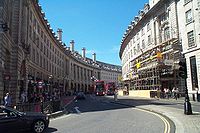 The heyday of Blomfield's practice, between 1885 and 1914, was dominated by the construction of new country houses and the renovation and extension of existing ones on the most generous scale. Notable among these works are the alteration of Chequers
, Buckinghamshire (mostly 1909-12), Heathfield Park
, Sussex (1896–1910) and Brocklesby Park, Lincolnshire (1898–1910). The completely new buildings are mostly slightly smaller but still substantial; houses such as Wittington at Medmenham
, Buckinghamshire; Caythorpe Court
, Lincolnshire; Moundsmere Manor. Hampshire; or Wretham Hall, Norfolk. Much of this work was carried out in a manner inspired by Blomfield's studies of both English and French Renaissance styles. Blomfield's fairly numerous university and commercial buildings also included a number of prestigious commissions, including the college buildings for Lady Margaret Hall, Oxford and the United Universities Club in London. He played a major part in the completion of the Quadrant in Regent Street
, London when Richard Norman Shaw
withdrew from the project. The First World War put an end to the type of building projects on which he had been engaged, and after it ended in 1919 his practice never returned to its former size. He was 65 in 1921, but continued working at a gradually decreasing pace into his late 70s, producing a large number of war memorials in the 1920s, including the Menin Gate
at Ypres
. His last major project was the reconstruction of 4 Carlton Gardens, London, in 1932.
 Blomfield had a gift for sketching and writing. His first book, Formal gardens in England, illustrated by F. Inigo Thomas, appeared in 1892. His views invoked the criticism of the gardener William Robinson
, who pursued a lengthy dispute with those architects who dared to interest themselves in gardening, especially Blomfield and John Dando Sedding. In 1897 Blomfield's first major historical work, A history of Renaissance architecture in England, 1500-1800 was published by George Bell & Sons. The architecture of the Wren period in particular appealed to him, and he came to regard it as England's finest hour, architectural speaking. This book was complemented by the appearance of a companion study, A history of French architecture, published in two volumes covering 1494-1661 (1911) and 1661-1774 (1921). Together with the work of Blomfield himself, Sir John Belcher and Mervyn Macartney, the arrival of a serious account of architectural development in the 17th and 18th centuries led not only to the preservation of many previously neglected buildings of those periods, but also increased interest in the neo-Georgian style.
His other published works include Studies in Architecture (1905); The Mistress Art (1908), Architectural Drawing and Draughtsmen (1912); The Touchstone of Architecture (1925); Six Architects (1925); Memoirs of an Architect (1932); the controversial anti-Modernist polemic, Modernismus (1934) and the sketchy Richard Norman Shaw
(1940). A further collection of autobiographical material, 1932–42, continuing his memoirs, remains unpublished and is in the possession of his descendants.
Drawings Collection has a number of his perspective drawings produced for Royal Academy
exhibitions and an incomplete collection of his sketchbooks, photographs and papers. Other documents remain in the possession of his descendants, but he disposed of the majority of his drawings during the Second World War. A bronze bust of Blomfield by Sir William Reid Dick
is in the National Portrait Gallery.

Among war memorials for which he was responsible are:
(RIBA) in 1881 and a Fellow in 1906; an Associate of the Royal Academy
in 1905 and elected to the Academy in 1914, where he had been Professor of Architecture 1907-11 and awarded the Royal Gold Medal in 1913. He was President of the RIBA in 1912-14 and was knighted in 1919.
Victorian era
The Victorian era of British history was the period of Queen Victoria's reign from 20 June 1837 until her death on 22 January 1901. It was a long period of peace, prosperity, refined sensibilities and national self-confidence...
and Edwardian period.
Early life and career
Blomfield was born at BowBow, Devon
Bow is a village and civil parish in the Mid Devon district of Devon, England, about 8 miles west of Crediton. According to the 2001 census it had a population of 1,093. There is an adjoining hamlet of Nymet Tracey which shares a church with Bow and much common history.-History:There is a 3rd...
vicarage in Devon
Devon
Devon is a large county in southwestern England. The county is sometimes referred to as Devonshire, although the term is rarely used inside the county itself as the county has never been officially "shired", it often indicates a traditional or historical context.The county shares borders with...
, where his father, the Rev. George John Blomfield (d. 1900) was curate. His mother, Isabella, was a distant cousin of his father and the second daughter of the Rt. Rev. Charles Blomfield, Bishop of London. He was brought up in Kent, where his father became rector of Dartford in 1857 and then of Aldington in 1868. He was educated at Haileybury
Haileybury and Imperial Service College
Haileybury and Imperial Service College, , is a prestigious British independent school founded in 1862. The school is located at Hertford Heath, near Hertford, from central London, on of parkland occupied until 1858 by the East India College...
school in Hertfordshire and at Exeter College
Exeter College, Oxford
Exeter College is one of the constituent colleges of the University of Oxford in England and the fourth oldest college of the University. The main entrance is on the east side of Turl Street...
, Oxford, where he took a first-class degree in classics. At Oxford, he attended John Ruskin
John Ruskin
John Ruskin was the leading English art critic of the Victorian era, also an art patron, draughtsman, watercolourist, a prominent social thinker and philanthropist. He wrote on subjects ranging from geology to architecture, myth to ornithology, literature to education, and botany to political...
's lectures, but found "the atmosphere of rapt adoration with which Ruskin and all he said was received by the young ladies... was altogether too much for me". Although he had a clear learning towards the polite arts, his family did not have the means to sustain him as a gentleman artist, and Blomfield at this date had no clear career. After Oxford, he spent a year travelling on the continent as a tutor before accepting an offer from his mother's brother, Sir Arthur Blomfield
Arthur Blomfield
Sir Arthur William Blomfield was an English architect.-Background:The fourth son of Charles James Blomfield, an Anglican Bishop of London helpfully began a programme of new church construction in the capital. Born in Fulham Palace, Arthur Blomfield was educated at Rugby and Trinity College,...
, to become an articled pupil in his London practice in the autumn of 1881. He also enrolled in the Royal Academy Schools, where R. Phene Spiers was Master of the Architectural School. He found the atmosphere in his uncle's office uncongenial and the practice's traditional Gothic Revival output hard and soulless, although he gained valuable mechanical skills at draughtsmanship and site experience. He prospered more at the Academy Schools, taking the junior prize in 1882 and the senior prize the following year, with a design for a town house in the fashionable Queen Anne Revival style, of which he was later ashamed. During his years in his uncle's office, the practice produced two uncharacteristic schemes (for work at Marlborough College
Marlborough College
Marlborough College is a British co-educational independent school for day and boarding pupils, located in Marlborough, Wiltshire.Founded in 1843 for the education of the sons of Church of England clergy, the school now accepts both boys and girls of all beliefs. Currently there are just over 800...
and Shrewsbury School
Shrewsbury School
Shrewsbury School is a co-educational independent school for pupils aged 13 to 18, founded by Royal Charter in 1552. The present campus to which the school moved in 1882 is located on the banks of the River Severn in Shrewsbury, Shropshire, England...
that appear to foreshadow Blomfield's enthusiasm for classicism, and in the design of which he was presumably involved.
Design work
At the beginning of 1884, having completed his training, he left his uncle's office and spent a further four months travelling in France and Spain before returning to London and establishing a practice at 17 Southampton Street, off the Strand, in London; E.S. Prior had an office in the same building. Through Prior, a former pupil of Richard Norman ShawRichard Norman Shaw
Richard Norman Shaw RA , was an influential Scottish architect from the 1870s to the 1900s, known for his country houses and for commercial buildings.-Life:...
, Blomfield met others of Shaw's circle, including Mervyn Macartney, Ernest Newton
Ernest Newton
Ernest Newton, FRIBA, ARA was an English architect and President of Royal Institute of British Architects.-Life:Newton was the son of an estate manager of Bickley, Kent. He was educated at Uppingham School. He married, in 1881, Antoinette Johanna Hoyack, of Rotterdam, and had three sons...
and Gerald Horsley. Although he never worked in Shaw's office, Blomfield was, like them, henceforth a great admirer of Shaw. With this ground, Blomfield was involved in the founding of the Art Workers Guild
Art Workers Guild
The Art Workers Guild or Art-Workers' Guild is an organisation established in 1884 by a group of British architects associated with the ideas of William Morris and the Arts and Crafts movement. The guild promoted the 'unity of all the arts', denying the distinction between fine and applied art...
and was at first made its Honorary Secretary, but he attended infrequently and when admonished about this, resigned in a huff. In retrospect, however, he paid tribute to these efforts to set a new direction for architecture: "I think it is due to these young men of the 80s that the arts were rescued from the paralysing conventions of the Victorian era
Victorian era
The Victorian era of British history was the period of Queen Victoria's reign from 20 June 1837 until her death on 22 January 1901. It was a long period of peace, prosperity, refined sensibilities and national self-confidence...
". In 1890, with the idea of designing and making fine furniture, Blomfield, Ernest Gimson
Ernest Gimson
Ernest William Gimson was an English furniture designer and architect. Gimson was described by the art critic Nikolaus Pevsner as "the greatest of the English architect-designers"...
, Macartney and William Lethaby
William Lethaby
William Richard Lethaby was an English architect and architectural historian whose ideas were highly influential on the late Arts and Crafts and early Modern movements in architecture, and in the fields of conservation and art education.-Early life:Lethaby was born in Barnstaple, Devon, the son of...
joined forces to establish Kenton & Co. Although the venture had the makings of a success, it lasted only two years, as the partners decided to concentrate instead on their increasingly successful architectural practices.
In 1886 Blomfield married the daughter of Henry Burra of Rye
Rye
Rye is a grass grown extensively as a grain and as a forage crop. It is a member of the wheat tribe and is closely related to barley and wheat. Rye grain is used for flour, rye bread, rye beer, some whiskeys, some vodkas, and animal fodder...
, Sussex
Sussex
Sussex , from the Old English Sūþsēaxe , is an historic county in South East England corresponding roughly in area to the ancient Kingdom of Sussex. It is bounded on the north by Surrey, east by Kent, south by the English Channel, and west by Hampshire, and is divided for local government into West...
, where he designed several houses, including his own, the very informal Point Hill, Playden
Playden
Playden is a village and civil parish in the Rother District of East Sussex, England. The village is located one mile north-west of Rye. It is mentioned in the Domesday Book; it is a largely rural parish, having no village centre, and the hamlet of Houghton Green is included in the parish...
, where his family still live. One he let to the American novelist Henry James
Henry James
Henry James, OM was an American-born writer, regarded as one of the key figures of 19th-century literary realism. He was the son of Henry James, Sr., a clergyman, and the brother of philosopher and psychologist William James and diarist Alice James....
. The same year, Blomfield and the printer T.J. Cobden Sanderson (1840–1922) built themselves a pair of pretty houses in Frognal
Frognal
Frognal is an affluent area in North West London in the London Borough of Camden between Hampstead and West Hampstead. Frognal is also the name of the major road in the area.-History:...
, Hampstead
Hampstead
Hampstead is an area of London, England, north-west of Charing Cross. Part of the London Borough of Camden in Inner London, it is known for its intellectual, liberal, artistic, musical and literary associations and for Hampstead Heath, a large, hilly expanse of parkland...
, Middlesex
Middlesex
Middlesex is one of the historic counties of England and the second smallest by area. The low-lying county contained the wealthy and politically independent City of London on its southern boundary and was dominated by it from a very early time...
; 51 Frognal remained Blomfield's London home and he died there.
Chequers
Chequers, or Chequers Court, is a country house near Ellesborough, to the south of Aylesbury in Buckinghamshire, England, at the foot of the Chiltern Hills...
, Buckinghamshire (mostly 1909-12), Heathfield Park
Heathfield Park
Heathfield Park is an English country house and walled park in the village of Old Heathfield in East Sussex. It is privately owned.Originally called Bayley Park, the mansion was begun by James Plummer in 1677 and continued by Raymond Blackmore in the early eighteenth century...
, Sussex (1896–1910) and Brocklesby Park, Lincolnshire (1898–1910). The completely new buildings are mostly slightly smaller but still substantial; houses such as Wittington at Medmenham
Medmenham
Medmenham is a village and civil parish in the Wycombe district of Buckinghamshire, England. It is on the River Thames, about three and a half miles southwest of Marlow and three miles east of Henley-on-Thames....
, Buckinghamshire; Caythorpe Court
Caythorpe Court
Caythorpe Court is a Grade II* listed former hunting lodge situated about one mile to the east of Caythorpe, Lincolnshire. It was originally built in 1901 for Edgar Lubbock, a brewer and banker, to the designs of Sir Reginald Blomfield. In 1946, it became the base for the Kesteven Agricultural...
, Lincolnshire; Moundsmere Manor. Hampshire; or Wretham Hall, Norfolk. Much of this work was carried out in a manner inspired by Blomfield's studies of both English and French Renaissance styles. Blomfield's fairly numerous university and commercial buildings also included a number of prestigious commissions, including the college buildings for Lady Margaret Hall, Oxford and the United Universities Club in London. He played a major part in the completion of the Quadrant in Regent Street
Regent Street
Regent Street is one of the major shopping streets in London's West End, well known to tourists and Londoners alike, and famous for its Christmas illuminations...
, London when Richard Norman Shaw
Richard Norman Shaw
Richard Norman Shaw RA , was an influential Scottish architect from the 1870s to the 1900s, known for his country houses and for commercial buildings.-Life:...
withdrew from the project. The First World War put an end to the type of building projects on which he had been engaged, and after it ended in 1919 his practice never returned to its former size. He was 65 in 1921, but continued working at a gradually decreasing pace into his late 70s, producing a large number of war memorials in the 1920s, including the Menin Gate
Menin Gate
The Menin Gate Memorial to the Missing is a war memorial in Ypres, Belgium dedicated to the commemoration of British and Commonwealth soldiers who were killed in the Ypres Salient of the First World War and whose graves are unknown...
at Ypres
Ypres
Ypres is a Belgian municipality located in the Flemish province of West Flanders. The municipality comprises the city of Ypres and the villages of Boezinge, Brielen, Dikkebus, Elverdinge, Hollebeke, Sint-Jan, Vlamertinge, Voormezele, Zillebeke, and Zuidschote...
. His last major project was the reconstruction of 4 Carlton Gardens, London, in 1932.
Publications
William Robinson (gardener)
William Robinson was an Irish practical gardener and journalist whose ideas about wild gardening spurred the movement that evolved into the English cottage garden, a parallel to the search for honest simplicity and vernacular style of the British Arts and Crafts movement...
, who pursued a lengthy dispute with those architects who dared to interest themselves in gardening, especially Blomfield and John Dando Sedding. In 1897 Blomfield's first major historical work, A history of Renaissance architecture in England, 1500-1800 was published by George Bell & Sons. The architecture of the Wren period in particular appealed to him, and he came to regard it as England's finest hour, architectural speaking. This book was complemented by the appearance of a companion study, A history of French architecture, published in two volumes covering 1494-1661 (1911) and 1661-1774 (1921). Together with the work of Blomfield himself, Sir John Belcher and Mervyn Macartney, the arrival of a serious account of architectural development in the 17th and 18th centuries led not only to the preservation of many previously neglected buildings of those periods, but also increased interest in the neo-Georgian style.
His other published works include Studies in Architecture (1905); The Mistress Art (1908), Architectural Drawing and Draughtsmen (1912); The Touchstone of Architecture (1925); Six Architects (1925); Memoirs of an Architect (1932); the controversial anti-Modernist polemic, Modernismus (1934) and the sketchy Richard Norman Shaw
Richard Norman Shaw
Richard Norman Shaw RA , was an influential Scottish architect from the 1870s to the 1900s, known for his country houses and for commercial buildings.-Life:...
(1940). A further collection of autobiographical material, 1932–42, continuing his memoirs, remains unpublished and is in the possession of his descendants.
Archival materials
The British Architectural LibraryRoyal Institute of British Architects
The Royal Institute of British Architects is a professional body for architects primarily in the United Kingdom, but also internationally.-History:...
Drawings Collection has a number of his perspective drawings produced for Royal Academy
Royal Academy
The Royal Academy of Arts is an art institution based in Burlington House on Piccadilly, London. The Royal Academy of Arts has a unique position in being an independent, privately funded institution led by eminent artists and architects whose purpose is to promote the creation, enjoyment and...
exhibitions and an incomplete collection of his sketchbooks, photographs and papers. Other documents remain in the possession of his descendants, but he disposed of the majority of his drawings during the Second World War. A bronze bust of Blomfield by Sir William Reid Dick
William Reid Dick
Sir William Reid, Dick was a Scottish sculptor known for his innovative stylization of form in his monument sculptures and simplicity in his portraits. He became an Associate of the Royal Academy in 1921, and a Royal Academician in 1928. Dick served as president of the Royal Society of British...
is in the National Portrait Gallery.
List of works
The following list of major works is selected from that given in R.A. Fellows, Sir Reginald Blomfield: an Edwardian architect, 1985, with additions from The Buildings of England and other sources cited in the bibliography:- Haileybury College, Hertfordshire: erection of Bradby Memorial Hall, 1886; Music School, Sports Pavilion and organ case, 1923
- BroxbourneBroxbourneBroxbourne is a commuter town in the Broxbourne borough of Hertfordshire in the East of England with a population of 13,298 in 2001.It is located 17.1 miles north north-east of Charing Cross in London and about a mile north of Wormley and south of Hoddesdon...
, Hertfordshire: erection of five houses on St Catherine's estate for J.A. Hunt, 1887 - 20 Buckingham Gate, WestminsterWestminsterWestminster is an area of central London, within the City of Westminster, England. It lies on the north bank of the River Thames, southwest of the City of London and southwest of Charing Cross...
, Middlesex: new town house in free Queen Anne style, 1887 - RyeRyeRye is a grass grown extensively as a grain and as a forage crop. It is a member of the wheat tribe and is closely related to barley and wheat. Rye grain is used for flour, rye bread, rye beer, some whiskeys, some vodkas, and animal fodder...
, Sussex: new vicarage, 1887; mission room, 1900 - Swinford Old Manor, near Ashford, Kent: restoration, 1887
- Blacknoll, Dorset: new house, 1889
- HertfordHertfordHertford is the county town of Hertfordshire, England, and is also a civil parish in the East Hertfordshire district of the county. Forming a civil parish, the 2001 census put the population of Hertford at about 24,180. Recent estimates are that it is now around 28,000...
, Hertfordshire: new covered market, public library and art school, 1889 (with W.H. Wilds) - BrooklandsBrooklandsBrooklands was a motor racing circuit and aerodrome built near Weybridge in Surrey, England. It opened in 1907, and was the world's first purpose-built motorsport venue, as well as one of Britain's first airfields...
, WeybridgeWeybridgeWeybridge is a town in the Elmbridge district of Surrey in South East England. It is bounded to the north by the River Thames at the mouth of the River Wey, from which it gets its name...
, Surrey: alterations and renovation for Arthur Brook, 1889, in free Queen Anne style - RyeRyeRye is a grass grown extensively as a grain and as a forage crop. It is a member of the wheat tribe and is closely related to barley and wheat. Rye grain is used for flour, rye bread, rye beer, some whiskeys, some vodkas, and animal fodder...
, Sussex: erection of houses in Gun Garden and Watchbell Street, 1890, 1910 - AslocktonAslocktonAslockton is a village and civil parish twelve miles east of Nottingham, England and two miles east of Bingham on the north bank of the River Smite opposite Whatton. It has a population of around 1,000 ....
, Nottinghamshire: new church, 1890–92 - Bern (Switzerland): rebuilding of St. Antonien Kapelle, 1891, in late Gothic style
- CarshaltonCarshaltonCarshalton is a suburban area of the London Borough of Sutton, England. It is located 10 miles south-southwest of Charing Cross, situated in the valley of the River Wandle, one of the sources of which is Carshalton Ponds in the centre of the village. The combined population of the five wards...
, Surrey: extension of All Saints church, 1891-1914 (with A.W. Blomfield) - Southwater, HorshamHorshamHorsham is a market town with a population of 55,657 on the upper reaches of the River Arun in the centre of the Weald, West Sussex, in the historic County of Sussex, England. The town is south south-west of London, north-west of Brighton and north-east of the county town of Chichester...
, Sussex: new house and gardens, 1891 - ChequersChequersChequers, or Chequers Court, is a country house near Ellesborough, to the south of Aylesbury in Buckinghamshire, England, at the foot of the Chiltern Hills...
Court, Buckinghamshire: restoration, alterations and gardens for Bertram Astley, 1892–1901 and Arthur LeeArthur Lee, 1st Viscount Lee of FarehamArthur Hamilton Lee, 1st Viscount Lee of Fareham, GCB, GBE, GCSI, PC was a British soldier, diplomat, politician and patron of the arts. After military postings and an assignment to the British Embassy in Washington, he entered politics and served as Minster of Agriculture and Fisheries and First...
, 1st Baron Lee of Fareham, 1909–12, in neo-Jacobean style - Frogmore Hall, Hertfordshire: alterations, 1892
- FrognalFrognalFrognal is an affluent area in North West London in the London Borough of Camden between Hampstead and West Hampstead. Frognal is also the name of the major road in the area.-History:...
, HampsteadHampsteadHampstead is an area of London, England, north-west of Charing Cross. Part of the London Borough of Camden in Inner London, it is known for its intellectual, liberal, artistic, musical and literary associations and for Hampstead Heath, a large, hilly expanse of parkland...
, Middlesex: new houses at 49-51 Frognal for himself and T.J. Cobden Sanderson, 1892 - Swiftsden, EtchinghamEtchinghamEtchingham is a village and civil parish in the Rother District in East Sussex, southern England. The village is approximately twelve miles north-west of Hastings, on the A265, half a mile west of its junction with the A21....
, Sussex: new house in neo-Georgian style, 1892 - Borrowstone Lodge, Kincardine O'NeilKincardine O'NeilKincardine O'Neil is one of the oldest villages in Deeside, in the northeast of Scotland. It is situated between Banchory and Aboyne. The village is known locally as Kinker, and was formerly known as Eaglais Iarach in Gaelic....
, Aberdeenshire: new house, 1893 - Queen Anne's SchoolQueen Anne's SchoolQueen Anne's School in Caversham, Berkshire is an independent boarding and day school for girls aged 11 to 18, situated just north of the River Thames and Reading town centre and occupying a campus.There are around 330 pupils. Nearly half are boarders...
, CavershamCaversham, BerkshireCaversham is a suburb and former village in the unitary authority of Reading, England. It lies on the north bank of the River Thames, within the royal county of Berkshire, on the opposite bank from the rest of Reading...
, Oxfordshire: chapel, 1893 - St. George, Hanover Square, London: new fittings, circa 1894
- Warley Lodge, Essex: new gardens, 1894
- Mystole House. CharthamCharthamChartham is a village and civil parish in Kent, west of Canterbury.It is located on the Great Stour river which provided power for the paper mills up until some point before 1955. The name literally means ‘Village on rough ground’, and the word "Chart" is also found in other villages in Kent with...
, Kent: alterations and additions, 1895, in neo-Georgian style - Godinton Park, Kent: alterations, 1895, 1924 and new garden, circa 1902
- Greycoat Place, London: warehouse for Army and Navy Stores, 1895
- Limpsfield ChartLimpsfield ChartLimpsfield Chart is a village near to Oxted in Surrey, just south of the A25.The High Chart to the east of Limpsfield is a large area of woodland owned by the National Trust and has a large network of footpaths. Within this area is the small settlement of Limpsfield Chart...
, Surrey: St. Andrew's Church, 1895, in Arts & Crafts style - Point Hill, PlaydenPlaydenPlayden is a village and civil parish in the Rother District of East Sussex, England. The village is located one mile north-west of Rye. It is mentioned in the Domesday Book; it is a largely rural parish, having no village centre, and the hamlet of Houghton Green is included in the parish...
, Sussex: expansion of cottage into new house for himself, 1895–1912 - Cowley House, Middlesex: addition and alterations, 1896
- Heathfield ParkHeathfield ParkHeathfield Park is an English country house and walled park in the village of Old Heathfield in East Sussex. It is privately owned.Originally called Bayley Park, the mansion was begun by James Plummer in 1677 and continued by Raymond Blackmore in the early eighteenth century...
, Sussex: alterations and additions for W.C. Alexander, 1896–1910, in neo-Georgian style - Lady Margaret Hall, Oxford: college buildings, 1896–1915
- St Edmund's SchoolSt Edmund's SchoolSt Edmund’s School is an independent school in Canterbury, Kent, England, U.K. with over 500 pupils, including both day pupils and boarders.-History:...
, CanterburyCanterburyCanterbury is a historic English cathedral city, which lies at the heart of the City of Canterbury, a district of Kent in South East England. It lies on the River Stour....
, Kent: headmaster's house, 1897 - Hillside SchoolHillside SchoolHillside School may refer to:United States:*Hillside Elementary School, in Berkeley, California* Hillside High School in Upland, California* Hillside High School in Durham, North Carolina...
, GodalmingGodalmingGodalming is a town and civil parish in the Waverley district of the county of Surrey, England, south of Guildford. It is built on the banks of the River Wey and is a prosperous part of the London commuter belt. Godalming shares a three-way twinning arrangement with the towns of Joigny in France...
, Surrey: school buildings and house, 1897 - Wittington, MedmenhamMedmenhamMedmenham is a village and civil parish in the Wycombe district of Buckinghamshire, England. It is on the River Thames, about three and a half miles southwest of Marlow and three miles east of Henley-on-Thames....
, Buckinghamshire: house, gardens and lodge for Hudson Kearley, 1st Lord Devonport, 1897–1904, and enlargement, 1909; in Wrenaissance style - Mellerstain, Roxburghshire: restoration and gardens for Lord Binning, 1898–1910
- Brocklesby Park, Lincolnshire: reconstruction and new gardens for Earl of Yarborough, 1898–1910 in Wrenaissance style
- Caythorpe CourtCaythorpe CourtCaythorpe Court is a Grade II* listed former hunting lodge situated about one mile to the east of Caythorpe, Lincolnshire. It was originally built in 1901 for Edgar Lubbock, a brewer and banker, to the designs of Sir Reginald Blomfield. In 1946, it became the base for the Kesteven Agricultural...
, Lincolnshire: new house and gardens for Edgar LubbockEdgar LubbockEdgar Lubbock LLB was an English amateur footballer who twice won the FA Cup, and later became a partner in the Whitbread Brewery, a Director of the Bank of England and the Master of the Blankney Foxhounds....
, brewer and banker, 1899–1903, in neo-Jacobean style - Effordleigh House, near Plymouth, Devonshire: new house, 1899
- Drakelow Hall, Derbyshire: restoration and gardens for Gresley family, 1900–06
- West Broyle, ChichesterChichesterChichester is a cathedral city in West Sussex, within the historic County of Sussex, South-East England. It has a long history as a settlement; its Roman past and its subsequent importance in Anglo-Saxon times are only its beginnings...
, Sussex: new house, 1901 - Yockley, FrimleyFrimleyFrimley is a small English town situated 2 miles south of Camberley, in the extreme west of Surrey, adjacent to the border with Hampshire. It is about 31 miles west south-west of Central London. It is part of the Borough of Surrey Heath...
, Surrey: new house and gardens for Charles Furse ARA, 1901-02 in neo-Georgian style; additional wing, 1910 - Murraythwaite, Dumfriesshire: new house, 1901
- Blundell's SchoolBlundell's SchoolBlundell's School is a co-educational day and boarding independent school located in the town of Tiverton in the county of Devon, England. The school was founded in 1604 by the will of Peter Blundell, one of the richest men in England at the time, and relocated to its present location on the...
, Tiverton, Devonshire: additions, 1901 - Heywood Manor, BoldreBoldreBoldre is a village and civil parish in the New Forest district of Hampshire. It is situated inside the New Forest National Park borders, near the Lymington River, and is about two miles north of Lymington...
, Hampshire: new house and gardens, 1902 - Euston HallEuston HallEuston Hall is a country house, with park by William Kent and Capability Brown located in Euston, small village located just south of Thetford in Suffolk, England. It is the family home of the Dukes of Grafton....
, Suffolk: new gardens for Duke of GraftonDuke of GraftonDuke of Grafton is a title in the Peerage of England. It was created in 1675 by Charles II of England for his 2nd illegitimate son by the Duchess of Cleveland, Henry FitzRoy...
, 1902 - Hatchlands, Surrey: new Music Room, 1902–03, in Wrenaissance style
- Sherborne School for GirlsSherborne School For GirlsSherborne Girls is an independent day and boarding school for girls located in Sherborne, North Dorset. The school was founded in 1895 by Mr. and Mrs. Kenelm Wingfield Digby...
, Dorset: new buildings, 1902–26, in neo-Tudor style - Gogmagog Hall, Cambridgeshire: alterations, 1903
- Ballard's Court, GoudhurstGoudhurstGoudhurst is a village in Kent on the Weald, about south of Maidstone.It stands on a crossroads , where there is a large village pond. It is also in the Cranbrook School catchment area....
, Kent: new house, 1903 - Leasam House, PlaydenPlaydenPlayden is a village and civil parish in the Rother District of East Sussex, England. The village is located one mile north-west of Rye. It is mentioned in the Domesday Book; it is a largely rural parish, having no village centre, and the hamlet of Houghton Green is included in the parish...
, Sussex: alterations and new gardens, 1903 - MedmenhamMedmenhamMedmenham is a village and civil parish in the Wycombe district of Buckinghamshire, England. It is on the River Thames, about three and a half miles southwest of Marlow and three miles east of Henley-on-Thames....
Manor House, Buckinghamshire: restoration for Hudson Kearley, 1903 - Apethorpe HallApethorpe HallApethorpe Hall in Apethorpe, Northamptonshire, England is a Grade I listed country house, dating back to the 15th century.The house is built around three courtyards lying on an east-west axis and is approximately by in area...
, Northamptonshire: alterations and additions, and new gardens, for Leonard Brassey, 1st Baron Brassey, 1904 - Knowlton CourtKnowlton CourtKnowlton Court is a country estate in Kent, England, with a Grade I listed manor house that dates back to the Elizabethan period.-Early history:...
, Kent: alterations and new gardens for Major Elmer Speed, 1904 - Merchant Taylors' Hall, LondonMerchant Taylors' Hall, LondonThe Merchant Taylors' Hall, London is the seat of the Worshipful Company of Merchant Taylors, one of the Twelve Great Livery Companies of the City of London surviving from Mediaeval times....
: alterations, 1904, 1926 - Saltcote Place, RyeRyeRye is a grass grown extensively as a grain and as a forage crop. It is a member of the wheat tribe and is closely related to barley and wheat. Rye grain is used for flour, rye bread, rye beer, some whiskeys, some vodkas, and animal fodder...
, Sussex: new house for Mr Hennessy, 1905 - Kenfield Hall, Kent: additions and alterations, 1906–09
- Oxford & Cambridge Club, Pall Mall, LondonPall Mall, LondonPall Mall is a street in the City of Westminster, London, and parallel to The Mall, from St. James's Street across Waterloo Place to the Haymarket; while Pall Mall East continues into Trafalgar Square. The street is a major thoroughfare in the St James's area of London, and a section of the...
: alterations, including new staircase, 1906–12 - United University ClubUnited University ClubThe United University Club was a London gentlemen's club, founded in 1821. It occupied the purpose-built University Club House, at 1, Suffolk Street, London, England, from 1826 until 1971.-Formation and membership:...
, Suffolk St., London: new building, 1906; extensions, 1924, 1938 - Wyphurst, CranleighCranleighCranleigh is a large village, self-proclaimed the largest in England, and is situated 8 miles south east of Godalming in Surrey. It lies to the east of the A281 which links Guildford with Horsham; neighbouring villages include: Ewhurst, Alfold and Hascombe....
, Surrey: additions for C.E.H. Chadwyck-Healey, 1907, in neo-Tudor style - Garnons, Herefordshire: alterations, 1907, in neo-Georgian style
- IckworthIckworthIckworth is a small village and civil parish in the St Edmundsbury district of Suffolk in eastern England. Located on the A143 around a mile and a half south-west of Bury St Edmunds, in 2005 its population was 30....
, Suffolk: remodelling of entrance hall for 4th Marquess of BristolMarquess of BristolMarquess of Bristol is a title in the Peerage of the United Kingdom held by the Hervey family since 1826. The Marquess's subsidiary titles are: Earl of Bristol , Earl Jermyn, of Horningsheath in the County of Suffolk , and Baron Hervey, of Ickworth in the County of Suffolk...
, 1907 - Hill House, Shenley, Hertfordshire: new gardens for S. de la Rue, 1907
- Milner Court, SturrySturrySturry is a village on the Great Stour river three miles north-east of Canterbury in Kent. The large parish of Sturry Church incorporates the former mining village of Hersden and several hamlets.-Geography:...
, Kent: additions and new gardens, 1907 - Moundsmere Manor, Hampshire: new house and gardens for Wilfred Buckley, 1908-09 in neo-Georgian style
- RoehamptonRoehamptonRoehampton is a district in south-west London, forming the western end of the London Borough of Wandsworth. It lies between the town of Barnes to the north, Putney to the east and Wimbledon Common to the south. The Richmond Park golf courses are west of the neighbourhood, and just south of these is...
, Surrey: new archive repository for Bank of EnglandBank of EnglandThe Bank of England is the central bank of the United Kingdom and the model on which most modern central banks have been based. Established in 1694, it is the second oldest central bank in the world...
, 1908–10 - Hill Hall, Essex: alterations and additions for Mrs Charles Hunter, 1909
- Sherborne SchoolSherborne SchoolSherborne School is a British independent school for boys, located in the town of Sherborne in north-west Dorset, England. It is one of the original member schools of the Headmasters' and Headmistresses' Conference....
, Dorset: Carrington Building, 1909–10; Great Court, 1913–23; Gymnasium and Music School, 1926 - Manoir de la Trinité, Jersey: remodelling for Athelstan RileyAthelstan RileyJohn Athelstan Laurie Riley was an English hymn writer and hymn translator.Riley was born in Paddington, London, and attended Pembroke College, Oxford although left without obtaining a degree. Active in the Anglo-Catholic wing of the Church of England, he energised the development of the English...
, 1909–12 - Sandhouse, WitleyWitleyWitley, in Surrey, England is a village south west of Godalming. The village lies just east of the A3 that runs from Guildford to Petersfield. Witley together with the neighbouring area of Hambledon have a population of about 4,000. Neighbouring villages include Milford, Chiddingfold and...
, Surrey: new house, circa 1909-11 - New Public Library, Lincoln, LincolnshireLincoln, LincolnshireLincoln is a cathedral city and county town of Lincolnshire, England.The non-metropolitan district of Lincoln has a population of 85,595; the 2001 census gave the entire area of Lincoln a population of 120,779....
, 1910–14, in Wrenaissance style - Westgate Water Tower, Lincoln, LincolnshireLincoln, LincolnshireLincoln is a cathedral city and county town of Lincolnshire, England.The non-metropolitan district of Lincoln has a population of 85,595; the 2001 census gave the entire area of Lincoln a population of 120,779....
, 1910 - 20 Upper Grosvenor Street, London: alterations and redecoration, 1910
- Regent StreetRegent StreetRegent Street is one of the major shopping streets in London's West End, well known to tourists and Londoners alike, and famous for its Christmas illuminations...
/PiccadillyPiccadillyPiccadilly is a major street in central London, running from Hyde Park Corner in the west to Piccadilly Circus in the east. It is completely within the city of Westminster. The street is part of the A4 road, London's second most important western artery. St...
, London: redevelopment of The Quadrant with new shops and stores, 1910–26 - Lockleys, WelwynWelwynWelwyn is a village and civil parish in Hertfordshire, England. The parish also includes the villages of Digswell and Oaklands. It is sometimes called Old Welwyn to distinguish it from the newer settlement of Welwyn Garden City, about a mile to the south.-History:Situated in the valley of the...
, Hertfordshire: alterations, additions and gardens, 1911 - Whiteley VillageWhiteley VillageWhiteley Village, in Hersham, Surrey, England, provides homes for needy elderly people. It was formed as the result of a bequest of £1,000,000 in 1907 upon the death, by murder, of William Whiteley...
, Surrey: new houses in North Avenue, 1911 - The Lordship, Much HadhamMuch HadhamMuch Hadham is a village and civil parish in the district of East Hertfordshire, Hertfordshire, England, formerly known as Great Hadham. It is situated on the B1004 road, midway between Ware and Bishop's Stortford...
, Hertfordshire: additions, 1912 - Wretham Hall, Norfolk: new house and gardens for Sir Saxton Noble, 1912–13, in Wrenaissance style
- Netherseal Hall, Derbyshire: restoration, 1914
- Kinnaird House, Pall Mall, LondonPall Mall, LondonPall Mall is a street in the City of Westminster, London, and parallel to The Mall, from St. James's Street across Waterloo Place to the Haymarket; while Pall Mall East continues into Trafalgar Square. The street is a major thoroughfare in the St James's area of London, and a section of the...
: new building, 1915 (with A.J. Driver) - Penn House, Buckinghamshire: alterations, 1918
- Brodick CastleBrodick CastleBrodick Castle is a castle situated outside the port of Brodick on the Isle of Arran, an island in the Firth of Clyde, Scotland. It was previously a seat of the Dukes of Hamilton, but is now owned by the National Trust for Scotland.-Early and High Mediæval:...
, Arran: restoration and new gardens, 1919 - Harefield Place, Middlesex: alterations, 1920, 1934
- Carlton ClubCarlton ClubThe Carlton Club is a gentlemen's club in London which describes itself as the "oldest, most elite, and most important of all Conservative clubs." Membership of the club is by nomination and election only.-History:...
, Pall Mall, LondonPall Mall, LondonPall Mall is a street in the City of Westminster, London, and parallel to The Mall, from St. James's Street across Waterloo Place to the Haymarket; while Pall Mall East continues into Trafalgar Square. The street is a major thoroughfare in the St James's area of London, and a section of the...
: extension, 1920 (destroyed in Second World War: not the current premises in St James's Street) - Sulgrave Manor, Northamptonshire: additions and restoration, 1921
- Halstead Hall, Lincolnshire: restoration, 1922
- Barkers Department Store, KensingtonKensingtonKensington is a district of west and central London, England within the Royal Borough of Kensington and Chelsea. An affluent and densely-populated area, its commercial heart is Kensington High Street, and it contains the well-known museum district of South Kensington.To the north, Kensington is...
, Middlesex: new department store, 1924 - The HeadrowThe HeadrowThe Headrow is an avenue in Leeds city centre, West Yorkshire, England. It holds many of the city's premier shopping, civic and cultural attractions including Leeds Town Hall, Leeds Central Library, Leeds Art Gallery, The Henry Moore Institute and The Light...
, LeedsLeedsLeeds is a city and metropolitan borough in West Yorkshire, England. In 2001 Leeds' main urban subdivision had a population of 443,247, while the entire city has a population of 798,800 , making it the 30th-most populous city in the European Union.Leeds is the cultural, financial and commercial...
, Yorkshire: layout of new street with shops, offices and banks, 1924-37 (with other architects) - Lambeth BridgeLambeth BridgeLambeth Bridge is a road traffic and footbridge crossing the River Thames in an east-west direction in central London, England; the river flows north at the crossing point...
, London: new bridge, 1929–32 - YpresYpresYpres is a Belgian municipality located in the Flemish province of West Flanders. The municipality comprises the city of Ypres and the villages of Boezinge, Brielen, Dikkebus, Elverdinge, Hollebeke, Sint-Jan, Vlamertinge, Voormezele, Zillebeke, and Zuidschote...
(Belgium): new British School building, 1925 - Stowe SchoolStowe SchoolStowe School is an independent school in Stowe, Buckinghamshire. It was founded on 11 May 1923 by J. F. Roxburgh, initially with 99 male pupils. It is a member of the Rugby Group and Headmasters' and Headmistresses' Conference. The school is also a member of the G20 Schools Group...
, Buckinghamshire: development plan, 1926 - Usher Art Gallery, Lincoln, LincolnshireLincoln, LincolnshireLincoln is a cathedral city and county town of Lincolnshire, England.The non-metropolitan district of Lincoln has a population of 85,595; the 2001 census gave the entire area of Lincoln a population of 120,779....
: new building, 1926–27 - Chantry Bridge, RotherhamRotherhamRotherham is a town in South Yorkshire, England. It lies on the River Don, at its confluence with the River Rother, between Sheffield and Doncaster. Rotherham, at from Sheffield City Centre, is surrounded by several smaller settlements, which together form the wider Metropolitan Borough of...
, Yorkshire: reconstruction, 1927 - CrockerhillCrockerhill, West SussexCrockerhill is a hamlet on the A27 road between Tangmere and Fontwell in West Sussex, England. It has one public house....
, Sussex: alterations, 1929 - County Hall, LewesLewesLewes is the county town of East Sussex, England and historically of all of Sussex. It is a civil parish and is the centre of the Lewes local government district. The settlement has a history as a bridging point and as a market town, and today as a communications hub and tourist-oriented town...
, Sussex: rebuilding, 1928–30 - Middlesex HospitalMiddlesex HospitalThe Middlesex Hospital was a teaching hospital located in the Fitzrovia area of London, United Kingdom. First opened in 1745 on Windmill Street, it was moved in 1757 to Mortimer Street where it remained until it was finally closed in 2005. Its staff and services were transferred to various sites...
, London: new facade, 1930 - 4 Carlton Gardens, London: new offices, 1932 (part of a scheme for the total redevelopment of Carlton House TerraceCarlton House TerraceCarlton House Terrace refers to a street in the St. James's district of the City of Westminster in London, England, and in particular to two terraces of white stucco-faced houses on the south side of the street overlooking St. James's Park. These terraces were built in 1827–32 to overall designs by...
Among war memorials for which he was responsible are:
- Brandhoek Military Commonwealth War Graves Commission CemeteryBrandhoek Military Commonwealth War Graves Commission CemeteryBrandhoek Military Cemetery is a Commonwealth War Graves Commission burial ground for the dead of the First World War located near Ypres in Belgium on the Western Front....
, IeperYpresYpres is a Belgian municipality located in the Flemish province of West Flanders. The municipality comprises the city of Ypres and the villages of Boezinge, Brielen, Dikkebus, Elverdinge, Hollebeke, Sint-Jan, Vlamertinge, Voormezele, Zillebeke, and Zuidschote...
, West Flanders, BelgiumBelgiumBelgium , officially the Kingdom of Belgium, is a federal state in Western Europe. It is a founding member of the European Union and hosts the EU's headquarters, and those of several other major international organisations such as NATO.Belgium is also a member of, or affiliated to, many...
, 1915. - Belgian War Memorial, Victoria EmbankmentVictoria EmbankmentThe Victoria Embankment is part of the Thames Embankment, a road and river walk along the north bank of the River Thames in London. Victoria Embankment extends from the City of Westminster into the City of London.-Construction:...
, London, 1917, with Belgian sculptor Victor RousseauVictor RousseauVictor Rousseau was a Belgian sculptor and medalist.- Life :Rousseau was of Walloon heritage and descended from a line of stonemasons. He began carving stone at age 11, working at the site of the Law Courts of Brussels, designed by architect Joseph Poelaert... - Hertfordshire Regiment Memorial, Hertford, 1921
- YpresYpresYpres is a Belgian municipality located in the Flemish province of West Flanders. The municipality comprises the city of Ypres and the villages of Boezinge, Brielen, Dikkebus, Elverdinge, Hollebeke, Sint-Jan, Vlamertinge, Voormezele, Zillebeke, and Zuidschote...
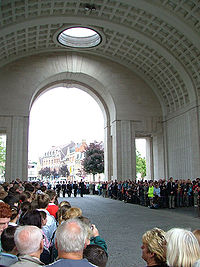
(Belgium): Menin GateMenin GateThe Menin Gate Memorial to the Missing is a war memorial in Ypres, Belgium dedicated to the commemoration of British and Commonwealth soldiers who were killed in the Ypres Salient of the First World War and whose graves are unknown...
, 1922 and Saint George's Memorial ChurchSaint George's Memorial Church, YpresSaint George's Memorial Church, Ypres, Belgium, was built to commemorate over 500,000 British and Commonwealth troops, who had died in the three battles fought for the Ypres Salient, during World War I....
, 1928 - The Royal Air Force MemorialRoyal Air Force MemorialThe Royal Air Force Memorial is a 1923 military memorial on the Victoria Embankment in central London, dedicated to the memory of the casualties of the Royal Air Force in World War I...
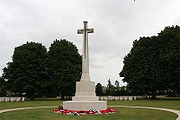
in London, 1923. - The Cross of SacrificeCross of SacrificeThe Cross of Sacrifice was designed by Sir Reginald Blomfield for the Imperial War Graves Commission and is usually present in Commonwealth war cemeteries containing 40 or more graves. It is normally a freestanding four point limestone Latin cross in one of three sizes ranging in height from 18 to...
or War Cross, for the Imperial War Graves Commission. These are in Commonwealth cemeteries in many countries.
Awards and honours
Blomfield was made an Associate of the Royal Institute of British ArchitectsRoyal Institute of British Architects
The Royal Institute of British Architects is a professional body for architects primarily in the United Kingdom, but also internationally.-History:...
(RIBA) in 1881 and a Fellow in 1906; an Associate of the Royal Academy
Royal Academy
The Royal Academy of Arts is an art institution based in Burlington House on Piccadilly, London. The Royal Academy of Arts has a unique position in being an independent, privately funded institution led by eminent artists and architects whose purpose is to promote the creation, enjoyment and...
in 1905 and elected to the Academy in 1914, where he had been Professor of Architecture 1907-11 and awarded the Royal Gold Medal in 1913. He was President of the RIBA in 1912-14 and was knighted in 1919.