

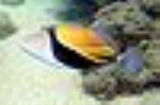
Reef triggerfish

Encyclopedia
The reef, rectangular, or wedge-tail triggerfish, also known by its Hawaiian
name, humuhumunukunukuāpuaa (ˈhumuˈhumuˈnukuˈnukuˈwaːpuˈwɐʔə), also spelled Humuhumunukunukuapua'a or just humuhumu for short; meaning "triggerfish with a snout like a pig"), is one of several species
of triggerfish
. Classified as Rhinecanthus rectangulus, it is endemic to the salt water
coasts of various central and south Pacific Ocean
islands. It is often asserted that the Hawaiian name is one of the longest words in the Hawaiian language and that "the name is longer than the fish."
One particularly interesting aspect of the fish's behavior is the ability to blow jets of water from its mouth. These jets help the fish find benthic invertebrates that may be buried under the substrate. Triggerfish can often be seen spitting sand from their mouths in order to sift through the material in search of edible detritus or organisms. Reef triggers are fairly aggressive and will generally not tolerate conspecific species in its general vicinity, thus the fish is often found solitary. This is particularly true in captivity. Triggers have the remarkable ability to rapidly alter their coloration. They can fade into a relatively drab appearance when sleeping or demonstrating submission while the coloration is often the most vivid when the fish is healthy and unthreatened by its surrounding.
region, and it is especially prominent in the coral reef
s of the Hawaiian Islands
.
 The reef triggerfish was originally designated the official fish of Hawaii in 1985, but due to an expiration of a Hawaiian state law after five years, it ceased to be the state fish of in 1990. On April 17, 2006, bill HB1982 was presented to the Governor of Hawaii
which permanently reinstated the reef triggerfish (humuhumunukunukuapuaa) as the state fish of Hawaii. The bill passed into law on May 2, 2006 and was effective upon its approval.
The 1933 popular song "My Little Grass Shack in Kealakekua, Hawaii
" included the Hawaiian name in its refrain, and a song of this title was included in the film High School Musical 2.
The fish's name was also included in a scene from the movie Forgetting Sarah Marshall
, although pronounced slightly wrong by the actor.
Humuhumunukunukuapuaa means "triggerfish with a pig-like short snout". It is not, as often claimed, the longest fish name in Hawaiian; that distinction belongs to lauwiliwilinukunukuoioi ("long-snouted fish shaped like a wiliwili
leaf"), the butterflyfish
Forcipiger longirostris
.
Hawaiian language
The Hawaiian language is a Polynesian language that takes its name from Hawaii, the largest island in the tropical North Pacific archipelago where it developed. Hawaiian, along with English, is an official language of the state of Hawaii...
name, humuhumunukunukuāpuaa (ˈhumuˈhumuˈnukuˈnukuˈwaːpuˈwɐʔə), also spelled Humuhumunukunukuapua'a or just humuhumu for short; meaning "triggerfish with a snout like a pig"), is one of several species
Species
In biology, a species is one of the basic units of biological classification and a taxonomic rank. A species is often defined as a group of organisms capable of interbreeding and producing fertile offspring. While in many cases this definition is adequate, more precise or differing measures are...
of triggerfish
Triggerfish
Triggerfishes are about 40 species of often brightly colored fishes of the family Balistidae. Often marked by lines and spots, they inhabit tropical and subtropical oceans throughout the world, with the greatest species richness in the Indo-Pacific...
. Classified as Rhinecanthus rectangulus, it is endemic to the salt water
Seawater
Seawater is water from a sea or ocean. On average, seawater in the world's oceans has a salinity of about 3.5% . This means that every kilogram of seawater has approximately of dissolved salts . The average density of seawater at the ocean surface is 1.025 g/ml...
coasts of various central and south Pacific Ocean
Pacific Ocean
The Pacific Ocean is the largest of the Earth's oceanic divisions. It extends from the Arctic in the north to the Southern Ocean in the south, bounded by Asia and Australia in the west, and the Americas in the east.At 165.2 million square kilometres in area, this largest division of the World...
islands. It is often asserted that the Hawaiian name is one of the longest words in the Hawaiian language and that "the name is longer than the fish."
Description
The triggerfish's teeth are blue and they are set close together inside its relatively chubby mouth (like demir), it has a small second spine, which it can use to lock its main spine into an upright position. The triggerfish can wedge itself into small crevices and lock its spine to make it extremely difficult to get out. In addition, when fleeing from predators, the triggerfish will sometimes make grunting noises, possibly a call to warn other nearby triggerfish of danger at hand.One particularly interesting aspect of the fish's behavior is the ability to blow jets of water from its mouth. These jets help the fish find benthic invertebrates that may be buried under the substrate. Triggerfish can often be seen spitting sand from their mouths in order to sift through the material in search of edible detritus or organisms. Reef triggers are fairly aggressive and will generally not tolerate conspecific species in its general vicinity, thus the fish is often found solitary. This is particularly true in captivity. Triggers have the remarkable ability to rapidly alter their coloration. They can fade into a relatively drab appearance when sleeping or demonstrating submission while the coloration is often the most vivid when the fish is healthy and unthreatened by its surrounding.
Distribution
The reef triggerfish is distributed throughout the Indo-PacificIndo-Pacific
The Indo-Pacific is a biogeographic region of the Earth's seas, comprising the tropical waters of the Indian Ocean, the western and central Pacific Ocean, and the seas connecting the two in the general area of Indonesia...
region, and it is especially prominent in the coral reef
Coral reef
Coral reefs are underwater structures made from calcium carbonate secreted by corals. Coral reefs are colonies of tiny living animals found in marine waters that contain few nutrients. Most coral reefs are built from stony corals, which in turn consist of polyps that cluster in groups. The polyps...
s of the Hawaiian Islands
Hawaiian Islands
The Hawaiian Islands are an archipelago of eight major islands, several atolls, numerous smaller islets, and undersea seamounts in the North Pacific Ocean, extending some 1,500 miles from the island of Hawaii in the south to northernmost Kure Atoll...
.
Hawaii state fish
Governor of Hawaii
The Governor of Hawaii is the chief executive of the state of Hawaii and its various agencies and departments, as provided in the Hawaii State Constitution Article V, Sections 1 through 6. It is a directly elected position, votes being cast by popular suffrage of residents of the state...
which permanently reinstated the reef triggerfish (humuhumunukunukuapuaa) as the state fish of Hawaii. The bill passed into law on May 2, 2006 and was effective upon its approval.
The 1933 popular song "My Little Grass Shack in Kealakekua, Hawaii
My Little Grass Shack in Kealakekua, Hawaii
My Little Grass Shack in Kealakekua, Hawaii was a popular song written for the July 4th canoe races in Kona in 1933. Tommy Harrison gave the song to Johnny Noble to publish, who revised the music to give it a new melody without changing Bill Cogswell's words. Once published, the song became a major...
" included the Hawaiian name in its refrain, and a song of this title was included in the film High School Musical 2.
The fish's name was also included in a scene from the movie Forgetting Sarah Marshall
Forgetting Sarah Marshall
Forgetting Sarah Marshall is a 2008 American romantic comedy film directed by Nicholas Stoller and starring Jason Segel, Kristen Bell, Mila Kunis and Russell Brand...
, although pronounced slightly wrong by the actor.
Humuhumunukunukuapuaa means "triggerfish with a pig-like short snout". It is not, as often claimed, the longest fish name in Hawaiian; that distinction belongs to lauwiliwilinukunukuoioi ("long-snouted fish shaped like a wiliwili
Wiliwili
Wiliwili is a species of flowering tree in the pea family, Fabaceae that is endemic to the Hawaiian Islands. It is the only species of Erythrina that naturally occurs there. It is typically found in dry forests on leeward island slopes up to an elevation of .Wiliwili is occasionally seen in...
leaf"), the butterflyfish
Butterflyfish
The butterflyfish are a group of conspicuous tropical marine fish of the family Chaetodontidae; the bannerfish and coralfish are also included in this group. Found mostly on the reefs of the Atlantic, Indian and Pacific Oceans, there are approximately 120 species in 10 genera...
Forcipiger longirostris
Forcipiger longirostris
Forcipiger longirostris, commonly known as the Longnose Butterflyfish or Big Longnose Butterflyfish, is a species of butterflyfish found on coral reefs throughout the southern and western Pacific Ocean, as well as in portions of the Indian Ocean. It is easily confused with its more common cousin F....
.