


Red River ox cart

Encyclopedia
.jpg)
Cart
A cart is a vehicle designed for transport, using two wheels and normally pulled by one or a pair of draught animals. A handcart is pulled or pushed by one or more people...
made entirely of non-metallic materials. Often drawn by oxen, though also by horse
Horse
The horse is one of two extant subspecies of Equus ferus, or the wild horse. It is a single-hooved mammal belonging to the taxonomic family Equidae. The horse has evolved over the past 45 to 55 million years from a small multi-toed creature into the large, single-toed animal of today...
s or mule
Mule
A mule is the offspring of a male donkey and a female horse. Horses and donkeys are different species, with different numbers of chromosomes. Of the two F1 hybrids between these two species, a mule is easier to obtain than a hinny...
s, these carts were used throughout most of the 19th century in the fur trade
Fur trade
The fur trade is a worldwide industry dealing in the acquisition and sale of animal fur. Since the establishment of world market for in the early modern period furs of boreal, polar and cold temperate mammalian animals have been the most valued...
and in westward expansion in Canada
Canada
Canada is a North American country consisting of ten provinces and three territories. Located in the northern part of the continent, it extends from the Atlantic Ocean in the east to the Pacific Ocean in the west, and northward into the Arctic Ocean...
and the United States
United States
The United States of America is a federal constitutional republic comprising fifty states and a federal district...
, in the area of the Red River
Red River of the North
The Red River is a North American river. Originating at the confluence of the Bois de Sioux and Otter Tail rivers in the United States, it flows northward through the Red River Valley and forms the border between the U.S. states of Minnesota and North Dakota before continuing into Manitoba, Canada...
and on the plains west of the Selkirk Settlement. The cart was a simple conveyance developed by Métis
Métis people (Canada)
The Métis are one of the Aboriginal peoples in Canada who trace their descent to mixed First Nations parentage. The term was historically a catch-all describing the offspring of any such union, but within generations the culture syncretised into what is today a distinct aboriginal group, with...
for use in their settlement on the Red River
Red River of the North
The Red River is a North American river. Originating at the confluence of the Bois de Sioux and Otter Tail rivers in the United States, it flows northward through the Red River Valley and forms the border between the U.S. states of Minnesota and North Dakota before continuing into Manitoba, Canada...
in what later became Manitoba
Manitoba
Manitoba is a Canadian prairie province with an area of . The province has over 110,000 lakes and has a largely continental climate because of its flat topography. Agriculture, mostly concentrated in the fertile southern and western parts of the province, is vital to the province's economy; other...
.
Description
North West Company
The North West Company was a fur trading business headquartered in Montreal from 1779 to 1821. It competed with increasing success against the Hudson's Bay Company in what was to become Western Canada...
fur-trader Alexander Henry (the younger)
Alexander Henry (the younger)
Alexander Henry was a Canadian fur trader and explorer employed by the North West Company. He is well known for his extensive journals which he started in 1799. They contain an excellent record from the early 19th century of the fur trade. Alexander travelled and traded extensively from Lake...
, the carts made their first appearance in 1801 at Fort Pembina
Pembina, North Dakota
Pembina is a city in Pembina County, North Dakota in the United States. The population was 592 at the 2010 census.The area of Pembina was long inhabited by various indigenous peoples...
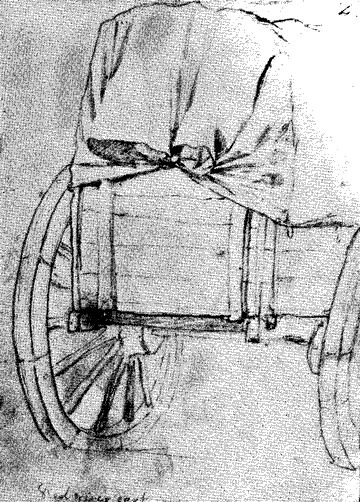
, just south of what is now the United States border. Derived either from the two-wheeled charettes used in French Canada or from Scottish carts, it was adapted to use only local materials.
Because nail
Nail (engineering)
In woodworking and construction, a nail is a pin-shaped, sharp object of hard metal or alloy used as a fastener. Formerly wrought iron, today's nails are typically made of steel, often dipped or coated to prevent corrosion in harsh conditions or improve adhesion...
s were unavailable or very expensive in the early west, these carts contained no iron at all, being entirely constructed of wood and animal hide. Two 12 feet (3.7 m) parallel oak shafts or "trams" bracketed the draft animal in front and formed the frame of the cart to the rear. Cross-pieces held the floorboards, and front, side and rear boards or rails enclosed the box. These wooden pieces were joined by mortices and tenons
Mortise and tenon
The mortise and tenon joint has been used for thousands of years by woodworkers around the world to join pieces of wood, mainly when the adjoining pieces connect at an angle of 90°. In its basic form it is both simple and strong. Although there are many joint variations, the basic mortise and tenon...
. Also of seasoned oak was the axle, lashed to the cart by strips of bison
American Bison
The American bison , also commonly known as the American buffalo, is a North American species of bison that once roamed the grasslands of North America in massive herds...
hide or "shaganappi" attached when wet which shrunk and tightened as they dried. The axles connected two spoked wheels, five or six feet in diameter, which were "dished" or in the form of a shallow cone, the apex of which was at the hub.
Motive power for the carts was originally supplied by small horses obtained from the First Nations
First Nations
First Nations is a term that collectively refers to various Aboriginal peoples in Canada who are neither Inuit nor Métis. There are currently over 630 recognised First Nations governments or bands spread across Canada, roughly half of which are in the provinces of Ontario and British Columbia. The...
. After cattle were brought to the Selkirk Settlement in the 1820s oxen were used, preferred because of their strength, endurance, and cloven hooves which spread their weight in swampy areas. The cart, constructed of native materials, could easily be repaired. A supply of shaganapi and wood was brought; a cart could break a half-dozen axles in a one-way trip. The axles were ungreased, as grease would capture dust which would act as sandpaper and immobilize the cart. The resultant squeal sounded like an untuned violin, giving it the sobriquet of "the North West fiddle"; one visitor wrote that "a den of wild beasts cannot be compared with its hideousness."
Uses
The Red River TrailsRed River Trails
The Red River Trails were a network of ox cart routes connecting the Red River Colony and Fort Garry in British North America with the head of navigation on the Mississippi River in the United States...
on which the carts were used extended from the Red River Colony
Red River Colony
The Red River Colony was a colonization project set up by Thomas Douglas, 5th Earl of Selkirk in 1811 on of land granted to him by the Hudson's Bay Company under what is referred to as the Selkirk Concession. The colony along the Red River of the North was never very successful...
via fur-trading post
Trading post
A trading post was a place or establishment in historic Northern America where the trading of goods took place. The preferred travel route to a trading post or between trading posts, was known as a trade route....
s such as Pembina
Pembina, North Dakota
Pembina is a city in Pembina County, North Dakota in the United States. The population was 592 at the 2010 census.The area of Pembina was long inhabited by various indigenous peoples...
and St. Joseph
Walhalla, North Dakota
As of the census of 2000, there were 1,057 people, 452 households, and 271 families residing in the city. The population density was 1,004.4 people per square mile . There were 556 housing units at an average density of 528.3 per square mile . The racial makeup of the city was 89.78% White, 5.96%...
in the Red River Valley
Red River Valley
The Red River Valley is a region in central North America that is drained by the Red River of the North. It is significant in the geography of North Dakota, Minnesota, and Manitoba for its relatively fertile lands and the population centers of Fargo, Moorhead, Grand Forks, and Winnipeg...
to Mendota
Mendota, Minnesota
Mendota is a city in Dakota County, Minnesota, United States. The name comes from the Dakota word for "where the waters meet." The population was 198 at the 2010 census.-History:...
and St. Paul, Minnesota. Furs were the usual cargo on the trip to St. Paul, and trade goods and supplies were carried on the trip back to the colony.
The Carlton Trail
Carlton Trail
The Carlton Trail was the primary land transportation route connecting the various parts of the Canadian Northwest for most of the 19th Century. It stretched from the Red River Colony up to what is today Fort Qu'Appelle, Saskatchewan via Fort Ellice...
was also an important route for the carts, running from the Red River Colony west to Fort Carlton
Fort Carlton
Fort Carlton was a Hudson's Bay Company fur trade post from 1810 until 1885. It was rebuilt by the Saskatchewan government as a provincial historic park and can be visited today...
and Fort Edmonton
Fort Edmonton
Fort Edmonton was the name of a series of trading posts of the Hudson's Bay Company from 1795 to 1891, all of which were located in central Alberta, Canada...
in present day Saskatchewan
Saskatchewan
Saskatchewan is a prairie province in Canada, which has an area of . Saskatchewan is bordered on the west by Alberta, on the north by the Northwest Territories, on the east by Manitoba, and on the south by the U.S. states of Montana and North Dakota....
and Alberta
Alberta
Alberta is a province of Canada. It had an estimated population of 3.7 million in 2010 making it the most populous of Canada's three prairie provinces...
, with branches such as the Fort à la Corne Trail. The carts were the primary conveyance in the Canadian west from early settlement until the coming of the Canadian Pacific Railway
Canadian Pacific Railway
The Canadian Pacific Railway , formerly also known as CP Rail between 1968 and 1996, is a historic Canadian Class I railway founded in 1881 and now operated by Canadian Pacific Railway Limited, which began operations as legal owner in a corporate restructuring in 2001...
toward the end of the century.
Invented and developed by the Métis
Métis people (Canada)
The Métis are one of the Aboriginal peoples in Canada who trace their descent to mixed First Nations parentage. The term was historically a catch-all describing the offspring of any such union, but within generations the culture syncretised into what is today a distinct aboriginal group, with...
and Anglo-Metis
Anglo-Métis
A 19th-century community of the Métis people of Canada, the Anglo-Métis, more commonly known as Countryborn, were children of fur traders; they typically had Orcadian, Scottish, or English fathers and Aboriginal mothers. Their first languages were generally those of their mothers: Cree, Saulteaux,...
peoples, it is sometimes used today as a symbol of Metis nationalism
Métis people (Canada)
The Métis are one of the Aboriginal peoples in Canada who trace their descent to mixed First Nations parentage. The term was historically a catch-all describing the offspring of any such union, but within generations the culture syncretised into what is today a distinct aboriginal group, with...
.
Models and replicas
Models may be found at St. LouisSt. Louis, Saskatchewan
St. Louis is a Canadian village in the province of Saskatchewan, south of Prince Albert and northeast of Batoche. It was founded by Métis settlers in the late 19th century, and is the northernmost Southbranch Settlement, a series of communities which range from Fish Creek in the south along the...
, Duck Lake and Prince Albert, Saskatchewan
Prince Albert, Saskatchewan
Prince Albert is the third-largest city in Saskatchewan, Canada. It is situated in the centre of the province on the banks of the North Saskatchewan River. The city is known as the "Gateway to the North" because it is the last major centre along the route to the resources of northern Saskatchewan...
. The Clay County, Minnesota
Clay County, Minnesota
Clay County is a county located in the U.S. state of Minnesota. As of 2010, the population was 58,999. Its name is in honor of American statesman Henry Clay, member of the United States Senate from Kentucky and United States Secretary of State in the 19th century. Its county seat is Moorhead...
Historical Society has a full-scale replica cart.