


Rajputana Rifles

Encyclopedia
The Rajputana Rifles is the most senior rifle regiment
of the Indian Army
. It was originally raised in 1921 as part of the British Indian Army
, when six previously existing regiments were amalgamated together to form six battalions of the 6th Rajputana Rifles. In 1945 the numeral designation was dropped from the title and in 1947 the regiment was transferred to the newly independent Indian Army
. Since independence, the regiment has been involved in a number of conflicts against Pakistan, as well as contributing to the United Nations Custodian Force in Korea in the 1950s and to the UN Mission to the Congo in 1962. Over the course of its existence, members of the regiment have received 6 Victoria Crosses,1 Ashok Chakra, 1 Padma Bushan, 11 Param Vishisht Seva Medals, 10 Maha Vir Chakras, 8 Kirti Chakras, 11 Ati Vishisht Seva Medals, 1 Uttam Yudh Seva Medal, 41 Vir Chakras, 25 Shaurya Chakras, 112 Sena Medals (including Bar), 36 Vishisht Seva Medals, 2 Yudh Seva Medals, 85 Mention-in-Despatches and 55 Arjun Awards.
word Rajputana which was the old name of Rajasthan
. It is based on the Sanskrit
word Rajaputra meaning son of a king.
Rajputana (räj'pʊtä'nə), historic region, NW India; roughly coextensive with the modern Indian state of Rajasthan. The name means "land of the Rajputs." Rajput tribal power rose here between the 7th and 13th cent., and the princes resisted the early Muslim incursions, which began in the 11th cent. Rajput power reached its peak in the early 16th cent., but the area fell to the Mughals when Akbar captured the fort of Chitor in 1568. From their seat at Ajmer the Mughals ruled Rajputana until the early 18th cent. The Marathas held feudatories in the region from c.1750 to 1818, when it passed to Great Britain. Under the British, Rajputana included more than 20 princely states, notably Bikaner, Jaipur, Jodhpur, Udaipur, and Ajmer. The internal autonomy of many of the states was guaranteed. Most of these states were incorporated into Rajasthan after India gained independence in 1947.
Region of northwestern India that now comprises Rajasthan state and small sections of Madhya Pradesh and Gujarat. The Aravalli Range crosses the southern part of the region from northeast to southwest. The northwestern part is largely the Thar desert, but to the southeast the land is extremely fertile. The Rajput princely states came under British protection by treaties in the early 19th century; most of the area was formed into Rajasthan state in 1948.
(HEIC) recruited Rajputs to protect its operations. The impressive performance of French local units which were composed of local recruits mixed with French officers, helped the HEIC to decide that it needed to do something similar. In January 1775, it raised its first local infantry units which included the 5th Battalion, Bombay Sepoys, which is considered to be the oldest rifle regiment of the Indian Army. The 5th Battalion was successively redesignated as 9th Battalion Bombay Sepoys in 1778; 2nd Battalion, 2nd Regiment of Bombay Native Infantry in 1796; 4th Regiment of Bombay Native Infantry in 1824, and then 4th Regiment Native Infantry (Rifle Corps) in 1881. It thus became the first Rifle Regiment of the British Indian Army
. In 1899 the Battalion was once more renamed as 4th Regiment (1st Battalion Rifle Corps) Bombay Infantry and again in 1901 as 4th Bombay Rifles.
In Kitchener's
1903 reorganisation of the Indian Army, 4th Bombay Rifles became 104th Wellesley’s Rifles, to commemorate the fact that the regiment had been commanded in 1800 by Arthur Wellesley
(later the Duke of Wellington). In the further re-organisation in 1921, six regiments were brought together to form six battalions of the 6th Rajputana Rifles Regiment:
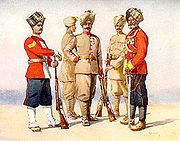
In 1945 the regiments of the British Indian Army
dropped the numeral in their titles and so the Rajputanas assumed their current name. In 1947 the regiment was allocated to India and the newly formed Indian Army
when the sub-continent became independent from the British Empire
. In 1949, the 1st Battalion was elevated to the status of guards
, becoming 3rd Battalion, Brigade of the Guards
.
. The defence earned the regiment the battle honor of "Khadki". In 1856–57 the 1st, 2nd and 4th Battalions were together in the Persian theatre of operations. In 1856 Captain J. A. Wood
of the 2nd Battalion (then the 20th Bombay Native Infantry) was awarded the Victoria Cross
for storming Reshire Fort. This was the first Victoria Cross to be won in an Indian unit. In the same battle Subedar Major Mohammed Sharief and Subedar Peer Bhatt were recommended for the Victoria Cross
but were turned down as at that time the medal category was not open to Indians.
In 1878–1880, during the Second Afghan War, the 1st Battalion marched 145 miles in 5 days from Quetta
to Kandahar
and laid siege to the city. In 1900–1902, the 3rd Battalion was part of a force used to contain the Boxer rebellion
in China
.
The First World War saw the regiment fight in battlefields from France
to Palestine
. The 5th Battalion was in all theatres of the war and participated in General Allenby’s march to recapture Jerusalem. In this march the units got the better of their German and Turkish opponents.
During World War II
the regiment was expanded to thirteen battalions and served in the Middle East, Burma and Malaya. The 4th Battalion had the distinction of earning two Victoria Crosses during this conflict.
Regiment
A regiment is a major tactical military unit, composed of variable numbers of batteries, squadrons or battalions, commanded by a colonel or lieutenant colonel...
of the Indian Army
Indian Army
The Indian Army is the land based branch and the largest component of the Indian Armed Forces. With about 1,100,000 soldiers in active service and about 1,150,000 reserve troops, the Indian Army is the world's largest standing volunteer army...
. It was originally raised in 1921 as part of the British Indian Army
British Indian Army
The British Indian Army, officially simply the Indian Army, was the principal army of the British Raj in India before the partition of India in 1947...
, when six previously existing regiments were amalgamated together to form six battalions of the 6th Rajputana Rifles. In 1945 the numeral designation was dropped from the title and in 1947 the regiment was transferred to the newly independent Indian Army
Indian Army
The Indian Army is the land based branch and the largest component of the Indian Armed Forces. With about 1,100,000 soldiers in active service and about 1,150,000 reserve troops, the Indian Army is the world's largest standing volunteer army...
. Since independence, the regiment has been involved in a number of conflicts against Pakistan, as well as contributing to the United Nations Custodian Force in Korea in the 1950s and to the UN Mission to the Congo in 1962. Over the course of its existence, members of the regiment have received 6 Victoria Crosses,1 Ashok Chakra, 1 Padma Bushan, 11 Param Vishisht Seva Medals, 10 Maha Vir Chakras, 8 Kirti Chakras, 11 Ati Vishisht Seva Medals, 1 Uttam Yudh Seva Medal, 41 Vir Chakras, 25 Shaurya Chakras, 112 Sena Medals (including Bar), 36 Vishisht Seva Medals, 2 Yudh Seva Medals, 85 Mention-in-Despatches and 55 Arjun Awards.
The Name
The name Rajputana Rifles is derived from the Rajput a Hindu clan and HindiHindi
Standard Hindi, or more precisely Modern Standard Hindi, also known as Manak Hindi , High Hindi, Nagari Hindi, and Literary Hindi, is a standardized and sanskritized register of the Hindustani language derived from the Khariboli dialect of Delhi...
word Rajputana which was the old name of Rajasthan
Rajasthan
Rājasthān the land of Rajasthanis, , is the largest state of the Republic of India by area. It is located in the northwest of India. It encompasses most of the area of the large, inhospitable Great Indian Desert , which has an edge paralleling the Sutlej-Indus river valley along its border with...
. It is based on the Sanskrit
Sanskrit
Sanskrit , is a historical Indo-Aryan language and the primary liturgical language of Hinduism, Jainism and Buddhism.Buddhism: besides Pali, see Buddhist Hybrid Sanskrit Today, it is listed as one of the 22 scheduled languages of India and is an official language of the state of Uttarakhand...
word Rajaputra meaning son of a king.
Rajputana (räj'pʊtä'nə), historic region, NW India; roughly coextensive with the modern Indian state of Rajasthan. The name means "land of the Rajputs." Rajput tribal power rose here between the 7th and 13th cent., and the princes resisted the early Muslim incursions, which began in the 11th cent. Rajput power reached its peak in the early 16th cent., but the area fell to the Mughals when Akbar captured the fort of Chitor in 1568. From their seat at Ajmer the Mughals ruled Rajputana until the early 18th cent. The Marathas held feudatories in the region from c.1750 to 1818, when it passed to Great Britain. Under the British, Rajputana included more than 20 princely states, notably Bikaner, Jaipur, Jodhpur, Udaipur, and Ajmer. The internal autonomy of many of the states was guaranteed. Most of these states were incorporated into Rajasthan after India gained independence in 1947.
Region of northwestern India that now comprises Rajasthan state and small sections of Madhya Pradesh and Gujarat. The Aravalli Range crosses the southern part of the region from northeast to southwest. The northwestern part is largely the Thar desert, but to the southeast the land is extremely fertile. The Rajput princely states came under British protection by treaties in the early 19th century; most of the area was formed into Rajasthan state in 1948.
Lineage
The regiment's origins lie in the 18th century when the East India CompanyBritish East India Company
The East India Company was an early English joint-stock company that was formed initially for pursuing trade with the East Indies, but that ended up trading mainly with the Indian subcontinent and China...
(HEIC) recruited Rajputs to protect its operations. The impressive performance of French local units which were composed of local recruits mixed with French officers, helped the HEIC to decide that it needed to do something similar. In January 1775, it raised its first local infantry units which included the 5th Battalion, Bombay Sepoys, which is considered to be the oldest rifle regiment of the Indian Army. The 5th Battalion was successively redesignated as 9th Battalion Bombay Sepoys in 1778; 2nd Battalion, 2nd Regiment of Bombay Native Infantry in 1796; 4th Regiment of Bombay Native Infantry in 1824, and then 4th Regiment Native Infantry (Rifle Corps) in 1881. It thus became the first Rifle Regiment of the British Indian Army
British Indian Army
The British Indian Army, officially simply the Indian Army, was the principal army of the British Raj in India before the partition of India in 1947...
. In 1899 the Battalion was once more renamed as 4th Regiment (1st Battalion Rifle Corps) Bombay Infantry and again in 1901 as 4th Bombay Rifles.
In Kitchener's
Herbert Kitchener, 1st Earl Kitchener
Field Marshal Horatio Herbert Kitchener, 1st Earl Kitchener KG, KP, GCB, OM, GCSI, GCMG, GCIE, ADC, PC , was an Irish-born British Field Marshal and proconsul who won fame for his imperial campaigns and later played a central role in the early part of the First World War, although he died halfway...
1903 reorganisation of the Indian Army, 4th Bombay Rifles became 104th Wellesley’s Rifles, to commemorate the fact that the regiment had been commanded in 1800 by Arthur Wellesley
Arthur Wellesley, 1st Duke of Wellington
Field Marshal Arthur Wellesley, 1st Duke of Wellington, KG, GCB, GCH, PC, FRS , was an Irish-born British soldier and statesman, and one of the leading military and political figures of the 19th century...
(later the Duke of Wellington). In the further re-organisation in 1921, six regiments were brought together to form six battalions of the 6th Rajputana Rifles Regiment:
- 1st Battalion - 104th Wellesley's Rifles104th Wellesley's RiflesThe 104th Wellesley's Rifles were an infantry regiment of the British Indian Army. They could trace their origins to 1775, when they were raised as the 5th Battalion, Bombay Sepoys....
- 2nd Battalion - 120th Rajputana Infantry120th Rajputana InfantryThe 120th Rajputana Infantry were an infantry regiment of the British Indian Army. The regiment traces their origins to 1817, when they were raised as the 2nd Battalion, 10th Regiment of Bombay Native Infantry....
- 3rd Battalion - 122nd Rajputana Infantry (God's Own)122nd Rajputana Infantry (God's Own)122nd Rajputana Infantry was one of the six regiments of the British Indian Army that were brought together to form six battalions of the 6th Rajputana Rifles Regiment...
- 4th Battalion - 123rd Outram's Rifles123rd Outram's Rifles-History:It traced its origins to the 12th Regiment of Bombay Native Infantry, part of the British East India Company's Bombay Army. It fought in the Battle of Khadki on 5 November 1817 in the Third Anglo-Maratha War and became the regiment's 1st Battalion in 1820...
- 5th Battalion - 125th Napier's Rifles125th Napier's RiflesThe 125th Napier's Rifles was an infantry regiment of the British Indian Army. Its earlier names include:1st Extra Battalion Bombay Native Infantry, The 25th Regiment of Bombay Native Infantry and The 25th Bombay Rifles...
- 10th (Training) Battalion - 13th Rajputs (The Shekhawati Regiment)13th Rajputs (The Shekhawati Regiment)The 13th Rajputs was an infantry regiment of the Bengal Army, and later of the British Indian Army. They could trace their origins to the Shekhawati Regiment raised in 1835, as part of the Jaipur contingent of the Honourable East India Company and were taken into the Company's service as a local...
.
In 1945 the regiments of the British Indian Army
British Indian Army
The British Indian Army, officially simply the Indian Army, was the principal army of the British Raj in India before the partition of India in 1947...
dropped the numeral in their titles and so the Rajputanas assumed their current name. In 1947 the regiment was allocated to India and the newly formed Indian Army
Indian Army
The Indian Army is the land based branch and the largest component of the Indian Armed Forces. With about 1,100,000 soldiers in active service and about 1,150,000 reserve troops, the Indian Army is the world's largest standing volunteer army...
when the sub-continent became independent from the British Empire
British Empire
The British Empire comprised the dominions, colonies, protectorates, mandates and other territories ruled or administered by the United Kingdom. It originated with the overseas colonies and trading posts established by England in the late 16th and early 17th centuries. At its height, it was the...
. In 1949, the 1st Battalion was elevated to the status of guards
Foot Guards
-British Army:The Foot Guards are the Regular Infantry regiments of the Household Division of the British Army. There have been six regiments of foot guards, five of which still exist. The Royal Guards Reserve Regiment was a reserve formation of the Household Brigade in existence from 1900-1901...
, becoming 3rd Battalion, Brigade of the Guards
Brigade of the Guards
Brigade of The Guards is a regiment of the Indian Army. It is the first "All India" mixed "All Class" Composition Infantry Regiment of the Army where troops from all parts of India serve together in various battalions of the Regiment...
.
History
In 1817 the 4th Battalion met the Marathas at the Battle of KhadkiBattle of Khadki
The Battle of Khadki took place at Khadki on November 5, 1817 between the forces of the British East India Company and those of Bajirao II, the Peshwa of the Maratha Empire...
. The defence earned the regiment the battle honor of "Khadki". In 1856–57 the 1st, 2nd and 4th Battalions were together in the Persian theatre of operations. In 1856 Captain J. A. Wood
John Augustus Wood
Colonel John Augustus Wood VC was a Scottish recipient of the Victoria Cross, the highest and most prestigious award for gallantry in the face of the enemy that can be awarded to British and Commonwealth forces....
of the 2nd Battalion (then the 20th Bombay Native Infantry) was awarded the Victoria Cross
Victoria Cross
The Victoria Cross is the highest military decoration awarded for valour "in the face of the enemy" to members of the armed forces of various Commonwealth countries, and previous British Empire territories....
for storming Reshire Fort. This was the first Victoria Cross to be won in an Indian unit. In the same battle Subedar Major Mohammed Sharief and Subedar Peer Bhatt were recommended for the Victoria Cross
Victoria Cross
The Victoria Cross is the highest military decoration awarded for valour "in the face of the enemy" to members of the armed forces of various Commonwealth countries, and previous British Empire territories....
but were turned down as at that time the medal category was not open to Indians.
In 1878–1880, during the Second Afghan War, the 1st Battalion marched 145 miles in 5 days from Quetta
Quetta
is the largest city and the provincial capital of the Balochistan Province of Pakistan. Known as the "Fruit Garden of Pakistan" due to the diversity of its plant and animal wildlife, Quetta is home to the Hazarganji Chiltan National Park, which contains some of the rarest species of wildlife in the...
to Kandahar
Kandahar
Kandahar is the second largest city in Afghanistan, with a population of about 512,200 as of 2011. It is the capital of Kandahar Province, located in the south of the country at about 1,005 m above sea level...
and laid siege to the city. In 1900–1902, the 3rd Battalion was part of a force used to contain the Boxer rebellion
Boxer Rebellion
The Boxer Rebellion, also called the Boxer Uprising by some historians or the Righteous Harmony Society Movement in northern China, was a proto-nationalist movement by the "Righteous Harmony Society" , or "Righteous Fists of Harmony" or "Society of Righteous and Harmonious Fists" , in China between...
in China
China
Chinese civilization may refer to:* China for more general discussion of the country.* Chinese culture* Greater China, the transnational community of ethnic Chinese.* History of China* Sinosphere, the area historically affected by Chinese culture...
.
The First World War saw the regiment fight in battlefields from France
France
The French Republic , The French Republic , The French Republic , (commonly known as France , is a unitary semi-presidential republic in Western Europe with several overseas territories and islands located on other continents and in the Indian, Pacific, and Atlantic oceans. Metropolitan France...
to Palestine
Palestine
Palestine is a conventional name, among others, used to describe the geographic region between the Mediterranean Sea and the Jordan River, and various adjoining lands....
. The 5th Battalion was in all theatres of the war and participated in General Allenby’s march to recapture Jerusalem. In this march the units got the better of their German and Turkish opponents.
During World War II
World War II
World War II, or the Second World War , was a global conflict lasting from 1939 to 1945, involving most of the world's nations—including all of the great powers—eventually forming two opposing military alliances: the Allies and the Axis...
the regiment was expanded to thirteen battalions and served in the Middle East, Burma and Malaya. The 4th Battalion had the distinction of earning two Victoria Crosses during this conflict.
Units
- 2nd Battalion (formerly 120th Rajputana Infantry120th Rajputana InfantryThe 120th Rajputana Infantry were an infantry regiment of the British Indian Army. The regiment traces their origins to 1817, when they were raised as the 2nd Battalion, 10th Regiment of Bombay Native Infantry....
) - 3rd Battalion (formerly 122nd Rajputana Infantry)
- 4th Battalion (formerly 123rd Outram's Rifles123rd Outram's Rifles-History:It traced its origins to the 12th Regiment of Bombay Native Infantry, part of the British East India Company's Bombay Army. It fought in the Battle of Khadki on 5 November 1817 in the Third Anglo-Maratha War and became the regiment's 1st Battalion in 1820...
) - 5th Battalion (formerly 125th Napier's Rifles125th Napier's RiflesThe 125th Napier's Rifles was an infantry regiment of the British Indian Army. Its earlier names include:1st Extra Battalion Bombay Native Infantry, The 25th Regiment of Bombay Native Infantry and The 25th Bombay Rifles...
) - 6th Battalion
- 7th Battalion
- 8th Battalion
- 9th Battalion
- 11th Battalion
- 12th Battalion (formerly 31st Rajputana Rifles)
- 13th Battalion
- 14th Battalion
- 15th Battalion
- 16th Battalion
- 17th Battalion (former State Forces unit or Imperial Service TroopsImperial Service TroopsThe Imperial Service Troops were forces raised by the princely states of the British Indian Empire. These troops were available for service alongside the Indian Army when such service was requested by the British government...
) - 19th Battalion
- 20th Battalion
- 21st Battalion
- 28th Battalion