
Home      Discussion      Topics      Dictionary      Almanac
Signup       Login
Clydebank

Clydebank

Overview
Clydebank is a town in West Dunbartonshire
West Dunbartonshire
West Dunbartonshire is one of the 32 local government council areas of Scotland. Bordering onto the west of the City of Glasgow, containing many of Glasgow's commuter towns and villages as well as the city's suburbs, West Dunbartonshire also borders onto Argyll and Bute, Stirling, East...

, in the Central Lowlands
Central Lowlands
The Central Lowlands or Midland Valley is a geologically defined area of relatively low-lying land in southern Scotland. It consists of a rift valley between the Highland Boundary Fault to the north and the Southern Uplands Fault to the south...

 of Scotland
Scotland
Scotland is a country that is part of the United Kingdom. Occupying the northern third of the island of Great Britain, it shares a border with England to the south and is bounded by the North Sea to the east, the Atlantic Ocean to the north and west, and the North Channel and Irish Sea to the...

. Situated on the north bank of the River Clyde
River Clyde
The River Clyde is a major river in Scotland. It is the ninth longest river in the United Kingdom, and the third longest in Scotland. Flowing through the major city of Glasgow, it was an important river for shipbuilding and trade in the British Empire....

, Clydebank borders Dumbarton, the town with which it was combined to form West Dunbartonshire, as well as the town of Milngavie
Milngavie
Milngavie , is a town in East Dunbartonshire, Scotland. It is on the Allander Water, at the northwestern edge of Greater Glasgow, and about from Glasgow city centre. It neighbours Bearsden....

 in East Dunbartonshire
East Dunbartonshire
This article is about the East Dunbartonshire council area of Scotland. See also East Dunbartonshire .East Dunbartonshire is one of the 32 council areas of Scotland. It borders onto the north-west of the City of Glasgow. It contains many of the suburbs of Glasgow as well as containing many of...

, and the Yoker
Yoker
Yoker is a western district of Glasgow, in Scotland, UK, lying on the northern bank of the Clyde to the east of Clydebank. It is located approximately 5 miles west of the City Centre. From the fourteenth century a ferry has linked Yoker with the burgh of Renfrew on the south bank...

 and Drumchapel
Drumchapel
Drumchapel , known to locals and residents as 'The Drum', is part of the city of Glasgow, Scotland, having been annexed from Dunbartonshire in 1938. It borders Bearsden to the east and Clydebank to the west . The area is bordered by Knightswood and Yoker in Glasgow. The name derives from the...

 districts of the adjacent City of Glasgow. Clydebank is part of the registration county of Dumbarton, the Dunbartonshire
Dunbartonshire
Dunbartonshire or the County of Dumbarton is a lieutenancy area and registration county in the west central Lowlands of Scotland lying to the north of the River Clyde. Until 1975 it was a county used as a primary unit of local government with its county town and administrative centre at the town...

 Crown lieutenancy area, and, for Office of National Statistics purposes, part of the urban area designated as Greater Glasgow
Greater Glasgow
Greater Glasgow is an urban settlement in Scotland consisting of all localities which are physically attached to the city of Glasgow, forming with it a single contiguous urban area...

. Clydebank was founded as a police burgh
Police burgh
A police burgh was a Scottish burgh which had adopted a “police system” for governing the town. They existed from 1833 to 1975.-The 1833 act:The first police burghs were created under the Burgh Police Act, 1833...

 on 18 November 1886.
Discussion
Ask a question about 'Clydebank'
Start a new discussion about 'Clydebank'
Answer questions from other users
Full Discussion Forum
 
Unanswered Questions
Encyclopedia
Clydebank is a town in West Dunbartonshire
West Dunbartonshire
West Dunbartonshire is one of the 32 local government council areas of Scotland. Bordering onto the west of the City of Glasgow, containing many of Glasgow's commuter towns and villages as well as the city's suburbs, West Dunbartonshire also borders onto Argyll and Bute, Stirling, East...

, in the Central Lowlands
Central Lowlands
The Central Lowlands or Midland Valley is a geologically defined area of relatively low-lying land in southern Scotland. It consists of a rift valley between the Highland Boundary Fault to the north and the Southern Uplands Fault to the south...

 of Scotland
Scotland
Scotland is a country that is part of the United Kingdom. Occupying the northern third of the island of Great Britain, it shares a border with England to the south and is bounded by the North Sea to the east, the Atlantic Ocean to the north and west, and the North Channel and Irish Sea to the...

. Situated on the north bank of the River Clyde
River Clyde
The River Clyde is a major river in Scotland. It is the ninth longest river in the United Kingdom, and the third longest in Scotland. Flowing through the major city of Glasgow, it was an important river for shipbuilding and trade in the British Empire....

, Clydebank borders Dumbarton, the town with which it was combined to form West Dunbartonshire, as well as the town of Milngavie
Milngavie
Milngavie , is a town in East Dunbartonshire, Scotland. It is on the Allander Water, at the northwestern edge of Greater Glasgow, and about from Glasgow city centre. It neighbours Bearsden....

 in East Dunbartonshire
East Dunbartonshire
This article is about the East Dunbartonshire council area of Scotland. See also East Dunbartonshire .East Dunbartonshire is one of the 32 council areas of Scotland. It borders onto the north-west of the City of Glasgow. It contains many of the suburbs of Glasgow as well as containing many of...

, and the Yoker
Yoker
Yoker is a western district of Glasgow, in Scotland, UK, lying on the northern bank of the Clyde to the east of Clydebank. It is located approximately 5 miles west of the City Centre. From the fourteenth century a ferry has linked Yoker with the burgh of Renfrew on the south bank...

 and Drumchapel
Drumchapel
Drumchapel , known to locals and residents as 'The Drum', is part of the city of Glasgow, Scotland, having been annexed from Dunbartonshire in 1938. It borders Bearsden to the east and Clydebank to the west . The area is bordered by Knightswood and Yoker in Glasgow. The name derives from the...

 districts of the adjacent City of Glasgow. Clydebank is part of the registration county of Dumbarton, the Dunbartonshire
Dunbartonshire
Dunbartonshire or the County of Dumbarton is a lieutenancy area and registration county in the west central Lowlands of Scotland lying to the north of the River Clyde. Until 1975 it was a county used as a primary unit of local government with its county town and administrative centre at the town...

 Crown lieutenancy area, and, for Office of National Statistics purposes, part of the urban area designated as Greater Glasgow
Greater Glasgow
Greater Glasgow is an urban settlement in Scotland consisting of all localities which are physically attached to the city of Glasgow, forming with it a single contiguous urban area...

. Clydebank was founded as a police burgh
Police burgh
A police burgh was a Scottish burgh which had adopted a “police system” for governing the town. They existed from 1833 to 1975.-The 1833 act:The first police burghs were created under the Burgh Police Act, 1833...

 on 18 November 1886.

History


Clydebank is located within the historical boundaries of the ancient Kingdom of Strathclyde
Kingdom of Strathclyde
Strathclyde , originally Brythonic Ystrad Clud, was one of the early medieval kingdoms of the celtic people called the Britons in the Hen Ogledd, the Brythonic-speaking parts of what is now southern Scotland and northern England. The kingdom developed during the post-Roman period...

, the Mormaerdom of Lennox
Lennox (district)
The district of Lennox , often known as "the Lennox", is a region of Scotland centred around the village of Lennoxtown in East Dunbartonshire, eight miles north of the centre of Glasgow. At various times in history, the district has had both a dukedom and earldom associated with it.- External...

, and the parish
Parish
A parish is a territorial unit historically under the pastoral care and clerical jurisdiction of one parish priest, who might be assisted in his pastoral duties by a curate or curates - also priests but not the parish priest - from a more or less central parish church with its associated organization...

 of Old Kilpatrick
Old Kilpatrick
Old Kilpatrick is a village in West Dunbartonshire, Scotland.The village is on the north bank of the River Clyde immediately to the north of the Forth and Clyde Canal, three miles from Clydebank on the road to Dumbarton. The Great Western Road runs through Old Kilpatrick, and the next village to...

 (12th century), on the north bank of the River Clyde
River Clyde
The River Clyde is a major river in Scotland. It is the ninth longest river in the United Kingdom, and the third longest in Scotland. Flowing through the major city of Glasgow, it was an important river for shipbuilding and trade in the British Empire....

. A long-standing local legend is that the village of Old Kilpatrick
Old Kilpatrick
Old Kilpatrick is a village in West Dunbartonshire, Scotland.The village is on the north bank of the River Clyde immediately to the north of the Forth and Clyde Canal, three miles from Clydebank on the road to Dumbarton. The Great Western Road runs through Old Kilpatrick, and the next village to...

 derived its name from being the birthplace of Saint Patrick
Saint Patrick
Saint Patrick was a Romano-Briton and Christian missionary, who is the most generally recognized patron saint of Ireland or the Apostle of Ireland, although Brigid of Kildare and Colmcille are also formally patron saints....

, the patron saint of Ireland
Ireland
Ireland is an island to the northwest of continental Europe. It is the third-largest island in Europe and the twentieth-largest island on Earth...

. There do not appear to be any historical sources which support this, however.

The town encompasses part of the Antonine Wall
Antonine Wall
The Antonine Wall is a stone and turf fortification built by the Romans across what is now the Central Belt of Scotland, between the Firth of Forth and the Firth of Clyde. Representing the northernmost frontier barrier of the Roman Empire, it spanned approximately 39 miles and was about ten feet ...

, including, at Hardgate
Hardgate
Hardgate is a village in West Dunbartonshire, Scotland.Hardgate has probably been settled since neolithic times with a burial site at Knappers Farm, a cup and ring marked stone and a Burial chamber near Cochno Loch providing evidence of this....

/Duntocher
Duntocher
Duntocher is a village in Dunbartonshire, Scotland.Although it is a far older settlement and still considered a village in its own right, it is administratively part of nearby Clydebank along with the neighbouring village of Hardgate and is now part of the West Dunbartonshire local authority area...

, the site of one of the forts built at regular intervals along the wall. In 2008, the Antonine Wall was designated as a World Heritage Site
World Heritage Site
A UNESCO World Heritage Site is a place that is listed by the UNESCO as of special cultural or physical significance...

, as part of a multinational Heritage Site encompassing the borders of the Roman Empire
Roman Empire
The Roman Empire was the post-Republican period of the ancient Roman civilization, characterised by an autocratic form of government and large territorial holdings in Europe and around the Mediterranean....

.

Before 1870, the area which later became Clydebank was largely rural, and agricultural. It consisted of some villages (Hardgate
Hardgate
Hardgate is a village in West Dunbartonshire, Scotland.Hardgate has probably been settled since neolithic times with a burial site at Knappers Farm, a cup and ring marked stone and a Burial chamber near Cochno Loch providing evidence of this....

, Faifley
Faifley
Faifley is a large council estate forming part of the town of Clydebank, Scotland, adjoining the former village of Hardgate, with a population of approximately 5,000....

, Duntocher
Duntocher
Duntocher is a village in Dunbartonshire, Scotland.Although it is a far older settlement and still considered a village in its own right, it is administratively part of nearby Clydebank along with the neighbouring village of Hardgate and is now part of the West Dunbartonshire local authority area...

, Dalmuir
Dalmuir
Dalmuir is an area on the western side of Clydebank, in West Dunbartonshire, Scotland.-Location:It is neighboured by the village of Old Kilpatrick, the Mountblow and Parkhall areas of Clydebank, as well as the town centre...

, Old Kilpatrick
Old Kilpatrick
Old Kilpatrick is a village in West Dunbartonshire, Scotland.The village is on the north bank of the River Clyde immediately to the north of the Forth and Clyde Canal, three miles from Clydebank on the road to Dumbarton. The Great Western Road runs through Old Kilpatrick, and the next village to...

), farms and estates, with some small scale mining operations (coal
Coal
Coal is a combustible black or brownish-black sedimentary rock usually occurring in rock strata in layers or veins called coal beds or coal seams. The harder forms, such as anthracite coal, can be regarded as metamorphic rock because of later exposure to elevated temperature and pressure...

, limestone
Limestone
Limestone is a sedimentary rock composed largely of the minerals calcite and aragonite, which are different crystal forms of calcium carbonate . Many limestones are composed from skeletal fragments of marine organisms such as coral or foraminifera....

 and whinstone
Whinstone
Whinstone is a term used in the quarrying industry to describe any hard dark-coloured rock. Examples include the igneous rocks basalt and dolerite as well as the sedimentary rock chert....

), several cotton mill
Cotton mill
A cotton mill is a factory that houses spinning and weaving machinery. Typically built between 1775 and 1930, mills spun cotton which was an important product during the Industrial Revolution....

s and some small shipbuilding yards.

At the start of the 1870s, however, the growing trade and industry in Glasgow
Glasgow
Glasgow is the largest city in Scotland and third most populous in the United Kingdom. The city is situated on the River Clyde in the country's west central lowlands...

 resulted in the Clyde Navigation Trustees needing additional space for shipping quays in Glasgow. They used their statutory powers to compulsorily purchase the area occupied by the Clyde Bank Iron Shipyard in Govan
Govan
Govan is a district and former burgh now part of southwest City of Glasgow, Scotland. It is situated west of Glasgow city centre, on the south bank of the River Clyde, opposite the mouth of the River Kelvin and the district of Partick....

, which belonged to J & G Thomson. Forced to find another site for their shipyard, J & G Thomson looked at various sites further down the River Clyde
River Clyde
The River Clyde is a major river in Scotland. It is the ninth longest river in the United Kingdom, and the third longest in Scotland. Flowing through the major city of Glasgow, it was an important river for shipbuilding and trade in the British Empire....

, and eventually purchased, from the estates of Miss Hamilton of Cochno, some suitably flat land on the "West Barns o'Clyde" on the north bank of the river, opposite the point where the River Cart
River Cart
The River Cart is a tributary of the River Clyde, Scotland, which it joins from the west roughly midway between the towns of Erskine and Renfrew....

 flows into the River Clyde
River Clyde
The River Clyde is a major river in Scotland. It is the ninth longest river in the United Kingdom, and the third longest in Scotland. Flowing through the major city of Glasgow, it was an important river for shipbuilding and trade in the British Empire....

. The land was situated close to the Forth and Clyde Canal
Forth and Clyde Canal
The Forth and Clyde Canal crosses Scotland, providing a route for sea-going vessels between the Firth of Forth and the Firth of Clyde at the narrowest part of the Scottish Lowlands. The canal is 35 miles long and its eastern end is connected to the River Forth by a short stretch of the River...

 and to the main road running west out Glasgow, and so was conveniently positioned for transporting materials and workers to and from the shipyard. The position opposite the mouth of the River Cart
River Cart
The River Cart is a tributary of the River Clyde, Scotland, which it joins from the west roughly midway between the towns of Erskine and Renfrew....

 was to also to prove important as the shipyard grew, since it enabled the company to build much bigger, heavier ships than would otherwise have been possible that far up the Clyde. Construction of the new shipyard started on 1 May 1871.

Initially, the company transported workers to and from the shipyard by paddle steamer
Paddle steamer
A paddle steamer is a steamship or riverboat, powered by a steam engine, using paddle wheels to propel it through the water. In antiquity, Paddle wheelers followed the development of poles, oars and sails, where the first uses were wheelers driven by animals or humans...

 (passenger steamers were commonly used by people to travel up and down the Clyde well into the second half of the 20th century). However it was not ideal, having to ship workers to and fro all the time, so the company also started building blocks of tenement flats to house the workers. These first blocks of housing became known unofficially as "Tamson's (Thomson's) Buildings", after the name of the company.

Gradually, as the shipyard grew, so did the cluster of buildings grow nearby. More houses, a school, a large shed which served as canteen, community hall and church (known as the "Tarry Kirk
Kirk
Kirk can mean "church" in general or the Church of Scotland in particular. Many place names and personal names are also derived from it.-Basic meaning and etymology:...

"), then finally two proper churches in 1876 and 1877. As the resident population grew, so did the needs and problems associated with a growing population. Other manufacturers and employers moved into the area, and by 1880 approximately 2,000 men were living and working there.

In 1882 a railway line was built running from Glasgow out to the new shipyard (the Glasgow, Yoker and Clydebank Railway
Glasgow, Yoker and Clydebank Railway
The Glasgow, Yoker and Clydebank Railway is a Scottish railway, authorised in 1878, and absorbed into the North British Railway in 1897. It runs from Whiteinch to Clydebank.-Sources:*...

). Then, between 1882 and 1884, the Singer Manufacturing Company
Singer Corporation
Singer Corporation is a manufacturer of sewing machines, first established as I.M. Singer & Co. in 1851 by Isaac Merritt Singer with New York lawyer Edward Clark. Best known for its sewing machines, it was renamed Singer Manufacturing Company in 1865, then The Singer Company in 1963. It is...

 built a massive sewing machine
Sewing machine
A sewing machine is a textile machine used to stitch fabric, cards and other material together with thread. Sewing machines were invented during the first Industrial Revolution to decrease the amount of manual sewing work performed in clothing companies...

 factory in Kilbowie, less than half a mile north of the Clyde Bank shipyard. More people moved into the area, and finally, in 1886, the local populace petitioned for the creation of a police burgh
Police burgh
A police burgh was a Scottish burgh which had adopted a “police system” for governing the town. They existed from 1833 to 1975.-The 1833 act:The first police burghs were created under the Burgh Police Act, 1833...

, on the basis that the area now qualified as a "populous place". The petition was granted, and the new town was named after the shipyard which had given birth to it - Clydebank.

On 13 and 14 March 1941, Luftwaffe
Luftwaffe
Luftwaffe is a generic German term for an air force. It is also the official name for two of the four historic German air forces, the Wehrmacht air arm founded in 1935 and disbanded in 1946; and the current Bundeswehr air arm founded in 1956....

 bombers attacked various targets in and around Clydebank. In what became known as the Clydebank Blitz
Clydebank Blitz
The Clydebank Blitz refers to two devastating Luftwaffe air raids on the shipbuilding town of Clydebank in Scotland which took place in March 1941.-The air raids:...

, the town itself was seriously damaged as were the local shipyards and armaments factories such as the Dalnottar tank farm and the Singer's Sewing Machine
Singer Corporation
Singer Corporation is a manufacturer of sewing machines, first established as I.M. Singer & Co. in 1851 by Isaac Merritt Singer with New York lawyer Edward Clark. Best known for its sewing machines, it was renamed Singer Manufacturing Company in 1865, then The Singer Company in 1963. It is...

 factory. Over the two days 528 civilians were killed and over 617 people were seriously injured.

Geography


Dalmuir
Dalmuir
Dalmuir is an area on the western side of Clydebank, in West Dunbartonshire, Scotland.-Location:It is neighboured by the village of Old Kilpatrick, the Mountblow and Parkhall areas of Clydebank, as well as the town centre...

, Drumry
Drumry
Drumry is a district in the Scottish town of Clydebank, split into North and South Drumry by Drumry Road.It was named the second most deprived area in Scotland by the Scottish Executive.-External links:* *...

, Duntocher
Duntocher
Duntocher is a village in Dunbartonshire, Scotland.Although it is a far older settlement and still considered a village in its own right, it is administratively part of nearby Clydebank along with the neighbouring village of Hardgate and is now part of the West Dunbartonshire local authority area...

, Faifley
Faifley
Faifley is a large council estate forming part of the town of Clydebank, Scotland, adjoining the former village of Hardgate, with a population of approximately 5,000....

, Hardgate
Hardgate
Hardgate is a village in West Dunbartonshire, Scotland.Hardgate has probably been settled since neolithic times with a burial site at Knappers Farm, a cup and ring marked stone and a Burial chamber near Cochno Loch providing evidence of this....

, Kilbowie, Linnvale
Linnvale
Linnvale is a housing estate in Clydebank, West Dunbartonshire, Scotland. The area was destroyed by German bombing in the 1941 Clydebank Blitz, during the Second World War...

, Mountblow, Old Kilpatrick
Old Kilpatrick
Old Kilpatrick is a village in West Dunbartonshire, Scotland.The village is on the north bank of the River Clyde immediately to the north of the Forth and Clyde Canal, three miles from Clydebank on the road to Dumbarton. The Great Western Road runs through Old Kilpatrick, and the next village to...

, Parkhall, Radnor Park, Town Centre, Whitecrook
Whitecrook
Whitecrook is an area in the southeast of the town of Clydebank, West Dunbartonshire, Greater Glasgow, Scotland, UK. It occupies the area between the Forth and Clyde Canal to the north, and Glasgow Road to the southwest....

 and a small part of the Yoker
Yoker
Yoker is a western district of Glasgow, in Scotland, UK, lying on the northern bank of the Clyde to the east of Clydebank. It is located approximately 5 miles west of the City Centre. From the fourteenth century a ferry has linked Yoker with the burgh of Renfrew on the south bank...

 district of Glasgow City (sometimes termed Clydebank East).

Duntocher, Hardgate and Faifley are part of Clydebank, however as each was annexed to the town during the existence of the former burgh and district councils, these three areas continue to have fairly strong local identities separate from that of the town. The town exists in the local zeitgeist as comprising the above listed areas, however the former Clydebank District also included the settlement of Bowling
Bowling
Bowling Bowling Bowling (1375–1425; late Middle English bowle, variant of boule Bowling (1375–1425; late Middle English bowle, variant of boule...

, while for statistical purposes the town is divided into several localities; namely Faifley, Duntocher & Hardgate, Old Kilpatrick, and a rump Clydebank.

Politics


In the early 20th century the town was synonymous with the Scottish socialist movements led by the shipyard workers along the river Clyde, giving rise to the title of Red Clydeside
Red Clydeside
Red Clydeside is a term used to describe the era of political radicalism that characterised the city of Glasgow in Scotland, and urban areas around the city on the banks of the River Clyde such as Clydebank, Greenock and Paisley...

.

The 11,000 workers at the largest factory of Singer
Singer Corporation
Singer Corporation is a manufacturer of sewing machines, first established as I.M. Singer & Co. in 1851 by Isaac Merritt Singer with New York lawyer Edward Clark. Best known for its sewing machines, it was renamed Singer Manufacturing Company in 1865, then The Singer Company in 1963. It is...

 sewing machines went on strike
Strike action
Strike action, also called labour strike, on strike, greve , or simply strike, is a work stoppage caused by the mass refusal of employees to work. A strike usually takes place in response to employee grievances. Strikes became important during the industrial revolution, when mass labour became...

 in March–April 1911, ceasing to work in solidarity of 12 female colleagues protesting against work process reorganization. Following the end of the strike, Singer fired 400 workers, including all strike leaders and purported members of the IWGB, among whom Arthur McManus, who later went on to become the first chairman of the Communist Party of Great Britain
Communist Party of Great Britain
The Communist Party of Great Britain was the largest communist party in Great Britain, although it never became a mass party like those in France and Italy. It existed from 1920 to 1991.-Formation:...

 between 1920 and 1922.

Labour unrest, in particular by women and unskilled labour, greatly increased between 1910-1914 in Clydeside, with four times more days on strike than between 1900 and 1910. During these four years preceding World War I
World War I
World War I , which was predominantly called the World War or the Great War from its occurrence until 1939, and the First World War or World War I thereafter, was a major war centred in Europe that began on 28 July 1914 and lasted until 11 November 1918...

, membership of those affiliated to the Scottish Trades Union Congress
Scottish Trades Union Congress
The Scottish Trades Union Congress is the co-ordinating body of trade unions, and local Trades Councils, in Scotland. With 39 affiliated unions as of 2007, the STUC represents around 630,000 trade unionists....

 rose from 129,000 in 1909 to 230,000 in 1914.

It is the generally held belief of residents that Clydebank has far more common interests with other urban towns and districts of the Glasgow Settlement or Greater Glasgow
Greater Glasgow
Greater Glasgow is an urban settlement in Scotland consisting of all localities which are physically attached to the city of Glasgow, forming with it a single contiguous urban area...

 city-region than they do with detached northern rural areas of West Dunbartonshire, although this should not be assumed to have ended the town's identifying itself as part of the historical county of Dunbartonshire, which many residents feel is important in maintaining Clydebank's independent identity from the adjacent City of Glasgow. As stated previously the town borders but is not part of the local authority area called the City of Glasgow, although as the boundary falls between neighbouring houses its existence is largely irrelevant in terms of people's use of commercial and leisure facilities, housing, employment and transport. The town is part of a single urban area (officially the Glasgow City Metropolitan Area) with the terms Glasgow
Glasgow
Glasgow is the largest city in Scotland and third most populous in the United Kingdom. The city is situated on the River Clyde in the country's west central lowlands...

 and Greater Glasgow
Greater Glasgow
Greater Glasgow is an urban settlement in Scotland consisting of all localities which are physically attached to the city of Glasgow, forming with it a single contiguous urban area...

 often used interchangeably, with context being important to establish meaning as for some Clydebank residents the claiming of the town as part of the City of Glasgow could be a sensitive issue. This Glasgow City Metropolitan Area includes places falling within the limits of the following local authorities: West Dunbartonshire
West Dunbartonshire
West Dunbartonshire is one of the 32 local government council areas of Scotland. Bordering onto the west of the City of Glasgow, containing many of Glasgow's commuter towns and villages as well as the city's suburbs, West Dunbartonshire also borders onto Argyll and Bute, Stirling, East...

 (Clydebank), all of East Dunbartonshire
East Dunbartonshire
This article is about the East Dunbartonshire council area of Scotland. See also East Dunbartonshire .East Dunbartonshire is one of the 32 council areas of Scotland. It borders onto the north-west of the City of Glasgow. It contains many of the suburbs of Glasgow as well as containing many of...

, North Lanarkshire
North Lanarkshire
North Lanarkshire is one of 32 council areas in Scotland. It borders onto the northeast of the City of Glasgow and contains much of Glasgow's suburbs and commuter towns and villages. It also borders Stirling, Falkirk, East Dunbartonshire, West Lothian and South Lanarkshire...

, South Lanarkshire
South Lanarkshire
South Lanarkshire is one of 32 unitary council areas of Scotland, covering the southern part of the former county of Lanarkshire. It borders the south-east of the city of Glasgow and contains many of Glasgow's suburbs, commuter towns and smaller villages....

, Renfrewshire
Renfrewshire
Renfrewshire is one of 32 council areas used for local government in Scotland. Located in the west central Lowlands, it is one of three council areas contained within the boundaries of the historic county of Renfrewshire, the others being Inverclyde to the west and East Renfrewshire to the east...

, all of East Renfrewshire
East Renfrewshire
East Renfrewshire is one of 32 council areas of Scotland. Until 1975 it formed part of the county of Renfrewshire for local government purposes along with the modern council areas of Renfrewshire and Inverclyde...

 and all of the City of Glasgow. These areas form a single health service area, NHS Greater Glasgow and Clyde. Like these areas, most of Clydebank uses the Glasgow telephone area code "0141", however the northern & western portions of the Clydebank area use "01389". The G81 postcode is the most widely used in the area, but the Bowling and Old Kilpatrick areas of the town use G60.

Sport


Clydebank has two semi-professional football
Football (soccer)
Association football, more commonly known as football or soccer, is a sport played between two teams of eleven players with a spherical ball...

 teams, Clydebank F.C.
Clydebank F.C.
Clydebank Football Club are a Scottish football club based in the town of Clydebank, West Dunbartonshire, near Yoker. The present club, formed in 2003, is a member of the Scottish Junior Football Association, and currently plays in West Super League Premier Division...

 and Yoker Athletic F.C.
Yoker Athletic F.C.
Yoker Athletic Football Club are a Scottish football club based in Clydebank near Glasgow. Yoker is an area of Glasgow adjacent to Clydebank, however Yoker's stadium lies just outside the Glasgow boundary. Nicknamed the Whe Ho, they were formed in 1886 and are based at Holm Park...

. Both are members of the Scottish Junior Football Association
Scottish Junior Football Association
The Scottish Junior Football Association is an affiliated national association of the Scottish Football Association and is the governing body for the Junior grade of football in Scotland. The term "Junior" refers to the level of football played...

, Clydebank playing in the West of Scotland Superleague First Division, one tier higher than Yoker AFC, who play in the Central District League Division One. Clydebank FC formerly held status as a senior league
Scottish Football League
The Scottish Football League is a league of football teams in Scotland, comprising theScottish First Division, Scottish Second Division and Scottish Third Division. From the league's foundation in 1890 until the breakaway Scottish Premier League was formed in 1998, the Scottish Football League...

 club but, while in administration in 2002, the club was purchased by a consortium and moved to Airdrie
Airdrie, North Lanarkshire
Airdrie is a town within North Lanarkshire, Scotland. It lies on a plateau roughly 400 ft above sea level, and is approximately 12 miles east of Glasgow city centre. Airdrie forms part of a conurbation with its neighbour Coatbridge, in the former district known as the Monklands. As of 2006,...

 and renamed Airdrie United F.C.
Airdrie United F.C.
Airdrie United Football Club are a Scottish professional football team based in the town of Airdrie, North Lanarkshire. They are currently managed by ex-Airdrieonians player and former Airdrie United Under 19s coach Jimmy Boyle. They are members of the Scottish Football League and play in the...

. A new Clydebank F.C. were formed in 2003 and entered the Central district of Scottish Junior football. Clydebank also encompass a variety of amateur football teams Drumchapel Utd, Drumchapel Amateurs and most recently the rise of Clydebank Rovers

Clydebank's Rugby Football Club is based in Whitecrook. The club was founded on 29 May 1969. Their first game was played at Whitecrook on Monday 1 September 1969 against a Presidents XV captained by Richard Alan of Hutchesons and Scotland. The club play in red and black and regularly field two XVs.

Other sport clubs based in Clydebank are: the Clydesdale Harriers
Clydesdale Harriers
Clydesdale Harriers are an athletics club, founded in 1885. It was Scotland's first amateur open athletics club with the object of promoting amateur athletics generally and cross country running in particular.-History:...

, founded in 1885 as Scotland's first amateur open athletics club; and the Lomond Roads Cycling Club
Lomond Roads Cycling Club
Lomond Roads Cycling Club is a cycling club based in Clydebank, Scotland. The club was founded in 1933. Their current clubroom is in the Double L Centre, Jowitt Avenue, Clydebank.- Team colours :...

.

The Antonine Sports Centre is located in Duntocher and was established in October 1980, it is a not-for-profit, charitable organisation which is run by a voluntary Board of Directors. It was founded by Mr. David Ward, a local resident who remained on the Board of Directors for 25 years.

Films


Clydebank has been the subject of several documentary films over the years, including (more recently) Iain McGuinness
Iain McGuinness
Iain McGuinness is a TV producer and director, and music video director. He is currently Creative Director at AND / OR Productions.-Biography:...

' Post-Blitz Clydebank and Clydebank Through A Lens.

Employment


Although the town currently has a fairly moderate official unemployment rate, at around 6%, however, 20% of the population are described by Scottish National Statistics as "employment deprived".

A major employer in the town was John Brown & Company
John Brown & Company
John Brown and Company of Clydebank was a pre-eminent Scottish marine engineering and shipbuilding firm, responsible for building many notable and world-famous ships, such as the , the , the , the , the , and the...

 shipyard, which built several well-known ships, including the RMS Lusitania
RMS Lusitania
RMS Lusitania was a British ocean liner designed by Leonard Peskett and built by John Brown and Company of Clydebank, Scotland. The ship entered passenger service with the Cunard Line on 26 August 1907 and continued on the line's heavily-traveled passenger service between Liverpool, England and New...

, Hood
HMS Hood (51)
HMS Hood was the last battlecruiser built for the Royal Navy. One of four s ordered in mid-1916, her design—although drastically revised after the Battle of Jutland and improved while she was under construction—still had serious limitations. For this reason she was the only ship of her class to be...

, Queen Mary
RMS Queen Mary
RMS Queen Mary is a retired ocean liner that sailed primarily in the North Atlantic Ocean from 1936 to 1967 for the Cunard Line...

, Queen Elizabeth
RMS Queen Elizabeth
RMS Queen Elizabeth was an ocean liner operated by the Cunard Line. Plying with her running mate Queen Mary as a luxury liner between Southampton, UK and New York City, USA via Cherbourg, France, she was also contracted for over twenty years to carry the Royal Mail as the second half of the two...

, and Queen Elizabeth 2. Later it became part of Upper Clyde Shipbuilders, which was the scene of a famous "work-in" in the 1970s. The yard and associated engineering works continued to operate under a succession of owners until 2000.

Singer Corporation
Singer Corporation
Singer Corporation is a manufacturer of sewing machines, first established as I.M. Singer & Co. in 1851 by Isaac Merritt Singer with New York lawyer Edward Clark. Best known for its sewing machines, it was renamed Singer Manufacturing Company in 1865, then The Singer Company in 1963. It is...

 was also a major industry in Clydebank, giving thousands of jobs to the townsfolk but closed in 1980, with Clydebank Business Park where its famous building used to stand (next to where Singer railway station
Singer railway station
Singer railway station is a two-platformed manned station serving Clydebank town centre, West Dunbartonshire, Scotland. It is located on the Argyle Line, west of and the North Clyde Line, 13 km west of ....

 is now).

The town is home to the independent Clydebank Co-operative Society
Clydebank Co-operative Society
The Clydebank Co-operative Society Limited is the smallest consumers' co-operative in Scotland, based in the town of Clydebank near Glasgow. Along with Scotmid and The Co-operative Group, it is one of three co-operative retailers in Scotland, and the only one not merged into a regional or national...

 which has a number of outlets in the town.

Coat of arms


The Burgh of Clydebank adopted an unofficial coat of arms
Coat of arms
A coat of arms is a unique heraldic design on a shield or escutcheon or on a surcoat or tabard used to cover and protect armour and to identify the wearer. Thus the term is often stated as "coat-armour", because it was anciently displayed on the front of a coat of cloth...

 in 1892, when it was required to obtain a common seal by the Burgh Police (Scotland) Act 1892
Police burgh
A police burgh was a Scottish burgh which had adopted a “police system” for governing the town. They existed from 1833 to 1975.-The 1833 act:The first police burghs were created under the Burgh Police Act, 1833...

. The design was described disparagingly by Arthur Charles Fox-Davies
Arthur Charles Fox-Davies
Arthur Charles Fox-Davies was a British author on heraldry. By profession, he was a barrister but he also worked as a journalist and novelist.Born in Bristol, he was the second son of T...

 as a fine healthy specimen of home-made heraldry.

The design comprised a shield surmounted by a mural crown
Mural crown
-Usage in ancient times:In Hellenistic culture, a mural crown identified the goddess Tyche, the embodiment of the fortune of a city, familiar to Romans as Fortuna...

, above which was a helm bearing a wreath and crest. In the centrepiece of the shield was a Lennox Cross representative of the ancient Earls of Lennox. In chief position was a sewing machine representing the Singer Corporation and in base position "on the waves of the sea" was a representation of the battleship HMS Ramillies
HMS Ramillies (1892)
HMS Ramillies was a pre-dreadnought battleship of Royal Navy and part of the seven ship Royal Sovereign' class.-Technical Characteristics:...

 built at J & G Thomson's Clydebank Shipyard in 1892. In the dexter fess position was a stag's head taken from the coat of arms of shipbuilder James Rodger Thomson, the first Provost of the Burgh. In sinister fess position there was a lion rampant taken from the coat of arms of local landowner, Alexander Dunn Pattison of Dalmuir.

The crest was a garb or wheatsheaf representing the agricultural interests of the area.

The Latin
Latin
Latin is an Italic language originally spoken in Latium and Ancient Rome. It, along with most European languages, is a descendant of the ancient Proto-Indo-European language. Although it is considered a dead language, a number of scholars and members of the Christian clergy speak it fluently, and...

 motto below the shield was Labore et Scientia or by work and by knowledge.

In 1929 there was a concerted campaign by the office of Lord Lyon King of Arms
Lord Lyon King of Arms
The Lord Lyon King of Arms, the head of Lyon Court, is the most junior of the Great Officers of State in Scotland and is the Scottish official with responsibility for regulating heraldry in that country, issuing new grants of arms, and serving as the judge of the Court of the Lord Lyon, the oldest...

 to ensure that all burghs using unmatriculated arms regularised their position, and more than fifty burghs registered arms between 1929 and 1931. This led to Clydebank's arms being matriculated on 6 February 1930. The 1930 grant was almost identical to the 1892 device.

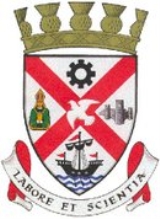
In 1975 the burgh was abolished, becoming part of larger Clydebank District, and the burgh arms went out of use. Clydebank District Council was granted new arms on 3 September 1975. This consisted of a red saltire on a white field for the ancient province of Lennox
Lennox (district)
The district of Lennox , often known as "the Lennox", is a region of Scotland centred around the village of Lennoxtown in East Dunbartonshire, eight miles north of the centre of Glasgow. At various times in history, the district has had both a dukedom and earldom associated with it.- External...

 and for the town's more recent historic links to Ireland which previously used the same flag. The cog-wheel symbolised all the local industries and the demi-figure of Saint Patrick
Saint Patrick
Saint Patrick was a Romano-Briton and Christian missionary, who is the most generally recognized patron saint of Ireland or the Apostle of Ireland, although Brigid of Kildare and Colmcille are also formally patron saints....

 referred to Old Kilpatrick, a burgh of barony from 1672, and where the saint is reputed to have been born. A representation of part of the Roman Antonine Wall
Antonine Wall
The Antonine Wall is a stone and turf fortification built by the Romans across what is now the Central Belt of Scotland, between the Firth of Forth and the Firth of Clyde. Representing the northernmost frontier barrier of the Roman Empire, it spanned approximately 39 miles and was about ten feet ...

 was included as the Wall and Roman forts at Old Kilpatrick
Kilpatrick
Kilpatrick Irish and Scottish surname. The name refers to:Persons:*Ben Kilpatrick , American outlaw in the Old West, member of Butch Cassidy's Wild Bunch gang...

 and Greenhill were features common to the burgh and to the villages in the District. The lymphad
Lymphad
thumb|200pxA Lymphad or galley is a charge used primarily in Scottish heraldry. It is a single masted ship propelled by oars. In addition to the mast and oars, the Lymphad has three flags and a basket. The word comes from the Scottish Gaelic long fhada, meaning a long ship or birlinn...

 (galley ship) was for Clyde shipbuilding. The burgh motto was retained. At the request of the district council, the arms were rematriculated on 19 April 1985 with the addition of a dove of peace in the centre of the saltire. The coat of arms went out of use in 1996 with the abolition of the District Council. In 1998 the successor West Dunbartonshire Council was granted very similar arms.

Local Transport


The town is served by scotsrail from Clydebank railway station
Clydebank railway station
Clydebank railway station is a railway station serving the town of Clydebank in Scotland. It is located on the Argyle Line and the North Clyde Line. Passenger services are operated by First ScotRail on behalf of Strathclyde Partnership for Transport.- 2008 :...

, Drumry railway station
Drumry railway station
Drumry railway station is a railway station serving the Drumry and Linnvale area of Clydebank, Scotland. The station is managed by First ScotRail and is served by trains on the Argyle Line and North Clyde Line....

, Dalmuir railway station
Dalmuir railway station
Dalmuir railway station is a railway station serving the Dalmuir area of Clydebank, West Dunbartonshire, Scotland. It is a large, five platform interchange between the Argyle Line, North Clyde Line and West Highland Line....

, Yoker railway station
Yoker railway station
Yoker railway station is an unstaffed station which serves the district of Yoker in Scotland. The station is in Clydebank in West Dunbartonshire, but it is very near the boundary with Glasgow....

, Kilpatrick railway station
Kilpatrick railway station
Kilpatrick railway station serves the village of Old Kilpatrick in the West Dunbartonshire region of Scotland. The station is managed by First ScotRail and is on the North Clyde Line, 18 km west of Glasgow and the Argyle Line on Sundays....

 and Singer railway station
Singer railway station
Singer railway station is a two-platformed manned station serving Clydebank town centre, West Dunbartonshire, Scotland. It is located on the Argyle Line, west of and the North Clyde Line, 13 km west of ....

. Bus connections to Glasgow, Dumbarton and the surrounding areas of Clydebank use the bus terminus at the southern end of the Clyde Shopping Centre.

Further reading


External links