

Prostate specific antigen

Encyclopedia
Prostate-specific antigen (PSA) also known as gamma-seminoprotein or kallikrein-3 (KLK3) is a glycoprotein
that in humans is encoded by the KLK3 gene
. KLK3 is a member of the kallikrein
-related peptidase
family that are secreted by the epithelial cells of the prostate
gland. PSA is produced for the ejaculate where it liquifies the semen
in the seminal coagulum and allows sperm
to swim freely. It is also believed to be instrumental in dissolving the cervical mucous, allowing the entry of sperm.
PSA is present in small quantities in the serum
of men
with healthy prostates, but is often elevated in the presence of prostate cancer
and in other prostate disorders. While frequently used for prostate cancer screening
, the United States Preventive Services Task Force (USPSTF) does not recommend its use in healthy men. This USPSTF recommendation, released in October 2011, is based on "review of evidence" studies concluding that "Prostate-specific antigen–based screening results in small or no reduction in prostate cancer–specific mortality and is associated with harms related to subsequent evaluation and treatments, some of which may be unnecessary." In those with prostate cancer, rising levels of PSA over time are associated with both localized and metastatic
prostate cancer (CaP). Prostate test screening is controversial and may lead to unnecessary, even harmful, consequences in some patients.
s and fibronectin
. Its proteolic action is effective in liquefying the coagulum so that the sperm can be liberated. The activity of PSA is well regulated. In the prostate it is present as an inactive pro-form which is activated through the action of KLK2
, another kallikrein-related peptidase. In the prostate, zinc ion concentrations are ten times higher than in other bodily fluids. Zinc ions have a strong inhibitory effect on the activity of PSA and on that of KLK2, so that PSA is totally inactive. Further regulation is achieved through pH variations. Although its activity is increased by higher pH, the inhibitory effect of zinc also increases. The pH of semen is slightly alkaline and the concentrations of zinc are high. On ejaculation, semen is exposed to the acidic pH of the vagina, due to the presence of lactic acid. In fertile couples, the final vaginal pH after coitus approaches the 6-7 levels, which coincides well with reduced zinc inhibition of PSA. At these pH levels, the reduced PSA activity is countered by a decrease in zinc inhibition. Thus, the coagulum is slowly liquified, releasing the sperm in a well regulated manner.
glycoprotein
produced almost exclusively by the prostate gland. It is a serine protease
enzyme
, the gene
of which is located on the nineteenth chromosome
(19q13) in humans.
Flocks was the first to experiment with antigens in the prostate and 10 years later Albin reported the presence of precipitation antigens in the prostate.
In 1971, Hara characterized a unique protein in the semen fluid, gamma-seminoprotein. Li and Beling, in 1973, isolated a protein, E1, from human semen in an attempt to find a novel method to achieve fertility control.
In 1978, Sensabaugh identified semen-specific protein p30, but proved that it was similar to E1 protein, and that prostate was the source. In 1979, Wang purified a tissue-specific antigen from the prostate ('prostate antigen').
PSA was first measured quantitatively in the blood by Papsidero in 1980 , and Stamey carried out the initial work on the clinical use of PSA as a marker of prostate cancer.
at very low levels. The reference range
of less than 4 ng/mL for the first commercial PSA test, the Hybritech Tandem-R PSA test released in February 1986, was based on a study that found 99% of 472 apparently healthy men had a total PSA level below 4 ng/mL—the upper limit of normal is much less than 4 ng/mL.
Increased levels of PSA may suggest the presence of prostate cancer. However, prostate cancer can also be present in the complete absence of an elevated PSA level, in which case the test result would be a false negative
.
Obesity
has been reported to reduce serum PSA levels. Delayed early detection may partially explain worse outcomes in obese men with early prostate cancer.
PSA levels can be also increased by prostatitis
, irritation, benign prostatic hyperplasia
(BPH), and recent ejaculation, producing a false positive result. Digital rectal examination
(DRE) has been shown in several studies to produce an increase in PSA. However, the effect is clinically insignificant, since DRE causes the most substantial increases in patients with PSA levels already elevated over 4.0 ng/mL.
The "normal" reference range
s for prostate-specific antigen increase with age, as do the usual ranges in cancer:
 Despite earlier findings, recent research suggests that the rate of increase of PSA (the 'PSA velocity') is not a more specific marker for prostate cancer, e.g. >0.35 ng/mL/yr
However, the PSA rate of rise may have value in prostate cancer prognosis. Men with prostate cancer whose PSA level increased by more than 2.0 ng per milliliter during the year before the diagnosis of prostate cancer have a higher risk of death from prostate cancer despite undergoing radical prostatectomy
.
in men with PSA levels between 4 and 10 ng/mL. However, both total and free PSA increase immediately after ejaculation, returning slowly to baseline levels within 24 hours.
It is now clear that the term prostate-specific antigen is a misnomer
: it is an antigen
but is not specific to the prostate. Although present in large amounts in prostatic tissue and semen, it has been detected in other body fluids and tissues.
In women, PSA is found in female ejaculate
at concentrations roughly equal to that found in male semen. Other than semen and female ejaculate, the greatest concentrations of PSA in biological fluids are detected in breast milk and amniotic fluid. Low concentrations of PSA have been identified in the urethral glands, endometrium, normal breast tissue and salivary gland tissue. PSA also is found in the serum of women with breast, lung, or uterine cancer and in some patients with renal cancer.
Tissue samples can be stained for the presence of PSA in order to determine the origin of malignant cells that have metastasized.
In the United States, the U.S. Food and Drug Administration (FDA) has approved the PSA test for annual screening of prostate cancer in men of age 50 and older. The patient needs to be informed of the risks and benefits of PSA testing prior to performing the test. PSA levels between 4 and 10 ng/mL (nanograms per milliliter) are considered to be suspicious and consideration should be given to confirming the abnormal PSA with a repeat test. If indicated, prostate biopsy
is performed to obtain tissue sample for histopathological analysis. The independent US Preventive Services Task Force rated the PSA test as "I", meaning it "found insufficient evidence to recommend either for or against screening"; for men aged 75 years or older, the rating is "D", meaning it found more reasons to advise against it.
In the United Kingdom, the National Health Service does not mandate, nor advise for PSA test, but allows patients to decide based on their doctor's advice.
PSA is false positive-prone (7 out of 10 men in this category will still not have prostate cancer) and false negative-prone (2.5 out of 10 men with prostate cancer have no elevation in PSA). A 1997 report indicated that refraining from ejaculation 24 hours or more prior to testing would improve test accuracy.
Researchers are working to identify more accurate prognostic variables for risk-stratification of men with prostate cancer.
Following radiation therapy of any type for prostate cancer, some PSA levels might be detected, even when the treatment ultimately proves to be successful. This makes it more difficult to interpret the relationship between PSA levels and recurrence/persistence of prostate cancer after radiation therapy. PSA levels may continue to decrease for several years after radiation therapy. The lowest level is referred to as the PSA nadir. A subsequent increase in PSA levels by 2.0 ng/dL above the nadir is the currently accepted definition of prostate cancer recurrence after radiation therapy.
If recurrent prostate cancer is detected by a rise in PSA levels after curative treatment, it is referred to as a "biochemical recurrence". The likelihood of developing recurrent prostate cancer after curative treatment is correlated to various risk factors, such as the grade of prostate cancer (Gleason score), PSA level prior to treatment, and the stage of disease prior to treatment. Patients with low-grade cancer (Gleason score ≤ 6), PSA < 10, and tumors that are not palpable by digital rectal examination are at the lowest risk of recurrence.
in forensic serology
. The semen of adult males has PSA levels far in excess of those found in other tissues; therefore, a high level of PSA found in a sample is an indicator that semen may be present. Because PSA is a biomarker that is expressed independently of spermatozoa
, it remains useful in identifying semen from vasectomized
and azoospermic
males.
PSA can also be found at low levels in other body fluids, such as urine and breast milk, thus setting a high minimum threshold of interpretation to rule out false positive
results and conclusively state that semen is present. While traditional tests such as crossover electrophoresis
have a sufficiently low sensitivity to detect only seminal PSA, newer diagnostics tests developed from clinical prostate cancer screening
methods have lowered the threshold of detection down to 4 ng/mL. This level of antigen has been shown to be present in the peripheral blood of males with prostate cancer, and rarely in female urine samples and breast milk. No studies have been performed to assess the PSA levels in the tissues and secretions of pre-pubescent children. Therefore, the presence of PSA from a high sensitivity (4 ng/mL) test cannot conclusively identify the presence of semen, so care must be taken with the interpretation of such results.
with Protein C inhibitor
.
Glycoprotein
Glycoproteins are proteins that contain oligosaccharide chains covalently attached to polypeptide side-chains. The carbohydrate is attached to the protein in a cotranslational or posttranslational modification. This process is known as glycosylation. In proteins that have segments extending...
that in humans is encoded by the KLK3 gene
Gene
A gene is a molecular unit of heredity of a living organism. It is a name given to some stretches of DNA and RNA that code for a type of protein or for an RNA chain that has a function in the organism. Living beings depend on genes, as they specify all proteins and functional RNA chains...
. KLK3 is a member of the kallikrein
Kallikrein
Kallikreins are a subgroup of serine proteases, enzymes capable of cleaving peptide bonds in proteins. In humans, plasma kallikrein has no known homologue, while tissue kallikrein-related peptidases encode a family of fifteen closely related serine proteases...
-related peptidase
Protease
A protease is any enzyme that conducts proteolysis, that is, begins protein catabolism by hydrolysis of the peptide bonds that link amino acids together in the polypeptide chain forming the protein....
family that are secreted by the epithelial cells of the prostate
Prostate
The prostate is a compound tubuloalveolar exocrine gland of the male reproductive system in most mammals....
gland. PSA is produced for the ejaculate where it liquifies the semen
Semen
Semen is an organic fluid, also known as seminal fluid, that may contain spermatozoa. It is secreted by the gonads and other sexual organs of male or hermaphroditic animals and can fertilize female ova...
in the seminal coagulum and allows sperm
Spermatozoon
A spermatozoon is a motile sperm cell, or moving form of the haploid cell that is the male gamete. A spermatozoon joins an ovum to form a zygote...
to swim freely. It is also believed to be instrumental in dissolving the cervical mucous, allowing the entry of sperm.
PSA is present in small quantities in the serum
Blood plasma
Blood plasma is the straw-colored liquid component of blood in which the blood cells in whole blood are normally suspended. It makes up about 55% of the total blood volume. It is the intravascular fluid part of extracellular fluid...
of men
Male
Male refers to the biological sex of an organism, or part of an organism, which produces small mobile gametes, called spermatozoa. Each spermatozoon can fuse with a larger female gamete or ovum, in the process of fertilization...
with healthy prostates, but is often elevated in the presence of prostate cancer
Prostate cancer
Prostate cancer is a form of cancer that develops in the prostate, a gland in the male reproductive system. Most prostate cancers are slow growing; however, there are cases of aggressive prostate cancers. The cancer cells may metastasize from the prostate to other parts of the body, particularly...
and in other prostate disorders. While frequently used for prostate cancer screening
Prostate cancer screening
Prostate cancer screening is an attempt to identify individuals with prostate cancer in a broad segment of the population—those for whom there is no reason to suspect prostate cancer. There are two methods used: One is the digital rectal examination , in which the examiner inserts a gloved,...
, the United States Preventive Services Task Force (USPSTF) does not recommend its use in healthy men. This USPSTF recommendation, released in October 2011, is based on "review of evidence" studies concluding that "Prostate-specific antigen–based screening results in small or no reduction in prostate cancer–specific mortality and is associated with harms related to subsequent evaluation and treatments, some of which may be unnecessary." In those with prostate cancer, rising levels of PSA over time are associated with both localized and metastatic
Metastasis
Metastasis, or metastatic disease , is the spread of a disease from one organ or part to another non-adjacent organ or part. It was previously thought that only malignant tumor cells and infections have the capacity to metastasize; however, this is being reconsidered due to new research...
prostate cancer (CaP). Prostate test screening is controversial and may lead to unnecessary, even harmful, consequences in some patients.
Mechanism of action
The physiological function of KLK3 is the dissolution of the coagulum, the sperm entrapping gel composed of semenogelinSemenogelin
Semenogelin is a protein that is involved in the formation of a gel matrix that encases ejaculated spermatozoa, preventing capacitation. It blocks capacitation mainly via inhibition of reactive oxygen species generation....
s and fibronectin
Fibronectin
Fibronectin is a high-molecular weight glycoprotein of the extracellular matrix that binds to membrane-spanning receptor proteins called integrins. In addition to integrins, fibronectin also binds extracellular matrix components such as collagen, fibrin and heparan sulfate proteoglycans...
. Its proteolic action is effective in liquefying the coagulum so that the sperm can be liberated. The activity of PSA is well regulated. In the prostate it is present as an inactive pro-form which is activated through the action of KLK2
KLK2
Kallikrein-2 is a protein that in humans is encoded by the KLK2 gene, and is particularly associated with prostatic tissue.-External Links:* The MEROPS online database for peptidases and their inhibitors:...
, another kallikrein-related peptidase. In the prostate, zinc ion concentrations are ten times higher than in other bodily fluids. Zinc ions have a strong inhibitory effect on the activity of PSA and on that of KLK2, so that PSA is totally inactive. Further regulation is achieved through pH variations. Although its activity is increased by higher pH, the inhibitory effect of zinc also increases. The pH of semen is slightly alkaline and the concentrations of zinc are high. On ejaculation, semen is exposed to the acidic pH of the vagina, due to the presence of lactic acid. In fertile couples, the final vaginal pH after coitus approaches the 6-7 levels, which coincides well with reduced zinc inhibition of PSA. At these pH levels, the reduced PSA activity is countered by a decrease in zinc inhibition. Thus, the coagulum is slowly liquified, releasing the sperm in a well regulated manner.
Biochemistry
Prostate-specific antigen (PSA, also known as kallikrein III, seminin, semenogelase, γ-seminoprotein and P-30 antigen) is a 34 kDAtomic mass unit
The unified atomic mass unit or dalton is a unit that is used for indicating mass on an atomic or molecular scale. It is defined as one twelfth of the rest mass of an unbound neutral atom of carbon-12 in its nuclear and electronic ground state, and has a value of...
glycoprotein
Glycoprotein
Glycoproteins are proteins that contain oligosaccharide chains covalently attached to polypeptide side-chains. The carbohydrate is attached to the protein in a cotranslational or posttranslational modification. This process is known as glycosylation. In proteins that have segments extending...
produced almost exclusively by the prostate gland. It is a serine protease
Serine protease
Serine proteases are enzymes that cleave peptide bonds in proteins, in which serine serves as the nucleophilic amino acid at the active site.They are found ubiquitously in both eukaryotes and prokaryotes...
enzyme
Enzyme
Enzymes are proteins that catalyze chemical reactions. In enzymatic reactions, the molecules at the beginning of the process, called substrates, are converted into different molecules, called products. Almost all chemical reactions in a biological cell need enzymes in order to occur at rates...
, the gene
Gene
A gene is a molecular unit of heredity of a living organism. It is a name given to some stretches of DNA and RNA that code for a type of protein or for an RNA chain that has a function in the organism. Living beings depend on genes, as they specify all proteins and functional RNA chains...
of which is located on the nineteenth chromosome
Chromosome
A chromosome is an organized structure of DNA and protein found in cells. It is a single piece of coiled DNA containing many genes, regulatory elements and other nucleotide sequences. Chromosomes also contain DNA-bound proteins, which serve to package the DNA and control its functions.Chromosomes...
(19q13) in humans.
Discovery
The discovery of prostate-specific antigen (PSA) is beset with controversy; as PSA is present in prostatic tissue and semen, it was independently discovered and given different names, thus adding to the controversy.Flocks was the first to experiment with antigens in the prostate and 10 years later Albin reported the presence of precipitation antigens in the prostate.
In 1971, Hara characterized a unique protein in the semen fluid, gamma-seminoprotein. Li and Beling, in 1973, isolated a protein, E1, from human semen in an attempt to find a novel method to achieve fertility control.
In 1978, Sensabaugh identified semen-specific protein p30, but proved that it was similar to E1 protein, and that prostate was the source. In 1979, Wang purified a tissue-specific antigen from the prostate ('prostate antigen').
PSA was first measured quantitatively in the blood by Papsidero in 1980 , and Stamey carried out the initial work on the clinical use of PSA as a marker of prostate cancer.
Serum PSA
PSA is normally present in the bloodBlood
Blood is a specialized bodily fluid in animals that delivers necessary substances such as nutrients and oxygen to the cells and transports metabolic waste products away from those same cells....
at very low levels. The reference range
Reference range
In health-related fields, a reference range or reference interval usually describes the variations of a measurement or value in healthy individuals...
of less than 4 ng/mL for the first commercial PSA test, the Hybritech Tandem-R PSA test released in February 1986, was based on a study that found 99% of 472 apparently healthy men had a total PSA level below 4 ng/mL—the upper limit of normal is much less than 4 ng/mL.
Increased levels of PSA may suggest the presence of prostate cancer. However, prostate cancer can also be present in the complete absence of an elevated PSA level, in which case the test result would be a false negative
Type I and type II errors
In statistical test theory the notion of statistical error is an integral part of hypothesis testing. The test requires an unambiguous statement of a null hypothesis, which usually corresponds to a default "state of nature", for example "this person is healthy", "this accused is not guilty" or...
.
Obesity
Obesity
Obesity is a medical condition in which excess body fat has accumulated to the extent that it may have an adverse effect on health, leading to reduced life expectancy and/or increased health problems...
has been reported to reduce serum PSA levels. Delayed early detection may partially explain worse outcomes in obese men with early prostate cancer.
PSA levels can be also increased by prostatitis
Prostatitis
Prostatitis is an inflammation of the prostate gland, in men. A prostatitis diagnosis is assigned at 8% of all urologist and 1% of all primary care physician visits in the United States.-Classification:...
, irritation, benign prostatic hyperplasia
Benign prostatic hyperplasia
Benign prostatic hyperplasia also known as benign prostatic hypertrophy , benign enlargement of the prostate , and adenofibromyomatous hyperplasia, refers to the increase in size of the prostate....
(BPH), and recent ejaculation, producing a false positive result. Digital rectal examination
Rectal examination
A rectal examination or rectal exam is an internal examination of the rectum such as by a physician or other healthcare professional.-Procedure:...
(DRE) has been shown in several studies to produce an increase in PSA. However, the effect is clinically insignificant, since DRE causes the most substantial increases in patients with PSA levels already elevated over 4.0 ng/mL.
The "normal" reference range
Reference range
In health-related fields, a reference range or reference interval usually describes the variations of a measurement or value in healthy individuals...
s for prostate-specific antigen increase with age, as do the usual ranges in cancer:
| Age | | <50 | | 50 - 59 | | 60 - 69 | | >70 | (years) | ||||
|---|---|---|---|---|---|---|---|---|---|
| Cancer | No cancer | Cancer | No cancer | Cancer | No cancer | Cancer | No cancer | ||
| 5th percentile Percentile In statistics, a percentile is the value of a variable below which a certain percent of observations fall. For example, the 20th percentile is the value below which 20 percent of the observations may be found... |
0.4 | 0.3 | 1.2 | 0.3 | 1.7 | 0.3 | 2.3 | 0.4 | (ng/mL) |
| 95th percentile | 163.0 | 2.5 | 372.5 | 4.7 | 253.2 | 8.3 | 613.2 | 17.8 |
PSA velocity
However, the PSA rate of rise may have value in prostate cancer prognosis. Men with prostate cancer whose PSA level increased by more than 2.0 ng per milliliter during the year before the diagnosis of prostate cancer have a higher risk of death from prostate cancer despite undergoing radical prostatectomy
Radical retropubic prostatectomy
Radical retropubic prostatectomy is a surgical procedure in which the prostate gland is removed through an incision in the abdomen. It is most often used to treat individuals who have early prostate cancer. Radical retropubic prostatectomy can be performed under general, spinal, or epidural...
.
Free PSA
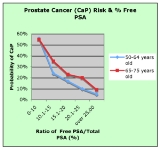
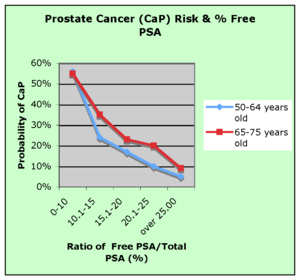
Most PSA in the blood is bound to serum proteins. A small amount is not protein bound and is called 'free PSA'. In men with prostate cancer the ratio of free (unbound) PSA to total PSA is decreased. The risk of cancer increases if the free to total ratio is less than 25%. (See graph at right.) The lower the ratio the greater the probability of prostate cancer. Measuring the ratio of free to total PSA appears to be particularly promising for eliminating unnecessary biopsiesBiopsy
A biopsy is a medical test involving sampling of cells or tissues for examination. It is the medical removal of tissue from a living subject to determine the presence or extent of a disease. The tissue is generally examined under a microscope by a pathologist, and can also be analyzed chemically...
in men with PSA levels between 4 and 10 ng/mL. However, both total and free PSA increase immediately after ejaculation, returning slowly to baseline levels within 24 hours.
PSA in other biologic fluids and tissues
| Fluid | PSA (ng/mL) |
|---|---|
| semen | |
| amniotic fluid | |
| breast milk | |
| saliva | |
| female urine | |
| female serum | |
It is now clear that the term prostate-specific antigen is a misnomer
Misnomer
A misnomer is a term which suggests an interpretation that is known to be untrue. Such incorrect terms sometimes derive their names because of the form, action, or origin of the subject becoming named popularly or widely referenced—long before their true natures were known.- Sources of misnomers...
: it is an antigen
Antigen
An antigen is a foreign molecule that, when introduced into the body, triggers the production of an antibody by the immune system. The immune system will then kill or neutralize the antigen that is recognized as a foreign and potentially harmful invader. These invaders can be molecules such as...
but is not specific to the prostate. Although present in large amounts in prostatic tissue and semen, it has been detected in other body fluids and tissues.
In women, PSA is found in female ejaculate
Female ejaculation
Female ejaculation refers to the expulsion of noticeable amounts of clear fluid by human females from the paraurethral ducts through and around the urethra during or before an orgasm...
at concentrations roughly equal to that found in male semen. Other than semen and female ejaculate, the greatest concentrations of PSA in biological fluids are detected in breast milk and amniotic fluid. Low concentrations of PSA have been identified in the urethral glands, endometrium, normal breast tissue and salivary gland tissue. PSA also is found in the serum of women with breast, lung, or uterine cancer and in some patients with renal cancer.
Tissue samples can be stained for the presence of PSA in order to determine the origin of malignant cells that have metastasized.
Screening
A recent published study concluded "After 20 years of follow-up the rate of death from prostate cancer did not differ significantly between men in the screening group and those in the control group".In the United States, the U.S. Food and Drug Administration (FDA) has approved the PSA test for annual screening of prostate cancer in men of age 50 and older. The patient needs to be informed of the risks and benefits of PSA testing prior to performing the test. PSA levels between 4 and 10 ng/mL (nanograms per milliliter) are considered to be suspicious and consideration should be given to confirming the abnormal PSA with a repeat test. If indicated, prostate biopsy
Prostate biopsy
Prostate biopsy is a procedure in which small samples are removed from a man's prostate gland to be tested for the presence of cancer. It is typically performed when the scores from a PSA blood test rise to a level that is associated with the possible presence of prostate cancer.The procedure,...
is performed to obtain tissue sample for histopathological analysis. The independent US Preventive Services Task Force rated the PSA test as "I", meaning it "found insufficient evidence to recommend either for or against screening"; for men aged 75 years or older, the rating is "D", meaning it found more reasons to advise against it.
In the United Kingdom, the National Health Service does not mandate, nor advise for PSA test, but allows patients to decide based on their doctor's advice.
PSA is false positive-prone (7 out of 10 men in this category will still not have prostate cancer) and false negative-prone (2.5 out of 10 men with prostate cancer have no elevation in PSA). A 1997 report indicated that refraining from ejaculation 24 hours or more prior to testing would improve test accuracy.
Risk stratification and staging
Patients with localized (non-metastatic) prostate cancer have traditionally been characterized as low-, intermediate-, or high-risk for failure of curative treatment and prostate cancer mortality. PSA level is one of three variables on which the risk-stratification is based; the others are the grade of prostate cancer (Gleason score) and the stage of cancer based on clinical investigations (as opposed to examination of surgical pathology). Criteria for each risk category are as follows:- Low-risk: PSA < 10, Gleason score ≤ 6, AND clinical stage ≤ T2a
- Intermediate-risk: PSA 10-20, Gleason score 7, OR clinical stage T2b/c
- High-risk: PSA > 20, Gleason score ≥ 8, OR clinical stage ≥ T3
Researchers are working to identify more accurate prognostic variables for risk-stratification of men with prostate cancer.
Post-treatment monitoring
PSA levels are monitored periodically (usually every 6–12 months) after treatment for prostate cancer. If surgical therapy (i.e., radical prostatectomy) is successful at removing all prostate tissue (and prostate cancer), PSA becomes undetectable within a few weeks. A subsequent rise in PSA level above 0.2 ng/dL is generally regarded as evidence of recurrent prostate cancer after a radical prostatectomy; less commonly, it may simply indicate residual benign prostate tissue.Following radiation therapy of any type for prostate cancer, some PSA levels might be detected, even when the treatment ultimately proves to be successful. This makes it more difficult to interpret the relationship between PSA levels and recurrence/persistence of prostate cancer after radiation therapy. PSA levels may continue to decrease for several years after radiation therapy. The lowest level is referred to as the PSA nadir. A subsequent increase in PSA levels by 2.0 ng/dL above the nadir is the currently accepted definition of prostate cancer recurrence after radiation therapy.
If recurrent prostate cancer is detected by a rise in PSA levels after curative treatment, it is referred to as a "biochemical recurrence". The likelihood of developing recurrent prostate cancer after curative treatment is correlated to various risk factors, such as the grade of prostate cancer (Gleason score), PSA level prior to treatment, and the stage of disease prior to treatment. Patients with low-grade cancer (Gleason score ≤ 6), PSA < 10, and tumors that are not palpable by digital rectal examination are at the lowest risk of recurrence.
Forensic identification of semen
PSA was first identified by researchers attempting to find a substance in seminal fluid that would aid in the investigation of rape cases. PSA is now used to indicate the presence of semenSemen
Semen is an organic fluid, also known as seminal fluid, that may contain spermatozoa. It is secreted by the gonads and other sexual organs of male or hermaphroditic animals and can fertilize female ova...
in forensic serology
Serology
Serology is the scientific study of blood serum and other bodily fluids. In practice, the term usually refers to the diagnostic identification of antibodies in the serum...
. The semen of adult males has PSA levels far in excess of those found in other tissues; therefore, a high level of PSA found in a sample is an indicator that semen may be present. Because PSA is a biomarker that is expressed independently of spermatozoa
Spermatozoon
A spermatozoon is a motile sperm cell, or moving form of the haploid cell that is the male gamete. A spermatozoon joins an ovum to form a zygote...
, it remains useful in identifying semen from vasectomized
Vasectomy
Vasectomy is a surgical procedure for male sterilization and/or permanent birth control. During the procedure, the vasa deferentia of a man are severed, and then tied/sealed in a manner such to prevent sperm from entering into the seminal stream...
and azoospermic
Azoospermia
Azoospermia is the medical condition of a male not having any measurable level of sperm in his semen. It is associated with very low levels of fertility or even sterility, but many forms are amenable to medical treatment...
males.
PSA can also be found at low levels in other body fluids, such as urine and breast milk, thus setting a high minimum threshold of interpretation to rule out false positive
Type I and type II errors
In statistical test theory the notion of statistical error is an integral part of hypothesis testing. The test requires an unambiguous statement of a null hypothesis, which usually corresponds to a default "state of nature", for example "this person is healthy", "this accused is not guilty" or...
results and conclusively state that semen is present. While traditional tests such as crossover electrophoresis
Electrophoresis
Electrophoresis, also called cataphoresis, is the motion of dispersed particles relative to a fluid under the influence of a spatially uniform electric field. This electrokinetic phenomenon was observed for the first time in 1807 by Reuss , who noticed that the application of a constant electric...
have a sufficiently low sensitivity to detect only seminal PSA, newer diagnostics tests developed from clinical prostate cancer screening
Prostate cancer screening
Prostate cancer screening is an attempt to identify individuals with prostate cancer in a broad segment of the population—those for whom there is no reason to suspect prostate cancer. There are two methods used: One is the digital rectal examination , in which the examiner inserts a gloved,...
methods have lowered the threshold of detection down to 4 ng/mL. This level of antigen has been shown to be present in the peripheral blood of males with prostate cancer, and rarely in female urine samples and breast milk. No studies have been performed to assess the PSA levels in the tissues and secretions of pre-pubescent children. Therefore, the presence of PSA from a high sensitivity (4 ng/mL) test cannot conclusively identify the presence of semen, so care must be taken with the interpretation of such results.
Interactions
Prostate-specific antigen has been shown to interactProtein-protein interaction
Protein–protein interactions occur when two or more proteins bind together, often to carry out their biological function. Many of the most important molecular processes in the cell such as DNA replication are carried out by large molecular machines that are built from a large number of protein...
with Protein C inhibitor
Protein C inhibitor
Protein C inhibitor is a serine protease inhibitor which limits the expression of protein C .An N-terminal fragment of PCI is a possible serum biomarker for prostate cancer.-Interactions:...
.
See also
External links
- The MEROPSMeropsMerops may refer to:* Merops , a genus of bee-eaters.* MEROPS, an on-line database for peptidases.It may also refer to several figures from Greek mythology:* King of Ethiopia, husband of Clymene, who lay with Helios and bore Phaethon...
online database for peptidases and their inhibitors: S01.162 - American Cancer Society: Detailed Guide: Prostate Cancer Can Prostate Cancer Be Found Early?
- National Cancer Institute: The Prostate-Specific Antigen (PSA) Test: Questions and Answers
- Prostate UK Help us stop prostate diseases ruining lives