

Powder glass beads

Encyclopedia
Zimbabwe
Zimbabwe is a landlocked country located in the southern part of the African continent, between the Zambezi and Limpopo rivers. It is bordered by South Africa to the south, Botswana to the southwest, Zambia and a tip of Namibia to the northwest and Mozambique to the east. Zimbabwe has three...
, and dated to 970-1000 CE. In our time, the main area of powder glass bead manufacture is West Africa, most importantly, Ghana
Ghana
Ghana , officially the Republic of Ghana, is a country located in West Africa. It is bordered by Côte d'Ivoire to the west, Burkina Faso to the north, Togo to the east, and the Gulf of Guinea to the south...
. The origins of beadmaking in Ghana are unknown, but the great majority of powder glass beads produced today is made by Ashanti and Krobo craftsmen and women. Krobo bead making has been documented to date from as early as the 1920s but despite limited archaeological evidence, it is believed that Ghanaian powder glass bead making dates further back. Bead making in Ghana was first documented by John Barbot in 1746. Beads still play important roles in Krobo society, be it in rituals of birth, coming of age, marriage, or death.
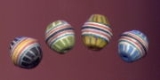
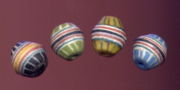
Powder glass beads are made from finely ground glass, the main source being broken and unusable bottles and a great variety of other scrap glasses. Special glasses such as old cobalt medicine bottles, cold cream jars, and many other types of glasses from plates, ashtrays, window panes - to name only a few - are occasionally bought new, just for the purpose. Pulverized or merely fragmented, and made into beads, these glasses yield particularly bright colours and shiny surfaces. Modern ceramic colourants, finely ground broken beads, or shards of different coloured glasses from various sources can be added to create a great variety of styles, designs and decorative patterns in many different colours. In addition, glass bead fragments of varying sizes, which have traditionally been used for the manufacture as well as for the decoration of specific types of beads, can now be found in interesting new combinations, and during the past few years in particular, bead makers have taken this tradition yet another step forward by using entire, i.e. whole small beads for making their colourful bead creations.
Krobo beads
Vertical direction
In astronomy, geography, geometry and related sciences and contexts, a direction passing by a given point is said to be vertical if it is locally aligned with the gradient of the gravity field, i.e., with the direction of the gravitational force at that point...
molds fashioned out of a special, locally dug clay
Clay
Clay is a general term including many combinations of one or more clay minerals with traces of metal oxides and organic matter. Geologic clay deposits are mostly composed of phyllosilicate minerals containing variable amounts of water trapped in the mineral structure.- Formation :Clay minerals...
. Most molds have a number of depressions, designed to hold one bead each, and each of these depressions, in turn, has a small central depression to hold the stem of a cassava
Cassava
Cassava , also called yuca or manioc, a woody shrub of the Euphorbiaceae native to South America, is extensively cultivated as an annual crop in tropical and subtropical regions for its edible starchy tuberous root, a major source of carbohydrates...
leaf. The mold is filled with finely ground glass that can be built up in layers in order to form sequences and patterns of different shapes and colours. The technique could be described as being somewhat similar to creating a sand "painting" or to filling a bottle with different-coloured sands and is called the "vertical-mold dry powder glass technique". When cassava leaf stems are used, these will burn away during firing and leave the bead perforation. Certain powder glass bead variants, however, receive their perforations after firing, by piercing the still hot and pliable glass with a hand-made, pointed metal tool. Firing takes place in clay kiln
Kiln
A kiln is a thermally insulated chamber, or oven, in which a controlled temperature regime is produced. Uses include the hardening, burning or drying of materials...
s until the glass fuses.
There are three distinct styles of modern Krobo powder glass beads:
Beads composed of two halves (usually bicone
Bicone
A bicone or dicone is the three-dimensional geometric shape swept by revolving an isosceles triangle around its edge of unequal length. Alternatively, one can view a bicone as the surface created by joining two identical right circular cones base-to-base....
s, occasionally sphere
Sphere
A sphere is a perfectly round geometrical object in three-dimensional space, such as the shape of a round ball. Like a circle in two dimensions, a perfect sphere is completely symmetrical around its center, with all points on the surface lying the same distance r from the center point...
s) that are being created from pulverized glass. The two halves are being joined together in a second, short firing process.
The "Mue ne Angma" or "Writing Beads", conventional powder glass beads made from finely ground glass, with glass slurry decorations that are being "written" on and fused in a second firing.
Akoso beads
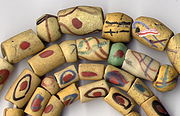
Equator
An equator is the intersection of a sphere's surface with the plane perpendicular to the sphere's axis of rotation and containing the sphere's center of mass....
, exposing a grey core. The most prevalent decorations, preformed from strips of hot glass, were applied in patterns of criss-crossed loops, longitudinal stripes and circles. Glass from crushed Venetian beads was used for making the glass powder, and the decorative patterns were made of glass derived from Venetian beads, or from small whole Venetian beads such as so-called green heart and white-heart beads.
Meteyi beads
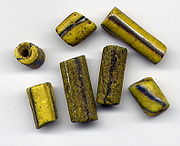
Horizontal plane
In geometry, physics, astronomy, geography, and related sciences, a plane is said to be horizontal at a given point if it is perpendicular to the gradient of the gravity field at that point— in other words, if apparent gravity makes a plumb bob hang perpendicular to the plane at that point.In...
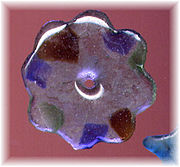
molds. Meteyi beads are often ellipsoid in cross section and they have a rough surface on the side which touched the bottom of the mold during firing. They can be opaque
Opacity (optics)
Opacity is the measure of impenetrability to electromagnetic or other kinds of radiation, especially visible light. In radiative transfer, it describes the absorption and scattering of radiation in a medium, such as a plasma, dielectric, shielding material, glass, etc...
yellow, and more rarely, green, blue or white, with stripe decorations in combinations of blue, yellow, white or red. Manufacture ceased during the 1940s.
Ateyun beads
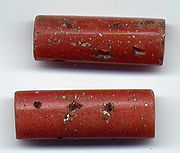
Yoruba people
The Yoruba people are one of the largest ethnic groups in West Africa. The majority of the Yoruba speak the Yoruba language...
from Nigeria
Nigeria
Nigeria , officially the Federal Republic of Nigeria, is a federal constitutional republic comprising 36 states and its Federal Capital Territory, Abuja. The country is located in West Africa and shares land borders with the Republic of Benin in the west, Chad and Cameroon in the east, and Niger in...
. Beads from their production differ technically from typical Ghanaian powder glass beads in that they are not made in molds and in the wet-core technique. Finely crushed glass is moistened with water and shaped by hand. The perforations are made before the beads are fired, using a pointed tool. So-called Ateyun beads were made in different shapes but always in red, to imitate real Mediterranean coral
Coral (precious)
Precious coral or red coral is the common name given to Corallium rubrum and several related species of marine coral. The distinguishing characteristic of precious corals is their durable and intensely colored red or pink skeleton, which is used for making jewelry.-Habitat:Red corals grow on rocky...
. Genuine coral was rare, but very much sought after and highly valued by the Yoruba people. Yoruba bead makers made their own imitations at more affordable prices.
Keta awuazi beads
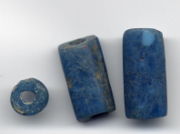
Togo
Togo, officially the Togolese Republic , is a country in West Africa bordered by Ghana to the west, Benin to the east and Burkina Faso to the north. It extends south to the Gulf of Guinea, on which the capital Lomé is located. Togo covers an area of approximately with a population of approximately...
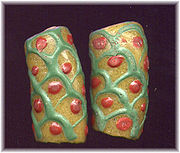
, were made in horizontal molds and mold marks are often evident along their sides. Keta awuazi beads are cylindrical in shape. Manufacture ceased during the 1940s. Krobo bead makers produced similar blue powder glass beads, using glass derived from cold cream jars to achieve the blue colouration.
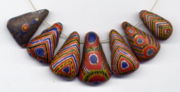
Kiffa beads
External links
- Krobo beadmaker - Nomoda Ebenizer Djaba is a contemporary beadmaker from the Odumasi/Krobo area in Ghana.
- African Krobo Beads - Source for history on African beadwork and Krobo beads.
- Beadmaking Illustrated - Article and pictures on the art of making traditional glass beads in Ghana.