

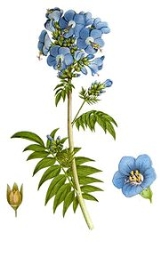
Polemonium caeruleum

Encyclopedia
Jacob's Ladder or Greek valerian (Polemonium caeruleum) is a hardy perennial
flowering plant. The plant produces cup-shaped, lavender-coloured or white flowers. It is native to temperate
regions of Europe
.
2.
s, woodland
s, meadow
s and rocky areas in temperate
areas of Europe.
that is rich in moisture and lime and does not require as much sunlight as other plants. Depending on the conditions, it will need varying amounts of water in the summer. If it is hot summer, the plant may require extra water. If it is an average summer, it probably won't need extra water. Normally hardy, some varieties (e.g. Blue Pearl) behave as tender biennials, which means they are effectively annuals in cooler climates (below hardiness zone
6).
Cultivated varieties include Blue Pearl and Brise d'Anjou. White flowered (Album, White Pearl) and a variegated (Snow and Sapphires)
variety are available.
(Cat
s are attracted to the scent of the plant, particularly younger plants. A person who is growing Greek valerian in a container or home garden should protect the plants if they own a cat.)
agent
and to treat rabies
. Today, the plant is not usually used medically.
of Derbyshire
in 2002 following a poll by the wild plant conservation charity Plantlife
.
Today, the plant is usually used in potpourri
s and is boiled in olive oil
to make black dyes and hair dressing, but it has few other significant uses.
Perennial plant
A perennial plant or simply perennial is a plant that lives for more than two years. The term is often used to differentiate a plant from shorter lived annuals and biennials. The term is sometimes misused by commercial gardeners or horticulturalists to describe only herbaceous perennials...
flowering plant. The plant produces cup-shaped, lavender-coloured or white flowers. It is native to temperate
Temperate
In geography, temperate or tepid latitudes of the globe lie between the tropics and the polar circles. The changes in these regions between summer and winter are generally relatively moderate, rather than extreme hot or cold...
regions of Europe
Europe
Europe is, by convention, one of the world's seven continents. Comprising the westernmost peninsula of Eurasia, Europe is generally 'divided' from Asia to its east by the watershed divides of the Ural and Caucasus Mountains, the Ural River, the Caspian and Black Seas, and the waterways connecting...
.
Growth
The plant usually reaches a height from 45 to 60 centimeters (18 to 24 inches), but some occasionally will be taller than 90 centimeters (35 inches.) The spread of the plant is also 45 to 60 centimeters. It can grow in North American hardiness zoneHardiness zone
A hardiness zone is a geographically defined area in which a specific category of plant life is capable of growing, as defined by climatic conditions, including its ability to withstand the minimum temperatures of the zone...
2.
Habitat
The plant is native to damp grasslandGrassland
Grasslands are areas where the vegetation is dominated by grasses and other herbaceous plants . However, sedge and rush families can also be found. Grasslands occur naturally on all continents except Antarctica...
s, woodland
Woodland
Ecologically, a woodland is a low-density forest forming open habitats with plenty of sunlight and limited shade. Woodlands may support an understory of shrubs and herbaceous plants including grasses. Woodland may form a transition to shrubland under drier conditions or during early stages of...
s, meadow
Meadow
A meadow is a field vegetated primarily by grass and other non-woody plants . The term is from Old English mædwe. In agriculture a meadow is grassland which is not grazed by domestic livestock but rather allowed to grow unchecked in order to make hay...
s and rocky areas in temperate
Temperate
In geography, temperate or tepid latitudes of the globe lie between the tropics and the polar circles. The changes in these regions between summer and winter are generally relatively moderate, rather than extreme hot or cold...
areas of Europe.
Cultivation
The plant normally prefers soilSoil
Soil is a natural body consisting of layers of mineral constituents of variable thicknesses, which differ from the parent materials in their morphological, physical, chemical, and mineralogical characteristics...
that is rich in moisture and lime and does not require as much sunlight as other plants. Depending on the conditions, it will need varying amounts of water in the summer. If it is hot summer, the plant may require extra water. If it is an average summer, it probably won't need extra water. Normally hardy, some varieties (e.g. Blue Pearl) behave as tender biennials, which means they are effectively annuals in cooler climates (below hardiness zone
Hardiness zone
A hardiness zone is a geographically defined area in which a specific category of plant life is capable of growing, as defined by climatic conditions, including its ability to withstand the minimum temperatures of the zone...
6).
Cultivated varieties include Blue Pearl and Brise d'Anjou. White flowered (Album, White Pearl) and a variegated (Snow and Sapphires)
variety are available.
(Cat
Cat
The cat , also known as the domestic cat or housecat to distinguish it from other felids and felines, is a small, usually furry, domesticated, carnivorous mammal that is valued by humans for its companionship and for its ability to hunt vermin and household pests...
s are attracted to the scent of the plant, particularly younger plants. A person who is growing Greek valerian in a container or home garden should protect the plants if they own a cat.)
Historical medical uses
The plant was first used as a medicinal herb in ancient Greece. The ancient Greeks used the root to treat dysentery, toothaches and animal bites. The plant was also found in a few European pharmacies during the nineteenth century and was used as an antisyphiliticSyphilis
Syphilis is a sexually transmitted infection caused by the spirochete bacterium Treponema pallidum subspecies pallidum. The primary route of transmission is through sexual contact; however, it may also be transmitted from mother to fetus during pregnancy or at birth, resulting in congenital syphilis...
agent
Active ingredient
An active ingredient is the substance of a pharmaceutical drug or a pharmaceutical ingredient and bulk active in medicine; in pesticide formulations active substance may be used. Some medications and pesticide products may contain more than one active ingredient...
and to treat rabies
Rabies
Rabies is a viral disease that causes acute encephalitis in warm-blooded animals. It is zoonotic , most commonly by a bite from an infected animal. For a human, rabies is almost invariably fatal if post-exposure prophylaxis is not administered prior to the onset of severe symptoms...
. Today, the plant is not usually used medically.
Other uses
Polemonium caeruleum was voted the County flowerCounty flowers of the United Kingdom
The following are the flowers selected for the historic counties of the United Kingdom in Plantlife's 2002 "County Flowers" campaign...
of Derbyshire
Derbyshire
Derbyshire is a county in the East Midlands of England. A substantial portion of the Peak District National Park lies within Derbyshire. The northern part of Derbyshire overlaps with the Pennines, a famous chain of hills and mountains. The county contains within its boundary of approx...
in 2002 following a poll by the wild plant conservation charity Plantlife
Plantlife
Plantlife is a wild plant conservation charity. As of 2007, its membership was 10,500 and it owned 23 nature reserves around the UK.-History:It was founded in 1989 with its first President being Professor David Bellamy. By 1999 it had 22 nature reserves....
.
Today, the plant is usually used in potpourri
Potpourri
Potpourri is a mixture of dried, naturally fragrant plant material, used to provide a gentle natural scent in houses. It is usually placed in a decorative wooden bowl, or tied in small sachet made from sheer fabric....
s and is boiled in olive oil
Olive oil
Olive oil is an oil obtained from the olive , a traditional tree crop of the Mediterranean Basin. It is commonly used in cooking, cosmetics, pharmaceuticals, and soaps and as a fuel for traditional oil lamps...
to make black dyes and hair dressing, but it has few other significant uses.