


Plymouth Hoe

Encyclopedia
.jpg)
England
England is a country that is part of the United Kingdom. It shares land borders with Scotland to the north and Wales to the west; the Irish Sea is to the north west, the Celtic Sea to the south west, with the North Sea to the east and the English Channel to the south separating it from continental...
coastal city of Plymouth
Plymouth
Plymouth is a city and unitary authority area on the coast of Devon, England, about south-west of London. It is built between the mouths of the rivers Plym to the east and Tamar to the west, where they join Plymouth Sound...
. The Hoe is adjacent to and above the low limestone
Limestone
Limestone is a sedimentary rock composed largely of the minerals calcite and aragonite, which are different crystal forms of calcium carbonate . Many limestones are composed from skeletal fragments of marine organisms such as coral or foraminifera....
cliffs that form the seafront and it commands views of Plymouth Sound
Plymouth Sound
Plymouth Sound, or locally just The Sound, is a bay at Plymouth in England.Its southwest and southeast corners are Penlee Point in Cornwall and Wembury Point on Devon, a distance of about 3 nautical miles . Its northern limit is Plymouth Hoe giving a north-south distance of nearly 3 nautical miles...
, Drake's Island
Drake's Island
Drake's Island is a island lying in Plymouth Sound, the stretch of water south of the city of Plymouth, Devon, England. The rocks which make up the island are volcanic tuff and lava, together with marine limestone of the mid-Devonian period.-Early history:...
, and across the Hamoaze
Hamoaze
The Hamoaze is an estuarine stretch of the tidal River Tamar, between the River Lynher and Plymouth Sound, England.The Hamoaze flows past Devonport Dockyard, which belongs to the Royal Navy...
to Mount Edgcumbe
Mount Edgcumbe
Mount Edgcumbe may refer to:* Mount Edgcumbe Country Park, in Cornwall, United Kingdom* Mount Edgcumbe House, located within Mount Edgcumbe Country Park* Mount Edgecombe, KwaZulu-Natal, a sugar-growing town in KwaZulu-Natal, South Africa...
in Cornwall
Cornwall
Cornwall is a unitary authority and ceremonial county of England, within the United Kingdom. It is bordered to the north and west by the Celtic Sea, to the south by the English Channel, and to the east by the county of Devon, over the River Tamar. Cornwall has a population of , and covers an area of...
. The name derives from the Anglo-Saxon
Old English language
Old English or Anglo-Saxon is an early form of the English language that was spoken and written by the Anglo-Saxons and their descendants in parts of what are now England and southeastern Scotland between at least the mid-5th century and the mid-12th century...
word Hoe, a sloping ridge shaped like an inverted foot and heel.
History
Until the early 17th century large outline images of the giants Gog and MagogGog and Magog
Gog and Magog are names that appear primarily in various Jewish, Christian and Muslim scriptures, as well as numerous subsequent references in other works. Their context can be either genealogical or eschatological and apocalyptic, as in Ezekiel and Revelation...
(or Goemagot and Corineus) had for a long time been cut into the turf of the Hoe exposing the white limestone beneath. These figures were periodically re-cut and cleaned. No trace of them remains today, but this likely commemorates the Cornish
Cornwall
Cornwall is a unitary authority and ceremonial county of England, within the United Kingdom. It is bordered to the north and west by the Celtic Sea, to the south by the English Channel, and to the east by the county of Devon, over the River Tamar. Cornwall has a population of , and covers an area of...
foundation myth, being the point, Lam Goemagot - the Giant's Leap - from which the Giant was cast into the sea by the hero Corin.
Plymouth Hoe is perhaps best known for the probably apocryphal story that Sir Francis Drake
Francis Drake
Sir Francis Drake, Vice Admiral was an English sea captain, privateer, navigator, slaver, and politician of the Elizabethan era. Elizabeth I of England awarded Drake a knighthood in 1581. He was second-in-command of the English fleet against the Spanish Armada in 1588. He also carried out the...
played his famous game of bowls
Bowls
Bowls is a sport in which the objective is to roll slightly asymmetric balls so that they stop close to a smaller "jack" or "kitty". It is played on a pitch which may be flat or convex or uneven...
here in 1588 before sailing out with the English fleet to engage with the Spanish Armada
Spanish Armada
This article refers to the Battle of Gravelines, for the modern navy of Spain, see Spanish NavyThe Spanish Armada was the Spanish fleet that sailed against England under the command of the Duke of Medina Sidonia in 1588, with the intention of overthrowing Elizabeth I of England to stop English...
. The British Library holds a 1591 Spry map of Plimmouth from this era.
A Tudor
Tudor
- Architecture :*Tudor architecture, the final development of medieval architecture during the Tudor period *Tudor Revival architecture, also called Mock Tudor, refers to the 20th century emulation of Tudor architecture-Entertainment:...
fortress guarded the neck of water between the eastern Hoe and Mount Batten
Mount Batten
Mount Batten is a 24-metre-tall outcrop of rock on a 600-metre peninsula in Plymouth Sound, Devon, England.After some redevelopment which started with the area coming under the control of the Plymouth Development Corporation for five years from 1993, the peninsula now has a marina and centre for...
and some sheer granite and limestone cannon points remain, however in the late 1660s, following The Restoration, a massive star-shaped stone fortress known as the Royal Citadel
Royal Citadel, Plymouth
The Royal Citadel in Plymouth, Devon, England, was built in the late 1660s to the design of Sir Bernard de Gomme. It is at the eastern end of Plymouth Hoe overlooking Plymouth Sound, and encompasses the site of the earlier fort that had been built in the time of Sir Francis Drake.During the Dutch...
, was constructed to replace it. Its purpose was to protect the port and probably also to intimidate the townsfolk who had leaned towards Parliament during the Civil War
English Civil War
The English Civil War was a series of armed conflicts and political machinations between Parliamentarians and Royalists...
.. It remains occupied by the military.
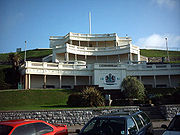
Camera obscura
The camera obscura is an optical device that projects an image of its surroundings on a screen. It is used in drawing and for entertainment, and was one of the inventions that led to photography. The device consists of a box or room with a hole in one side...
, probably built in the 1830s, which showed views of the harbour. Below this site was the Bull Ring (now a memorial garden), and a grand pleasure pier, started in 1880, which provided a dance hall, refreshment, promenading and a landing place for boat trips. The pier was destroyed by German bombing in World War II.
There is an imposing series of Victorian terraces to the west of the naval memorial which previously continued to the Grand Hotel and, until it was destroyed by bombing, the grand clubhouse of the Royal Western Yacht Club. The club then merged with the Royal Southern and occupied that club's older premises which it had created from the regency public steam baths by the basin at West Hoe before the rejuvenated club moved in the late 1980s to Queen Anne Battery.
Landmarks
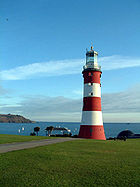
Smeaton's Tower
Smeaton's Tower is the third and most notable Eddystone Lighthouse. It marked a major step forward in the design of lighthouses. In use until 1877, it was largely dismantled and rebuilt on Plymouth Hoe in the city of Plymouth, Devon where it now stands as a memorial to its designer, John Smeaton,...
. This is the upper portion of John Smeaton
John Smeaton
John Smeaton, FRS, was an English civil engineer responsible for the design of bridges, canals, harbours and lighthouses. He was also a capable mechanical engineer and an eminent physicist...
's Eddystone Lighthouse
Eddystone Lighthouse
Eddystone Lighthouse is on the treacherous Eddystone Rocks, south west of Rame Head, United Kingdom. While Rame Head is in Cornwall, the rocks are in Devon and composed of Precambrian Gneiss....
, which was originally built on the Eddystone Rocks
Eddystone
See also Eddystone Rock, Falklands Islands and Eddystone, PennsylvaniaThe Eddystone, or the Eddystone Rocks, are a seaswept group of rocks situated some 9 statute miles south west of Rame Head in Cornwall, England, United Kingdom...
(22.5 km south) in 1759. It was dismantled in 1877 and moved, stone by stone, to the Hoe where it was re-erected.
Smeaton's Tower overlooks Tinside Pool
Tinside Pool
Tinside Pool is a unique 1935 Art Deco lido in the city of Plymouth in south-west England.It is sited beside Plymouth Sound and is overlooked by Plymouth Hoe and Smeaton's Tower...
, an unusual 1930s outdoor lido
Lido
The Lido is an 11 km long sandbar located in Venice, northern Italy, home to about 20,000 residents. The Venice Film Festival takes place at the Lido every September.-Geography:...
which sits upon the limestone shoreline at the base of the cliff. Most of the works to create the swimming areas and Madeira Road were carried out to make work for the local unemployed during the Depression.
A statue of Sir Francis Drake by Joseph Boehm
Joseph Boehm
Sir Joseph Edgar Boehm, 1st Baronet, RA was a medallist and sculptor, best known for the Jubilee head of Queen Victoria on coinage, and the statue of the Duke of Wellington at Hyde Park Corner.-Biography:...
(a copy of the original in his home town of Tavistock) was placed here in 1884 to commemorate him. There are also several war memorials along the northern side of the Hoe. The largest commemorates the Royal Naval dead of the two world wars; its central obelisk is by Robert Lorimer
Robert Lorimer
Sir Robert Stodart Lorimer was a prolific Scottish architect noted for his restoration work on historic houses and castles, and for promotion of the Arts and Crafts style.-Early life:...
and was unveiled in 1924, while the surrounding sunken garden was added by Edward Maufe
Edward Maufe
Sir Edward Brantwood Maufe KBE, R.A, F.R.I.B.A. was an English architect and designer, noted chiefly for his work on places of worship and remembrance memorials. He was a skilled interior designer and designed many pieces of furniture...
in 1954.
The Hoe also includes a long broad tarmacked promenade (currently a disabled motorists car park) which serves as a spectacular military
Military
A military is an organization authorized by its greater society to use lethal force, usually including use of weapons, in defending its country by combating actual or perceived threats. The military may have additional functions of use to its greater society, such as advancing a political agenda e.g...
parade ground and which is often used for displays by Plymouth based Royal Navy
Royal Navy
The Royal Navy is the naval warfare service branch of the British Armed Forces. Founded in the 16th century, it is the oldest service branch and is known as the Senior Service...
, Royal Marines, the Army garrison, as well as for funfair
Funfair
A funfair or simply "fair" is a small to medium sized travelling show primarily composed of stalls and other amusements. Larger fairs such as the permanent fairs of cities and seaside resorts might be called a fairground, although technically this should refer to the land where a fair is...
s and open-air concert
Concert
A concert is a live performance before an audience. The performance may be by a single musician, sometimes then called a recital, or by a musical ensemble, such as an orchestra, a choir, or a musical band...
s.
Set into the shape of the southern sea facing fortifications of the Royal Citadel
Royal Citadel, Plymouth
The Royal Citadel in Plymouth, Devon, England, was built in the late 1660s to the design of Sir Bernard de Gomme. It is at the eastern end of Plymouth Hoe overlooking Plymouth Sound, and encompasses the site of the earlier fort that had been built in the time of Sir Francis Drake.During the Dutch...
is the world-renowned Marine Biological Laboratory and below and to the east, perched on the rocky foreshore is the clubhouse of the Royal Plymouth Corinthian Yacht Club.
Tourism
The Hoe is a popular area for Plymothians and visitors. There is always a great deal of activity on the water, including frequent warship movements, ferries going and coming from France and Spain, fishing trawlers and a swarm of larger and smaller sailing boats. The Fastnet yacht raceFastnet race
The Fastnet Race is a famous offshore yachting race. It is considered one of the classic offshore races. It takes place every two years over a course of . The race starts off Cowes on the Isle of Wight in England, rounds the Fastnet Rock off the southwest coast of Ireland and then finishes at...
ends here. The annual two-day British Firework Championships attracts tens of thousands of spectators.
For forty years, there has been controversy about development on the edges of the Hoe green space. The erection of two discount hotel chain box buildings, at the southern end of Armada Way and the other at the Sound end of Leigham Street, contrast with their Victorian surroundings. The former Grand Hotel is being converted into luxury flats, and the long derelict yacht club site has now been filled by a modern block of flats. The Plymouth Dome, a turret and domed building, built into a small old quarry site above Tinside as an historical theme tourist attraction, failed to attract enough tourists or locals and closed in 2006. As of 2008, it may be demolished.