

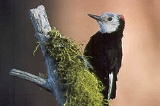
Picoides

Encyclopedia
Picoides is a genus
of woodpeckers (family
Picidae
) found primarily in North America
. The plumage in most species is predominantly black and white, brown and white in some southern species, with the male often having a red (or yellow) badge. Their bills
are straight and chisel-shaped. Although in the four-toed species, the toes normally have a zygodactyl or yoked arrangement while on the ground, one toe can be rotated forward for climbing. Some species in this genus are three-toed. All species in this genus feed mainly on insect
s.
and the Checkered Woodpecker
- have turned out to belong in Veniliornis
, a genus most closely related to Picoides. On the other hand, the Smoky-brown Woodpecker
(Veniliornis fumigatus) seems to be an early offshoot of Picoides. Its unique coloration (similar to the unrelated Okinawa Woodpecker
) would be an adaptation to dense forest habitat, although due to its distinctiveness it is not inconceivable that it belongs into a genus of its own and merely is a case of molecular convergence
. The American Three-toed Woodpecker was until recently considered conspecific with the Eurasia
n one (Sibley & Monroe 1990), and the Lesser Spotted Woodpecker
is often placed in the genus Dendrocopos
. Indeed, that genus is sometimes merged into Picoides, but this is neither generally accepted nor well supported.
Analysis of mtDNA COI
and Cyt b sequences
suggests that Picoides is really three genera (Moore et al., 2006). One is a group of small four-toed species and the Eurasian P. minor, whereas the other group unites the larger species and would include the Smoky-brown Woodpecker. The three-toed species consititute a different lineage closer to some species of Dendrocopos.
All three groups are notable for the high degree of convergent evolution
in plumage patterns existing between them (Weibel & Moore, 2005; Moore et al., 2006). There are several pairs of species from different groups which are almost alike; the most notable example is the Downy
and Hairy Woodpecker
s, which are not closely related but independently evolved a plumage pattern that is identical down to minor details.
Genus
In biology, a genus is a low-level taxonomic rank used in the biological classification of living and fossil organisms, which is an example of definition by genus and differentia...
of woodpeckers (family
Family (biology)
In biological classification, family is* a taxonomic rank. Other well-known ranks are life, domain, kingdom, phylum, class, order, genus, and species, with family fitting between order and genus. As for the other well-known ranks, there is the option of an immediately lower rank, indicated by the...
Picidae
Picidae
The woodpeckers, piculets and wrynecks are a family, Picidae, of near-passerine birds. Members of this family are found worldwide, except for Australia and New Zealand, Madagascar, and the extreme polar regions...
) found primarily in North America
North America
North America is a continent wholly within the Northern Hemisphere and almost wholly within the Western Hemisphere. It is also considered a northern subcontinent of the Americas...
. The plumage in most species is predominantly black and white, brown and white in some southern species, with the male often having a red (or yellow) badge. Their bills
Beak
The beak, bill or rostrum is an external anatomical structure of birds which is used for eating and for grooming, manipulating objects, killing prey, fighting, probing for food, courtship and feeding young...
are straight and chisel-shaped. Although in the four-toed species, the toes normally have a zygodactyl or yoked arrangement while on the ground, one toe can be rotated forward for climbing. Some species in this genus are three-toed. All species in this genus feed mainly on insect
Insect
Insects are a class of living creatures within the arthropods that have a chitinous exoskeleton, a three-part body , three pairs of jointed legs, compound eyes, and two antennae...
s.
Systematics
The genus is in need of revision. Two species which have a somewhat different color pattern, especially on the head and neck - the StripedStriped Woodpecker
The Striped Woodpecker is a woodpecker found in southwestern South America. It occurs northwest- and southwestwards of the range of its sister taxon, the Checkered Woodpecker, in the Cordillera Patagonica and its foothills, and in another population in the Andes of Bolivia and the adjacent...
and the Checkered Woodpecker
Checkered Woodpecker
The Checkered Woodpecker, Veniliornis mixtus, is a woodpecker found in eastern South America.This bird is about 5½ inches long...
- have turned out to belong in Veniliornis
Veniliornis
Veniliornis is a genus of bird in the Picidae family. The Smoky-brown Woodpecker, previously V. fumigatus, is now provisionally in the paraphyletic Picoides, while two other species have been moved from there to the present genus....
, a genus most closely related to Picoides. On the other hand, the Smoky-brown Woodpecker
Smoky-brown Woodpecker
The Smoky-brown Woodpecker or Brown Woodpecker is a species of bird in the Picidae family.It is found in Argentina, Belize, Bolivia, Colombia, Costa Rica, Ecuador, El Salvador, Guatemala, Honduras, Mexico, Nicaragua, Panama, Peru, and Venezuela.-Habitat:Its natural habitats are subtropical or...
(Veniliornis fumigatus) seems to be an early offshoot of Picoides. Its unique coloration (similar to the unrelated Okinawa Woodpecker
Okinawa Woodpecker
The is a woodpecker endemic to the island of Okinawa in Japan. It is the only member of the genus Sapheopipo.This is a medium-sized , dark woodpecker. It is dark brown in color with red-tipped feathers. It has white spots on the primaries. The head is a paler brown, with a dark red crown on the...
) would be an adaptation to dense forest habitat, although due to its distinctiveness it is not inconceivable that it belongs into a genus of its own and merely is a case of molecular convergence
Convergent evolution
Convergent evolution describes the acquisition of the same biological trait in unrelated lineages.The wing is a classic example of convergent evolution in action. Although their last common ancestor did not have wings, both birds and bats do, and are capable of powered flight. The wings are...
. The American Three-toed Woodpecker was until recently considered conspecific with the Eurasia
Eurasia
Eurasia is a continent or supercontinent comprising the traditional continents of Europe and Asia ; covering about 52,990,000 km2 or about 10.6% of the Earth's surface located primarily in the eastern and northern hemispheres...
n one (Sibley & Monroe 1990), and the Lesser Spotted Woodpecker
Lesser Spotted Woodpecker
The Lesser Spotted Woodpecker is a member of the woodpecker family Picidae. It is assigned to the genus Dendrocopos ....
is often placed in the genus Dendrocopos
Dendrocopos
Dendrocopos is a widespread genus of woodpeckers from Asia and Europe and Northern Africa. They range from the Philippines to the British Isles.-Species:* Sulawesi Pygmy Woodpecker, Dendrocopos temminckii...
. Indeed, that genus is sometimes merged into Picoides, but this is neither generally accepted nor well supported.
Analysis of mtDNA COI
Cytochrome c oxidase
The enzyme cytochrome c oxidase or Complex IV is a large transmembrane protein complex found in bacteria and the mitochondrion.It is the last enzyme in the respiratory electron transport chain of mitochondria located in the mitochondrial membrane...
and Cyt b sequences
DNA sequence
The sequence or primary structure of a nucleic acid is the composition of atoms that make up the nucleic acid and the chemical bonds that bond those atoms. Because nucleic acids, such as DNA and RNA, are unbranched polymers, this specification is equivalent to specifying the sequence of...
suggests that Picoides is really three genera (Moore et al., 2006). One is a group of small four-toed species and the Eurasian P. minor, whereas the other group unites the larger species and would include the Smoky-brown Woodpecker. The three-toed species consititute a different lineage closer to some species of Dendrocopos.
All three groups are notable for the high degree of convergent evolution
Convergent evolution
Convergent evolution describes the acquisition of the same biological trait in unrelated lineages.The wing is a classic example of convergent evolution in action. Although their last common ancestor did not have wings, both birds and bats do, and are capable of powered flight. The wings are...
in plumage patterns existing between them (Weibel & Moore, 2005; Moore et al., 2006). There are several pairs of species from different groups which are almost alike; the most notable example is the Downy
Downy Woodpecker
The Downy Woodpecker is a species of woodpecker, the smallest in North America.- Description :Adult Downy Woodpeckers are mainly black on the upperparts and wings, with a white back, throat and belly and white spotting on the wings. There is a white bar above the eye and one below. They have a...
and Hairy Woodpecker
Hairy Woodpecker
The Hairy Woodpecker is a medium-sized woodpecker, averaging approximately 250 mm in length with a 380 mm wingspan...
s, which are not closely related but independently evolved a plumage pattern that is identical down to minor details.
- Small group
- Downy WoodpeckerDowny WoodpeckerThe Downy Woodpecker is a species of woodpecker, the smallest in North America.- Description :Adult Downy Woodpeckers are mainly black on the upperparts and wings, with a white back, throat and belly and white spotting on the wings. There is a white bar above the eye and one below. They have a...
, Picoides pubescens - Nuttall's WoodpeckerNuttall's WoodpeckerNuttall's Woodpecker, Picoides nuttallii, is a species of woodpecker named after naturalist Thomas Nuttall in 1843. They are found in oak woodlands of California and are similar to the Ladder-backed Woodpecker in terms of genetics and in appearance. -Description:Nuttall’s Woodpecker has black...
, Picoides nuttallii - Ladder-backed WoodpeckerLadder-backed WoodpeckerThe Ladder-backed Woodpecker is a North American woodpecker.-Range and habitat:The Ladder-backed Woodpecker is fairly common in dry brushy areas and thickets and has a rather large range...
, Picoides scalaris
- Downy Woodpecker
- Large group
- Red-cockaded WoodpeckerRed-cockaded WoodpeckerThe Red-cockaded Woodpecker is a woodpecker found in southeastern North America.- Description :About the size of the Northern Cardinal, it is approximately 8.5 in. long, with a wingspan of about 14 in. and a weight of about 1.5 ounces...
, Picoides borealis - Smoky-brown WoodpeckerSmoky-brown WoodpeckerThe Smoky-brown Woodpecker or Brown Woodpecker is a species of bird in the Picidae family.It is found in Argentina, Belize, Bolivia, Colombia, Costa Rica, Ecuador, El Salvador, Guatemala, Honduras, Mexico, Nicaragua, Panama, Peru, and Venezuela.-Habitat:Its natural habitats are subtropical or...
, Picoides fumigatus - formerly in Veniliornis - Hairy WoodpeckerHairy WoodpeckerThe Hairy Woodpecker is a medium-sized woodpecker, averaging approximately 250 mm in length with a 380 mm wingspan...
, Picoides villosus - White-headed WoodpeckerWhite-headed WoodpeckerThe White-headed Woodpecker is a non-migratory woodpecker that resides in pine forests of the mountains of western North America. It has a black body and white head. It has white primary feathers that form a crescent in flight...
, Picoides albolarvatus - Strickland's WoodpeckerStrickland's WoodpeckerThe Strickland's Woodpecker is a medium-sized species of woodpecker endemic to Mexico. The Arizona Woodpecker The Strickland's Woodpecker (Picoides stricklandi) is a medium-sized species of woodpecker endemic to Mexico. The Arizona Woodpecker The Strickland's Woodpecker (Picoides stricklandi) is...
, Picoides stricklandi - Arizona WoodpeckerArizona WoodpeckerThe Arizona Woodpecker is a woodpecker native to southern Arizona and New Mexico and the Sierra Madre Occidental of western Mexico...
, Picoides arizonae
- Red-cockaded Woodpecker
- Three-toed group (Picoides sensu stricto)
- Eurasian Three-toed WoodpeckerEurasian Three-toed WoodpeckerThe Three-toed Woodpecker, Picoides tridactylus, is a medium-sized woodpecker.The adult is 21.5-24 cm in length. It is black on the head, wings and rump, and white from the throat to the belly; the flanks are white with black bars. The back is white with black bars, and the tail is black with the...
, Picoides tridactylus - American Three-toed WoodpeckerAmerican Three-toed WoodpeckerThe American Three-toed woodpecker, Picoides dorsalis is a medium-sized woodpecker .This woodpecker has a length of 21 cm and a wingspan of 38 cm and closely resembles the Black-backed Woodpecker, which is also three-toed. Until recently, it was considered to be the same species as the Eurasian...
, Picoides dorsalis - Black-backed WoodpeckerBlack-backed WoodpeckerThe Black-backed Woodpecker also known as the Arctic Three-toed Woodpecker is a medium-sized woodpecker inhabiting the forests of North America. It is a medium sized woodpecker ....
, Picoides arcticus
- Eurasian Three-toed Woodpecker