
All Topics  
Phenols


   Email Print
   Bookmark   Link


Phenols


In organic chemistry
Organic chemistry

Organic chemistry is a discipline within chemistry which involves the science study of the structure, properties, composition, chemical reaction, and preparation of chemical compounds that contain carbon....
, phenols, sometimes called phenolics, are a class of chemical compound
Chemical compound

A chemical compound is a Chemical substance consisting of two or more different chemical element Chemical bond together in a fixed mass ratio that can be split into simpler substances....
s consisting of a hydroxyl
Hydroxyl

Hydroxyl in chemistry stands for a molecule consisting of an oxygen atom and a hydrogen atom connected by a covalent bond. The neutral form is a hydroxyl Radical and the hydroxyl anion is called a hydroxide....
 group
Functional group

In organic chemistry, functional groups are specific groups of atoms within molecules that are responsible for the characteristic chemical reactions of those molecules....
 (-O
Oxygen

Oxygen no O2 produced; 2) O2 produced, but absorbed in oceans & seabed rock; 3) O2 starts to gas out of the oceans, but is absorbed by land surfaces and formation of ozone layer; 4-5) O2 sinks filled and the gas accumulates]]...
 H
Hydrogen

Hydrogen is the chemical element with atomic number 1. It is represented by the chemical symbol H. At standard temperature and pressure, hydrogen is a colorless, odorless, nonmetallic, tasteless, highly combustion and explosive Diatomic molecule gas with the molecular formula H2....
) attached to an aromatic hydrocarbon
Aromatic hydrocarbon

An aromatic hydrocarbon or arene is a hydrocarbon, of which the molecular structure incorporates one or more planar sets of six carbon atoms that are connected by delocalised electrons numbering the same as if they consisted of alternating single and double covalent bonds....
 group. The simplest of the class is phenol
Phenol

Phenol, also known as carbolic acid, is a toxic, white crystalline solid with a sweet tarry odor, commonly referred to as a "hospital smell"....
 (C6H5OH). Although similar to alcohol
Alcohol

In chemistry, an alcohol is any organic compound in which a hydroxyl Functional group is bound to a carbon atom of an alkyl or substituted alkyl group....
s, phenols have unique properties and are not classified as alcohols (since the hydroxyl group is not bonded to a saturated carbon atom).


Discussion
Ask a question about 'Phenols'
Start a new discussion about 'Phenols'
Answer questions from other users
Full Discussion Forum


Recent Posts


Encyclopedia


In organic chemistry
Organic chemistry

Organic chemistry is a discipline within chemistry which involves the science study of the structure, properties, composition, chemical reaction, and preparation of chemical compounds that contain carbon....
, phenols, sometimes called phenolics, are a class of chemical compound
Chemical compound

A chemical compound is a Chemical substance consisting of two or more different chemical element Chemical bond together in a fixed mass ratio that can be split into simpler substances....
s consisting of a hydroxyl
Hydroxyl

Hydroxyl in chemistry stands for a molecule consisting of an oxygen atom and a hydrogen atom connected by a covalent bond. The neutral form is a hydroxyl Radical and the hydroxyl anion is called a hydroxide....
 group
Functional group

In organic chemistry, functional groups are specific groups of atoms within molecules that are responsible for the characteristic chemical reactions of those molecules....
 (-O
Oxygen

Oxygen no O2 produced; 2) O2 produced, but absorbed in oceans & seabed rock; 3) O2 starts to gas out of the oceans, but is absorbed by land surfaces and formation of ozone layer; 4-5) O2 sinks filled and the gas accumulates]]...
 H
Hydrogen

Hydrogen is the chemical element with atomic number 1. It is represented by the chemical symbol H. At standard temperature and pressure, hydrogen is a colorless, odorless, nonmetallic, tasteless, highly combustion and explosive Diatomic molecule gas with the molecular formula H2....
) attached to an aromatic hydrocarbon
Aromatic hydrocarbon

An aromatic hydrocarbon or arene is a hydrocarbon, of which the molecular structure incorporates one or more planar sets of six carbon atoms that are connected by delocalised electrons numbering the same as if they consisted of alternating single and double covalent bonds....
 group. The simplest of the class is phenol
Phenol

Phenol, also known as carbolic acid, is a toxic, white crystalline solid with a sweet tarry odor, commonly referred to as a "hospital smell"....
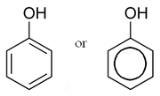
 (C6H5OH).
Phenol Chemical Structure
Although similar to alcohol
Alcohol

In chemistry, an alcohol is any organic compound in which a hydroxyl Functional group is bound to a carbon atom of an alkyl or substituted alkyl group....
s, phenols have unique properties and are not classified as alcohols (since the hydroxyl group is not bonded to a saturated carbon atom). They have relatively higher acid
Acid

An acid is traditionally considered any chemical compound that, when dissolved in water, gives a solution with a hydrogen ion Activity greater than in pure water, i.e....
ities due to the aromatic ring's tight coupling with the oxygen and a relatively loose bond between the oxygen
Oxygen

Oxygen no O2 produced; 2) O2 produced, but absorbed in oceans & seabed rock; 3) O2 starts to gas out of the oceans, but is absorbed by land surfaces and formation of ozone layer; 4-5) O2 sinks filled and the gas accumulates]]...
 and hydrogen
Hydrogen

Hydrogen is the chemical element with atomic number 1. It is represented by the chemical symbol H. At standard temperature and pressure, hydrogen is a colorless, odorless, nonmetallic, tasteless, highly combustion and explosive Diatomic molecule gas with the molecular formula H2....
. The acidity of the hydroxyl group in phenols is commonly intermediate between that of aliphatic alcohols and carboxylic acid
Carboxylic acid

Carboxylic acids are organic acids characterized by the presence of a carboxyl group, which has the Chemical formula -COH, usually written -COOH or -CO2H....
s (their pKa is usually between 10 and 12). Loss of a positive hydrogen ion (H+) from the hydroxyl group of a phenol forms a negative phenolate ion.

Some phenols are germicidal and are used in formulating disinfectants. Others possess estrogen
Estrogen

Estrogens are a group of steroid compounds, named for their importance in the estrous cycle, and functioning as the primary female sex hormone....
ic or endocrine disrupting
Endocrine disruptor

Endocrine disruptors are exogenous substances that act like hormones in the endocrine system and disrupt the physiologic function of endogenous hormones....
 activity.

Synthesis of phenols

Several laboratory methods for the synthesis of phenols:
  • by an ester rearrangement in the Fries rearrangement
    Fries rearrangement

    The Fries rearrangement, named for the German chemist Karl Theophil Fries, is a rearrangement reaction of a phenyl ester to a hydroxy aryl ketone by catalysis of lewis acids....
  • by a rearrangement of N-phenylhydroxylamines in the Bamberger rearrangement
    Bamberger rearrangement

    The Bamberger rearrangement is the chemical reaction of N-phenylhydroxylamines with strong aqueous acid, which will rearrangement reaction to give 4-aminophenols....
  • by hydrolysis
    Hydrolysis

    Hydrolysis is a chemical reaction during which one or more water are split into hydrogen and hydroxide ions which may go on to participate in further reactions....
     of phenolic ester
    Ester

    An ester is an often Aroma compound organic chemistry or partially organic compound formed by the reaction between an acid and an alcohol or aromatic alcohol with the elimination of water....
    s or ether
    Ether

    Ether is a class of organic compounds which contain an ether functional group ? an oxygen atom connected to two alkyl or aryl groups ? of general formula R?O?R....
    s
  • by reduction of quinone
    Quinone

    Quinones are "compounds having a fully conjugated cyclic Diketone structure, such as that of benzoquinones, derived from aromatic compounds by conversion of an even number of ?CH= groups into ?C? groups with any necessary rearrangement of double bonds ."...
    s
  • by replacement of an aromatic amine by an hydroxyl group with water and sodium bisulfide in the Bucherer reaction
    Bucherer reaction

    The Bucherer reaction in organic chemistry is the reversible conversion of Naphthol to naphtylamine in presence of ammonia and sodium bisulfite ....
  • by hydrolysis
    Hydrolysis

    Hydrolysis is a chemical reaction during which one or more water are split into hydrogen and hydroxide ions which may go on to participate in further reactions....
     of diazonium salts
  • by oligomerisation with formaldehyde + base catalysed reaction with epichlorohydrine to epoxi resin components
  • by reaction with acetone/ketones to e.g. Bisphenol A
    Bisphenol A

    Bisphenol A, commonly abbreviated as BPA, is an organic compound with two phenol functional groups. It is a difunctional building block of several important plastics and plastic additives....
    , an important monomer for resins, e.g. polycarbonate(PC), epoxi resins
  • by a rearrangement reaction
    Rearrangement reaction

    A rearrangement reaction is a broad class of organic reactions where the carbon skeleton of a molecule is rearranged to give a structural isomer of the original molecule ....
     of dienones in the dienone phenol rearrangement :

Reactions of phenols

Phenols react in a wide variety of ways.
  • Esterfication reactions and ether
    Ether

    Ether is a class of organic compounds which contain an ether functional group ? an oxygen atom connected to two alkyl or aryl groups ? of general formula R?O?R....
     formation
  • Electrophilic aromatic substitution
    Electrophilic aromatic substitution

    Electrophilic aromatic substitution or EAS is an organic reaction in which an atom, usually hydrogen, appended to an aromatic ring is replaced by an electrophile....
    s as the hydroxyl group is activating
    Activating group

    In organic chemistry, a functional group is called an activating group if a benzene molecule to which it is attached more readily participates in electrophilic substitution reactions....
    , for example synthesis of calixarene
    Calixarene

    A calixarene is a macrocycle or Cyclic compound oligomer based on a hydroxyalkylation product of a phenol and an aldehyde [1]. The word calixarene is derived from calix or Chalice because this type of molecule resembles a vase and from the word arene that refers to the aromatic building block....
    s
  • Reaction of naphtols and hydrazines and sodium bisulfite in the Bucherer carbazole synthesis
    Bucherer carbazole synthesis

    The Bucherer carbazole synthesis is a chemical reaction used to synthesize carbazoles from naphthols and aryl hydrazines using sodium bisulfite....
  • Oxidative cleavage, for instance cleavage of 1,2-dihydroxybenzene to the monomethylester of 2,4 hexadienedioic acid with oxygen, copper chloride in pyridine
  • Oxidative de-aromatization to quinone
    Quinone

    Quinones are "compounds having a fully conjugated cyclic Diketone structure, such as that of benzoquinones, derived from aromatic compounds by conversion of an even number of ?CH= groups into ?C? groups with any necessary rearrangement of double bonds ."...
    s also known as the Teuber reaction. Oxidizing reagents are Fremy's salt
    Fremy's salt

    Fr?my's salt, discovered in 1845 by Edmond Fr?my , is a chemical compound and a strong organic oxidation agent. The formal name is disodium nitrosodisulfonic acid or Na2NO2, but the expression "Fr?my's salt" refers equally well to potassium nitrosodisulfonate, also known as potassium peroxylamine disulfonate....
      and oxone . In reaction depicted below 3,4,5-trimethylphenol reacts with singlet oxygen
    Singlet oxygen

    Singlet oxygen is the common name used for the diamagnetic form of molecular oxygen , which is less stable than the normal triplet oxygen. Because of its unusual properties, singlet oxygen can persist for over an hour at room temperature, depending on the environment....
     generated from oxone/sodium carbonate
    Sodium carbonate

    Sodium carbonate , , is a sodium salt of carbonic acid. It most commonly occurs as a crystalline heptahydrate, which readily efflorescence to form a white powder, the monohydrate....
     in an acetonitrile
    Acetonitrile

    Acetonitrile is the chemical compound with chemical formula CH3CN. This colourless liquid is the simplest organic nitrile and is widely used as a solvent....
    /water mixture to a para-peroxyquinole. This hydroperoxide is reduced to the quinole with sodium thiosulfate
    Sodium thiosulfate

    Sodium thiosulfate , also spelled Sodium thiosulphate, is a colorless crystalline compound that is more familiar as the pentahydrate, Sodium2Sulfur2Oxygen3?5Hydrogen2Oxygen, an efflorescent, monoclinic crystalline substance also called sodium hyposulfite or ?hypo.?...
    .
  • Phenols are oxidized to phediols in the Elbs persulfate oxidation
    Elbs persulfate oxidation

    The Elbs persulfate oxidation is the organic reaction of phenols with alkaline potassium persulfate to form Aromatic para position-diphenols....


  • Phenolate anions (deriving from phenols by the loss of H+) can act as ligands towards metal cations


Phenolic compounds

For a full list, see :Category:Phenols


Phenol
Phenol

Phenol, also known as carbolic acid, is a toxic, white crystalline solid with a sweet tarry odor, commonly referred to as a "hospital smell"....
the parent compound, used as an and for chemical synthesis
Chemical synthesis

In chemistry, chemical synthesis is purposeful execution of chemical reactions in order to get a product , or several products. This happens by physics and chemical manipulations usually involving one or more reactions....
BHT
BHT

BHT may refer to:* British Home Tutors, a group of teachers who provide home tuition in central London* Butylated hydroxytoluene, an organic compound primarily used as an antioxidant food additive...
(butylated hydroxytoluene) - a fat-soluble antioxidant
Antioxidant

An antioxidant is a molecule capable of slowing or preventing the Redox of other molecules. Oxidation is a chemical reaction that transfers electrons from a substance to an oxidizing agent....
 and food additive
Food additive

Food additives are substances added to food to preserve flavour or improve its taste and appearance.Some additives have been used for centuries; for example, preserving food by pickling , edible salting, as with bacon, preserving sweets or using sulfur dioxide as in some wines....
Capsaicin
Capsaicin

Capsaicin is the active component of chili peppers, which are plants belonging to the genus Capsicum. It is an Irritation for mammals, including humans, and produces a sensation of burning in any Biological tissue with which it comes into contact....
the pungent compound of chilli peppers
Bisphenol A
Bisphenol A

Bisphenol A, commonly abbreviated as BPA, is an organic compound with two phenol functional groups. It is a difunctional building block of several important plastics and plastic additives....
and other bisphenols produced from ketones and phenol / cresol
Cresol
Cresol

Cresols are organic compounds which are methyl groupphenols. They are a widely occurring natural and manufactured group of aromatic organic compounds which are categorized as phenols ....
found in coal tar
Coal tar

Coal tar is a brown or black liquid of high viscosity, which smells of naphthalene and aromatic hydrocarbons. Coal tar is among the by-products when coal is...
 and creosote
Creosote

Creosote is the name used for a variety of products including wood creosote and coal tar creosote. Wood creosote is created by high temperature treatment of beech and other woods, or from the resin of the Creosote bush....
Estradiol
Estradiol

Estradiol is a sex hormone. Mislabelled the "female" hormone, it is also present in males; it represents the major estrogen in humans. Estradiol has not only a critical impact on reproductive and sexual functioning, but also affects other organs including bone structure....
estrogen
Estrogen

Estrogens are a group of steroid compounds, named for their importance in the estrous cycle, and functioning as the primary female sex hormone....
 - hormones
Eugenol
Eugenol

Eugenol , is an allyl chain-substituted guaiacol. Eugenol is a member of the phenylpropanoids class of chemical compounds. It is a clear to pale yellow oily liquid extracted from certain essential oils especially from clove oil, nutmeg, cinnamon, and bay leaf....
the main constituent of the essential oil
Essential oil

An essential oil is a concentrated, hydrophobic liquid containing volatile aroma compounds from plants. They are also known as volatile or ethereal oils, or simply as the "oil of" the plant material from which they were extracted, such as oil of clove....
 of clove
Clove

Cloves are the aromatic dried flower buds of a tree in the family Myrtaceae. Cloves are native to Indonesia and used as a spice in cuisine all over the world....
Gallic acid
Gallic acid

Gallic acid is an organic acid, also known as 3,4,5-trihydroxybenzoic acid, found in gallnuts, sumac, witch hazel, tea leaves, oak bark, and other plants....
found in galls
Guaiacol
Guaiacol

Guaiacol is a naturally occurring organic compound with the Chemical formula C6H4. This colourless aromatic oil is derived from guaiacum or wood creosote....
(2-methoxyphenol) - has a smokey flavor
Flavor

Flavor or flavour is the sensory impression of a food or other chemical substance, and is determined mainly by the chemical senses of taste and olfaction....
, and is found in roasted coffee
Coffee

Coffee is a brewed drink prepared from roasted seeds, commonly called coffee beans, of the Coffea. Caffeinated coffee has a stimulating effect in humans....
, whisky
Whisky

Whisky or whiskey refers to a broad category of Distilled beverages that are distilled from Fermentation grain Mashing and aged in wooden casks ....
, and smoke
Smoke

File:Bling-Bling Skywriting David Shankbone.jpgSmoke is the collection of airborne solid and liquid particulates and gases emitted when a material undergoes combustion or pyrolysis, together with the quantity of air that is entrainment or otherwise mixed into the mass....
4-Nonylphenola breakdown product of detergents and nonoxynol-9
Nonoxynol-9

Nonoxynol-9, sometimes abbreviated as N-9, is a non-ionic nonoxynol surfactant that is used as an ingredient in various cleaning and cosmetic products, but is also widely used as a contraceptive for its spermicidal properties....
Orthophenyl phenola fungicide
Fungicide

Fungicides are chemical compounds or biological organisms used to kill or inhibit fungus or fungal spores. Fungi can cause serious damage in agriculture, resulting in critical losses of Crop yield, quality and profit....
 used for waxing citrus fruits
Picric acid
Picric acid

Picric acid is the chemical compound more formally called 2,4,6-trinitrophenol . This, a yellow crystalline solid, is one of the most acidic phenols....
(trinitrophenol) - an explosive material
Explosive material

File:M112 Demolition Charge.jpgAn explosive material is a material that either is chemistry or otherwise energetically unstable or produces a sudden expansion of the material usually accompanied by the production of heat and large changes in pressure upon initiation; this is called the explosion....
Phenolphthalein
Phenolphthalein

Phenolphthalein is a chemical compound with the chemical formula carbon20hydrogen14oxygen4 . Often used in titrations, it turns colorless in acidic solutions and pink in base solutions....
pH indicator
PH indicator

A pH indicator is a halochromism chemical chemical compound that is added in small amounts to a solution so that the pH of the solution can be determined easily....
Polyphenol
Polyphenol

Polyphenols are a group of chemical substances found in plants, characterized by the presence of more than one phenol unit or building block per molecule....
e.g. flavonoid
Flavonoid

The term flavonoid refers to a class of plant secondary metabolites. According to the IUPAC nomenclature, they can be classified into:*flavonoids, derived from 2-phenylchromone structure...
s and tannin
Tannin

Tannins are astringent, bitter plant polyphenols that either bind and Precipitation or shrink proteins. The astringency from the tannins is what causes the dry and puckery feeling in the mouth following the consumption of red wine or an unripened fruit....
s
Raspberry ketone
Raspberry ketone

Raspberry ketone is a natural phenols that is the primary aroma compound of raspberry. It is used in perfumery, in cosmetics, and as a food additive to impart a fruity odor....
a compound with an intense raspberry
Raspberry

The raspberry is the edible fruit of a multitude of plant species in the subgenus Rubus#Scientific classification of the genus Rubus; the name also applies to these plants themselves....
 smell
Serotonin
Serotonin

Serotonin is a monoamine neurotransmitter synthesized in serotonergic neurons in the central nervous system and enterochromaffin cells in the gastrointestinal tract of animals including humans....
 / dopamine
Dopamine

Dopamine is a neurotransmitter occurring in a wide variety of animals, including both vertebrates and invertebrates. In the human brain, this phenethylamine functions as a neurotransmitter, activating the five types of dopamine receptors ? D1, D2, D3, D4 and D5, and their variants....
 / adrenaline / noradrenaline
natural neurotransmitters
Thymol
Thymol

Thymol also known as isopropylmethylphenol, is a monoterpene phenols derivative of cymene, C10H14OH, isomeric with carvacrol, found in oil of thyme, and Liquid-liquid extraction as a white crystalline substance of a pleasant aromatic odor and strong antiseptic properties....
(2-Isopropyl-5-methyl phenol) - an antiseptic
Antiseptic

Antiseptics are antimicrobials that are applied to living biological tissue/skin to reduce the possibility of infection, sepsis, or putrefaction....
 that is used in mouthwash
Mouthwash

Mouthwash or mouth rinse is a product used for oral hygiene. Antiseptic and anti-plaque mouth rinse claims to kill the plaque causing Dental caries, gingivitis, and bad breath....
es
Tyrosine
Tyrosine

Tyrosine or 4-hydroxyphenylalanine, is one of the 20 amino acids that are used by cell to protein biosynthesis proteins. This is a non-essential amino acid and it is found in casein....
an amino acid
Amino acid

In chemistry, an amino acid is a molecule containing both amine and carboxyl functional groups. These molecules are particularly important in biochemistry, where this term refers to alpha-amino acids with the general formula H2NCHRCOOH, where R is an organic substituent....
Xylenol
Xylenol

Xylenol or dimethylphenol is an arene compound with two methyl groups and a hydroxyl group. 6 isomers exist of xylenol of which 2,6-xylenol with both methyl group in an arene substitution patterns with respect to the hydroxyl group is the most important....
-used in antiseptics & disinfecticides


Adverse health effects of some phenols

Some of the above substances are related to endocrine-disruptive chemicals.