

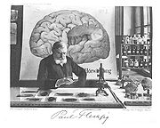
Paul Flechsig

Encyclopedia
Paul Emil Flechsig was a German neuroanatomist, psychiatrist
and neuropathologist. He is mainly remembered today for his research of myelinogenesis
.
, he received his education at the University of Leipzig
and in 1884 became professor of psychiatry there. In 1882, he became director of the Clinical Institute of Psychiatry and Neurology at Leipzig. He made personal investigations of the European systems for the treatment of the insane, on which he was a recognized authority. He spent over fifty years of his medical career at Leipzig.
Although Flechsig contributed much in his study of neurological disorders, he is mainly remembered today for his research of myelinogenesis
. Among his students were Emil Kraepelin
and Oskar Vogt
(mentor to Korbinian Brodmann
). Flechsig was the treating psychiatrist for Daniel Paul Schreber
, whose memoir inspired Sigmund Freud
to publish a detailed analysis of the case in 1911. Flechsig's work has still not been rediscovered widely but his map was reprinted and discussed in Fuster's "Cortex and Mind".
Myelinogenesis
is a technique he pioneered in which he studied brains of the late term fetus and newborn by staining for myelin
. Between about two months before and after birth, most of the cerebral cortex becomes myelinated. The order in which this happens appears to reflect the evolutionary order of mammals from less to more complex. He derived a map of the cerebral cortex divided not by histology
(as Korbinian Brodmann
did) but by order of myelination.
Flechsig divided the cortical regions into:
The last area of the human cerebral cortex to myelinate is the Dorsolateral Prefrontal cortex. (Flechsig #45, Brodmann areas 9 & 46). This region continues to develop in adolescence and adulthood it is related to executive function and working memory
.
The "Paul-Flechsig-Institute of Brain Research" at the University of Leipzig
is an institution established in 1974 in tribute to Flechsig. The institute's scientific emphases is on cellular and molecular aspects of neurodegenerative diseases and glial reactions in the brain and the retina
.
Flechsig's fasciculus or Flechsig's tract is a neurological structure which conveys proprioceptive information from the body to the cerebellum
.
Psychiatrist
A psychiatrist is a physician who specializes in the diagnosis and treatment of mental disorders. All psychiatrists are trained in diagnostic evaluation and in psychotherapy...
and neuropathologist. He is mainly remembered today for his research of myelinogenesis
Myelinogenesis
Myelinogenesis is the process of sequential myelination or development of a myelin sheaths around nerve fibres of the central nervous system.- Function :...
.
Biography
Born in ZwickauZwickau
Zwickau in Germany, former seat of the government of the south-western region of the Free State of Saxony, belongs to an industrial and economical core region. Nowadays it is the capital city of the district of Zwickau...
, he received his education at the University of Leipzig
University of Leipzig
The University of Leipzig , located in Leipzig in the Free State of Saxony, Germany, is one of the oldest universities in the world and the second-oldest university in Germany...
and in 1884 became professor of psychiatry there. In 1882, he became director of the Clinical Institute of Psychiatry and Neurology at Leipzig. He made personal investigations of the European systems for the treatment of the insane, on which he was a recognized authority. He spent over fifty years of his medical career at Leipzig.
Although Flechsig contributed much in his study of neurological disorders, he is mainly remembered today for his research of myelinogenesis
Myelinogenesis
Myelinogenesis is the process of sequential myelination or development of a myelin sheaths around nerve fibres of the central nervous system.- Function :...
. Among his students were Emil Kraepelin
Emil Kraepelin
Emil Kraepelin was a German psychiatrist. H.J. Eysenck's Encyclopedia of Psychology identifies him as the founder of modern scientific psychiatry, as well as of psychopharmacology and psychiatric genetics. Kraepelin believed the chief origin of psychiatric disease to be biological and genetic...
and Oskar Vogt
Oskar Vogt
Oskar Vogt was a German physician and neurologist. He was born in Husum - Schleswig-Holstein...
(mentor to Korbinian Brodmann
Korbinian Brodmann
Korbinian Brodmann was a German neurologist who became famous for his definition of the cerebral cortex into 52 distinct regions from their cytoarchitectonic characteristics.-Life:...
). Flechsig was the treating psychiatrist for Daniel Paul Schreber
Daniel Paul Schreber
Daniel Paul Schreber was a German judge who suffered from what was then diagnosed as dementia praecox. He described his second mental illness , making also a brief reference to the first illness in his book Memoirs of My Nervous Illness...
, whose memoir inspired Sigmund Freud
Sigmund Freud
Sigmund Freud , born Sigismund Schlomo Freud , was an Austrian neurologist who founded the discipline of psychoanalysis...
to publish a detailed analysis of the case in 1911. Flechsig's work has still not been rediscovered widely but his map was reprinted and discussed in Fuster's "Cortex and Mind".
Myelinogenesis
Myelinogenesis
Myelinogenesis is the process of sequential myelination or development of a myelin sheaths around nerve fibres of the central nervous system.- Function :...
is a technique he pioneered in which he studied brains of the late term fetus and newborn by staining for myelin
Myelin
Myelin is a dielectric material that forms a layer, the myelin sheath, usually around only the axon of a neuron. It is essential for the proper functioning of the nervous system. Myelin is an outgrowth of a type of glial cell. The production of the myelin sheath is called myelination...
. Between about two months before and after birth, most of the cerebral cortex becomes myelinated. The order in which this happens appears to reflect the evolutionary order of mammals from less to more complex. He derived a map of the cerebral cortex divided not by histology
Histology
Histology is the study of the microscopic anatomy of cells and tissues of plants and animals. It is performed by examining cells and tissues commonly by sectioning and staining; followed by examination under a light microscope or electron microscope...
(as Korbinian Brodmann
Korbinian Brodmann
Korbinian Brodmann was a German neurologist who became famous for his definition of the cerebral cortex into 52 distinct regions from their cytoarchitectonic characteristics.-Life:...
did) but by order of myelination.
Flechsig divided the cortical regions into:
- an early myelinating primitive zone, which includes the motor cortex and the visual, auditory, and somatosensory cortex;
- a field bordering the primitive zone that myelinates next;
- a late-myelinating zone, which he called “association”.
The last area of the human cerebral cortex to myelinate is the Dorsolateral Prefrontal cortex. (Flechsig #45, Brodmann areas 9 & 46). This region continues to develop in adolescence and adulthood it is related to executive function and working memory
Working memory
Working memory has been defined as the system which actively holds information in the mind to do verbal and nonverbal tasks such as reasoning and comprehension, and to make it available for further information processing...
.
The "Paul-Flechsig-Institute of Brain Research" at the University of Leipzig
University of Leipzig
The University of Leipzig , located in Leipzig in the Free State of Saxony, Germany, is one of the oldest universities in the world and the second-oldest university in Germany...
is an institution established in 1974 in tribute to Flechsig. The institute's scientific emphases is on cellular and molecular aspects of neurodegenerative diseases and glial reactions in the brain and the retina
Retina
The vertebrate retina is a light-sensitive tissue lining the inner surface of the eye. The optics of the eye create an image of the visual world on the retina, which serves much the same function as the film in a camera. Light striking the retina initiates a cascade of chemical and electrical...
.
Flechsig's fasciculus or Flechsig's tract is a neurological structure which conveys proprioceptive information from the body to the cerebellum
Cerebellum
The cerebellum is a region of the brain that plays an important role in motor control. It may also be involved in some cognitive functions such as attention and language, and in regulating fear and pleasure responses, but its movement-related functions are the most solidly established...
.
External links
- Picture, biography and bibliography in the Virtual LaboratoryVirtual LaboratoryThe online project Virtual Laboratory. Essays and Resources on the Experimentalization of Life, 1830-1930, located at the Max Planck Institute for the History of Science, is dedicated to research in the history of the experimentalization of life...
of the Max Planck Institute for the History of ScienceMax Planck Institute for the History of ScienceThe Max Planck Institute for the History of Science in Berlin was established in March 1994. Its research is primarily devoted to a theoretically oriented history of science, principally of the natural sciences, but with methodological perspectives drawn from the cognitive sciences and from... - Official site of the Paul-Flechsig-Institute of Brain Research in Leipzig (mainly German, some English)
- Paul Flechsig @ Who Named ItWho Named ItWho Named It? is an English-language dictionary of medical eponyms and the people associated with their identification. Though this is a dictionary, many eponyms and persons are presented in extensive articles with comprehensive bibliographies. It is hosted in Norway and maintained by medical...
; retrieved 4 May 2009