

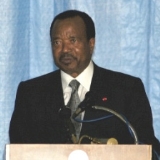
Paul Biya

Encyclopedia
Paul Biya is a Cameroon
ian politician who has been the President of Cameroon since 6 November 1982. A native of Cameroon's south, Biya rose rapidly as a bureaucrat under President Ahmadou Ahidjo
in the 1960s, serving as Secretary-General of the Presidency from 1968 to 1975 and then as Prime Minister of Cameroon
from 1975 to 1982. He succeeded Ahidjo as President upon the latter's surprise resignation in 1982 and consolidated power in a 1983–1984 power struggle with his predecessor.
Biya introduced political reforms within the context of a single-party system in the 1980s. Under pressure, he accepted the introduction of multiparty politics in the early 1990s. He narrowly won the 1992 presidential election
with 40% of the plural, single-ballot vote and was re-elected by large margins in 1997, 2004, and 2011. Opposition politicians and Western governments have alleged voting irregularities and fraud on each of these occasions.
Biya has maintained Cameroon's close relationship with France
, Cameroon's former colonial ruler.
in the South Region of French Cameroon. He studied at lycee Louis Legrand, Sorbonne and Science PO Paris, where he graduated in 1961 with a diploma in International Relations
. He married Jeanne-Irène Biya, who did not have any children, though she adopted Franck Biya who was born from a relationship of Paul Biya with another woman. After Jeanne-Irène Biya died on 29 July 1992, Paul Biya married Chantal Biya
(38 years Paul's junior) on 23 April 1994, and he has had two more children with her.
in 1972, he became Prime Minister of Cameroon
on 30 June 1975. In June 1979, a law designated the Prime Minister as the President's constitutional successor. Ahidjo unexpectedly announced his resignation on 4 November 1982, and Biya accordingly succeeded him as President of Cameroon on 6 November.
Because Biya is a Christian
from southern Cameroon, it was considered surprising that he was chosen by Ahidjo, a Muslim
from the north, as his successor. After Biya became President, Ahidjo initially remained head of the ruling Cameroon National Union
(CNU). Biya was brought into the CNU Central Committee and Political Bureau and was elected as the Vice-President of the CNU. On 11 December 1982, he was placed in charge of managing party affairs in Ahidjo's absence. During the first months after Biya's succession, he continued to show loyalty to Ahidjo, and Ahidjo continued to show support for Biya, but in 1983 a deep rift developed between the two. Ahidjo went into exile in France, and from there he publicly accused Biya of abuse of power and paranoia about plots against him. The two could not be reconciled despite the efforts of several foreign leaders. After Ahidjo resigned as CNU leader, Biya took the helm of the party at an extraordinary session held on 14 September 1983.
In November 1983, Biya announced that the next presidential election would be held on 14 January 1984; it had been previously scheduled for 1985. He was the sole candidate in this election and won 99.98% of the vote. In February 1984, Ahidjo was put on trial in absentia for alleged involvement in a 1983 coup plot, along with two others; they were sentenced to death, although Biya commuted their sentences to life in prison, a gesture seen by many as a sign of weakness. Biya survived a military coup attempt on 6 April 1984, following his decision on the previous day to disband the Republican Guard and disperse its members across the military. Estimates of the death toll ranged from 71 (according to the government) to about 1,000. Northern Muslims were the primary participants in this coup attempt, which was seen by many as an attempt to restore that group's supremacy; Biya, however, chose to emphasize national unity and did not focus blame on northern Muslims. Ahidjo was widely believed to have orchestrated the coup attempt, and Biya is thought to have learned of the plot in advance and to have disbanded the Republican Guard as a reaction, forcing the coup plotters to act earlier than they had planned, which may have been a crucial factor in the coup's failure.
In 1985, the CNU was transformed into the Cameroon People's Democratic Movement
, in Bamenda the political capital of the north west region and Biya was elected as its President. He was also re-elected as President of Cameroon on 24 April 1988.
Biya initially took some steps to open up the regime, culminating in the decision to legalize opposition parties in 1990. According to official results, Biya won the first multiparty presidential election
, held on 11 October 1992, with about 40% of the vote; the second placed candidate, John Fru Ndi
of the opposition Social Democratic Front (SDF), officially received about 36%. The results were strongly disputed by the opposition, which alleged fraud. In the October 1997 presidential election
, which was boycotted by the main opposition parties, Biya was re-elected with 92.6 percent of the vote; he was sworn in on 3 November.
Biya won another seven-year term in the presidential election of 11 October 2004, officially taking 70.92 percent of the vote, although the opposition alleged widespread fraud. Biya was sworn in on 3 November.
After being re-elected in 2004, Biya was barred by a two-term limit in the 1996 Constitution
from running for President again in 2011, but he sought to revise this to allow him to run again. In his 2008 New Year's message, Biya expressed support for revising the Constitution, saying that it was undemocratic to limit the people's choice. The proposed removal of term limits was among the grievances expressed during violent protests
in late February 2008. Nevertheless, on 10 April 2008, the National Assembly voted to change the Constitution to remove term limits. Given the RDPC's control of the National Assembly, the change was overwhelmingly approved, with 157 votes in favor and five opposed; the 15 deputies of the SDF chose to boycott the vote in protest. The change also provided for the President to enjoy immunity from prosecution for his actions as President after leaving office.
He has been consistently re-elected as the National President of the RDPC; he was re-elected at the party's second extraordinary congress on 7 July 2001 and its third extraordinary congress on 21 July 2006.
In presidential elections held in October 2011, Biya secured a sixth term in office, polling 77.9% of votes cast. John Fru Ndi
was his nearest rival, polling 10%. Biya's opponents alleged wide-scale fraud in the election and procedural irregularities were noted by the French and US governments. In his victory speech, Biya promised to stimulate growth and create jobs with a programme of public works which would "transform our country into a vast construction site". On 3 November 2011, he was sworn in once again as president.
population of the former Southern Cameroons
in the western part of the country.
Although Biya made some efforts to open up the political environment, his regime still retains clear authoritarian
characteristics. Under the constitution, Biya has sweeping executive and legislative powers. He even has considerable authority over the judiciary; the courts can only review a law's constitutionality at his request. The RDPC continues to dominate the National Assembly, which does little more than approve his policies.
"Tyrants, the World's 20 Worst Living Dictators", by David Wallechinsky
, ranked Biya with three others commonly in sub-Saharan Africa: Robert Mugabe
of Zimbabwe
, Teodoro Obiang Nguema Mbasogo
of Equatorial Guinea
, and King Mswati
of Swaziland
. He describes Cameroon's electoral process in these terms: "Every few years, Biya stages an election to justify his continuing reign, but these elections have no credibility. In fact, Biya is credited with a creative innovation in the world of phony elections. In 2004, annoyed by the criticisms of international vote-monitoring groups, he paid for his own set of international observers, six ex-U.S. congressmen, who certified his election as free and fair.
Biya regularly spends extended periods of time in Switzerland
at the Hotel InterContinental
Geneva
where the former director Herbert Schott reportedly said he comes to work without being disturbed. These extended stays away from Cameroon – while sometimes as short as two weeks – are sometimes as long as three months and are almost always referred to as "short stays" in the state-owned press and other media. In February 2008, he passed a bill that allows for having an additional term in office as president which was followed by civil unrests throughout the country. The main violent riots took place in the Western, English-speaking part of the country starting with a "strike" initiated by taxi drivers in Douala, allegedly causing more than 200 casualties in the end. In 2009, his holiday in France allegedly cost $40,000 a day spent on 43 hotel rooms.
In 2009, Biya was ranked 19th in Parade Magazine's Top 20 list of "The World's Worst Dictators".
In November 2010, Bertrand Teyou
published a book titled La belle de la république bananière: Chantal Biya, de la rue au palais (English: "The belle of the banana republic: Chantal Biya, from the streets to the palace"), tracing Chantal Biya's rise from humble origins to become Paul Biya's First Lady. He was subsequently given a two year prison term on charges of "insult to character" and organizing an "illegal demonstration" for attempting to hold a public reading. Amnesty International
and International PEN
's Writers in Prison Committee both protested his arrest and issued appeals on his behalf; Amnesty International also named him a prisoner of conscience
. He was freed on 2 May 2011 when the London chapter of International PEN agreed to pay his fine in order that he might seek treatment for his worsening health condition.
Cameroon
Cameroon, officially the Republic of Cameroon , is a country in west Central Africa. It is bordered by Nigeria to the west; Chad to the northeast; the Central African Republic to the east; and Equatorial Guinea, Gabon, and the Republic of the Congo to the south. Cameroon's coastline lies on the...
ian politician who has been the President of Cameroon since 6 November 1982. A native of Cameroon's south, Biya rose rapidly as a bureaucrat under President Ahmadou Ahidjo
Ahmadou Ahidjo
Ahmadou Babatoura Ahidjo was the first President of Cameroon from 1960 until 1982.-Early life:Ahidjo was born in Garoua, a major river port along the Benue River in northern Cameroun, which was at the time a French mandate territory...
in the 1960s, serving as Secretary-General of the Presidency from 1968 to 1975 and then as Prime Minister of Cameroon
Prime Minister of Cameroon
Under the current constitution of Cameroon, the Prime Minister of Cameroon is a relatively powerless executive. While the Prime Minister is officially appointed to be the head of government, the President retains most of the executive power and can fire the Prime Minister at will.-History:The...
from 1975 to 1982. He succeeded Ahidjo as President upon the latter's surprise resignation in 1982 and consolidated power in a 1983–1984 power struggle with his predecessor.
Biya introduced political reforms within the context of a single-party system in the 1980s. Under pressure, he accepted the introduction of multiparty politics in the early 1990s. He narrowly won the 1992 presidential election
Cameroonian presidential election, 1992
A presidential election was held in Cameroon on 11 October 1992. It was the first presidential election since multi-party politics had been legalised, and it was also the first to feature more than one candidate. Incumbent Paul Biya won with 39.98% of the vote. Voter turnout was 71.9%.The 1992...
with 40% of the plural, single-ballot vote and was re-elected by large margins in 1997, 2004, and 2011. Opposition politicians and Western governments have alleged voting irregularities and fraud on each of these occasions.
Biya has maintained Cameroon's close relationship with France
France
The French Republic , The French Republic , The French Republic , (commonly known as France , is a unitary semi-presidential republic in Western Europe with several overseas territories and islands located on other continents and in the Indian, Pacific, and Atlantic oceans. Metropolitan France...
, Cameroon's former colonial ruler.
Personal life
Biya was born in the village of Mvomeka'aMvomeka'a
Mvomeka'a is a village near Sangmélima, in Meyomessala sub-division, Dja-et-Lobo division, South Province, Cameroon. It is mostly known for being the native village of the current President Paul Biya.-References:...
in the South Region of French Cameroon. He studied at lycee Louis Legrand, Sorbonne and Science PO Paris, where he graduated in 1961 with a diploma in International Relations
International relations
International relations is the study of relationships between countries, including the roles of states, inter-governmental organizations , international nongovernmental organizations , non-governmental organizations and multinational corporations...
. He married Jeanne-Irène Biya, who did not have any children, though she adopted Franck Biya who was born from a relationship of Paul Biya with another woman. After Jeanne-Irène Biya died on 29 July 1992, Paul Biya married Chantal Biya
Chantal Biya
Chantal Biya is the First Lady of Cameroon. She was born in Dimako, East Province, to French expatriate Georges Vigouroux and Miss Doumé pageant winner Rosette Ndongo Mengolo. Chantal Biya spent her adolescence in Yaoundé.She married President Paul Biya on 23 April 1994, after his first wife,...
(38 years Paul's junior) on 23 April 1994, and he has had two more children with her.
Political career
As an official in post-independence 1960s Cameroon, Biya rose to prominence under President Ahmadou Ahidjo. After becoming Director of the Cabinet of the Minister of National Education in January 1964 and Secretary-General of the Ministry of National Education in July 1965, he was named Director of the Civil Cabinet of the President in December 1967 and Secretary-General of the Presidency (while remaining Director of the Civil Cabinet) in January 1968. He gained the rank of Minister in August 1968 and the rank of Minister of State in June 1970, while remaining Secretary-General of the Presidency. Following the creation of a unitary stateUnitary state
A unitary state is a state governed as one single unit in which the central government is supreme and any administrative divisions exercise only powers that their central government chooses to delegate...
in 1972, he became Prime Minister of Cameroon
Prime Minister of Cameroon
Under the current constitution of Cameroon, the Prime Minister of Cameroon is a relatively powerless executive. While the Prime Minister is officially appointed to be the head of government, the President retains most of the executive power and can fire the Prime Minister at will.-History:The...
on 30 June 1975. In June 1979, a law designated the Prime Minister as the President's constitutional successor. Ahidjo unexpectedly announced his resignation on 4 November 1982, and Biya accordingly succeeded him as President of Cameroon on 6 November.
Because Biya is a Christian
Christianity
Christianity is a monotheistic religion based on the life and teachings of Jesus as presented in canonical gospels and other New Testament writings...
from southern Cameroon, it was considered surprising that he was chosen by Ahidjo, a Muslim
Islam
Islam . The most common are and . : Arabic pronunciation varies regionally. The first vowel ranges from ~~. The second vowel ranges from ~~~...
from the north, as his successor. After Biya became President, Ahidjo initially remained head of the ruling Cameroon National Union
Cameroon National Union
The Cameroon National Union was Cameroon's sole legal political party until 1990...
(CNU). Biya was brought into the CNU Central Committee and Political Bureau and was elected as the Vice-President of the CNU. On 11 December 1982, he was placed in charge of managing party affairs in Ahidjo's absence. During the first months after Biya's succession, he continued to show loyalty to Ahidjo, and Ahidjo continued to show support for Biya, but in 1983 a deep rift developed between the two. Ahidjo went into exile in France, and from there he publicly accused Biya of abuse of power and paranoia about plots against him. The two could not be reconciled despite the efforts of several foreign leaders. After Ahidjo resigned as CNU leader, Biya took the helm of the party at an extraordinary session held on 14 September 1983.
In November 1983, Biya announced that the next presidential election would be held on 14 January 1984; it had been previously scheduled for 1985. He was the sole candidate in this election and won 99.98% of the vote. In February 1984, Ahidjo was put on trial in absentia for alleged involvement in a 1983 coup plot, along with two others; they were sentenced to death, although Biya commuted their sentences to life in prison, a gesture seen by many as a sign of weakness. Biya survived a military coup attempt on 6 April 1984, following his decision on the previous day to disband the Republican Guard and disperse its members across the military. Estimates of the death toll ranged from 71 (according to the government) to about 1,000. Northern Muslims were the primary participants in this coup attempt, which was seen by many as an attempt to restore that group's supremacy; Biya, however, chose to emphasize national unity and did not focus blame on northern Muslims. Ahidjo was widely believed to have orchestrated the coup attempt, and Biya is thought to have learned of the plot in advance and to have disbanded the Republican Guard as a reaction, forcing the coup plotters to act earlier than they had planned, which may have been a crucial factor in the coup's failure.
In 1985, the CNU was transformed into the Cameroon People's Democratic Movement
Cameroon People's Democratic Movement
The Cameroon People's Democratic Movement is the ruling political party in Cameroon.-History:Previously known as the Cameroon National Union, which had dominated Cameroon politics since independence in 1960, it was renamed in 1985...
, in Bamenda the political capital of the north west region and Biya was elected as its President. He was also re-elected as President of Cameroon on 24 April 1988.
Biya initially took some steps to open up the regime, culminating in the decision to legalize opposition parties in 1990. According to official results, Biya won the first multiparty presidential election
Cameroonian presidential election, 1992
A presidential election was held in Cameroon on 11 October 1992. It was the first presidential election since multi-party politics had been legalised, and it was also the first to feature more than one candidate. Incumbent Paul Biya won with 39.98% of the vote. Voter turnout was 71.9%.The 1992...
, held on 11 October 1992, with about 40% of the vote; the second placed candidate, John Fru Ndi
John Fru Ndi
Ni John Fru Ndi is the founder and leader of Cameroon's Social Democratic Front .Fru Ndi was born in Baba II, near Bamenda in the Northwest Province of Cameroon. The title of Ni, a marker of respect, was given to him when he was born...
of the opposition Social Democratic Front (SDF), officially received about 36%. The results were strongly disputed by the opposition, which alleged fraud. In the October 1997 presidential election
Cameroonian presidential election, 1997
Presidential elections were held in Cameroon on 12 October 1997. They were boycotted by the main opposition parties, the Social Democratic Front, the National Union for Democracy and Progress, and the Cameroon Democratic Union, as well as the smaller African Peoples Union. As a result incumbent...
, which was boycotted by the main opposition parties, Biya was re-elected with 92.6 percent of the vote; he was sworn in on 3 November.
Biya won another seven-year term in the presidential election of 11 October 2004, officially taking 70.92 percent of the vote, although the opposition alleged widespread fraud. Biya was sworn in on 3 November.
After being re-elected in 2004, Biya was barred by a two-term limit in the 1996 Constitution
Constitution of Cameroon
The Constitution of Cameroon is the supreme law of the Republic of Cameroon. The document consists of a preamble and 13 Parts, each divided into Articles...
from running for President again in 2011, but he sought to revise this to allow him to run again. In his 2008 New Year's message, Biya expressed support for revising the Constitution, saying that it was undemocratic to limit the people's choice. The proposed removal of term limits was among the grievances expressed during violent protests
2008 Cameroonian anti-government protests
The 2008 Cameroon protests were a series of violent demonstrations in Cameroon's biggest cities that took place from 25 February to 29 February 2008. The protests followed on the heels of a strike by transport workers, who were opposing high fuel prices and poor working conditions...
in late February 2008. Nevertheless, on 10 April 2008, the National Assembly voted to change the Constitution to remove term limits. Given the RDPC's control of the National Assembly, the change was overwhelmingly approved, with 157 votes in favor and five opposed; the 15 deputies of the SDF chose to boycott the vote in protest. The change also provided for the President to enjoy immunity from prosecution for his actions as President after leaving office.
He has been consistently re-elected as the National President of the RDPC; he was re-elected at the party's second extraordinary congress on 7 July 2001 and its third extraordinary congress on 21 July 2006.
In presidential elections held in October 2011, Biya secured a sixth term in office, polling 77.9% of votes cast. John Fru Ndi
John Fru Ndi
Ni John Fru Ndi is the founder and leader of Cameroon's Social Democratic Front .Fru Ndi was born in Baba II, near Bamenda in the Northwest Province of Cameroon. The title of Ni, a marker of respect, was given to him when he was born...
was his nearest rival, polling 10%. Biya's opponents alleged wide-scale fraud in the election and procedural irregularities were noted by the French and US governments. In his victory speech, Biya promised to stimulate growth and create jobs with a programme of public works which would "transform our country into a vast construction site". On 3 November 2011, he was sworn in once again as president.
Opposition and criticism
Biya is sometimes characterized as aloof, making relatively few public appearances. Since the early 1990s, he has faced his strongest opposition from the AnglophoneEnglish-speaking world
The English-speaking world consists of those countries or regions that use the English language to one degree or another. For more information, please see:Lists:* List of countries by English-speaking population...
population of the former Southern Cameroons
Southern Cameroons
Southern Cameroons was the southern part of the British Mandate territory of Cameroons in West Africa. Since 1961 it is part of the Republic of Cameroon, where it makes up the Northwest Province and Southwest Province...
in the western part of the country.
Although Biya made some efforts to open up the political environment, his regime still retains clear authoritarian
Authoritarianism
Authoritarianism is a form of social organization characterized by submission to authority. It is usually opposed to individualism and democracy...
characteristics. Under the constitution, Biya has sweeping executive and legislative powers. He even has considerable authority over the judiciary; the courts can only review a law's constitutionality at his request. The RDPC continues to dominate the National Assembly, which does little more than approve his policies.
"Tyrants, the World's 20 Worst Living Dictators", by David Wallechinsky
David Wallechinsky
David Wallechinsky has worked as a commentator for NBC Olympic coverage and is the author of many Olympic reference books and other reference books. He is a Jewish-American. He is the author of The Complete Book of the Summer Olympics and The Complete Book of the Winter Olympics series...
, ranked Biya with three others commonly in sub-Saharan Africa: Robert Mugabe
Robert Mugabe
Robert Gabriel Mugabe is the President of Zimbabwe. As one of the leaders of the liberation movement against white-minority rule, he was elected into power in 1980...
of Zimbabwe
Zimbabwe
Zimbabwe is a landlocked country located in the southern part of the African continent, between the Zambezi and Limpopo rivers. It is bordered by South Africa to the south, Botswana to the southwest, Zambia and a tip of Namibia to the northwest and Mozambique to the east. Zimbabwe has three...
, Teodoro Obiang Nguema Mbasogo
Teodoro Obiang Nguema Mbasogo
Teodoro Obiang Nguema Mbasogo is an Equatoguinean politician who has been President of Equatorial Guinea since 1979. He ousted his uncle, Francisco Macías Nguema, in an August 1979 military coup and has overseen Equatorial Guinea's emergence as an important oil producer, beginning in the 1990s...
of Equatorial Guinea
Equatorial Guinea
Equatorial Guinea, officially the Republic of Equatorial Guinea where the capital Malabo is situated.Annobón is the southernmost island of Equatorial Guinea and is situated just south of the equator. Bioko island is the northernmost point of Equatorial Guinea. Between the two islands and to the...
, and King Mswati
Mswati III of Swaziland
Mswati III is the King of Swaziland and head of the Swazi Royal Family. In 1986, he succeeded his father Sobhuza II as ruler of the southern African kingdom...
of Swaziland
Swaziland
Swaziland, officially the Kingdom of Swaziland , and sometimes called Ngwane or Swatini, is a landlocked country in Southern Africa, bordered to the north, south and west by South Africa, and to the east by Mozambique...
. He describes Cameroon's electoral process in these terms: "Every few years, Biya stages an election to justify his continuing reign, but these elections have no credibility. In fact, Biya is credited with a creative innovation in the world of phony elections. In 2004, annoyed by the criticisms of international vote-monitoring groups, he paid for his own set of international observers, six ex-U.S. congressmen, who certified his election as free and fair.
Biya regularly spends extended periods of time in Switzerland
Switzerland
Switzerland name of one of the Swiss cantons. ; ; ; or ), in its full name the Swiss Confederation , is a federal republic consisting of 26 cantons, with Bern as the seat of the federal authorities. The country is situated in Western Europe,Or Central Europe depending on the definition....
at the Hotel InterContinental
InterContinental
InterContinental is a brand of upscale luxury hotels, founded by Pan American World Airways, under Juan Trippe, and now owned by InterContinental Hotels Group. The chain operates over 200 hotels and resorts in approximately 75 nations.-History:...
Geneva
Geneva
Geneva In the national languages of Switzerland the city is known as Genf , Ginevra and Genevra is the second-most-populous city in Switzerland and is the most populous city of Romandie, the French-speaking part of Switzerland...
where the former director Herbert Schott reportedly said he comes to work without being disturbed. These extended stays away from Cameroon – while sometimes as short as two weeks – are sometimes as long as three months and are almost always referred to as "short stays" in the state-owned press and other media. In February 2008, he passed a bill that allows for having an additional term in office as president which was followed by civil unrests throughout the country. The main violent riots took place in the Western, English-speaking part of the country starting with a "strike" initiated by taxi drivers in Douala, allegedly causing more than 200 casualties in the end. In 2009, his holiday in France allegedly cost $40,000 a day spent on 43 hotel rooms.
In 2009, Biya was ranked 19th in Parade Magazine's Top 20 list of "The World's Worst Dictators".
In November 2010, Bertrand Teyou
Bertrand Teyou
Bertrand Zepherin Teyou is a Cameroonian author who was imprisoned from November 2010 to May 2011 on charges of insulting Chantal Biya, the wife of President Paul Biya in a recent book and for trying to hold a public reading of this book...
published a book titled La belle de la république bananière: Chantal Biya, de la rue au palais (English: "The belle of the banana republic: Chantal Biya, from the streets to the palace"), tracing Chantal Biya's rise from humble origins to become Paul Biya's First Lady. He was subsequently given a two year prison term on charges of "insult to character" and organizing an "illegal demonstration" for attempting to hold a public reading. Amnesty International
Amnesty International
Amnesty International is an international non-governmental organisation whose stated mission is "to conduct research and generate action to prevent and end grave abuses of human rights, and to demand justice for those whose rights have been violated."Following a publication of Peter Benenson's...
and International PEN
International PEN
PEN International , the worldwide association of writers, was founded in London in 1921 to promote friendship and intellectual co-operation among writers everywhere....
's Writers in Prison Committee both protested his arrest and issued appeals on his behalf; Amnesty International also named him a prisoner of conscience
Prisoner of conscience
Prisoner of conscience is a term defined in Peter Benenson's 1961 article "The Forgotten Prisoners" often used by the human rights group Amnesty International. It can refer to anyone imprisoned because of their race, religion, or political views...
. He was freed on 2 May 2011 when the London chapter of International PEN agreed to pay his fine in order that he might seek treatment for his worsening health condition.