
All Topics  
Parasympathetic nervous system


   Email Print
   Bookmark   Link


Parasympathetic nervous system


The parasympathetic nervous system
Nervous system

The nervous system is a Neural network of specialized cells that communicate information about an animal's surroundings and itself. It processes this information and causes reactions in other parts of the body....
 (PSNS) is a division of the autonomic nervous system
Autonomic nervous system

The autonomic nervous system is the part of the peripheral nervous system that acts as a control system, maintaining human homeostasis in the body....
 (ANS), along with the sympathetic nervous system
Sympathetic nervous system

The Sympathetic Nervous System is a branch of the autonomic nervous system along with the enteric nervous system and parasympathetic nervous system....
 (SNS) and enteric nervous system
Enteric nervous system

The enteric nervous system is a subdivision of the Peripheral Nervous System, that directly controls the gastrointestinal system.It is derived from neural crest....
 (ENS or "bowels NS"). The ANS is a subdivision of the peripheral nervous system
Peripheral nervous system

The peripheral nervous system resides or extends outside the central nervous system , which consists of the brain and spinal cord. The main function of the PNS is to connect the CNS to the limbs and organs....
 (PNS). ANS sends fibers to three tissues: cardiac muscle
Cardiac muscle

Cardiac muscle is a type of involuntary sarcomere muscle found in the walls of the heart, specifically the wikt:myocardium. Cardiac muscle cells are known as cardiac myocytes ....
, smooth muscle
Smooth muscle

Smooth muscle is a type of non-striated muscle, found within the tunica media layer of large and small arteries and veins, the urinary bladder, uterus, male and female reproductive tracts, gastrointestinal tract, respiratory tract, the ciliary muscle, and iris of the eye....
, or glandular tissue
Gland

A gland is an Organ in an animal's body that synthesizes a substance for release such as hormones or breast milk, often into the bloodstream or into cavities inside the body or its outer surface ....
. This stimulation, sympathetic or parasympathetic, is to control smooth muscle contraction, regulate cardiac muscle, or stimulate or inhibit glandular secretion.


Discussion
Ask a question about 'Parasympathetic nervous system'
Start a new discussion about 'Parasympathetic nervous system'
Answer questions from other users
Full Discussion Forum


Recent Posts


Encyclopedia


Gray839
The parasympathetic nervous system
Nervous system

The nervous system is a Neural network of specialized cells that communicate information about an animal's surroundings and itself. It processes this information and causes reactions in other parts of the body....
 (PSNS) is a division of the autonomic nervous system
Autonomic nervous system

The autonomic nervous system is the part of the peripheral nervous system that acts as a control system, maintaining human homeostasis in the body....
 (ANS), along with the sympathetic nervous system
Sympathetic nervous system

The Sympathetic Nervous System is a branch of the autonomic nervous system along with the enteric nervous system and parasympathetic nervous system....
 (SNS) and enteric nervous system
Enteric nervous system

The enteric nervous system is a subdivision of the Peripheral Nervous System, that directly controls the gastrointestinal system.It is derived from neural crest....
 (ENS or "bowels NS"). The ANS is a subdivision of the peripheral nervous system
Peripheral nervous system

The peripheral nervous system resides or extends outside the central nervous system , which consists of the brain and spinal cord. The main function of the PNS is to connect the CNS to the limbs and organs....
 (PNS). ANS sends fibers to three tissues: cardiac muscle
Cardiac muscle

Cardiac muscle is a type of involuntary sarcomere muscle found in the walls of the heart, specifically the wikt:myocardium. Cardiac muscle cells are known as cardiac myocytes ....
, smooth muscle
Smooth muscle

Smooth muscle is a type of non-striated muscle, found within the tunica media layer of large and small arteries and veins, the urinary bladder, uterus, male and female reproductive tracts, gastrointestinal tract, respiratory tract, the ciliary muscle, and iris of the eye....
, or glandular tissue
Gland

A gland is an Organ in an animal's body that synthesizes a substance for release such as hormones or breast milk, often into the bloodstream or into cavities inside the body or its outer surface ....
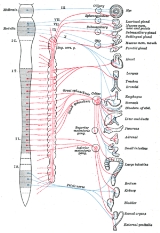
. This stimulation, sympathetic or parasympathetic, is to control smooth muscle contraction, regulate cardiac muscle, or stimulate or inhibit glandular secretion. The actions of the parasympathetic nervous system can be summarized as "rest and digest" (as opposed to the "fight-or-flight" effects of the sympathetic nervous system).

Relation to sympathetic nervous system

Sympathetic
Sympathetic nervous system

The Sympathetic Nervous System is a branch of the autonomic nervous system along with the enteric nervous system and parasympathetic nervous system....
 and parasympathetic divisions typically function in opposition to each other. But this opposition is better understood as complementary in nature rather than antagonistic. For an analogy, one may think of the sympathetic division as the accelerator and the parasympathetic division as the brake. The sympathetic division typically functions in actions requiring quick responses. The parasympathetic division functions with actions that do not require immediate reaction. The main actions of the parasympathetic nervous system are summarized by the phrase "rest and repose" or "rest and digest" (in contrast to the "fight-or-flight" of the sympathetic nervous system). A rarely used (but useful) acronym to summarize the functions of the parasympathetic nervous system is SLUDD (saliva
Saliva

Saliva is the watery and usually frothy substance produced in the mouths of humans and most other animals. Saliva is produced in and secreted from the salivary glands....
tion, lacrimation
Tears

Tears are the liquid product of a process of lacrimation to clean and lubricate the eyes. The word lacrimation may also be used in a medical or literary sense to refer to crying....
, urination
Urination

Urination, also known as micturition, voiding, and, more rarely, emiction, is the process of disposing urine from the urinary bladder through the urethra to the outside of the body....
, digestion
Digestion

Digestion is the mechanical and chemical breaking down of food into smaller components, to a form that can be Absorption, for instance, by a blood stream....
 and defecation
Defecation

Defecation is the final act of digestion by which organisms eliminate solid, semisolid or liquid waste material from the digestive tract via the anus....
).

Physical location

The parasympathetic nerves (PSN) are visceral, autonomic branches of the peripheral nervous system
Peripheral nervous system

The peripheral nervous system resides or extends outside the central nervous system , which consists of the brain and spinal cord. The main function of the PNS is to connect the CNS to the limbs and organs....
 (PNS). The autonomic nervous system (ANS), which includes sympathetic and parasympathetic divisions, regulates the body's visceral organs via the innervation of three kinds of tissues: smooth muscle
Smooth muscle

Smooth muscle is a type of non-striated muscle, found within the tunica media layer of large and small arteries and veins, the urinary bladder, uterus, male and female reproductive tracts, gastrointestinal tract, respiratory tract, the ciliary muscle, and iris of the eye....
, cardiac muscle
Cardiac muscle

Cardiac muscle is a type of involuntary sarcomere muscle found in the walls of the heart, specifically the wikt:myocardium. Cardiac muscle cells are known as cardiac myocytes ....
, and glands. The sympathetic and parasympathetic system work in tandem to create a synergistic
Synergy

Synergy is the term used to describe a situation where different entities cooperate advantageously for a final outcome. Simply defined, it means that the whole is greater than the sum of its parts....
 stimulation that is not merely on or off, but can be described as a continuum depending upon how vigorously each division is attempting to carry out its actions. The regions of the body associated with the parasympathetic division of the ANS are in the cranial and sacral regions of the spinal cord
Spinal cord

The spinal cord is a long, thin, tubular bundle of neuron and glia that extends from the brain. The brain and spinal cord together make up the central nervous system....
. Because of its location the parasympathetic system is commonly referred to as having craniosacral outflow whereas the sympathetic system is referred to as thoracolumbar outflow (T1-L2 spinal nerves). In the cranium the PSN originate from cranial nerves
Cranial nerves

Cranial nerves are nerves that emerge directly from the brain stem in contrast to spinal nerves which emerge from segments of the spinal cord. Although thirteen cranial nerves in human anatomy fit this description, twelve are conventionally recognized....
 CN III (oculomotor nerve
Oculomotor nerve

The oculomotor nerve is the third of twelve paired cranial nerves. It controls most of the eye's movements, constriction of the pupil, and maintains an open eyelid....
), CN VII (facial nerve
Facial nerve

The facial nerve is the seventh of twelve paired cranial nerves. It emerges from the brainstem between the pons and the medulla oblongata, and controls the muscles of facial expression, and taste to the anterior two-thirds of the tongue....
), CN IX (glossopharyngeal nerve
Glossopharyngeal nerve

The glossopharyngeal nerve is the ninth of twelve pairs of cranial nerves . It exits the brainstem out from the sides of the upper Medulla oblongata, just rostral to the vagus nerve....
) and CN X (vagus n.
Vagus nerve

The vagus nerve is the tenth of twelve paired cranial nerves, and is the only nerve that starts in the brainstem and extends, through the jugular foramen, down below the head , to the neck, chest and abdomen, where it contributes to the innervation of the viscera....
) In the sacral
Sacral

The adjective sacral may have one of the following meanings:*A synonym for "sacred"*Related to sacrum...
 region of the body the PSN is derived from spinal nerves S2, S3 and S4, commonly referred to as the pelvic splanchnics.

Similar to the SN, the PSN follows a two-neuron efferent (motor signals leaving CNS) system
Efferent nerve

In the nervous system, efferent nerves ? otherwise known as motoneuron or effector neurons ? carry action potential away from the central nervous system to effectors such as muscles or glands ....
 that has both preganglionic
Preganglionic fibers

In the autonomic nervous system, fibers from the central nervous system to the autonomic ganglion are known as preganglionic fibers.All preganglionic fibers, whether they are in the sympathetic nervous system or in the parasympathetic nervous system, are cholinergic ....
 and postganglionic neurons
Postganglionic fibers

In the autonomic nervous system, fibers from the ganglion to the effector organ are called postganglionic fibers....
. In the cranium, preganglionic PSN (CN III, CN VII, and CN IX) arise from specific nuclei in the CNS and synapse at one of four parasympathetic ganglia
Ganglion

In anatomy, a ganglion is a biological tissue.Cells found in a ganglion are called ganglion cells, though this term is also sometimes used to refer specifically to Retinal ganglion cells....
: ciliary
Ciliary ganglion

The ciliary ganglion is a Parasympathetic nervous system ganglion located in the posterior Orbit . It measures 1?2 millimeters in diameter and contains approximately 2,500 neurons....
, pterygopalatine
Pterygopalatine ganglion

The pterygopalatine ganglion is a parasympathetic ganglion found in the pterygopalatine fossa. It is one of four parasympathetic ganglia of the head and neck....
, otic
Otic ganglion

The otic ganglion is a small, ovalshaped, flattened parasympathetic ganglion of a reddish-gray color, located immediately below the foramen ovale in the infratemporal fossa....
, or submandibular
Submandibular ganglion

The submandibular ganglion is part of the human autonomic nervous system. It is one of four parasympathetic ganglia of the head and neck. ....
. From these four ganglia the PSN complete their journey to target tissues via CN V (trigeminal) branches (ophthalmic nerve
Ophthalmic nerve

The ophthalmic nerve is one of the three branches of the trigeminal nerve, the fifth cranial nerve. Like the maxillary nerve branch of the trigeminal nerve, the ophthalmic branch carries sensory fibers only....
 CN V1, maxillary nerve
Maxillary nerve

The maxillary nerve is one of the three branches of the Trigeminal nerve, the fifth cranial nerve. It comprises the principal functions of sensation from the maxillary, nasal cavity, sinus, the palate and subsequently that of the mid-face, and is intermediate, both in position and size, between the ophthalmic nerve and the mandibular nerve...
 CN V2, mandibular nerve
Mandibular nerve

The mandibular nerve is the largest of the three branches of the trigeminal nerve....
 CN V3). The vagus nerve does not participate in these cranial ganglion
Ganglion

In anatomy, a ganglion is a biological tissue.Cells found in a ganglion are called ganglion cells, though this term is also sometimes used to refer specifically to Retinal ganglion cells....
 as most of its PSN fibers are destined for a broad array of ganglia on or near organs including the thoracic viscera (esophagus
Esophagus

The esophagus or oesophagus , sometimes known as the gullet, is an Organ in vertebrates which consists of a Muscle tube through which food passes from the pharynx to the stomach....
, trachea
Vertebrate trachea

The traceartes, or windpipe, is a tube that has an inner diameter of about 20-25 mm and a length of about 10-16 cm in humans. It commences at the larynx and bifurcates into the primary bronchus in mammals, and from the pharynx to the syrinx in birds, allowing the passage of air to the lungs....
, heart
Heart

The heart is a muscle organ in all vertebrates responsible for pumping blood through the blood vessels by repeated, rhythmic contractions, or a similar structure in annelids, mollusks, and arthropods....
, lungs) and abdominal viscera (stomach
Stomach

In most mammals, the stomach is a hollow muscular organ of the gastrointestinal tract involved in the second phase of digestion, following mastication....
, pancreas
Pancreas

The pancreas is a gland Organ in the digestive system and endocrine system of vertebrates. It is both an endocrine gland , as well as an exocrine gland, secreting pancreatic juice containing Digestion enzymes that pass to the small intestine....
, liver
Liver

The liver is a vital organ present in vertebrates and some other animals; it has a wide range of functions, a few of which are detoxification, protein synthesis, and production of biochemicals necessary for digestion....
, kidneys) traveling all the way down to the midgut/hindgut junction just before the splenic flexure
Splenic flexure

The splenic flexure is a sharp bend between the Transverse colon and the Descending colon Colon in the left upper quadrant of humans. The left colic flexure is near the spleen, and hence called the splenic flexure....
 of the transverse colon
Transverse colon

The transverse colon the longest and most movable part of the Colon , passes with a downward convexity from the right hypochondrium region across the abdomen, opposite the confines of the epigastric and umbilical zones, into the left hypochondrium region, where it curves sharply on itself beneath the lower end of the spleen, forming the splen...
. The pelvic splanchnic preganglionic nerve cell bodies
Pelvic splanchnic nerves

Pelvic splanchnic nerves or nervi erigentes are splanchnic nerves that arise from sacral spinal nerves sacral spinal nerve 2, sacral spinal nerve 3, sacral spinal nerve 4 to provide parasympathetic innervation to the hindgut....
 arise in the lateral horn
Lateral horn

In the thoracic region, the postero-lateral part of the anterior column projects lateralward as a triangular field, which is named the lateral column ....
 of the spinal cord
Spinal cord

The spinal cord is a long, thin, tubular bundle of neuron and glia that extends from the brain. The brain and spinal cord together make up the central nervous system....
 and continue away from the CNS to synapse at an autonomic ganglion. The PSN ganglion
Ganglion

In anatomy, a ganglion is a biological tissue.Cells found in a ganglion are called ganglion cells, though this term is also sometimes used to refer specifically to Retinal ganglion cells....
, where the preganglionic neurons synapse, will be close to the organ of innervation (unlike the SN where the ganglion is typically farther away from the target organ). The two neuron system is only for efferent
Efferent nerve

In the nervous system, efferent nerves ? otherwise known as motoneuron or effector neurons ? carry action potential away from the central nervous system to effectors such as muscles or glands ....
 innervation. Afferent
Afferent nerve

In the nervous system, afferent neurons , carry action potential from receptor s or sense organs toward the central nervous system. This term can also be used to describe relative connections between structures....
, unconscious sensations sent from the viscera to the CNS are done so in a one neuron tract.

The afferent parasympathetic sensations are mostly unconscious visceral motor reflex sensations from hollow organs and glands that are transmitted to the CNS. Like regular somatic sensory
Somatosensory system

The somatosensory system is a diverse sensory system comprising the receptors and processing centres to produce the sensory modality such as touch, temperature perception, proprioception , and nociception ....
 neurons, parasympathetic afferent cell bodies are located in the dorsal root ganglion
Dorsal root ganglion

In anatomy and neurology, the dorsal root ganglion is a nodule on a dorsal root that contains cell bodies of neurons in afferent nerve spinal nerves....
. While the unconscious reflex arcs normally are undetectable, in certain instances they may send pain sensations to the CNS masked as referred pain
Referred pain

Referred pain is a term used to describe the phenomenon of pain perceived at a site adjacent to or at a distance from the site of an injury's origin....
. If the peritoneal cavity
Peritoneal cavity

The peritoneal cavity is a potential space between the parietal peritoneum and visceral peritoneum. It is one of the spaces derived from the coelomic cavity of the embryo, the others being the pleural cavities and the pericardial cavity....
 becomes inflamed or if the bowel is suddenly distended your body will interpret the afferent pain stimulus as somatic
Somatic nervous system

The somatic nervous system is the part of the peripheral nervous system associated with the voluntary control of body movements through the action of skeletal muscles, and with sensory receptor of external stimulus, which helps keep the body in touch with its surroundings ....
 in origin. This pain is usually non-localized. The pain is also usually referred to dermatomes that are at the same spinal nerve level as the visceral afferent synapse.

Cranial Nerve Parasympathetic Paths and Control


The oculomotor nerve
Oculomotor nerve

The oculomotor nerve is the third of twelve paired cranial nerves. It controls most of the eye's movements, constriction of the pupil, and maintains an open eyelid....
 is responsible for several parasympathetic functions related to the eye. The oculomotor PNS fibers originate in the Edinger-Westphal nucleus
Edinger-Westphal nucleus

The Edinger-Westphal nucleus is the accessory parasympathetic nervous system cranial nerve nucleus of the oculomotor nerve , supplying the constricting muscles of the Iris ....
 in the CNS and travel through the superior orbital fissure
Superior orbital fissure

The superior orbital fissure is a foramen in the skull, although strictly it is more of a cleft, lying between the Small wings of the sphenoid and Great wings of the sphenoid of the sphenoid bone....
 to synapse in the ciliary ganglion
Ciliary ganglion

The ciliary ganglion is a Parasympathetic nervous system ganglion located in the posterior Orbit . It measures 1?2 millimeters in diameter and contains approximately 2,500 neurons....
 located just behind the orbit (eye). From the ciliary ganglion the postganglionic PSN fibers leave via short ciliary nerve fibers, a continuation of the nasociliary nerve
Nasociliary nerve

The nasociliary nerve is a branch of the ophthalmic nerve. It is intermediate in size between the two other main branches of the ophthalmic nerve, the frontal nerve and the lacrimal nerve, and is more deeply placed....
 (a branch of ophthalmic division of the trigeminal nerve
Trigeminal nerve

The trigeminal nerve is responsible for sensation in the face. Sensory information from the face and body is processed by parallel pathways in the central nervous system....
, CN V1). The short ciliary nerves innervate the orbit to control the ciliary muscle (responsible for accommodation
Accommodation (eye)

Accommodation is the process by which the :eye increases optical power to maintain a clear image on an object as it draws near the eye. The young human eye can change focus from distance to 7 cm from the eye in 350 milliseconds....
) and the sphincter pupillae muscle which is responsible for miosis or constriction of the pupil (in response to light or accommodation).

The parasympathetic aspect of the facial nerve controls secretion of the sublingual and submandibular salivary glands, the lacrimal gland
Lacrimal gland

The lacrimal glands are paired almond-shaped glands, one for each eye, that secrete the aqueous layer of the tears film. They are situated in the upper, outer portion of each Orbit ....
, and the glands associated with the nasal cavity. The preganglionic fibers originate within the CNS in the superior salvatory nucleus and leave as the intermediate nerve (which some consider a separate cranial nerve altogether) to connect with the facial nerve
Facial nerve

The facial nerve is the seventh of twelve paired cranial nerves. It emerges from the brainstem between the pons and the medulla oblongata, and controls the muscles of facial expression, and taste to the anterior two-thirds of the tongue....
 just distal (further out) to it surfacing the CNS. Just after the facial nerve geniculate ganglion
Geniculate ganglion

The geniculate ganglion is an L-shaped collection of fibers and sensory neurons of the facial nerve located in the facial canal of the head. It receives fibers from the motor, sensory, and parasympathetic nervous system components of the facial nerve and sends fibers that will innervate the lacrimal glands, submandibular glands, sublingual g...
 (general sensory ganglion) in the temporal bone
Temporal bone

The temporal bones are situated at the sides and base of the skull.The temporal bone supports that part of the face known as the temple ....
, the facial nerve gives off two separate parasympathetic nerves. The first is the greater petrosal nerve
Petrosal nerve

Petrosal nerve may refer to:*Deep petrosal nerve*Greater petrosal nerve *Lesser petrosal nerve from the geniculate ganglion to the otic ganglion...
 and the second is the chorda tympani
Chorda tympani

The chorda tympani is a nerve that branches from the facial nerve inside the facial canal, just before the facial nerve exits the skull via the stylomastoid foramen....
. The greater petrosal nerve travels through the middle ear and eventually combines with the deep petrosal nerve (sympathetic fibers) to form the nerve of the pterygoid canal
Pterygoid canal

The pterygoid canal is a passage in the skull leading from just anterior to the foramen lacerum in the middle cranial fossa to the pterygopalatine fossa....
. The PSN fibers of the nerve of the pterygoid canal synapse at the pterygopalatine ganglion
Pterygopalatine ganglion

The pterygopalatine ganglion is a parasympathetic ganglion found in the pterygopalatine fossa. It is one of four parasympathetic ganglia of the head and neck....
, which is closely associated with the maxillary division of the trigeminal nerve
Trigeminal nerve

The trigeminal nerve is responsible for sensation in the face. Sensory information from the face and body is processed by parallel pathways in the central nervous system....
 (CN V2). The postganglionic PSN fibers leave the pterygopalatine ganglion in several directions. One division leaves on the zygomatic
Zygomatic

Zygomatic can refer to:* Zygomatic bone* Zygomaticus major muscle...
 division of CN V2 and travels on a communicating branch to unite with the lacrimal nerve (branch of the ophthalmic nerve of CN V1) before synapsing at the lacrimal gland. These PSN to the lacrimal gland control tear production.

A separate group of PSN leaving from the pterygopalatine ganglion are the descending palatine nerves
Palatine nerves

The palatine nerves are distributed to the roof of the mouth, soft palate, tonsil, and lining membrane of the nasal cavity.Most of their fibers are derived from the sphenopalatine branches of the maxillary nerve....
 (CN V2 branch) which include the greater and lesser palatine nerves. The greater palatine PSN synapse on the hard palate and regulate mucus glands located there. The lesser palatine nerve synapses at the soft palate and controls sparse taste receptors and mucus glands. Yet another set of divisions from the pterygopalatine ganglion are the posterior, superior, and inferior lateral nasal nerves; and the nasopalatine nerves (all branches of CN V2, maxillary division of the trigeminal nerve) that bring PSN to glands of the nasal mucosa. The second PSN branch that leaves the facial nerve is the chorda tympani. This nerve carries secretomotor
Secretomotor

Secretomotor refers to the capacity of a structure to induce a gland to secrete a substance .Secretomotor nerve endings are frequently contrasted with sensory neuron endings and motor nerve endings....
 fibers to the submandibular
Submandibular gland

The paired submandibular glands are salivary glands located beneath the floor of the mouth. In humans, they account for 70% of the salivary volume and weigh about 15 grams....
 and sublingual
Sublingual gland

The sublingual glands are salivary glands in the mouth.They lie anterior to the submandibular gland under the tongue, beneath the mucous membrane of the floor of the mouth....
 glands. The chorda tympani travels through the middle ear
Middle ear

The middle ear is the portion of the ear internal to the eardrum, and external to the oval window of the cochlea. The mammalian middle ear contains three ossicles, which couple vibration of the eardrum into waves in the fluid and membranes of the inner ear....
 and attaches to the lingual nerve
Lingual nerve

The lingual nerve is a branch of the mandibular nerve , itself a branch of the trigeminal nerve,which supplies sensory innervation to the tongue....
 (mandibular division of trigeminal, CN V3). After joining the lingual nerve the preganglionic fibers synapse at the submandibular ganglion and send postganglionic fibers to the sublingual and submandibular salivary glands.

The glossopharyngeal nerve, CNIX, has parasympathetic fibers that innervate the parotid salivary gland. The preganglionic fibers depart CNIX as the tympanic nerve and continue to the middle ear where they make up a tympanic plexus on the promontory of the tympanic membrane. The tympanic plexus of nerves rejoin and form the lesser petrosal nerve and exit through the foramen ovale
Foramen ovale

There are multiple structures in the human body with the name foramen ovale :* In the fetal heart, the foramen ovale is a shunt from the right to left Atrium ....
 to synapse at the otic ganglion
Otic ganglion

The otic ganglion is a small, ovalshaped, flattened parasympathetic ganglion of a reddish-gray color, located immediately below the foramen ovale in the infratemporal fossa....
. From the otic ganglion postganglionic parasympathetic fibers travel with the auriculotemporal nerve (mandibular branch of trigeminal, CN V3) to the parotid salivary gland.

The vagus nerve, named from the Latin word vagus means literally "Wandering", since the nerve controls such a broad range of target tissues, has PSN that originate in the dorsal nucleus of the vagus nerve and the nucleus ambiguus
Nucleus ambiguus

The nucleus ambiguus is a region of histology disparate cell s located just Dorsum to the inferior olivary nucleus in the Human anatomical terms#Anatomical directions portion of the upper medulla oblongata....
 in the CNS. The vagus nerve is an unusual cranial PSN in that it doesn't join the trigeminal nerve in order to get to its target tissues. Another peculiarity is that the vagus has an autonomic ganglion
Autonomic ganglion

Autonomic ganglia are clusters of neuronal cell bodies and their dendrites and are essentially a junction between autonomic nerves originating from the central nervous system and autonomic nerves innervating their target organs in the periphery....
 associated with it at approximately the level of C1 vertebra. The vagus gives no PSN to the cranium. The vagus nerve is hard to track definitively due to its ubiquitous nature in the thorax
Thorax

The thorax is a division of an animal's body that lies between the head and the abdomen.In mammals, the thorax is the region of the body formed by the sternum, the thoracic vertebrae and the ribs....
 and abdomen
Abdomen

In vertebrates such as mammals the abdomen constitutes the part of the body between the thorax and pelvis. The region enclosed by the abdomen is termed the abdominal cavity....
 so the major contributions will be discussed. Several PSN nerves come off the vagus nerve as it enters the thorax. One nerve is the recurrent laryngeal nerve
Laryngeal nerve

The Laryngeal nerve, or Galen's nerve, is a nerve originating from the vagus nerve. It comprises two branches, the cranial superior laryngeal nerve, which leaves the vagus at the distal ganglion and passes ventrally to the larynx supplying the cricothyroid muscle and laryngeal mucosa, and the caudal recurrent laryngeal nerve, which ente...
, which becomes the inferior laryngeal nerve. From the left vagus nerve the recurrent laryngeal nerve hooks around the aorta
Aorta

The aorta is the largest artery in the human body, originating from the left ventricle of the heart and bringing oxygenated blood to all parts of the body in the systemic circulation....
 to travel back up to the larynx and proximal esophagus
Esophagus

The esophagus or oesophagus , sometimes known as the gullet, is an Organ in vertebrates which consists of a Muscle tube through which food passes from the pharynx to the stomach....
 while, from the right vagus nerve, the recurrent laryngeal nerve hooks around the right subclavian artery
Subclavian artery

In human anatomy, the subclavian artery is a major artery of the upper thorax that mainly supplies blood to the head and arms. It is located below the collar bone, hence the name....
 to travel back up to the same location as its counterpart. These different paths are a direct result of embryological development of the circulatory system. Each recurrent laryngeal nerve supplies the trachea
Trachea

Trachea is a common term for 'Wind Pipe' an airway through which respiratory air passes in organisms. In vertebrates, it is held open by up to 20 C-shaped rings of cartilage....
 and the esophagus with parasympathetic secretomotor
Secretomotor

Secretomotor refers to the capacity of a structure to induce a gland to secrete a substance .Secretomotor nerve endings are frequently contrasted with sensory neuron endings and motor nerve endings....
 innervation for glands associated with them (and other fibers that are not PSN).

Another nerve that comes off the vagal nerves approximately at the level of entering the thorax are the cardiac nerves. These cardiac nerves go on to form cardiac and pulmonary plexuses around the heart and lungs. As the main vagus nerves continue into the thorax they become intimately linked with the esophagus and sympathetic nerves from the sympathetic trunks to form the esophageal plexus. This is very efficient as the major function of the vagus nerve from there on will be control of the gut smooth muscles and glands. As the esophageal plexus
Esophageal plexus

The esophageal plexus is formed by fibers from two sources: 1.branches of the vagus nerve 2.visceral branches of the sympathetic trunk. The esophageal plexus and the cardiac plexus contain the same types of fibers and are both considered thoracic autonomic plexus....
 enter the abdomen
Abdomen

In vertebrates such as mammals the abdomen constitutes the part of the body between the thorax and pelvis. The region enclosed by the abdomen is termed the abdominal cavity....
 through the esophageal hiatus
Esophageal hiatus

In human anatomy, the esophageal hiatus is a hole in the diaphragm through which the esophagus passes. It is located in the right crus of the diaphragm....
 anterior and posterior vagal trunks form. The vagal trunks then join with preaortic sympathetic ganglion around the aorta to disperse with the blood vessels and sympathetic nerves throughout the abdomen. The extent of the PSN in the abdomen include the pancreas
Pancreas

The pancreas is a gland Organ in the digestive system and endocrine system of vertebrates. It is both an endocrine gland , as well as an exocrine gland, secreting pancreatic juice containing Digestion enzymes that pass to the small intestine....
, kidneys, liver
Liver

The liver is a vital organ present in vertebrates and some other animals; it has a wide range of functions, a few of which are detoxification, protein synthesis, and production of biochemicals necessary for digestion....
, gall bladder, stomach
Stomach

In most mammals, the stomach is a hollow muscular organ of the gastrointestinal tract involved in the second phase of digestion, following mastication....
 and gut tube. The vagal contribution of PSN continues down the gut tube until the end of the midgut
Midgut

The midgut is the portion of the embryo from which most of the intestines are derived. After it bends around the superior mesenteric artery, it is called the "midgut loop"....
. The midgut ends 2/3 of the way across the transverse colon near the splenic flexure
Splenic flexure

The splenic flexure is a sharp bend between the Transverse colon and the Descending colon Colon in the left upper quadrant of humans. The left colic flexure is near the spleen, and hence called the splenic flexure....
.

Pelvic Splanchnic Control


The pelvic splanchnic nerves, S2-4, work in tandem to innervate the pelvic viscera. Unlike in the cranium, where one PSN was in charge of one particular tissue or region, for the most part the pelvic splanchnics each contribute fibers to pelvic viscera by first traveling to one or more plexuses before being dispersed to the target tissue. These plexuses are composed of mixed autonomic nerve fibers (PSN and SN) and include the vesical, prostatic, rectal, uterovaginal and inferior hypogastric plexus. The preganglionic neurons in the neurons do not synapse in named ganglion as in the cranium but rather in the walls of the tissues or organs that they innervate. The fiber paths are variable and each individual's autonomic nervous system in the pelvis is unique. The visceral tissues in the pelvis that the PSN control include: urinary bladder, ureters, urinary sphincter, anal sphincter, uterus, prostate, glands, vagina and penis. Unconsciously, the PSN will cause peristaltic movements of the ureters helping to move urine from the kidneys into the bladder and move feces down the intestinal tract and upon necessity, the PSN will help you excrete urine from the bladder or defaecate. Stimulation of the PSN will cause the detruser muscle (urinary bladder wall) to contract and simultaneously relax the internal sphincter urethrae muscle to relax allowing void of urine. Also, PSN stimulation to the internal anal sphincter will relax this muscle and allow you to have a bowel movement. There are other skeletal muscles involved with these processes but the PSN play a huge role in continence.

Another role that the PSN play in the pelvis is in sexual activity. In males, the cavernous nerves from the prostatic plexus stimulate smooth muscle in the fibrous trabeculae of the coiled helicene arteries to relax and allow blood to fill the corpora cavernosum and the corpus spongiosum of the penis, making it rigid to prepare for sexual activity. Upon emission of ejaculate, the sympathetics participate and cause peristalsis of the ductus deferens and closure of the internal urethral sphincter to prevent semen from entering the bladder. At the same time, parasympathetics cause peristalsis of the urethral muscle, and the pudendal nerve causes contraction of the bulbospongiosus (skeletal muscle is not via PSN), to forcibly emit the semen. During remission the penis becomes flaccid again. In the female, there is erectile tissue analogous to the male yet less substantial that plays a large role in sexual stimulation. The PSN cause release of secretions in the female that decrease friction. Also in the female, the parasympathetics innervate the fallopian tubes which helps peristaltic contractions and movement of the oocyte to the uterus for implantation. The secretions from the female genital tract aids in semen migration. The PSN (and SN to a lesser extent) play a huge role in reproduction.

Clinical Significance

The parasympathetic nervous system promotes digestion, synthesizes glycogen
Glycogen

Glycogen is a polysaccharide of glucose which functions as the secondary short term energy storage in animal cells. It is made primarily by the liver and the muscles, but can also be made by the brain and stomach....
, and allows for normal function and behavior.

Receptors

The parasympathetic nervous system uses only acetylcholine
Acetylcholine

The chemical compound acetylcholine is a neurotransmitter in both the peripheral nervous system and central nervous system in many organisms including homo sapiens....
 (ACh) as its neurotransmitter
Neurotransmitter

Neurotransmitters are chemistry which relay, amplify and modulate signals between a neuron and another cell . Neurotransmitters are packaged into vesicles that cluster beneath the membrane on the presynaptic side of a synapse, and are released into the synaptic cleft, where they bind to receptors in the membrane on the postsynaptic side of...
, although other peptides (such as cholecystokinin
Cholecystokinin

Cholecystokinin is a peptide hormone of the gastrointestinal system responsible for stimulating the digestion of fat and protein. Cholecystokinin, previously called pancreozymin, is synthesised by I-cells in the mucosal epithelium of the small intestine and secreted in the duodenum, the first segment of the small intestine, and ca...
) may act on the PSNS as a neurotransmitter. The ACh acts on two types of receptors, the muscarinic and nicotinic cholinergic
Cholinergic

A receptor is cholinergic if it uses acetylcholine as its neurotransmitter.Cholinergic means related to the neurotransmitter acetylcholine, and is typically used in a neurological perspective....
 receptors. Most transmissions occur in two stages: When stimulated, the preganglionic nerve releases ACh at the ganglion, which acts on nicotinic receptors of postganglionic neurons. The postganglionic nerve then releases ACh to stimulate the muscarinic receptors of the target organ.

Types of muscarinic receptors

The three main types of muscarinic receptors that are well characterised are:
  • The M1 muscarinic receptors are located in the neural system.


  • The M2 muscarinic receptors are located in the heart, and act to bring the heart back to normal after the actions of the sympathetic nervous system: slowing down the heart rate, reducing contractile forces of the atrial cardiac muscle, and reducing conduction velocity of the sinoatrial node
    Sinoatrial node

    The sinoatrial node is the impulse generating tissue located in the right atrium of the heart, and thus the generator of sinus rhythm. It is a group of cells positioned on the wall of the right atrium, near the entrance of the superior vena cava....
     (SA node) and atrioventricular node
    Atrioventricular node

    The atrioventricular node is a part of electrical control system of the heart that co-ordinates heart rate. It electrically connects atrial and ventricular chambers....
     (AV node). Note, they have a minimal effect on the contractile forces of the ventricular muscle due to sparse innervation of the ventricles from the parasympathetic nervous system.


  • The M3 muscarinic receptors are located at many places in the body, such as the smooth muscles of the blood vessels causing vasoconstriction
    Vasoconstriction

    Vasoconstriction is the narrowing of the blood vessels resulting from contraction of the muscular wall of the vessels, particularly the large arteries, arterioles and veins....
    , as well as the lungs causing bronchoconstriction
    Bronchoconstriction

    Bronchoconstriction is the constriction of the airways in the lungs due to the tightening of surrounding smooth muscle, with consequent coughing, wheezing, and shortness of breath....
    . However, its net effect on blood vessels is vasodilation
    Vasodilation

    Vasodilation refers to the widening of blood vessels resulting from relaxation of smooth muscle cells within the vessel walls, particularly in the large arteries, smaller arterioles and large veins....
    , as acetylcholine causes endothelial cells to produce nitric oxide, which diffuses to smooth muscle and results in vasodilation. They are also in the smooth muscles of the gastrointestinal tract
    Gastrointestinal tract

    The digestive tract is the system of Organ s within multicellular animals that takes in food, digestion it to extract energy and nutrients, and expels the remaining waste....
     (GIT), which help in increasing intestinal motility and dilating sphincters. The M3 receptors are also located in many glands that help to stimulate secretion in salivary glands and other glands of the body.


  • The M4 muscarinic receptors: Postganglionic cholinergic nerves, possible CNS effects


  • The M5 muscarinic receptors: Possible effects on the CNS


External links