
All Topics  
Urination


   Email Print
   Bookmark   Link


Urination


Urination, also known as micturition, voiding, and, more rarely, emiction, is the process of disposing urine
Urine

Urine is a liquid waste product of the body secreted by the kidneys by a process of filtration from blood called urination and excreted through the urethra....
 from the urinary bladder
Urinary bladder

In anatomy, the urinary bladder is a solid, muscle, and distensible organ that sits on the pelvic floor in mammals. It is the organ that collects urine excreted by the kidneys prior to disposal by urination....
 through the urethra
Urethra

In anatomy, the urethra is a tube which connects the urinary bladder to the outside of the body. The urethra has an excretory function in both sexes to pass urine to the outside, and also a reproductive function in the male, as a passage for semen....
 to the outside of the body. In healthy adults, the process of urination is under voluntary control; in infants and individuals with neurological injury, urination may occur as an involuntary reflex.

main organs involved in urination are the bladder and the urethra.


Discussion
Ask a question about 'Urination'
Start a new discussion about 'Urination'
Answer questions from other users
Full Discussion Forum


Recent Posts


Encyclopedia


Urination, also known as micturition, voiding, and, more rarely, emiction, is the process of disposing urine
Urine

Urine is a liquid waste product of the body secreted by the kidneys by a process of filtration from blood called urination and excreted through the urethra....
 from the urinary bladder
Urinary bladder

In anatomy, the urinary bladder is a solid, muscle, and distensible organ that sits on the pelvic floor in mammals. It is the organ that collects urine excreted by the kidneys prior to disposal by urination....
 through the urethra
Urethra

In anatomy, the urethra is a tube which connects the urinary bladder to the outside of the body. The urethra has an excretory function in both sexes to pass urine to the outside, and also a reproductive function in the male, as a passage for semen....
 to the outside of the body. In healthy adults, the process of urination is under voluntary control; in infants and individuals with neurological injury, urination may occur as an involuntary reflex.

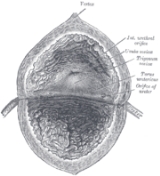
Anatomy of the bladder and outlet

Gray1140
The main organs involved in urination are the bladder and the urethra. The smooth muscle of the bladder, known as the detrusor, is innervated by sympathetic nervous system
Sympathetic

The word sympathetic means different things in different contexts.* In neurology and neuroscience, the sympathetic nervous system is a part of the autonomic nervous system....
 fibers from the lumbar
Lumbar

In anatomy, lumbar is an adjective that means of or pertaining to the abdominal segment of the torso, between the diaphragm and the sacrum ....
 spinal cord and parasympathetic fibers from the sacral
Sacral

The adjective sacral may have one of the following meanings:*A synonym for "sacred"*Related to sacrum...
 spinal cord. Fibers in the pelvic nerves constitute the main afferent limb of the voiding reflex; the parasympathetic fibers to the bladder that constitute the excitatory efferent limb also travel in these nerves. Part of the urethra is surrounded by the external urinary sphincter, which is innervated by somatic fibers originating in the sacral cord, in an area termed Onuf's nucleus.

Muscle bundles pass on either side of the urethra, and these fibers are sometimes called the internal urethral sphincter, although they do not encircle the urethra. Farther along the urethra is a sphincter of skeletal muscle, the sphincter of the membranous urethra (external urethral sphincter). The bladder's epithelium is termed transitional epithelium which contains a superficial layer of dome-like cells and multiple layers of stratified cuboidal cells underneath when evacuated. When the bladder is fully distended the superficial cells become squamous (flat) and the stratification of the cuboidal is reduced in order to provide lateral stretching.

Physiology of urination

The physiology of micturition and the physiologic basis of its disorders are subjects about which there is much confusion, especially at the supraspinal level. Micturition is fundamentally a spinobulbospinal reflex facilitated and inhibited by higher brain centers and, like defecation
Defecation

Defecation is the final act of digestion by which organisms eliminate solid, semisolid or liquid waste material from the digestive tract via the anus....
, subject to voluntary facilitation and inhibition.

In healthy individuals, the lower urinary tract has two discrete phases of activity: the storage phase, when urine is stored in the bladder; and the voiding phase, when urine is released through the urethra. The state of the reflex system is dependent on both a conscious signal from the brain and the firing rate of sensory fibers from the bladder and urethra. At low bladder volumes, afferent firing is low, resulting in excitation of the outlet (the sphincter and urethra), and relaxation of the bladder. At high bladder volumes, afferent firing increases, causing a conscious sensation of urinary urge. When the individual is ready to urinate, he or she consciously initiates voiding, causing the bladder to contract and the outlet to relax. Voiding continues until the bladder empties completely, at which point the bladder relaxes and the outlet contracts to re-initiate storage. The muscles controlling micturition are controlled by the autonomic
Autonomic nervous system

The autonomic nervous system is the part of the peripheral nervous system that acts as a control system, maintaining human homeostasis in the body....
 and somatic nervous systems. During the storage phase the internal urethral sphincter remains tense and the detrusor muscle relaxed by sympathetic
Sympathetic nervous system

The Sympathetic Nervous System is a branch of the autonomic nervous system along with the enteric nervous system and parasympathetic nervous system....
 stimulation. During micturition, parasympathetic
Parasympathetic nervous system

The parasympathetic nervous system is a division of the autonomic nervous system , along with the sympathetic nervous system and enteric nervous system ....
 stimulation causes the detrusor muscle to contract and the internal urethral sphincter to relax. The external urethral sphincter (sphincter urethrae) is under somatic control and is consciously relaxed during micturition.

In infants, voiding occurs involuntarily (as a reflex). The ability to voluntarily inhibit micturition develops at the age of 2-3 years, as control at higher levels of the central nervous system develops. In the adult, the volume of urine in the bladder that normally initiates a reflex contraction is about 300-400 ml.

Storage phase

During storage, bladder pressure stays low, because of the bladder's highly compliant nature. A plot of bladder (intravesical) pressure against the depressant of fluid in the bladder (called a cystometrogram) will show a very slight rise as the bladder is filled. This phenomenon is a manifestation of the law of Laplace, which states that the pressure in a spherical viscus is equal to twice the wall tension divided by the radius. In the case of the bladder, the tension increases as the organ fills, but so does the radius. Therefore, the pressure increase is slight until the organ is relatively full. The bladder smooth muscle has some inherent contractile activity; however, when its nerve supply is intact, stretch receptors in the bladder wall initiate a reflex contraction that has a lower threshold than the inherent contractile response of the muscle.

Action potentials carried by sensory neurons from stretch receptors in the urinary bladder wall travel to the sacral segments of the spinal cord through the pelvic nerves. Since bladder wall stretch is low during the storage phase, these afferent neurons fire at low frequencies. Low-frequency afferent signals cause relaxation of the bladder by inhibiting sacral parasympathetic preganglionic neurons and exciting lumbar sympathetic preganglionic neurons. Conversely, afferent input causes contraction of the sphincter through excitation of Onuf's nucleus, and contraction of the bladder neck and urethra through excitation of the sympathetic preganglionic neurons.

Diuresis
Diuresis

Diuresis is the increased production of urine by the kidney....
 (production of urine by the kidney) occurs constantly, and as the bladder becomes full, afferent firing increases, yet the micturition reflex can be voluntarily inhibited until it is appropriate to begin voiding (e.g. a bathroom is reached).

Voiding phase

Voiding begins when a voluntary signal is sent from the brain to begin urination, and continues until the bladder is empty.

Bladder afferent signals ascend the spinal cord to the periaqueductal gray
Periaqueductal gray

Periaqueductal gray is the midbrain grey matter that is located around the cerebral aqueduct within the midbrain. It plays a role in the descending modulation of pain and in defensive behaviour....
, where they project both to the pontine micturition center and to the cerebrum . At a certain level of afferent activity, the conscious urge to void becomes difficult to ignore. Once the voluntary signal to begin voiding has been issued, neurons in pontine micturition center fire maximally, causing excitation of sacral preganglionic neurons. The firing of these neurons causes the wall of the bladder to contract; as a result, a sudden, sharp rise in pressure in intravesical pressure occurs. The pontine micturition center also causes inhibition of Onuf's nucleus, resulting in relaxation of the external urinary sphincter. When the external urinary sphincter is relaxed urine flows from the urinary bladder when the pressure there is great enough to force urine to flow through the urethra. The micturition reflex normally produces a series of contractions of the urinary bladder.

The flow of urine through the urethra has an overall excitatory role in micturition, which helps sustain voiding until the bladder is empty.

After urination, the female urethra empties by gravity. Urine remaining in the urethra of the male is expelled by several contractions of the bulbospongiosus muscle
Bulbospongiosus muscle

Bulbospongiosus is one of the superficial muscles of the perineum. It has a slightly different origin, insertion and function in males and females....
.

Voluntary control


The mechanism by which voluntary urination is initiated remains unsettled. One possibility is that the voluntary relaxation of the muscles of the pelvic floor causes a sufficient downward tug on the detrusor muscle to initiate its contraction. Another possibility is the excitation or disinhibition of neurons in the pontine micturition center, which causes concurrent contraction of the bladder and relaxation of the sphincter.

There is an inhibitory area for micturition in the midbrain. After transection of the brain stem just above the pons, the threshold is lowered and less bladder filling is required to trigger it, whereas after transection at the top of the midbrain, the threshold for the reflex is essentially normal. There is another facilitatory area in the posterior hypothalamus. In humans with lesions in the superior frontal gyrus, the desire to urinate is reduced and there is also difficulty in stopping micturition once it has commenced. However, stimulation experiments in animals indicate that other cortical areas also affect the process.

The bladder can be made to contract by voluntary facilitation of the spinal voiding reflex when it contains only a few milliliters of urine. Voluntary contraction of the abdominal muscles aids the expulsion of urine by increasing the pressure applied to the urinary bladder wall, but voiding can be initiated without straining even when the bladder is nearly empty.

Voiding can also be consciously interrupted once it has begun, through a contraction of the perineal muscles and the external sphincter can be contracted voluntarily, which will prevent urine from passing down the urethra.

The other way around, voiding can be facilitated by immersing a hand in a cup or sink full of warm water or running a tap to imitate urination sounds. The mechanism is unclear, but may involve making control regions in the central nervous system believe that voiding has already begun, making it release the remaining inhibitory stimuli. The phenomenon (and perhaps immersion diuresis
Immersion diuresis

Immersion diuresis is a type of diuresis caused by immersion of the body in water . It is mainly caused by lower temperature and by pressure.The temperature component is caused by water drawing heat away from the body and causing vasoconstriction of the cutaneous blood vessels within the body to conserve heat....
) has given rise to the hand in warm water trick, which is immersing the hand of a sleeping person in water to make this victim urinate in sleep, although the efficacy of the trick is disputed. Nevertheless, it may be helpful for people with paruresis
Paruresis

Paruresis , also known as pee shyness, shy kidney, bashful bladder, stage fright, urophobia, shy phallus or shy bladder syndrome, is a type of phobia in which the sufferer is unable to urination in the presence of others, such as in a public restroom....
 (inability to urinate in the presence of others, such as in a public restroom).

Experience of urination

Need to urinate is experienced as an uncomfortable, full, feeling. It is highly correlated with the fullness of the bladder. In males the feeling of the need to urinate can be sensed at the base of the penis, even though the neural activity associated with a full bladder comes from the bladder itself. In females the need to urinate is felt in the lower abdomen in the region of the bladder.

Release of urine is experienced as a lessening of the uncomfortable, full, feeling. In most people this release is experienced as a relief.

Post-micturition convulsion syndrome

Post-micturition convulsion syndrome, also colloquially known as piss shivers or pee shivers, is a phenomenon in which one feels a shiver running down the spine following urination....
, the feeling of a shiver running down the spine following urination, occurs in more than 80% of males, but also occurs in more than 55% of females. Its explanation is unknown.

Disorders of urination


Experimentally induced disorders

There are three major types of bladder dysfunction due to neural lesions: (1) the type due to interruption of the afferent nerves from the bladder; (2) the type due to interruption of both afferent and efferent nerves; and (3) the type due to interruption of facilitatory and inhibitory pathways descending from the brain. In all three types the bladder contracts, but the contractions are generally not sufficient to empty the viscus completely, and residual urine is left in the bladder. Paruresis
Paruresis

Paruresis , also known as pee shyness, shy kidney, bashful bladder, stage fright, urophobia, shy phallus or shy bladder syndrome, is a type of phobia in which the sufferer is unable to urination in the presence of others, such as in a public restroom....
, also known as shy bladder syndrome, is an example of a bladder interruption from the brain that often causes total interruption until the person has left a public area.

Effects of deafferentation

When the sacral dorsal roots are cut in experimental animals or interrupted by diseases of the dorsal roots such as tabes dorsalis in humans, all reflex contractions of the bladder are abolished. The bladder becomes distended, thin-walled, and hypotonic, but there are some contractions because of the intrinsic response of the smooth muscle to stretch.

Effects of denervation

When the afferent and efferent nerves are both destroyed, as they may be by tumors of the cauda equina or filum terminale, the bladder is flaccid and distended for a while. Gradually, however, the muscle of the "decentralized bladder" becomes active, with many contraction waves that expel dribbles of urine out of the urethra. The bladder becomes shrunken and the bladder wall hypertrophied. The reason for the difference between the small, hypertrophic bladder seen in this condition and the distended, hypotonic bladder seen when only the afferent nerves are interrupted is not known. The hyperactive state in the former condition suggests the development of denervation hypersensitization even though the neurons interrupted are preganglionic rather than postganglionic.

Effects of spinal cord transection

During spinal shock, the bladder is flaccid and unresponsive. It becomes overfilled, and urine dribbles through the sphincters (overflow incontinence). After spinal shock has passed, the voiding reflex returns, although there is, of course, no voluntary control and no inhibition or facilitation from higher centers when the spinal cord is transected. Some paraplegic patients train themselves to initiate voiding by pinching or stroking their thighs, provoking a mild mass reflex. In some instances, the voiding reflex becomes hyperactive. Bladder capacity is reduced, and the wall becomes hypertrophied. This type of bladder is sometimes called the spastic neurogenic bladder. The reflex hyperactivity is made worse by, and may be caused by, infection in the bladder wall.

Clinical conditions

Many clinical conditions can cause disturbances to normal urination. Here is a partial list:

  • Urinary incontinence
    Urinary incontinence

    Urinary incontinence is any involuntary leakage of urine. It is a common and distressing problem, which may have a profound impact on quality of life....
    , or the inability to hold urine
    • Stress urinary incontinence, incontinence that occurs as a result of external mechanical disturbances
    • Urge urinary incontinence, incontinence that occurs as a result of the uncontrollable urge to urinate
    • Mixed urinary incontinence, a combination of the two types of incontinence
  • Urinary retention
    Urinary retention

    Urinary retention also known as ischuria is a lack of ability to urinate. It is a common complication of Benign prostatic hyperplasia , although anticholinergics may also play a role, and requires a catheter or Prostatic stent....
    , the inability to initiate urination
  • Overactive bladder
    Overactive bladder

    Overactive bladder is a urological condition defined by a set of symptoms: "urgency, with or without Urinary incontinence#Urge_incontinence_or_Hypertonic, usually with frequency and nocturia." The is responsible for this definition....
    , a strong urge to urinate, usually accompanied by detrusor overactivity
  • Interstitial cystitis
    Interstitial cystitis

    Interstitial cystitis is a urinary bladder disease of unknown cause characterised by urinary frequency , urgency, pressure and/or pain in the bladder and/or pelvis....
    , a condition characterized by urinary frequency, urgency, and pain
  • Prostatitis
    Prostatitis

    Prostatitis is an inflammation of the prostate gland, in men. A prostatitis diagnosis is assigned at 8% of all urologist and 1% of all primary care physician visits in the United States....
    , a supposed inflammation of the prostate gland that can cause urinary frequency, urgency, and pain
  • Benign prostatic hyperplasia
    Benign prostatic hyperplasia

    Benign prostatic hyperplasia also known as nodular hyperplasia, benign prostatic hypertrophy or benign enlargement of the prostate refers to the increase in size of the prostate in middle-aged and elderly men....
    , an enlargement of the prostate that can cause urinary frequency, urgency, retention, and the dribbling of urine
  • Urinary tract infection
    Urinary tract infection

    A urinary tract infection is a bacterial infection that affects any part of the urinary tract. Although urine contains a variety of fluids, salts, and waste products, it usually does not have bacteria in it....
    , which can cause urinary frequency and dysuria
    Dysuria

    In medicine, specifically urology, dysuria refers to painful urination. This is typically described to be a burning or stinging sensation. It is most often a result of a urinary tract infection....
  • Oliguria
    Oliguria

    Oliguria and anuria are the decreased or absent production of urine, respectively. The decreased production of urine may be a sign of dehydration, renal failure or urinary obstruction/urinary retention....
     refers to a low urine output, usually due to a problem with the upper urinary tract
  • Anuria
    Anuria

    Anuria means nonpassage of urine. But, is practically defined as passage of less than 50 milliliter of urine in a day. Anuria is inability to urinate due to failure in the function of kidneys....
     refers to absent or almost absent urine output.


Urination techniques

Due to the differences in where the urethra
Urethra

In anatomy, the urethra is a tube which connects the urinary bladder to the outside of the body. The urethra has an excretory function in both sexes to pass urine to the outside, and also a reproductive function in the male, as a passage for semen....
 ends, males and females use different techniques for urination.

Male urination


Because of the flexible and protruding nature of the penis
Penis

The penis is an external sex organ of certain biologically male organisms, in both vertebrates and invertebrates.The penis is a reproductive organ, technically an intromittent organ, and for Eutheria, additionally serves as the external organ of urination....
, it is simple to control the direction of the urine stream. This makes it easy to urinate while standing
Standing (position)

Standing is a human position in which the body is held upright and supported only by the feet, referred to as an orthostatic state.Although quiet standing appears to be static, modern instrumentation shows it to be a process of rocking from the ankle in the Anatomical terms of location#Planes plane....
; most males urinate this way. Extant foreskin (acropostheon) may block the direct path of the outgoing stream by causing turbulence
Turbulence

In fluid dynamics, turbulence or turbulent flow is a fluid regime characterized by chaotic, stochastic property changes. This includes low momentum diffusion, high momentum convection, and rapid variation of pressure and velocity in space and time....
, resulting in a slower but thicker stream of urine that may also dribble. A retracted or absent foreskin may have a more focused stream of urine that travels at the same speed as it exits the urethra
Urethra

In anatomy, the urethra is a tube which connects the urinary bladder to the outside of the body. The urethra has an excretory function in both sexes to pass urine to the outside, and also a reproductive function in the male, as a passage for semen....
. When a male is done urinating, he will usually shake and/or gently squeeze his penis to expel the excess urine trapped in the opening of the foreskin or on the glans
Glans penis

The glans penis is the sensitive bulbous structure at the distal end of the penis. It is also commonly referred to as the "head" of the penis. Slang terms include "helmet", "nob" , and "bell end", and all refer to its distinctive shape....
. Trousers
Trousers

Trousers are an item of clothing worn on the lower part of the body from the waist to the ankles, covering both legs separately . Such items of clothing are often referred to as pants in countries such as Canada, South Africa and The United States....
 commonly have a fly
Fly (clothing)

A fly on clothing is a covering over an opening join concealing the mechanism, such as a zipper, velcro or buttons used to join the opening. The term is most frequently applied to a short opening in trousers, shorts and other garments covering the groin, and to allow garments to be taken on and off with greater ease, and for convenience at...
 allowing men to urinate without lowering the whole trousers. Trousers without a fly, like some jogging trousers, usually have an elastic waist band allowing lowering the front side like underpants.

Female urination

Gray1229
In females, the urethra opens straight into the vulva
Vulva

The vulva refers to the external sex organ of the female. In colloquial speech, the term vagina is often used to refer to the female genitals generally, although, strictly speaking, the vagina is a specific internal structure, whereas the vulva is the whole exterior genitalia....
. Because of this, the urine does not exit at a distance from the body and is therefore hard to control. Due to surface tension
Surface tension

Surface tension is an attractive property of the surface of a liquid. It is what causes the surface portion of liquid to be attracted to another surface, such as that of another portion of liquid ....
 in the urine, the easiest method is to rely simply on gravitational force to take over once the urine has exited the body. This can easily be achieved by sitting on a toilet. When sitting, it helps if the female leans forward and keeps her legs together, as this helps direct her stream downwards. When not urinating into a toilet, squatting is the easiest way for a female to direct the urine stream. Some females use one or both hands to focus the direction of the urine stream, which is more easily achieved while in the squatting position.

It is possible for many females to urinate standing while spreading their legs. This technique for urinating while standing is not uncommon for a female who wears a sarong
Sarong

A sarong or sarung is a large tube or length of textile, often wrapped around the waist and worn as a kilt by men and as a skirt by women throughout much of South Asia, Southeast Asia, the Arabian Peninsula, the Horn of Africa, and on many Pacific islands....
, skirt
Skirt

A skirt is a tube- or cone-shaped garment that hangs from the waist and covers all or part of the legs.In European culture, skirts are usually considered woman clothing....
, or other such open bottomed garments, and either wears no underwear, or removes it. In many parts of Africa
Africa

Africa is the world's second-largest and second most-populous continent, after Asia. At about 30.2 million km? including adjacent islands, it covers 6% of the Earth's total surface area and 20.4% of the total land area....
 it is considered normal for females to urinate like this, whereas in contrast, public urination by females is not allowed for modesty reasons even when toilets are unavailable in places like India
India

India, officially the Republic of India , is a country in South Asia. It is the List of countries and outlying territories by total area country by geographical area, the List of countries by population country, and the most populous liberal democracy in the world....
 though public urination by males is accepted . In Africa, even sign
Sign

A sign is an entity which signifies another entity. A natural sign is an entity which bears a causal relation to the signified entity, as thunder is a sign of storm....
s which forbid public urination often show a picture of a female urinating while standing.

Though uncommon, it is also possible for females to urinate standing up in a way similar to that of males. This may be done by spreading the labia minora
Labia minora

The labia minora or nymphae are two Longitudinal#Anatomy cutaneous folds on the human vulva. They are situated between the labia majora, and extend from the clitoris obliquely downward, laterally, and backward on either side of the vulval vestibule, ending between bottom of the vulval vestibule and the labia majora....
 open in a certain way and orienting the pelvis
Pelvis

The pelvis or pelvic girdle is the irregular bone structure located at the base of the spine . In the adult human, it is formed by the sacrum and the coccyx, the caudal part of the axial skeleton, and a pair of hip bones, part of the appendicular skeleton or human leg....
 at an angle and rapidly forcing the urine stream out. An alternative method is to use a tool known as a female urination device
Female urination device

A female urination device or female urination aid is a device which enables a female to urination while standing upright. Variations include basic funnel shapes to more obscure and comedic designs....
 to assist.

Urination after injury

Occasionally, if a male's penis is damaged or removed, or a female's genitals/urinary tract is damaged, other urination techniques must be used. Most often in such cases, doctors will reposition the urethra to a location where urination can still be accomplished, usually in a position that would only promote urination while seated/squatting, though a permanent urinary catheter
Urinary catheterization

In urinary catheterization, or "cathing" for short, a plastic tube known as a urinary catheter is inserted into a patient's urinary bladder via their urethra....
 may rarely be used in some cases.

Social factors


Toilet training

Babies have no socialized control over urination within societies that do not practice elimination communication
Elimination communication

Elimination communication is a practice in which a caregiver uses timing, signals, cues, and intuition to address an infant need to eliminate waste....
 and instead use diapers. Toilet training
Toilet training

Toilet training, or potty training, is the process of training a young child to use the toilet for urination and defecation. In Western countries it is usually started and completed between the ages of 12 months and three years....
 is the process of learning to restrict urination to socially approved times and situations. Many young children suffer from nocturnal enuresis.

Toilets

It is socially more accepted and more hygienic for adults and older children to urinate in a toilet
Toilet

A toilet is a plumbing fixture and disposal system primarily intended for the disposal of the excretory system: urine and feces. Additionally, vomit and menstrual waste is sometimes disposed in toilets in western societies....
. In some countries, public toilets are separated for men and women, and may be partitioned for reasons of cultural modesty
Modesty

Standards of modesty are aspects of the culture of a country or people, at a given point in time, and is a measure against which an individual in society may be judged....
.

Urinals

Public restrooms may have urinal
Urinal

A urinal is a specialized toilet for urination only, generally by men and boys. It has the form of a container or simply a wall, with drainage and automatic or manual flushing....
s for male users. Female urinals, though rare, allow females to urinate while standing through the use of a special tool or through the finger-assist method . Urinals for either sex may have partitions between them in order to increase privacy
Privacy

Privacy is the ability of an individual or group to seclude themselves or information about themselves and thereby reveal themselves selectively....
. People with a mild form of paruresis
Paruresis

Paruresis , also known as pee shyness, shy kidney, bashful bladder, stage fright, urophobia, shy phallus or shy bladder syndrome, is a type of phobia in which the sufferer is unable to urination in the presence of others, such as in a public restroom....
, or "shy bladder syndrome," may have difficulty urinating in the presence of others and will consequently avoid using urinals directly adjacent to another person. Alternatively, they may opt for the privacy of a stall or simply avoid public restrooms altogether.

Urination without facilities

Acceptability of outdoor urination in a public place other than at a public urinal varies with the situation and with customs. Typically males do this standing up, while females squat
Sitting

Sitting is a rest position supported by the buttocks or thighs where the torso is more or less upright. There are several ways for humans to sit....
. Potential disadvantages are the "dirtyness", including smell, of urine, and some exposure of genitals. The latter can be unpleasant for the one who exposes them (modesty
Modesty

Standards of modesty are aspects of the culture of a country or people, at a given point in time, and is a measure against which an individual in society may be judged....
, lack of privacy
Privacy

Privacy is the ability of an individual or group to seclude themselves or information about themselves and thereby reveal themselves selectively....
) and/or those who can see them; it can be avoided or mitigated by going to a quiet place, and/or, for males, facing a tree or wall and for females, hiding the back behind walls or bushes. The more developed and crowded a place is the more urination tends to be objectional. In the countryside it is more acceptable than in a street in a town. In the latter case it is a common transgression. Often this is done after the consumption of alcoholic beverages. The alcohol causes production of additional urine as well as a reduction of inhibition
Social inhibition

Social inhibition is what keeps humans from becoming involved in potentially objectionable actions and/or expressions in a social setting. The significance of this inhibiting behaviour varies greatly from person to person, and may be closely linked to a person's confidence....
s. In most places, public urination is punishable by fine, though attitudes vary widely by country.

Urination can also be seen and/or intended as a sign of disrespect or contempt for someone or something. In popular culture, signs of a cartoon figure (such as Calvin
Calvin (Calvin and Hobbes)

Calvin is a fictional character in the comic strip Calvin and Hobbes by Bill Watterson. He is one of the strip's primary characters, along with Hobbes ....
) urinating on an object are common.

It is common to find both men and women urinating outdoors in Africa, Vietnam , Laos and Cambodia , and sometimes also in the United Kingdom, because of lack of toilet facilities. However in India women are told to control urine whereas men from all ages urinate in public because no facilities are found.

Females typically feel a need to urinate more than males on account of their (usually) smaller bladders . Routinely resisting the urge to urinate can promote urinary tract infection
Urinary tract infection

A urinary tract infection is a bacterial infection that affects any part of the urinary tract. Although urine contains a variety of fluids, salts, and waste products, it usually does not have bacteria in it....
.

Alternative urination tools

Sometimes urination is done in a container such as a bottle, urinal
Urinal

A urinal is a specialized toilet for urination only, generally by men and boys. It has the form of a container or simply a wall, with drainage and automatic or manual flushing....
, bedpan or chamber pot
Chamber pot

A chamber pot is a bowl-shaped container with a handle kept in the bedroom under a bed or in the cabinet of a nightstand and generally used as a urinal at night....
, also known as a gazunder
Gazunder

The word gazunder may refer to:*A chamber pot, so called because it "goes under" the bed;*In real estate transactions, gazundering is the practice of lowering an offer at the last moment, a variation on gazumping....
, e.g., in case of lying sick in bed, in the case that the urine has to be examined (for medical reasons, or for a drug test
Doping (sport)

In sports, the use of performance-enhancing drugs is commonly referred to by the disparaging term "doping", particularly by those organizations that regulate competitions....
), or when no toilet is available, and there is no other possibility to dispose of the urine right away. See also Bedpan use and output measurement
Nursing assistant skills

Nursing assistant skills are the set of learned tasks used by Certified Nursing Assistant in helping residents or patients with activities of daily living and providing bedside care--including basic nursing procedures--under the supervision of a Registered Nurse or Licensed Practical Nurse ....
.

For the latter application a more expensive solution (hence for special occasions while traveling etc.) is a special disposable bag containing absorbent material that solidifies the urine within ten seconds, making it convenient and safe to keep. If used in the presence of others, there is still the issue of privacy; it is hardly suitable in public transport, because if there is no toilet there is typically no other place to withdraw either; depending on social aspects and/or possibilities to withdraw it may or may not be suitable in a car, boat, private plane, etc., shared with others. Such a bag can also be used for vomiting
Vomiting

Vomiting is the forceful expulsion of the contents of one's stomach through the mouth and sometimes the nose. Undesired vomiting may result from many causes, ranging from gastritis or poisoning to brain tumors, or elevated intracranial pressure....
, should one experience motion sickness
Motion sickness

Motion sickness or kinetosis is a condition in which a disagreement exists between visually perceived movement and the vestibular system's sense of movement....
.

It is possible for both sexes to urinate into bottles in case of emergencies. Wide mouthed bottles can be used for females. The technique can help the sickly and the children to urinate discreetly inside cars and in other places without getting seen by others.

Talking about urination

In many societies and in many social classes, even mentioning the need to urinate is seen as a social transgression, despite it being a universal need. Even today, many adults avoid stating that they need to urinate. In India school students raise their little finger to indicate the need to pass urine. They may also say they need to go for number "one". This appears to be a universal practice in India .

Urination is often referred to as "peeing", a euphemism for "piss" which is considered more vulgar. It is also referred to as "weeing", "squirting", "taking a leak", or "doing/having a wee-wee".

"To whiz" is common in the U.S. "To piddle" is common in the U.K., as well as "to have a slash", which originates from the Scottish word "slash" meaning a large splash of liquid. An English term is to 'splash (one's) boots'. In the UK, common euphemisms include "Spending a penny" (a reference to coin-operated pay toilet
Pay toilet

A pay toilet is a Toilet#Public toilets that requires money payment of any individual to use. It may be street furniture or be inside a building, e.g....
s), "Going to see my aunt", or "Going to see a man about a dog." Others of note are "tinkle
Tinkle

Tinkle is an Indian monthly comic Indian magazine, published in several Indian languages. Originally owned by the India Book House, the Tinkle brand was acquired by ACK Media in 2007....
" and "potty" - both of which are often used with children. One expression used in some circles in Australia is to say "I am off to take a Chinese singing lesson," derived from the tinkling sound of urination against the China porcelain of a toilet bowl.

Depicting urination

Urination has been depicted in such artworks as Manneken Pis
Manneken Pis

Manneken Pis , also known in French language as the petit Julien, is a very famous Brussels landmark. It is a small bronze fountain sculpture depicting a naked little boy urinating into the fountain's basin....
. Urination in art may, however, be controversial. Some pornography
Pornography

Pornography or porn is the explicit depiction of sexual subject matter with the sole intention of sexually exciting the viewer. It is to a certain extent similar to erotica, which is the use of sexually arousing imagery....
 depicts urination; see also urolagnia
Urolagnia

Urolagnia is a sexual activity in which participants derive sexual pleasure from urine and/or urination. The term has origins in the Greek Language ....
.

Animals

While the primary purpose of urination is the same across the animal kingdom
Kingdom (biology)

In Biology taxonomy, kingdom or regnum is a taxonomic rank in either the highest rank, or the Rank below domain . Each kingdom is divided into smaller groups called Phylum ....
, urination often serves a social purpose beyond the expulsion of waste material. In dog
Dog

The dog is a domesticated subspecies of the Gray Wolf, a member of the Canidae family of the order Carnivora. The term is used for both feral and pet varieties....
s and other animals, urination can mark territory
Territorial marking

Spraying is behavior used by animals to identify their Territory . Most commonly, this is scent marking, accomplished by depositing strong-smelling chemical compound such as urine at prominent locations within the territory....
 or express submissiveness. In small rodent
Rodent

Rodentia is an Order of mammals also known as rodents, characterised by two continuously growing Incisors#The_Rodent_incisor in the upper and lower jaws which must be kept short by gnawing....
s such as rats and mice, it marks familiar paths.

The urine and urination of animals of differing physiology
Physiology

Physiology is the study of the mechanical, physical, and biochemical functions of living organisms. Physiology has traditionally been divided between plant physiology and animal and all living things physiology but the principles of physiology are universal, no matter what particular organism is being studied....
 or sex
Sex

In biology, sex is a process of combining and mixing genetics traits, often resulting in the specialization of organisms into male and female types ....
 sometimes have different characteristics. For example, birds urine is whitish and discharged with the droppings of the bird whereas mammals urine is a yellow colour and often discharged without faeces. Some animals urine has a strong smell, especially when it is used urine to mark territory or communicate in other ways. A male fox
Fox

A fox is an animal belonging to any one of about 27 species of small to medium-sized Canidae, characterized by possessing a long, narrow snout, and a bushy tail, or brush....
 raises one hind leg and its urine is sprayed forward in front of it, whereas a female fox squats down so that the urine is sprayed in the ground between the hind legs. Indeed, four-legged animals
Quadruped

Quadrupedalism is a form of Terrestrial locomotion in animals using four limbs or leg . An animal or machine that usually moves in a quadrupedal manner is known as a quadruped, meaning "four feet" ....
 usually kneel, or lift or spread one or more the legs, to complete full urination.

See also

  • Urinary bladder
    Urinary bladder

    In anatomy, the urinary bladder is a solid, muscle, and distensible organ that sits on the pelvic floor in mammals. It is the organ that collects urine excreted by the kidneys prior to disposal by urination....
  • Urethra
    Urethra

    In anatomy, the urethra is a tube which connects the urinary bladder to the outside of the body. The urethra has an excretory function in both sexes to pass urine to the outside, and also a reproductive function in the male, as a passage for semen....
  • Defecation
    Defecation

    Defecation is the final act of digestion by which organisms eliminate solid, semisolid or liquid waste material from the digestive tract via the anus....
  • Micturition syncope
    Micturition syncope

    Micturition syncope or post-micturition syncope is the name given to the human phenomenon of fainting shortly after or during urination....
  • History of toilets
  • Urolagnia
    Urolagnia

    Urolagnia is a sexual activity in which participants derive sexual pleasure from urine and/or urination. The term has origins in the Greek Language ....
  • Urophagia
    Urophagia

    Urophagia is the consumption of urine. There are various reasons that humans may consume urine. Urine was used in several ancient cultures for various health, healing, and cosmetic purposes; practices which are still used by some people of these cultures today....
  • Omorashi
    Omorashi

    is a fetish subculture recognized predominantly in Japan, in which participants experience Sexual arousal from having a full Urinary bladder or a sexual attraction to someone else experiencing the feeling of a full bladder....


External links


Physiology of urination