Papal Fanon

Encyclopedia
Vestment
Vestments are liturgical garments and articles associated primarily with the Christian religion, especially among Latin Rite and other Catholics, Eastern Orthodox, Anglicans, and Lutherans...
reserved only for the Pope
Pope
The Pope is the Bishop of Rome, a position that makes him the leader of the worldwide Catholic Church . In the Catholic Church, the Pope is regarded as the successor of Saint Peter, the Apostle...
for use during a pontifical Mass.
Description and use
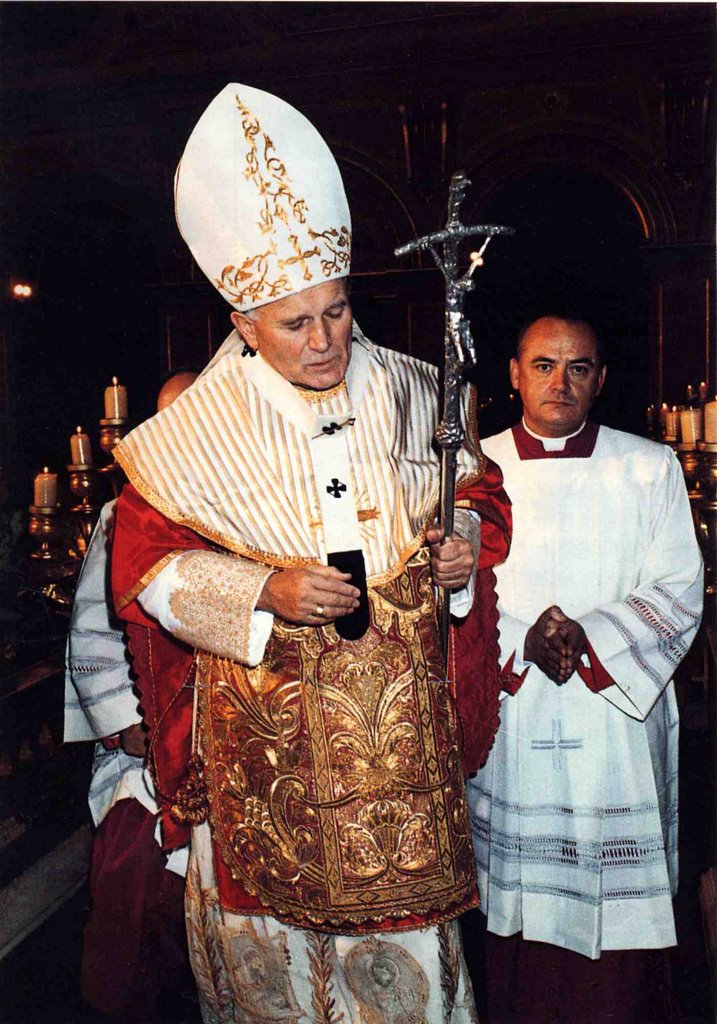
It consists of a doubled shoulder-cape (somewhat like a mozzettaMozzetta
The mozzetta is a short elbow-length cape that covers the shoulders and is buttoned over the breast. It is worn over the rochet or cotta as part of choir dress by some of the clergy of the Catholic Church, among them the Pope, cardinals, bishops, abbots, canons and religious superiors...
) of white silk ornamented with narrow woven golden stripes, so that the colors alternate white and gold. The first layer of the fanon is placed under the stole and the second over the chasuble
Chasuble
The chasuble is the outermost liturgical vestment worn by clergy for the celebration of the Eucharist in Western-tradition Christian Churches that use full vestments, primarily in the Roman Catholic, Anglican and Lutheran churches, as well as in some parts of the United Methodist Church...
, under the white pallium
Pallium
The pallium is an ecclesiastical vestment in the Roman Catholic Church, originally peculiar to the Pope, but for many centuries bestowed by him on metropolitans and primates as a symbol of the jurisdiction delegated to them by the Holy See. In that context it has always remained unambiguously...
. The two pieces of the fanon are nearly circular in shape but somewhat unequal in size and the smaller is laid over and fastened to the larger one. To allow the head to pass through there is a round opening in the middle with a vertical slit running down farther. The front part of the fanon is ornamented with a small cross embroidered in gold.
The fanon is similar to an amice
Amice
The amice is a liturgical vestment used mainly in the Roman Catholic Church, Lutheran Church, in some Anglican churches, Armenian and Polish National Catholic churches. It consists of a white cloth connected to two long ribbon-like attachments, by which it is fastened around the shoulders of the...
; it is, however, put on not under but above the alb. The pope wears it only when celebrating a solemn Pontifical Mass, that is, only when all the pontifical vestments are used. The manner of putting on the fanon recalls the method of assuming the amice universal in the Middle Ages and still observed by some of the older religious orders. After the deacon
Deacon
Deacon is a ministry in the Christian Church that is generally associated with service of some kind, but which varies among theological and denominational traditions...
has vested the pope with the usual amice, alb
Alb
The alb , one of the liturgical vestments of the Roman Catholic, Anglican and many Protestant churches, is an ample white garment coming down to the ankles and usually girdled with a cincture. It is simply the long linen tunic used by the Romans...
, the cingulum
Cingulum
The cingulum is a collection of white matter fibers projecting from the cingulate gyrus to the entorhinal cortex in the brain, allowing for communication between components of the limbic system....
and sub-cinctorium
Sub-cinctorium
The subcinctorium, is an ornamental vestment reserved for the pope, which is worn at a solemn pontifical Mass, it is very similar to, but somewhat broader than, the maniple in form and nature....
, and the pectoral cross
Pectoral cross
A pectoral cross or pectorale is a cross, usually relatively large, suspended from the neck by a cord or chain that reaches well down the chest. It is worn by the clergy as an indication of their position, and is different from the small crosses worn on necklaces by many Christians, which have no...
, he places the fanon on the pope by means of the opening, and then folds half of the upper piece towards the back over the pope's head. Then he vests the pope with the stole, tunicle
Tunicle
The tunicle is a liturgical vestment associated with Roman Catholicism and Anglicanism.For a description of the tunicle, see dalmatic, the vestment with which it became identical in form, although earlier editions of the Caeremoniale Episcoporum indicated that it should have narrower sleeves...
, dalmatic
Dalmatic
The dalmatic is a long wide-sleeved tunic, which serves as a liturgical vestment in the Roman Catholic, Lutheran, Anglican, and United Methodist Churches, which is sometimes worn by a deacon at the Mass or other services. Although infrequent, it may also be worn by bishops above the alb and below...
, and chasuble
Chasuble
The chasuble is the outermost liturgical vestment worn by clergy for the celebration of the Eucharist in Western-tradition Christian Churches that use full vestments, primarily in the Roman Catholic, Anglican and Lutheran churches, as well as in some parts of the United Methodist Church...
, after which he turns down that part of the fanon which had been placed over the head of the pope, draws the front half of the upper piece above the chasuble, and finally arranges the whole upper piece of the fanon so that it covers the shoulders of the pope like a collar. The pallium is placed over the fanon.
History
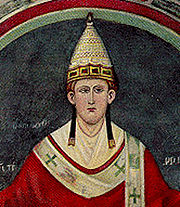
But it is certain that as early as the end of the twelfth century the fanon was worn solely by the pope, as is evident from the express statement of Innocent III (1198–1216). The vestment was then called an orale; the name of fanon, from the late Latin fano, derived from pannus (penos), cloth, woven fabric, was not used until a subsequent age. Even as early as the eighth century the pope wore the fanon only at solemn high Mass. The present usage, according to which the pope is vested, in addition to the fanon, with an amice under the alb, did not appear, at the earliest, until the close of the Middle Ages.
As to the form of the fanon and the material from which it was made in early times no positive information exists. Late in the Middle Ages it was made of white silk, as is shown by the inventory of the year 1295 of the papal treasure, as well as by numerous works of art; the favourite ornamentation was one of narrow stripes of gold and of some colour, especially red, woven into the silk. Up into the fifteenth century the fanon was square in shape; the present collar-like form seems to have appeared about the sixteenth century or even later.