

Panokseon

Encyclopedia
Panokseon was an oar- and sail-propelled ship that was the main class of warship used by the Korean Joseon Dynasty
during the late 16th century. The first ship of this class was constructed in 1555. It was a ship made of sturdy pine wood, and was instrumental in the victories over the numerically superior Japanese Navy during the Imjin War beginning in 1592. Admiral Yi Sunsin (1545–98) of the Joseon navy employed them alongside turtle ship
s during the war with great success.
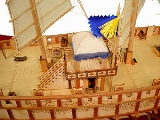
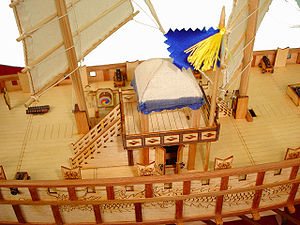
A key feature of a panokseon was its multiple decks. The first deck had non-combatant personnel, such as the rowers, who were positioned between the main-deck and the upper-deck, away from enemy fire. The combatant personnel were stationed on the upper-deck, which allowed them to attack the enemy from a higher vantage point. Also, on the deck of the panokseon, there was a raised, roofed observation platform where the commander stood.
 Panokseons were propelled by both sails and oars. Of the two basic types of sail, square and lateen, the square gives a strong performance downwind but struggles windward, whereas the fore-and-aft lateen sail excels against the wind, though requiring a large crew to handle it. In the West, square sails were used in the galleys of Ancient Greece
and the Viking longships, and the fore-and-aft variety as early as the Mediterranean dromon
ships of the Middle Ages
. When the Age of Exploration began in the fifteenth century, multiple-masted ships equipped with both types of sails eventually appeared. In Korea fore-and-aft sail equipped ships had been in use since the eighth century. Korea’s panokseon and Kobukson therefore had two masts by default, and their position and angle could easily be managed so that the sails could be used in all winds, whether adverse or favorable.
The ships had two to three levels stacked up on top of each other. By having multiple levels the rowers at the bottom were relatively safe, and marines at the top would have a height advantage over the enemy, firing down upon them and avoiding boarding of the ship. The upper deck had a tower in the middle of the ship that is used for command and observation. The deck of the panokseon was broad and flat, making it ideal for the installation of cannons.
Panokseons came in different sizes from a medium, 70 feet(23m) in length version to a large 100 to 120 feet(33 to 40m) in length vessel. The ship usually had 8 to 10 oars on each side, 50 to 60 oarsman and sailors and another 125 marines (i.e. fighting men).
Two types of woods were used to construct panokseon: pine for the hull and oak for the pegs and masts. Oak is a strong but heavy wood, so its use on ships was limited to the frame. Pine was also strong, but much lighter. Pine was usually allowed to season incompletely so that it would bend easily and not become too stiff. Despite its advantages pine had many knots and had to be cut thickly, thus the panokseon were built using thicker timbers. Instead of iron nails panokseons were held together by means of bamboo pegs, matching indentations, and interlocking teeth. This meant that as its boards absorbed water and expanded the fasteners did not rust, thus accounting for greater integrity of the hull.
s were also used on panokseons.
Another noteworthy aspect of Korea’s heavy fire-arms is that they were not all invented to meet the sudden emergency of war. These weapons in fact made their appearance some 200 years prior to Hideyoshi's invasions of Korea. Thanks to the efforts of Choe Mu-seon
, a general and a chemist, Korea began manufacturing and developing gunpowder and power-based weapons. Korean cannons first saw action in 1380 against a large fleet of Japanese pirate ships, and were found to be a great success.
In the 15th century, under the lead of King Sejong, who was himself a pioneer of scientific research, the performance of these heavy artillery improved dramatically. Having built a cannon range next to the Royal Court, and after much experimentation and study, King Sejong finally increased the extent of the cannons’ firepower from 300 m (980 ft) to 1000 m (3,100 ft). Naval cannons were also developed at this time and among them, Heaven, Earth, Black and Yellow cannon were later employed by Yi Sun-sin. The development of artillery steadily continued after King Sejong, and saw the invention of the Bigyeokjincholloe, a timed grenade that flung out hundreds of metal shards upon explosion, and the Dapoki, a machine capable of firing many arrows at once. One of the types of cannons were arrows with a pipe filled with gunpowder that went right through as many as 10 ships making devastating holes.
During Hideyoshi's invasions of Korea, Korea lacked advanced muskets, but had several types of powerful cannons.
class and the medium Sekibune class ships. In contrast to the Panokseon, the hulls of the Japanese vessels had sharp, V-shaped bows. A sharp underside was favorable for swift or long-distance travel in the open seas because of lower water resistance (thus these ships had faster cruising speeds). Since this variety of hull had a deep draft (penetrates deeper into the water), however, the ship’s turning radius was considerably large and changing direction was therefore a lengthy process. In addition, ships with larger drafts have a more difficult time of navigating narrow and shallower waters. Japanese ships were thus vastly less maneuverable than the panokseon in Korea's narrow channel waters.
The medium sized Sekibune ships, smaller craft and most Japanese transport ships had a single mast and can thus only sail in favorable winds. The Atakebune
was an exception in that it had two masts, but the main parts of its vessels were square-rigged and their sails were again limited to use in favorable winds.
It is worthwhile also to compare the hulls of the two nations’ respective warships, and their relative strength. The panokseon used thick, high density boards, giving an overall sturdiness to the ship’s structure. Japanese warships were structurally weaker, due to the thin, lower density timber used to build them, particularly cedar and fir. These were light weight woods and because they didn't have as many knots as pine, could be cut thinner. The Sekibune in particular, being the standard warship of the Japanese fleet, was built to be as light as possible, increasing its speed at the expense of structural integrity. This is consistent with traditional Japanese naval tactics of the time, which emphasized boarding enemy ships and engaging their crews in hand to hand combat.
Another major difference was the use of iron nails versus the use of wood pegs to hold the ship together. As previously mentioned, Korean ships were held together by interlocking teeth in the wood and wood pegs. The Japanese warships, on the other hand, relied on iron nails which, as time passed and corrosion and rust set in, eventually weakened the hull.
This difference in structural integrity also determined the number of cannons that could be carried on board. Because the Japanese ships lacked the strength to withstand the recoil of cannon, even the largest ship class, Atakebune
, could carry only three or four at the most. A Sekibune could only carry one. A panokseon could carry at least 26 cannons, but usually carried more (maybe up to 50). Since the hulls of Korean warships were strong enough, moreover, they were able to carry a large number of long-range cannons. These could be installed with ease on the large upper-deck of panokseon ships, and their angle configured at will to increase the range. Since the Japanese warships only allowed for a very limited number of cannons, their sailors mainly used muskets, which had a range of 100–200 m (330–660 ft) and Japanese naval commanders were sure that a volley of musket bullets would clear the enemy ships and allow for the grapple and board method.
The traditional and main naval strategy employed by the Japanese was that of "grapple-and-board", whereby sailors would attempt to board an enemy ship and fall to sword fighting on the decks. This method was mainly used because Japanese soldiers excelled at melee combat and because their ships were very fast. The Japanese Navy's concept of sea battle was therefore one of a fight between crews rather than the vessels themselves. This was the most common naval strategy in the world during this time, and was also used by the Spanish and the home fleets of the Mediterranean and Indian Ocean of the day. The Korean Navy, however, utilizing superior warships and firepower, engaged in a more modern, distanced kind of naval warfare. During Hideyoshi's invasions of Korea, a vast number of Japan's transports and warships were destroyed by Admiral Yi Sun-shin's leadership and strategies, superior firepower, and knowledge of strategic points on what amounts to a home field advantage.
Joseon Dynasty
Joseon , was a Korean state founded by Taejo Yi Seong-gye that lasted for approximately five centuries. It was founded in the aftermath of the overthrow of the Goryeo at what is today the city of Kaesong. Early on, Korea was retitled and the capital was relocated to modern-day Seoul...
during the late 16th century. The first ship of this class was constructed in 1555. It was a ship made of sturdy pine wood, and was instrumental in the victories over the numerically superior Japanese Navy during the Imjin War beginning in 1592. Admiral Yi Sunsin (1545–98) of the Joseon navy employed them alongside turtle ship
Turtle ship
The Turtle ship, also known as Geobukseon or Kobukson , was a type of large warship belonging to the Panokseon class in Korea that was used intermittently by the Royal Korean Navy during the Joseon Dynasty from the early 15th century up until the 19th century.The first references to older, first...
s during the war with great success.
A key feature of a panokseon was its multiple decks. The first deck had non-combatant personnel, such as the rowers, who were positioned between the main-deck and the upper-deck, away from enemy fire. The combatant personnel were stationed on the upper-deck, which allowed them to attack the enemy from a higher vantage point. Also, on the deck of the panokseon, there was a raised, roofed observation platform where the commander stood.
Characteristics
In line with the traditional structure of Korean ships, panokseon had a flat keel. This feature was due to the nature of the Korean coastal waters, which have a large tidal range and flat, expansive tidal plains. A flat keel enables a ship to sit comfortably on the tideland when the tide was out, after coming ashore or inside a wharf at high water. It also ensured greater mobility and a shallow draft and in particular allowed a ship to make sharp changes of direction at short notice. This panokseon was one of the main reasons why Admiral Yi was able to employ the Crane Wing formation at the Battle of Hansando with great success.Ancient Greece
Ancient Greece is a civilization belonging to a period of Greek history that lasted from the Archaic period of the 8th to 6th centuries BC to the end of antiquity. Immediately following this period was the beginning of the Early Middle Ages and the Byzantine era. Included in Ancient Greece is the...
and the Viking longships, and the fore-and-aft variety as early as the Mediterranean dromon
Dromon
The dromon was a type of galley and the most important warship of the Byzantine navy from the 6th to 12th centuries AD...
ships of the Middle Ages
Middle Ages
The Middle Ages is a periodization of European history from the 5th century to the 15th century. The Middle Ages follows the fall of the Western Roman Empire in 476 and precedes the Early Modern Era. It is the middle period of a three-period division of Western history: Classic, Medieval and Modern...
. When the Age of Exploration began in the fifteenth century, multiple-masted ships equipped with both types of sails eventually appeared. In Korea fore-and-aft sail equipped ships had been in use since the eighth century. Korea’s panokseon and Kobukson therefore had two masts by default, and their position and angle could easily be managed so that the sails could be used in all winds, whether adverse or favorable.
The ships had two to three levels stacked up on top of each other. By having multiple levels the rowers at the bottom were relatively safe, and marines at the top would have a height advantage over the enemy, firing down upon them and avoiding boarding of the ship. The upper deck had a tower in the middle of the ship that is used for command and observation. The deck of the panokseon was broad and flat, making it ideal for the installation of cannons.
Panokseons came in different sizes from a medium, 70 feet(23m) in length version to a large 100 to 120 feet(33 to 40m) in length vessel. The ship usually had 8 to 10 oars on each side, 50 to 60 oarsman and sailors and another 125 marines (i.e. fighting men).
Construction
Because of the rough waters around Korea's coast, as well as the sudden changes in tides and currents, Korean boats throughout history had to be strong. Korean ship building tradition created simple, but very structurally sound vessels. Throughout Korea's naval history, strength and power was emphasized rather than speed.Two types of woods were used to construct panokseon: pine for the hull and oak for the pegs and masts. Oak is a strong but heavy wood, so its use on ships was limited to the frame. Pine was also strong, but much lighter. Pine was usually allowed to season incompletely so that it would bend easily and not become too stiff. Despite its advantages pine had many knots and had to be cut thickly, thus the panokseon were built using thicker timbers. Instead of iron nails panokseons were held together by means of bamboo pegs, matching indentations, and interlocking teeth. This meant that as its boards absorbed water and expanded the fasteners did not rust, thus accounting for greater integrity of the hull.
Weapons
Panokseons had on board several varieties of cannon, such as those named Heaven, Earth, Black and Yellow. Heaven was the largest cannon with the greatest range and the most common cannon on the ships. Earth was a smaller cannon and Black and Yellow were smaller still. The Heaven cannon fired daejeon (a long, thick arrow in the shape of a rocket) with a range of 500 m (1,650 ft), as well as cheolhwan (cannon shot) which could travel up to a distance of 1 km (3300 ft). Wangu, a kind of mortar, which fired stones or shells with a radius of 20cm (7.8 in), was also used by the Korean navy. HwachaHwacha
Hwacha or Hwach'a is the world's first multiple rocket launcher developed and used in Joseon Korea. It had the ability to fire up to 100 steel-tipped rockets, or 200 Singijeon flaming arrow projectiles from a range of 500 yards in multiple salvos...
s were also used on panokseons.
Another noteworthy aspect of Korea’s heavy fire-arms is that they were not all invented to meet the sudden emergency of war. These weapons in fact made their appearance some 200 years prior to Hideyoshi's invasions of Korea. Thanks to the efforts of Choe Mu-seon
Choe Mu-seon
Choe Mu-Seon was a medieval Korean scientist, inventor, and military commander during the late Goryeo Dynasty and early Joseon Dynasty...
, a general and a chemist, Korea began manufacturing and developing gunpowder and power-based weapons. Korean cannons first saw action in 1380 against a large fleet of Japanese pirate ships, and were found to be a great success.
In the 15th century, under the lead of King Sejong, who was himself a pioneer of scientific research, the performance of these heavy artillery improved dramatically. Having built a cannon range next to the Royal Court, and after much experimentation and study, King Sejong finally increased the extent of the cannons’ firepower from 300 m (980 ft) to 1000 m (3,100 ft). Naval cannons were also developed at this time and among them, Heaven, Earth, Black and Yellow cannon were later employed by Yi Sun-sin. The development of artillery steadily continued after King Sejong, and saw the invention of the Bigyeokjincholloe, a timed grenade that flung out hundreds of metal shards upon explosion, and the Dapoki, a machine capable of firing many arrows at once. One of the types of cannons were arrows with a pipe filled with gunpowder that went right through as many as 10 ships making devastating holes.
During Hideyoshi's invasions of Korea, Korea lacked advanced muskets, but had several types of powerful cannons.
Comparison to Japanese Warships
The differences between the Panokseon and Japanese ships were significant. Japanese equivalents were the large AtakebuneAtakebune
were large Japanese warships of the 16th and 17th century internecine Japanese wars for political control and unity of all Japan.Japan undertook major naval building efforts in the mid to late 16th century, during the Sengoku period, when feudal rulers vying for supremacy built vast coastal navies...
class and the medium Sekibune class ships. In contrast to the Panokseon, the hulls of the Japanese vessels had sharp, V-shaped bows. A sharp underside was favorable for swift or long-distance travel in the open seas because of lower water resistance (thus these ships had faster cruising speeds). Since this variety of hull had a deep draft (penetrates deeper into the water), however, the ship’s turning radius was considerably large and changing direction was therefore a lengthy process. In addition, ships with larger drafts have a more difficult time of navigating narrow and shallower waters. Japanese ships were thus vastly less maneuverable than the panokseon in Korea's narrow channel waters.
The medium sized Sekibune ships, smaller craft and most Japanese transport ships had a single mast and can thus only sail in favorable winds. The Atakebune
Atakebune
were large Japanese warships of the 16th and 17th century internecine Japanese wars for political control and unity of all Japan.Japan undertook major naval building efforts in the mid to late 16th century, during the Sengoku period, when feudal rulers vying for supremacy built vast coastal navies...
was an exception in that it had two masts, but the main parts of its vessels were square-rigged and their sails were again limited to use in favorable winds.
It is worthwhile also to compare the hulls of the two nations’ respective warships, and their relative strength. The panokseon used thick, high density boards, giving an overall sturdiness to the ship’s structure. Japanese warships were structurally weaker, due to the thin, lower density timber used to build them, particularly cedar and fir. These were light weight woods and because they didn't have as many knots as pine, could be cut thinner. The Sekibune in particular, being the standard warship of the Japanese fleet, was built to be as light as possible, increasing its speed at the expense of structural integrity. This is consistent with traditional Japanese naval tactics of the time, which emphasized boarding enemy ships and engaging their crews in hand to hand combat.
Another major difference was the use of iron nails versus the use of wood pegs to hold the ship together. As previously mentioned, Korean ships were held together by interlocking teeth in the wood and wood pegs. The Japanese warships, on the other hand, relied on iron nails which, as time passed and corrosion and rust set in, eventually weakened the hull.
This difference in structural integrity also determined the number of cannons that could be carried on board. Because the Japanese ships lacked the strength to withstand the recoil of cannon, even the largest ship class, Atakebune
Atakebune
were large Japanese warships of the 16th and 17th century internecine Japanese wars for political control and unity of all Japan.Japan undertook major naval building efforts in the mid to late 16th century, during the Sengoku period, when feudal rulers vying for supremacy built vast coastal navies...
, could carry only three or four at the most. A Sekibune could only carry one. A panokseon could carry at least 26 cannons, but usually carried more (maybe up to 50). Since the hulls of Korean warships were strong enough, moreover, they were able to carry a large number of long-range cannons. These could be installed with ease on the large upper-deck of panokseon ships, and their angle configured at will to increase the range. Since the Japanese warships only allowed for a very limited number of cannons, their sailors mainly used muskets, which had a range of 100–200 m (330–660 ft) and Japanese naval commanders were sure that a volley of musket bullets would clear the enemy ships and allow for the grapple and board method.
The traditional and main naval strategy employed by the Japanese was that of "grapple-and-board", whereby sailors would attempt to board an enemy ship and fall to sword fighting on the decks. This method was mainly used because Japanese soldiers excelled at melee combat and because their ships were very fast. The Japanese Navy's concept of sea battle was therefore one of a fight between crews rather than the vessels themselves. This was the most common naval strategy in the world during this time, and was also used by the Spanish and the home fleets of the Mediterranean and Indian Ocean of the day. The Korean Navy, however, utilizing superior warships and firepower, engaged in a more modern, distanced kind of naval warfare. During Hideyoshi's invasions of Korea, a vast number of Japan's transports and warships were destroyed by Admiral Yi Sun-shin's leadership and strategies, superior firepower, and knowledge of strategic points on what amounts to a home field advantage.
See also
- Military history of KoreaMilitary history of KoreaKoreas military history spans back thousands of years, beginning with the early struggles of the ancient Kingdom of Gojoseon. Its long history consists of the many successful repulsions of major invasions and defensive against foreign invasions...
- History of KoreaHistory of KoreaThe Korean Peninsula was inhabited from the Lower Paleolithic about 400,000-500,000 years ago. Archeological evidence indicates that the presence of modern humans in northeast Asia dates to 39,000 years ago. The earliest known Korean pottery dates to around 8000 BC, and the Neolithic period began...
- Hideyoshi's Invasions of Korea
- Turtle ShipTurtle shipThe Turtle ship, also known as Geobukseon or Kobukson , was a type of large warship belonging to the Panokseon class in Korea that was used intermittently by the Royal Korean Navy during the Joseon Dynasty from the early 15th century up until the 19th century.The first references to older, first...