
All Topics  
Ozonolysis


   Email Print
   Bookmark   Link


Ozonolysis


Ozonolysis is the cleavage of an alkene
Alkene

In organic chemistry, an alkene, olefin, or olefine is an Saturation chemical compound containing at least one carbon-to-carbon double bond....
 or alkyne
Alkyne

Alkynes are hydrocarbons that have at least one triple bond between two carbon atoms, with the formula CnH2n-2. The alkynes are traditionally known as acetylenes or the acetylene series, although the name acetylene is also used to refer specifically to the simplest member of the series, known as e...
 with ozone
Ozone

Ozone or trioxygen is a triatomic molecule, consisting of three oxygen atoms. It is an allotrope of oxygen that is much less stable than the diatomic O2....
 to form organic compound
Organic compound

An organic compound is any member of a large class of chemical compounds whose molecules contain carbon. For historical reasons discussed below, a few types of compounds such as carbonates, simple oxides of carbon and cyanides, as well as the allotropes of carbon, are considered Inorganic compound....
s in which the multiple carbon-carbon bond
Carbon-carbon bond

A carbon-carbon bond is a covalent Chemical bond between two carbon atoms. The most common form is the single bond ? a bond composed of two electrons, one from each of the two atoms....
 has been replaced by a double bond to oxygen
Oxygen

Oxygen no O2 produced; 2) O2 produced, but absorbed in oceans & seabed rock; 3) O2 starts to gas out of the oceans, but is absorbed by land surfaces and formation of ozone layer; 4-5) O2 sinks filled and the gas accumulates]]...
. The outcome of the reaction depends on the type of multiple bond being oxidized and the workup conditions.

nes can be oxidized with ozone
Ozone

Ozone or trioxygen is a triatomic molecule, consisting of three oxygen atoms. It is an allotrope of oxygen that is much less stable than the diatomic O2....
 to form alcohol
Alcohol

In chemistry, an alcohol is any organic compound in which a hydroxyl Functional group is bound to a carbon atom of an alkyl or substituted alkyl group....
s, aldehyde
Aldehyde

An aldehyde is an organic compound containing a terminal carbonyl group. This functional group, which consists of a carbon atom bonded to a hydrogen atom and double bond to an oxygen atom , is called the aldehyde group....
s or ketone
Ketone

In organic chemistry, a ketone is a type of organic compound which contains a carbonyl group bonded to two other carbon atoms in the form:Neither of the substituents R1 and R2 may be equal to hydrogen ....
s, or carboxylic acid
Carboxylic acid

Carboxylic acids are organic acids characterized by the presence of a carboxyl group, which has the Chemical formula -COH, usually written -COOH or -CO2H....
s. In a typical procedure, ozone is bubbled through a solution of the alkene in dichloromethane
Dichloromethane

Dichloromethane or methylene chloride is the chemical compound with the chemical formula CarbonHydrogen2Chlorine2....
 at –78 °C until the solution takes on a characteristic blue color.


Discussion
Ask a question about 'Ozonolysis'
Start a new discussion about 'Ozonolysis'
Answer questions from other users
Full Discussion Forum


Recent Posts


Encyclopedia


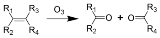
Ozonolysis is the cleavage of an alkene
Alkene

In organic chemistry, an alkene, olefin, or olefine is an Saturation chemical compound containing at least one carbon-to-carbon double bond....
 or alkyne
Alkyne

Alkynes are hydrocarbons that have at least one triple bond between two carbon atoms, with the formula CnH2n-2. The alkynes are traditionally known as acetylenes or the acetylene series, although the name acetylene is also used to refer specifically to the simplest member of the series, known as e...
 with ozone
Ozone

Ozone or trioxygen is a triatomic molecule, consisting of three oxygen atoms. It is an allotrope of oxygen that is much less stable than the diatomic O2....
 to form organic compound
Organic compound

An organic compound is any member of a large class of chemical compounds whose molecules contain carbon. For historical reasons discussed below, a few types of compounds such as carbonates, simple oxides of carbon and cyanides, as well as the allotropes of carbon, are considered Inorganic compound....
s in which the multiple carbon-carbon bond
Carbon-carbon bond

A carbon-carbon bond is a covalent Chemical bond between two carbon atoms. The most common form is the single bond ? a bond composed of two electrons, one from each of the two atoms....
 has been replaced by a double bond to oxygen
Oxygen

Oxygen no O2 produced; 2) O2 produced, but absorbed in oceans & seabed rock; 3) O2 starts to gas out of the oceans, but is absorbed by land surfaces and formation of ozone layer; 4-5) O2 sinks filled and the gas accumulates]]...
. The outcome of the reaction depends on the type of multiple bond being oxidized and the workup conditions.

Ozonolysis of alkenes

Alkenes can be oxidized with ozone
Ozone

Ozone or trioxygen is a triatomic molecule, consisting of three oxygen atoms. It is an allotrope of oxygen that is much less stable than the diatomic O2....
 to form alcohol
Alcohol

In chemistry, an alcohol is any organic compound in which a hydroxyl Functional group is bound to a carbon atom of an alkyl or substituted alkyl group....
s, aldehyde
Aldehyde

An aldehyde is an organic compound containing a terminal carbonyl group. This functional group, which consists of a carbon atom bonded to a hydrogen atom and double bond to an oxygen atom , is called the aldehyde group....
s or ketone
Ketone

In organic chemistry, a ketone is a type of organic compound which contains a carbonyl group bonded to two other carbon atoms in the form:Neither of the substituents R1 and R2 may be equal to hydrogen ....
s, or carboxylic acid
Carboxylic acid

Carboxylic acids are organic acids characterized by the presence of a carboxyl group, which has the Chemical formula -COH, usually written -COOH or -CO2H....
s. In a typical procedure, ozone is bubbled through a solution of the alkene in dichloromethane
Dichloromethane

Dichloromethane or methylene chloride is the chemical compound with the chemical formula CarbonHydrogen2Chlorine2....
 at –78 °C until the solution takes on a characteristic blue color. This indicates consumption of the olefin. A reagent is then added to convert the intermediate ozonide to a carbonyl derivative. Reductive work-up
Work-up

In chemistry, work-up refers to the series of manipulations required to isolate and purify the product of a chemical reaction.Typically, these manipulations include:...
 conditions are far more commonly used than oxidative conditions. The use of triphenylphosphine
Triphenylphosphine

Triphenylphosphine is a common organophosphorus compound with the formula P3 - often abbreviated to PhosphorusPhenyl group or Ph3P....
, zinc
Zinc

Zinc is a metallic chemical element with the symbol Zn and atomic number 30. It is a first-row transition metal of the group 12 element of the periodic table....
 dust, or dimethyl sulfide
Dimethyl sulfide

Dimethyl sulfide or methylthiomethane is an Organosulfur compounds compound with the formula 2S. Dimethyl sulfide is a water-insoluble flammable liquid that boils at 37?C and has a characteristic disagreeable odor....
 produces aldehydes or ketones while the use of sodium borohydride
Sodium borohydride

Sodium borohydride, also known as sodium tetrahydroborate, has the chemical formula sodiumboronhydrogen4. This white solid, usually encountered as a powder, is a specialty reducing agent used in the manufacture of Pharmacologys and other organic and inorganic compounds....
 produces alcohols. The use of hydrogen peroxide
Hydrogen peroxide

Hydrogen peroxide is a very pale blue liquid which appears colorless in a dilute solution, slightly more viscous than water. It is a weak acid....
 produces carboxylic acids. Recently, the use of amine N-oxides has been reported to produce aldehydes directly. Other functional group
Functional group

In organic chemistry, functional groups are specific groups of atoms within molecules that are responsible for the characteristic chemical reactions of those molecules....
s, such as benzyl
Benzyl

In organic chemistry, benzyl is the term used to describe the substituent or molecular fragment possessing the structure C6H5CH2-....
 ether
Ether

Ether is a class of organic compounds which contain an ether functional group ? an oxygen atom connected to two alkyl or aryl groups ? of general formula R?O?R....
s, can also be oxidized by ozone. It has been proposed that small amounts of acid may be generated during the reaction from oxidation of the solvent, so pyridine
Pyridine

Pyridine is a simple and important heterocyclic aromatic organic compound with the formula CarbonHydrogenNitrogen. This colorless liquid with a distinctive fish-like odor is structurally related to benzene, wherein one CH group in the six-membered ring is replaced by a nitrogen atom....
 is sometimes used to buffer
Buffering agent

A buffering agent adjusts the pH of a solution. The function of a buffering agent is to drive an acidic or basic solution to a certain pH state and prevent a change in this pH....
 the reaction. Methanol
Methanol

Methanol, also known as methyl alcohol, carbinol, wood alcohol, wood naphtha or wood spirits, is a chemical compound with chemical formula carbonhydrogen3oxygenhydrogen ....
 is often used as a 1:1 cosolvent to facilitate timely cleavage of the ozonide. Azelaic acid
Azelaic acid

Azelaic acid is a saturated dicarboxylic acid found naturally in wheat, rye, and barley. It is a natural substance that is produced by Malassezia furfur , a yeast that lives on normal skin....
 and pelargonic acids are produced from ozonolysis of oleic acid
Oleic acid

Oleic acid is a monounsaturated omega-9 fatty acid fatty acid found in various animal and vegetable sources. It has the formula C18H34O2 ....
 on an industrial scale.

Ozonolysis Scheme
A widely used alternative method for the ozonolysis of symmetrical alkenes allows differentially terminated hydrocarbons to be generated:
  • with O3/MeOH/CH2Cl2; TsOH; sodium hydrogencarbonate (NaHCO3); dimethyl sulfide
    Dimethyl sulfide

    Dimethyl sulfide or methylthiomethane is an Organosulfur compounds compound with the formula 2S. Dimethyl sulfide is a water-insoluble flammable liquid that boils at 37?C and has a characteristic disagreeable odor....
     (DMS), aldehyde and dimethyl acetal
    Acetal

    An acetal is a molecule with two single bonded oxygens attached to the same carbon atom.Traditional usages distinguish ketal from acetal . Current accepted terminology classifies ketals as a subset of acetals....
     termini
  • with O3/MeOH/CH2Cl2; acetic anhydride
    Acetic anhydride

    Acetic anhydride is the chemical compound with the chemical formula 2O. Commonly abbreviated Acetyl2O, it is one of the simplest acid anhydrides and is a widely used reagent in organic synthesis....
     (Ac2O), triethylamine
    Triethylamine

    Triethylamine is the chemical compound with the chemical formula N3, commonly abbreviated ethyl group3N or TEA. It is a commonly encountered in organic synthesis probably because it is the simplest symmetrically trisubstituted amine, i.e....
     (Et3N), methyl ester
    Ester

    An ester is an often Aroma compound organic chemistry or partially organic compound formed by the reaction between an acid and an alcohol or aromatic alcohol with the elimination of water....
    s and aldehyde termini
  • with O3/MeOH/CH2Cl2; TsOH; Ac2O, Et3N, methyl ester and dimethyl acetal termini.


An example is the ozonolysis of eugenol
Eugenol

Eugenol , is an allyl chain-substituted guaiacol. Eugenol is a member of the phenylpropanoids class of chemical compounds. It is a clear to pale yellow oily liquid extracted from certain essential oils especially from clove oil, nutmeg, cinnamon, and bay leaf....
 converting the terminal alkene to an aldehyde :

Reaction mechanism

In the generally accepted mechanism proposed by Rudolf Criegee
Rudolf Criegee

Rudolf Criegee was a German chemist. He studied in T?bingen, Greifswald, and W?rzburg and received his doctorate at W?rzburg in 1925. He proposed a reaction mechanism for ozonolysis in 1953....
 in 1953, the alkene and ozone form an intermediate molozonide
Molozonide

A molozonide is an unstable cyclic organic compound, which includes three oxygen atoms and two sp3-Orbital hybridisation carbon atoms....
 in a 1,3-dipolar cycloaddition
1,3-dipolar cycloaddition

The 1,3-dipolar cycloaddition, also known as the Huisgen cycloaddition or Huisgen reaction, is an organic chemistry chemical reaction belonging to the larger class of cycloadditions....
. Next, the molozonide reverts to its corresponding carbonyl oxide (also called the Criegee intermediate) and aldehyde or ketone in a retro-1,3-dipolar cycloaddition. The oxide and aldehyde or ketone react again in a 1,3-dipolar cycloaddition or produce a stable ozonide
Ozonide

Ozonide is an unstable, reactive polyatomic ion anion O3−, derived from ozone, or an organic compound similar to organic peroxide formed by a reaction of ozone with an unsaturated compound....
 intermediate (a trioxolane).

Ozonolysis
Evidence for this mechanism is found in isotopic labeling
Isotopic labeling

Isotopic labeling is a technique for tracking the passage of a sample of substance through a system. The substance is 'labeled' by including unusual isotopes in its chemical composition....
. When 17O-labelled benzaldehyde
Benzaldehyde

Benzaldehyde is a chemical compound consisting of a benzene ring with an aldehyde substituent. It is the simplest representative of the aromatic aldehydes and one of the most industrially used members of this family of compounds....
 reacts with carbonyl oxides, the label ends up exclusively in the ether linkage of the ozonide. There is still dispute over whether the molozonide collapses via a concerted or radical process; this may also exhibit a substrate dependence.

History

Ozonolysis was invented by Christian Friedrich Schönbein
Christian Friedrich Schönbein

Christian Friedrich Sch?nbein was a German-Swiss chemist who is best known for inventing the fuel cell and his discoveries of guncotton and ozone....
 in 1840. Before the advent of modern spectroscopic techniques, it was an important method for determining the structure of organic molecules. Chemists would ozonize an unknown alkene to yield smaller and more identififable fragments. The ozonolysis of alkenes is sometimes referred to as "Harries Ozonolysis," because some attribute this reaction to Carl Dietrich Harries
Carl Harries

Carl Dietrich Harries was a Germany Chemist. Carl Dietrich Harries was born in Luckenwalde, Germany. He received his doctorate in 1892. In 1900, he married Hertha von Siemens, daughter of the electrical genius Werner von Siemens, and the inventor of one of the earliest ozone generators....
.

Ozonolysis of alkynes

Ozonolysis of alkyne
Alkyne

Alkynes are hydrocarbons that have at least one triple bond between two carbon atoms, with the formula CnH2n-2. The alkynes are traditionally known as acetylenes or the acetylene series, although the name acetylene is also used to refer specifically to the simplest member of the series, known as e...
s generally gives an acid anhydride or diketone
Diketone

A diketone is a molecule containing two ketone groups. The simpliest diketone is diacetyl, also known as 2,3-butanedione. Diacetyl, acetylacetone, and hexane-2,5-dione are examples of 1,2-, 1,3-, and 1,4-diketones, respectively....
 product, not complete fragmentation as for alkene
Alkene

In organic chemistry, an alkene, olefin, or olefine is an Saturation chemical compound containing at least one carbon-to-carbon double bond....
s. A reducing agent is not needed for these reactions. The exact mechanism is not completely known. If the reaction is performed in the presence of water, the anhydride hydrolyzes to give two carboxylic acid
Carboxylic acid

Carboxylic acids are organic acids characterized by the presence of a carboxyl group, which has the Chemical formula -COH, usually written -COOH or -CO2H....
s.

Ozonolysis of elastomers

The method was used to confirm the structural repeat unit
Repeat unit

An essential concept which defines polymer structure, the repeat unit is the simplest structural unit of a polymer chain. So a polymer consists of repeat units linked together, like the beads of a necklace....
 in natural rubber as isoprene
Isoprene

Isoprene is a common synonym for the chemical compound 2-methyl-1,3-butadiene. It is commonly used in industry, is an important biological material, and can be a harmful environmental pollutant and toxicant when present in excess quantities....
. It is also a serious problem, known as "ozone cracking" where traces of the gas in an atmosphere will attack and split double bonds in susceptible elastomers, including natural rubber, polybutadiene
Polybutadiene

Polybutadiene is a synthetic rubber that is a polymer formed from the polymerization of the monomer 1,3-butadiene. It has a high resistance to wear and is used especially in the Tire manufacturing of tires....
, Styrene-butadiene
Styrene-butadiene

Styrene-Butadiene or Styrene-Butadiene-Rubber is a synthetic rubber copolymer consisting of styrene and butadiene. It has good Wear#Abrasive wear resistance and good aging stability when protected by additives, and is widely used in car tires, where it is blended with natural rubber....
 and Nitrile rubber
Nitrile rubber

Nitrile rubber, or Buna-N, is a synthetic rubber copolymer of acrylonitrile and butadiene. Some trade names are: Nipol, Krynac and Europrene....
. Ozone cracking creates small cracks at right angles to the load in the surfaces exposed to the gas, the cracks growing steadily as attack continues. The rubber product must be under tension
Tension

Tension may refer to:In science:*Tension , a force related to the stretching of an object *Electrical tension, see voltage*High-tension, in electrical power transmissions wires which carry high-voltages...
 for crack growth to occur. Ozone cracking
Ozone cracking

Cracks can be formed in many different elastomers by ozone attack, and the characteristic form of attack of vulnerable rubbers is known as ozone cracking....
 is a form of stress corrosion cracking
Stress corrosion cracking

Stress corrosion cracking is the unexpected sudden failure of normally ductile metals or tough thermoplastics subjected to a tensile stress in a corrosion environment, especially at elevated temperature in the case of metals....
 where active chemical species attack products of a susceptible material. Ozone cracking is a serious problem in fuel line
Fuel line

A fuel line is a hose used to bring fuel from one point in a vehicle to another. It is commonly made up of reinforced rubber to prevent splitting and kinking....
s since cracks can penetrate the bore and cause a fuel leak, leading to fires or spillage of diesel fuel onto roads for example. Spills are especially hazardous since the slick is extremely slippery and is the cause of many road accidents, especially those involving motorcyclists. Ozone cracking was formerly commonly seen in the tyre
Tyre

Tyre is a city in the South Governorate, Lebanon of Lebanon . There were approximately 117,000 inhabitants in 2003, however, the government of Lebanon has released only rough estimates of population numbers since 1932, so an accurate statistical accounting is not possible....
 sidewalls but is now rare owing to the use of anti-ozonants. Other means of prevention include replacing susceptible rubbers with resistant elastomers such as polychloroprene, EPDM or fluoroelastomers such as Viton
Viton

Viton is a brand of synthetic rubber and fluoropolymer elastomer commonly used in O-rings and other Molding or Plastics extrusion goods. The name is a registered trademark of ....
.

See also

  • Ozone
    Ozone

    Ozone or trioxygen is a triatomic molecule, consisting of three oxygen atoms. It is an allotrope of oxygen that is much less stable than the diatomic O2....
  • Ozone cracking
    Ozone cracking

    Cracks can be formed in many different elastomers by ozone attack, and the characteristic form of attack of vulnerable rubbers is known as ozone cracking....
  • Polymer degradation
    Polymer degradation

    Polymer degradation is a change in the properties - tensile strength, colour, shape, etc - of a polymer or polymer based product under the influence of one or more environmental factors such as heat, light or chemicals....


External links