

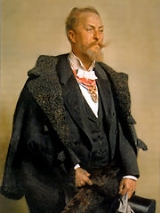
Otto Wagner

Encyclopedia
Otto Koloman Wagner was an Austria
n architect
and urban planner
, known for his lasting impact on the appearance of his home town Vienna
, to which he contributed many landmarks.
, a district in Vienna
. He studied in Berlin
and Vienna. In 1864, he started designing his first buildings in the historicist style. In the mid- and late-1880s, like many of his contemporaries in Germany (such as Constantin Lipsius
, Richard Streiter and Georg Heuser), Switzerland (Hans Auer
and Alfred Friedrich Bluntschli
) and France (Paul Sédille
), Wagner became a proponent of Architectural Realism. It was a theoretical position that enabled him to mitigate the reliance on historical forms. In 1894, when he became Professor of Architecture at the Academy of Fine Arts Vienna
, he was well advanced on his path toward a more radical opposition to the prevailing currents of historicist architecture.
By the mid-1890s, he had already designed several Jugendstil buildings. Wagner was very interested in urban planning — in 1890 he designed a new city plan for Vienna, but only his urban rail network, the Stadtbahn
, was built. In 1896 he published a textbook entitled Modern Architecture in which he expressed his ideas about the role of the architect; it was based on the text of his 1894 inaugural lecture to the Academy. His style incorporated the use of new materials and new forms to reflect the fact that society itself was changing. In his textbook, he stated that "new human tasks and views called for a change or reconstitution of existing forms". In pursuit of this ideal, he designed and built structures that reflected their intended function, such as the austere Neustiftgasse apartment block in Vienna.
In 1897, he joined Gustav Klimt
, Joseph Maria Olbrich
, Josef Hoffmann
and Koloman Moser
shortly after they founded the "Vienna Secession
" artistic group. From the ideas of this group he developed a style that included quasi-symbolic references to the new forms of modernity.
Wagner died in Vienna in 1918.
 Hungary
Austria
Digitized books from the architecture collection of AMS Historica, the digital library of the University of Bologna
. skizzen 1, Wien, 1905. skizzen 2, Wien, 1905. skizzen 3, Wien, 1905.
Austria
Austria , officially the Republic of Austria , is a landlocked country of roughly 8.4 million people in Central Europe. It is bordered by the Czech Republic and Germany to the north, Slovakia and Hungary to the east, Slovenia and Italy to the south, and Switzerland and Liechtenstein to the...
n architect
Architect
An architect is a person trained in the planning, design and oversight of the construction of buildings. To practice architecture means to offer or render services in connection with the design and construction of a building, or group of buildings and the space within the site surrounding the...
and urban planner
Urban planner
An urban planner or city planner is a professional who works in the field of urban planning/land use planning for the purpose of optimizing the effectiveness of a community's land use and infrastructure. They formulate plans for the development and management of urban and suburban areas, typically...
, known for his lasting impact on the appearance of his home town Vienna
Vienna
Vienna is the capital and largest city of the Republic of Austria and one of the nine states of Austria. Vienna is Austria's primary city, with a population of about 1.723 million , and is by far the largest city in Austria, as well as its cultural, economic, and political centre...
, to which he contributed many landmarks.
Life
Wagner was born in PenzingPenzing (Vienna)
Penzing is the 14th District of Vienna and consists of the boroughs of Penzing, Breitensee, Baumgarten, Hütteldorf and Hadersdorf-Weidlingau. In the west, it shares a border with Purkersdorf and Mauerbach...
, a district in Vienna
Vienna
Vienna is the capital and largest city of the Republic of Austria and one of the nine states of Austria. Vienna is Austria's primary city, with a population of about 1.723 million , and is by far the largest city in Austria, as well as its cultural, economic, and political centre...
. He studied in Berlin
Berlin
Berlin is the capital city of Germany and is one of the 16 states of Germany. With a population of 3.45 million people, Berlin is Germany's largest city. It is the second most populous city proper and the seventh most populous urban area in the European Union...
and Vienna. In 1864, he started designing his first buildings in the historicist style. In the mid- and late-1880s, like many of his contemporaries in Germany (such as Constantin Lipsius
Constantin Lipsius
Johannes Wilhelm Constantin Lipsius was a German architect and architectural theorist, best known for his controversial design of the Royal Academy of Fine Arts and Exhibition Building on the Brühl Terrace in Dresden, today known as the Lipsius-Bau.After attending Gymnasium, Lipsius initially...
, Richard Streiter and Georg Heuser), Switzerland (Hans Auer
Hans Auer
Hans Wilhelm Auer was a Swiss-Austrian architect best known for his design of the Swiss Bundeshaus in Bern.Auer was born in Wädenswil...
and Alfred Friedrich Bluntschli
Alfred Friedrich Bluntschli
Alfred Friedrich Bluntschli was a Swiss Architect and Educator.Son of a distinguished legal scholar, Johann Caspar Bluntschli, A. F...
) and France (Paul Sédille
Paul Sédille
Paul Sédille was a French architect and theorist; and designed the 1880 reconstruction of the iconic Magasins du Printemps department store in Paris.- Life :...
), Wagner became a proponent of Architectural Realism. It was a theoretical position that enabled him to mitigate the reliance on historical forms. In 1894, when he became Professor of Architecture at the Academy of Fine Arts Vienna
Academy of Fine Arts Vienna
The Academy of Fine Arts Vienna is an institution of higher education in Vienna, Austria.- History :The Academy of Fine Arts Vienna was founded in 1692 as a private academy by the court-painter Peter Strudl, who became the Praefectus Academiae Nostrae. In 1701 he was ennobled as Baron of the Empire...
, he was well advanced on his path toward a more radical opposition to the prevailing currents of historicist architecture.
By the mid-1890s, he had already designed several Jugendstil buildings. Wagner was very interested in urban planning — in 1890 he designed a new city plan for Vienna, but only his urban rail network, the Stadtbahn
Wiener Stadtbahn
The Wiener Stadtbahn was a public transportation system operated under this name from 1898 to 1989. Today, the Vienna U-Bahn lines U4 and U6 and the Vienna S-Bahn run on its former lines....
, was built. In 1896 he published a textbook entitled Modern Architecture in which he expressed his ideas about the role of the architect; it was based on the text of his 1894 inaugural lecture to the Academy. His style incorporated the use of new materials and new forms to reflect the fact that society itself was changing. In his textbook, he stated that "new human tasks and views called for a change or reconstitution of existing forms". In pursuit of this ideal, he designed and built structures that reflected their intended function, such as the austere Neustiftgasse apartment block in Vienna.
In 1897, he joined Gustav Klimt
Gustav Klimt
Gustav Klimt was an Austrian Symbolist painter and one of the most prominent members of the Vienna Secession movement. His major works include paintings, murals, sketches, and other art objects...
, Joseph Maria Olbrich
Joseph Maria Olbrich
Joseph Maria Olbrich was an Austrian architect and co-founder of the Vienna Secession.-Life:Olbrich was born in Opava, Austrian Silesia .He was the third child of Edmund and Aloisia Olbrich. He had two sisters who died before he was born, and two younger brothers John and Edmund...
, Josef Hoffmann
Josef Hoffmann
Josef Hoffmann was an Austrian architect and designer of consumer goods.- Biography :...
and Koloman Moser
Koloman Moser
Koloman Moser was an Austrian artist who exerted considerable influence on twentieth-century graphic art and one of the foremost artists of the Vienna Secession movement and a co-founder of Wiener Werkstätte....
shortly after they founded the "Vienna Secession
Vienna Secession
The Vienna Secession was formed in 1897 by a group of Austrian artists who had resigned from the Association of Austrian Artists, housed in the Vienna Künstlerhaus. This movement included painters, sculptors, and architects...
" artistic group. From the ideas of this group he developed a style that included quasi-symbolic references to the new forms of modernity.
Wagner died in Vienna in 1918.
Major works
- Rumbach Street synagogueRumbach Street synagogueThe Rumbach Street synagogue is located in Belváros, the inner city of the historical old town of Pest, in the eastern section of Budapest.The synagogue in Rumbach Street was built in 1872 to the design of the Viennese architect Otto Wagner...
, BudapestBudapestBudapest is the capital of Hungary. As the largest city of Hungary, it is the country's principal political, cultural, commercial, industrial, and transportation centre. In 2011, Budapest had 1,733,685 inhabitants, down from its 1989 peak of 2,113,645 due to suburbanization. The Budapest Commuter...
(1872)
Austria
- Floodgate, Nußdorf, ViennaNußdorf, ViennaNußdorf was a separate municipality until 1892 and is today a suburb of Vienna in the 19th district of Döbling.- Location :Nußdorf lies on both banks of the Nußbach , where the brook meets the Danube Canal...
(1894) - VienneseViennaVienna is the capital and largest city of the Republic of Austria and one of the nine states of Austria. Vienna is Austria's primary city, with a population of about 1.723 million , and is by far the largest city in Austria, as well as its cultural, economic, and political centre...
Wiener StadtbahnWiener StadtbahnThe Wiener Stadtbahn was a public transportation system operated under this name from 1898 to 1989. Today, the Vienna U-Bahn lines U4 and U6 and the Vienna S-Bahn run on its former lines....
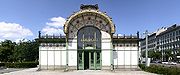
, metropolitan railway system , e.g. Karlsplatz Stadtbahn StationKarlsplatz Stadtbahn StationKarlsplatz Stadtbahn Station is a former station of the Viennese Stadtbahn. The buildings above ground on Karlsplatz are a well-known example of Jugendstil architecture. These buildings were included in The Vienna Secession, as they followed many of the artistic styles of that movement... - Majolica House, Vienna (1898-1899)
- Postal Office Savings Bank Building, Vienna (1894-1902)
- Kirche am SteinhofKirche am SteinhofThe Kirche am Steinhof in Vienna is the Roman Catholic oratory of the Steinhof Psychiatric Hospital...
, Vienna (1903-1907)
External links
- Otto Wagner Museum in Vienna
- Great Buildings Online
- Images of several Wagner buildings
- Otto Wagner at WOKA (de/en)
- Majolica House in Vienna by Otto Wagner (with drawings and photos)
- AEIOU - Das österreichische Kulturinformationssystem
Digitized books from the architecture collection of AMS Historica, the digital library of the University of Bologna
University of Bologna
The Alma Mater Studiorum - University of Bologna is the oldest continually operating university in the world, the word 'universitas' being first used by this institution at its foundation. The true date of its founding is uncertain, but believed by most accounts to have been 1088...
. skizzen 1, Wien, 1905. skizzen 2, Wien, 1905. skizzen 3, Wien, 1905.