
|
|
|
|
Omeprazole
|
| |
|
| |
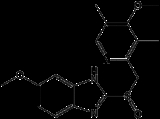
Omeprazole (INN) is a proton pump inhibitor used in the treatment of dyspepsia, peptic ulcer disease (PUD), gastroesophageal reflux disease (GORD/GERD) and Zollinger-Ellison syndrome. It was first marketed in the US in 1989 by AstraZeneca as the magnesium salt omeprazole magnesium under the brand names Losec and Prilosec, and is now also available from generic manufacturers under various brand names. Omeprazole is one of the most widely prescribed drugs internationally and is available over the counter in some countries.
razole is a racemate.

Discussion
Ask a question about 'Omeprazole'
Start a new discussion about 'Omeprazole'
Answer questions from other users
|
Recent Posts

Encyclopedia
Omeprazole (INN) is a proton pump inhibitor used in the treatment of dyspepsia, peptic ulcer disease (PUD), gastroesophageal reflux disease (GORD/GERD) and Zollinger-Ellison syndrome. It was first marketed in the US in 1989 by AstraZeneca as the magnesium salt omeprazole magnesium under the brand names Losec and Prilosec, and is now also available from generic manufacturers under various brand names. Omeprazole is one of the most widely prescribed drugs internationally and is available over the counter in some countries.
Pharmacology
Omeprazole is a racemate. It contains a tricoordinated sulfur atom in a pyramidal structure and therefore can exist in equal amounts of both the S and R enantiomers. In the acidic conditions of the stomach, both are converted to achiral products, which reacts with a cysteine group in H+/K+ ATPase, thereby inhibiting the ability of the parietal cells to produce gastric acid.
-
Facing the loss of patent protection and competition from generic drug manufacturers, AstraZeneca developed and heavily marketed esomeprazole (Nexium) as a replacement. Esomeprazole is the S-enantiomer in the pure form.
According to AstraZeneca, omeprazole undergoes a chiral shift in vivo which converts the inactive R-enantiomer to the active S-enantiomer doubling the concentration of the active form. This chiral shift is accomplished by the CYP2C19 isozyme of cytochrome P450, which is not found equally in all human populations. Those who do not metabolize the drug effectively are called "poor metabolizers." The approximate proportion of the poor metabolizer phenotype in different populations is as follows:
- Caucasians 10%
- Asian 20%
- South Pacific Islands 70%
In theory, by using pure esomeprazole the effect on the proton pump will be equal in all patients, eliminating the "poor metabolizer effect".
Name change
In 1990, at the request of the United States Food and Drug Administration (FDA), the brand name Losec was changed to Prilosec to avoid confusion with the diuretic Lasix (furosemide). Unfortunately, the new name has led to confusion between omeprazole (Prilosec) and fluoxetine (Prozac), an antidepressant.
Clinical use
Use in Helicobacter pylori eradication
Omeprazole is combined with the antibiotics clarithromycin and amoxicillin (or metronidazole in penicillin-hypersensitive patients) in the 7-14 day eradication triple therapy for Helicobacter pylori. Infection by H. pylori is the causative factor in the majority of peptic and duodenal ulcers.
Dosage forms
Omeprazole is available as tablets and capsules (containing omeprazole or omeprazole magnesium) in strengths of 10 mg, 20 mg, and in some markets 40 mg; and as a powder (omeprazole sodium) for intravenous injection. Most oral omeprazole preparations are enteric-coated, due to the rapid degradation of the drug in the acidic conditions of the stomach. This is most commonly achieved by formulating enteric-coated granules within capsules, enteric-coated tablets, and the multiple-unit pellet system.
It is also available for use in injectable form (I.V.) in Europe, but not in the U.S.
The injection pack is a combination pack consisting of a vial and a separate ampule of reconstituting solution. Each 10 ml clear glass vial contains a white to off-white lyophilised powder consisting of omeprazole sodium 42.6 mg equivalent to 40 mg of omeprazole.
Losec is manufactured by AstraZeneca, Södertälje, Sweden.
Multiple unit pellet system
Omeprazole tablets manufactured by AstraZeneca (notably Losec/Prilosec) are formulated as a "multiple unit pellet system" (MUPS). Essentially, the tablet consists of extremely small enteric-coated granules (pellets) of the omeprazole formulation inside an outer shell. When the tablet is immersed in an aqueous solution, as happens when the tablet reaches the stomach, water enters the tablet by osmosis. The contents swell from water absorption causing the shell to burst, releasing the enteric-coated granules. For most patients, the multiple-unit pellet system is of no advantage over conventional enteric-coated preparations. Patients for which the formulation is of benefit include those requiring nasogastric tube feeding and those with difficulty swallowing (dysphagia).
The granules are manufactured in a fluid air bed system. Sugar spheres in suspension are sequentially sprayed with aqueous suspensions of omeprazole, a protective layer, an enteric coating and an outer layer to reduce granule aggregation. The granules are mixed with other excipients and compressed into tablets. Finally, the tablets are film-coated to improve the stability and appearance of the preparation.
Immediate release formulation
In June 2004 the FDA approved an immediate release preparation of omeprazole and sodium bicarbonate that does not require an enteric coating. This preparation employs sodium bicarbonate as a buffer to protect omeprazole from gastric acid degradation. This allows for the production of chewable tablets. This combination preparation is marketed in the United States by Santarus under the trade name Zegerid. Zegerid is marketed as capsules, chewable tablets, and powder for oral suspension. Zegerid is most useful for those patients who suffer from nocturnal acid breakthrough (NAB) or those patients who desire immediate relief. In India it is marketed by Dr Reddy's Labs as powder formulation with the brand name OMEZ-INSTA. It is reported to have additional benefits with patients suffering from alcoholic gastritis and life-style associated gastritis.
Side effects
As with all proton pump inhibitors, omeprazole is generally well tolerated. Some of the most frequent side effects of omeprazole (experienced by over 1% of those taking the drug) are headache, diarrhea, abdominal pain, nausea, dizziness, trouble awakening and sleep deprivation, although in clinical trials the incidence of these effects with omeprazole was mostly comparable to that found with placebo.
Proton pump inhibitors may be associated with a greater risk of hip fractures , clostridium difficile diarrhea and heart problems, including cardiac arrest.
Interactions Patients who are taking Plavix in combination with proton pump inhibiting drugs may be at a greater risk of stroke or heart attack
Absorption and distribution
The absorption of omeprazole takes place in the small intestine and is usually completed within 3-6 hours. The systemic bioavailability of omeprazole after repeated dose is about 60%. Concomitant intake of food has no influence on the bioavailability. Plasma protein binding is about 95%.
Metabolism and excretion
Omeprazole is completely metabolised by the cytochrome P450 system, mainly in the liver. Identified metabolites are the sulfone, the sulfide and hydroxy-omeprazole, which exert no significant effect on the acid secretion. About 80% of an orally given dose is excreted as metabolites in the urine and the remainder is found in the faeces, primarily originating from bile secretion.
Brand names
- Antra in Italy
- Famodyl ( Dominican Republic)
- Gasec (Mepha)
- Gastrazole (Egypt)
- Lopraz
- Losepine (Pinewood Healthcare, Ireland)
- Losec worldwide.
- Maxpro ( Renata Ltd., bangladesh)
- Miracid (Thailand)
- Nexium (esomeprazole, a S-enantiomer of omeprazole)
- Ocid (India)
- Ocid (Zydus Cadila)
- Odasole Caps/ Inj. (Greece & Sudan)
- Omep (Sandoz)
- Omepradex-Z (Dexxon, Israel)
- Acimax, Losec, Omepral (Australia)
- Omeprol (Serbia)
- Omepron (Philippines)
- Omesec (CCM, Malaysia)
- Ometid(Opsonin Pharma Ltd, Bangladesh)
- OMEZ (Dr Reddy's Laboratories Ltd)- FGP
- Omezol (Bosch Pharmaceuticals, Pakistan)
- Ompic (Pharma Corp Inc, India)
- ONIZ 20 (Nepal, Nepal Pharmaceuticals)
- Ortanol (Lek Polska Sp. z o.o.)
- Ozid (in Indonesia)
- Procepin (OMEPRAZOLE in Singapore)
- Prilosec, Prilosec OTC, Omez
- RISEK (GETZ PHARMA)
- Ucetal (SERRAL, Mexico)
- Ulcesep (Middle East)
- Zegerid (powder for suspension and capsules)
- OM(Ambee pharmaceuticals ltd.)
External links
|
| |
|
|