
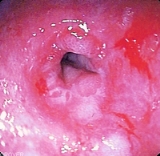
|
|
|
|
Gastroesophageal reflux disease
|
| |
|
| |
Gastroesophageal reflux disease (GERD), Gastro-oesophageal reflux disease (GORD), Gastric reflux disease, or Acid reflux disease is defined as chronic symptoms or mucosal damage produced by the abnormal reflux in
the esophagus.
This is commonly due to transient or permanent changes in the barrier between the esophagus and the stomach. This can be due to incompetence of the lower esophageal sphincter, transient lower esophageal sphincter relaxation, impaired expulsion of gastric reflux from the esophagus, or a hiatus hernia.
If the reflux reaches the throat, it is called laryngopharyngeal reflux disease.
most-common symptoms of GERD are heartburn, regurgitation, and trouble swallowing (dysphagia).

Discussion
Ask a question about 'Gastroesophageal reflux disease'
Start a new discussion about 'Gastroesophageal reflux disease'
Answer questions from other users
|
Encyclopedia
Gastroesophageal reflux disease (GERD), Gastro-oesophageal reflux disease (GORD), Gastric reflux disease, or Acid reflux disease is defined as chronic symptoms or mucosal damage produced by the abnormal reflux in
the esophagus.
This is commonly due to transient or permanent changes in the barrier between the esophagus and the stomach. This can be due to incompetence of the lower esophageal sphincter, transient lower esophageal sphincter relaxation, impaired expulsion of gastric reflux from the esophagus, or a hiatus hernia.
If the reflux reaches the throat, it is called laryngopharyngeal reflux disease.
Signs and symptoms
Adults
The most-common symptoms of GERD are heartburn, regurgitation, and trouble swallowing (dysphagia). Less-common symptoms include pain with swallowing (odynophagia), excessive salivation (this is common during heartburn, however, as saliva is generally slightly basic and is the body's natural response to heartburn and acts similarly to an antacid), and nausea.
GERD sometimes causes injury of the esophagus. These injuries may include:
- Reflux esophagitis—necrosis of esophageal epithelium causing ulcers near the junction of the stomach and esophagus.
- Esophageal strictures—the persistent narrowing of the esophagus caused by reflux-induced inflammation.
- Barrett's esophagus—metaplasia (changes of the epithelial cells from squamous to columnar epithelium) of the distal esophagus.
- Esophageal adenocarcinoma—a rare form of cancer.
Several other atypical symptoms are associated with GERD, but there is good evidence for causation only when they are accompanied by esophageal injury. These symptoms are chronic cough, laryngitis (hoarseness, throat clearing), asthma, and erosion of dental enamel. Some people have proposed that symptoms such as pharyngitis, sinusitis, recurrent ear infections, and idiopathic pulmonary fibrosis are due to GERD; however, a causative role has not been established.
Children GERD may be difficult to detect in infants and children. Symptoms may vary from typical adult symptoms. GERD in children may cause repeated vomiting, effortless spitting up, coughing, and other respiratory problems. Inconsolable crying, failure to gain adequate weight, refusing food, bad breath, and belching or burping are also common. Children may have one symptom or many — no single symptom is universal in all children with GERD.
Common symptoms of Paediatric Reflux
Irritability and pain, sometimes screaming suddenly when asleep. Constant or sudden crying or colic like
symptoms. Babies can be inconsolable especially when laid down flat.
Poor sleep habits typically with arching their necks and back during or after feeding
Excessive possetting or vomiting
Frequent burping or frequent hiccups
Excessive dribbling or running nose
Swallowing problems, gagging and choking
Frequent ear infections or sinus congestion
Babies are often very gassy and extremely difficult to burp after feeds
Refusing feeds or frequent feeds for comfort
Night time coughing, extreme cases of acid reflux can cause apnoea and respiratory problems such as asthma,
bronchitis and pneumonia if stomach contents are inhaled.
Bad breath smelling acidy
Rancid/acid smelling diapers with loose stool. Bowel movements can be very frequent or babies can be
constipated.
Vomiting feeds
Possetting after a feed is quite normal with most infants. They gain weight, feed well and have no other symptoms, but
still this can be upsetting for parents. As the child gets older the lower oesophageal sphincter becomes more competent
so the vomiting should begin to show signs of improvement and eventually stop. Some babies suffer more with reflux
and about 60% of these babies with persistent reflux may have weight gain issues. It is a very popular misconception
though that all babies and children with reflux are underweight. This isn't always the case, some may comfort eat and
feed very frequently and not all are sick. Many doctors advise that babies outgrow reflux once they can sit up, or once
they stand. Many do, but some will not only fail to outgrow it, but will noticeably worsen with developmental milestones,
teething episodes, viral illness and weaning.
Silent Reflux
Some babies with reflux do not vomit at all. This is actually more of a problem because the acidic stomach contents go
up the throat and back down again, causing twice the pain and twice the damage.
There is no clear relationship between symptoms and the severity of reflux.
It is estimated that of the approximately 4 million babies born in the U.S. each year, up to 35% of them may have difficulties with reflux in the first few months of their life, known as spitting up. Most of those children will outgrow their reflux by their first birthday. However, a small but significant number of them will not outgrow the condition. This is particularly true where there is a family history of GERD present.
Diagnosis
A detailed historical knowledge is vital for an accurate diagnosis. Useful investigations may include barium swallow X-rays, esophageal manometry, 24 hour esophageal impedance-pH monitoring, and Esophagogastroduodenoscopy (EGD). In general, an EGD is done when the patient either does not respond well to treatment or has alarm symptoms including dysphagia, anemia, blood in the stool (detected chemically), wheezing, weight loss, or voice changes. Some physicians advocate once-in-a-lifetime endoscopy for patients with longstanding GERD, to evaluate the possible presence of Barrett's esophagus, a precursor lesion for esophageal adenocarcinoma.
Esophagogastroduodenoscopy (EGD) (a form of endoscopy) involves insertion of a thin scope through the mouth and throat into the esophagus and stomach (often while the patient is sedated) in order to assess the internal surfaces of the esophagus, stomach, and duodenum.
Biopsies can be performed during gastroscopy and these may show:
- Edema and basal hyperplasia (non-specific inflammatory changes)
- Lymphocytic inflammation (non-specific)
- Neutrophilic inflammation (usually due to reflux or Helicobacter gastritis)
- Eosinophilic inflammation (usually due to reflux)
- Goblet cell intestinal metaplasia or Barretts esophagus
- Elongation of the papillae
- Thinning of the squamous cell layer
- Dysplasia or pre-cancer
- Carcinoma
Reflux changes may be non-erosive in nature, leading to the entity "non-erosive reflux disease".
Patients with ongoing symptoms while on PPI therapy are commonly diagnosed with impedance-pH monitoring while continuing their medications. The impedance-pH monitoring diagnostic test determines the frequency of reflux episodes and the time relationship of reflux episodes and symptoms. The impedance-pH monitoring test determines if the patient's symptoms are related to acid reflux, related to nonacid reflux, or not related to reflux of any type. A positive GERD diagnosis is made if acid or nonacid reflux precedes symptoms in a statistically meaningful manner. Patients with a positive impedance-pH monitoring test may benefit from acid-reduction therapy such as fundoplication surgery or endoscopic fundoplication techniques.
Pathophysiology
GERD is caused by a failure of the cardia. In healthy patients, the "Angle of His"—the angle at which the esophagus enters the stomach—creates a valve that prevents duodenal bile, enzymes, and stomach acid from traveling back into the esophagus where they can cause burning and inflammation of sensitive esophageal tissue.
Another paradoxical cause of GERD-like symptoms is not enough stomach acid (hypochlorhydria). The valve that empties the stomach into the intestines is triggered by acidity. If there is not enough acid, this valve does not open, and the stomach contents are churned up into the esophagus. However, there is still enough acidity to irritate the esophagus.
Factors that can contribute to GERD:
GERD has been linked to laryngitis, chronic cough, pulmonary fibrosis, earache, and asthma, even when not clinically apparent, as well as to laryngopharyngeal reflux and ulcers of the vocal cords.
Factors that have been linked with GERD but not conclusively:
Treatment
Physicians normally recommend lifestyle modifications, whether or not recommending drugs to treat GERD.
Foods
Certain foods and lifestyle are considered to promote gastroesophageal reflux, but a 2006 review suggested that evidence for most dietary interventions is anecdotal; only weight loss and elevating the head of the bed were supported by evidence. A subsequent randomized crossover study showed benefit by avoiding eating two hours before bedtime.
- Coffee, alcohol, and excessive amounts of Vitamin C supplements stimulate gastric acid secretion. Taking these before bedtime especially can cause evening reflux.
- Antacids based on calcium carbonate (but not aluminum hydroxide) were found to actually increase the acidity of the stomach. However, all antacids reduced acidity in the lower esophagus, so the net effect on GERD symptoms may still be positive..
- Foods high in fats and smoking reduce lower esophageal sphincter competence, so avoiding these may help. Fat also delays stomach emptying.
- Eating within 2-3 hours before bedtime.
- Large meals. Having smaller, more frequent meals reduces GERD risk, as it means there is less food in the stomach at any one time.
- Carbonated soft drinks with or without sugar.
- Chocolate and peppermint.
- Acidic foods: tomatoes and tomato-based preparations; citrus fruits and citrus juices.
- Cruciferous vegetables: onions, cabbage, cauliflower, broccoli, spinach, and Brussels sprouts.
- Milk and milk-based products containing calcium and fat, within 2 hours of bedtime.
Positional therapy
Sleeping on the left side has been shown to reduce nighttime reflux episodes in patients..
A meta-analysis suggested that elevating the head of bed is an effective therapy, although this conclusion was only supported by nonrandomized studies. The head of the bed can be elevated by plastic or wooden bed risers that support bed posts or legs, a bed wedge pillow, or a wedge or an inflatable mattress lifter that fits in between mattress and box spring. The height of the elevation is critical and must be at least 6 to 8 inches (15 to 20 cm) to be at least minimally effective to prevent the backflow of gastric fluids. Some innerspring mattresses do not work well when inclined and may cause back pain; some prefer foam mattresses. Some practitioners use higher degrees of incline than provided by the commonly suggested 6 to 8 inches (15 to 20 cm) and claim greater success.
Drug treatment
A number of drugs are registered for GERD treatment, and they are among the most-often-prescribed forms of medication in most Western countries. They can be used in combination with other drugs, although some antacids can interfere with the function of other drugs:
- Proton pump inhibitors (such as omeprazole, pantoprazole, lansoprazole, and rabeprazole) are the most effective in reducing gastric acid secretion. These drugs stop acid secretion at the source of acid production, i.e., the proton pump.
- Gastric H2 receptor blockers (such as ranitidine, famotidine and cimetidine) can reduce gastric secretion of acid. These drugs are technically antihistamines. They relieve complaints in about 50% of all GERD patients. Compared to placebo (which also is associated with symptom improvement), they have a number needed to treat of eight (8).
- Antacids before meals or symptomatically after symptoms begin can reduce gastric acidity (increase pH).
- Alginic acid (Gaviscon) may coat the mucosa as well as increase pH and decrease reflux. A meta-analysis of randomized controlled trials suggests alginic acid may be the most effective of non-prescription treatments with a number needed to treat of 4.
- Prokinetics strengthen the lower esophageal sphincter (LES) and speed up gastric emptying. Cisapride, a member of this class, was withdrawn from the market for causing Long QT syndrome.
- Sucralfate (Carafate) is also useful as an adjunct in helping to heal and prevent esophageal damage caused by GERD, however it must be taken several times daily and at least two (2) hours apart from meals and medications.
- Mosapride citrate is a 5-HT4 receptor agonist used outside the United States largely as a therapy for GERD and dyspepsia.
Clinical trials which compare GERD treatments head-to-head provide physicians with critical information. Unfortunately most pharmaceutical-company sponsored studies are conducted versus placebo and not an active control. However, the DIAMOND has shown rough equivalence of efficacy between a "step-up" approach to therapy (antacids, followed by histamine antagonists, followed by PPIs) and a "step-down" approach (the reverse). The primary endpoint of the study was treatment success after 6 months, and was achieved for 70% of patients in "step-down" versus 72% of patients in "step-up".
Posture and GERD In adults, a slouched posture is an important factor contributing to GERD. With a slouched posture there is no straight path between the stomach and esophagus; muscles around the esophagus go into a spasm. Gas and acidity get blocked in the spasm, causing coughing and other asthma-like symptoms.
Surgical treatment
The standard surgical treatment, sometimes preferred over longtime use of medication, is the Nissen fundoplication. The upper part of the stomach is wrapped around the LES to strengthen the sphincter and prevent acid reflux and to repair a hiatal hernia. The procedure is often done laparoscopically.
An obsolete treatment is vagotomy ("highly selective vagotomy"), the surgical removal of vagus nerve branches that innervate the stomach lining. This treatment has been largely replaced by medication.
Another treatment is the use of a device called Esophyx that allows doctors to rebuild the valve between the stomach and the diaphragm by going through the esophagus.
See also Stretta procedure
Other treatments
In 2000 the U.S. Food and Drug Administration (FDA) approved two endoscopic devices to treat chronic heartburn. One system, Endocinch, puts stitches in the LES to create little pleats that help strengthen the muscle. However, long-term results were disappointing, and the device is no longer sold by Bard. Another, the Stretta Procedure, uses electrodes to apply radio frequency energy to the LES. The long-term outcomes of both procedures compared to a Nissen fundoplication are still being determined.
Subsequently the NDO Surgical Plicator was cleared by the FDA for endoscopic GERD treatment. The Plicator creates a plication, or fold, of tissue near the gastroesophageal junction, and fixates the plication with a suture-based implant. The company ceased operations in mid 2008, and the device is no longer on the market.
Another treatment that involved injection of a solution during endoscopy into the lower esophageal wall was available for about one year ending in late 2005. It was marketed under the name Enteryx. It was removed from the market due to several reports of complications from misplaced injections.
Barrett's esophagus
GERD may lead to Barrett's esophagus, a type of metaplasia which is in turn a precursor condition for carcinoma. The risk of progression from Barrett's to dysplasia is uncertain but is estimated at about 20% of cases. Due to the risk of chronic heartburn progressing to Barrett's, EGD every 5 years is recommended for patients with chronic heartburn, or who take drugs for chronic GERD.
External links
- at NIH
- of acid peptic disorders from the Cleveland Clinic.
|
| |
|
|