


Okiagari-koboshi

Encyclopedia
.jpg)
Japanese traditional dolls
Japanese traditional dolls are known by the name in Japan, which literally means human shape.There are various types of Japanese dolls, some representing children and babies, some the imperial court, warriors and heroes, fairy-tale characters, gods and demons, and also people of the daily life of...
. The toy is made from papier-mâché
Papier-mâché
Papier-mâché , alternatively, paper-mache, is a composite material consisting of paper pieces or pulp, sometimes reinforced with textiles, bound with an adhesive, such as glue, starch, or wallpaper paste....
and is designed so that its weight causes it to return to an upright position if it is knocked over
Roly-poly toy
A roly-poly toy, round-bottomed doll, tilting doll, tumbler or wobbly man is a toy that rights itself when pushed over. The bottom of a roly-poly toy is round, roughly a hemisphere. Many roly-poly toys are hollow, with a weight inside the bottom. It has a center of mass below the center of the...
. Okiagari-koboshi is considered a good-luck charm and a symbol of perseverance and resilience.
History
The makers of the earliest okiagari-koboshi likely modeled them after a Chinese toy called Budaoweng (不倒翁; not-falling-down old man) that is similarly weighted. Okiagari-koboshi has long been popular among Japanese children. It is mentioned in a 14th-century play called Manju-Kui, and folkloristJapanese folklore
The folklore of Japan is heavily influenced by both Shinto and Buddhism, the two primary religions in the country. It often involves humorous or bizarre characters and situations and also includes an assortment of supernatural beings, such as bodhisattva, kami , yōkai , yūrei ,...
Lafcadio Hearn
Lafcadio Hearn
Patrick Lafcadio Hearn , known also by the Japanese name , was an international writer, known best for his books about Japan, especially his collections of Japanese legends and ghost stories, such as Kwaidan: Stories and Studies of Strange Things...
recorded a lullaby
Lullaby
A lullaby is a soothing song, usually sung to young children before they go to sleep, with the intention of speeding that process. As a result they are often simple and repetitive. Lullabies can be found in every culture and since the ancient period....
from Matsue
Matsue, Shimane
is the capital city of Shimane Prefecture in the Chūgoku region of Japan.As of August, 2011, the city has an estimated population of 207,000, following its most recent merging with Higashi-Izumo...
in Izumo Province
Izumo Province
was an old province of Japan which today consists of the eastern part of Shimane Prefecture. It was sometimes called . The province is in the Chūgoku Region.- History :It was one of the regions of ancient Japan where major political powers arose...
in the early 20th century that lists the doll as a gift for a young child:
Nenneko, nenneko nenneko ya!
Kono ko nashite naku-yara?
O-chichi ga taranuka? — o-mama ga taranuka?
Ima ni ototsan no ōtoto no o-kaeri ni
Ame ya, o-kwashi ya, hii-hii ya,
Gara-gara, nagureba fuito tatsu
Okiagarikoboshi! —
Neneko, neneko, nenneko ya!
Translated, it says:
Sleep, sleep, sleep, little one!
Why does the child continue to cry?
Is the milk deficient? — is the rice deficient?
Presently when father returns from the great Lord's palace,
Ame will be given to you, and also cake, and a hii-hii likewise,
And a rattle as well, and an okiagarikoboshi
That will stand up immediately after being thrown down.
Okiagari-koboshi are popular in the Aizu
Aizu
is an area comprising the westernmost third of Fukushima Prefecture in Japan. The principal city of the area is Aizuwakamatsu.During the Edo period, Aizu was a feudal domain known as and part of Mutsu Province.-History:...
region of Fukushima Prefecture
Fukushima Prefecture
is a prefecture of Japan located in the Tōhoku region on the island of Honshu. The capital is the city of Fukushima.-History:Until the Meiji Restoration, the area of Fukushima prefecture was known as Mutsu Province....
. There, the dolls are sold in red and blue varieties. People buy the dolls during the Tokaichi (Tenth-day Market) held each 10 January. Shoppers typically throw several okiagari-koboshi down at the same time; those that stand back up are supposedly the lucky ones. Tradition mandates the purchase of one okiagari-koboshi for each member of the family plus one extra in the hope that the family will grow over the coming year.
Daruma dolls
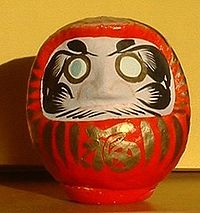
Daruma doll
The , also known as a Dharma doll, is a hollow, round, Japanese traditional doll modeled after Bodhidharma, the founder of the Zen sect of Buddhism. These dolls, though typically red and depicting a bearded man , vary greatly in color and design depending on region and artist...
works on the same principle as okiagari-koboshi and is sometimes referred to by that name; whenever it is thrown down, it rights itself. This depiction of the Buddhist
Buddhism
Buddhism is a religion and philosophy encompassing a variety of traditions, beliefs and practices, largely based on teachings attributed to Siddhartha Gautama, commonly known as the Buddha . The Buddha lived and taught in the northeastern Indian subcontinent some time between the 6th and 4th...
monk Bodhidharma
Bodhidharma
Bodhidharma was a Buddhist monk who lived during the 5th/6th century AD. He is traditionally credited as the transmitter of Ch'an to China, and regarded as the first Chinese patriarch...
likely arose in connection with a legend that says that he once meditated for nine years, which caused his legs to either atrophy or fall off. A 17th-century children's song shows that the okiagari-koboshi Daruma dolls of the time were almost identical to their modern equivalents:
Hi ni! fu ni!
Fundan Daruma ga
Akai zukin kaburi sunmaita!
Once! twice!
Ever the red-hooded Daruma
Heedlessly sits up again!