


Japanese traditional dolls

Encyclopedia
Japanese traditional dolls are known by the name in Japan, which literally means human shape.
There are various types of Japanese dolls, some representing children and babies, some the imperial court, warriors and heroes, fairy-tale characters, gods and (rarely) demons, and also people of the daily life of Japanese cities. Many have a long tradition and are still made today, for household shrines, for formal gift-giving, or for festival celebrations such as Hinamatsuri
, the doll festival, or Kodomo no Hi
, Children's Day. Some are manufactured as a local craft, to be purchased by pilgrims as a souvenir of a temple visit or some other trip.
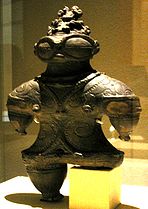 There may be a continuity in the making of the Dogū
, humanoid figures, by the ancient Jōmon
culture in Japan (8000-200 BC) and in the Haniwa
funerary figures of the subsequent Kofun
culture (around 300-600 AD). Expert Alan Pate notes that temple records refer to the making of a grass doll to be blessed and thrown into the river at Ise Shrine
in 3 BC; the custom was probably even more ancient, but it is at the root of the modern doll festival or Hinamatsuri.
In the early eleventh century, around the peak of the Heian period
, several types of dolls had already been defined, as known from Lady Murasaki's
novel The Tale of Genji
. Girls played with dolls and doll houses; women made protective dolls for their children or grandchildren; dolls were used in religious ceremonies, taking on the sins of a person whom they had touched.
Okiagari-koboshi
are roly-poly toy
s made from papier-mâché
, dating back to at least the 14th-century. They are good-luck charms and symbols of perseverance and resilience.
Probably the first professional dollmakers were temple sculptors, who used their skill to make painted wooden images of children (Saga dolls). The possibilities of this art form, using carved wood or wood composition, a shining white "skin" lacquer called gofun made from ground oystershell and glue, and textiles, were vast.
(about 1603-1867), when Japan was closed to most trade, there developed both fine dollmakers and a market of wealthy individuals who would pay for the most beautiful doll sets for display in their homes or as valuable gifts. Sets of dolls came to include larger and more elaborate figures, and more of them. The competitive trade was eventually regulated by government, meaning that doll makers could be arrested or banished for breaking laws on materials and height.
 Hina dolls are the dolls for Hinamatsuri
, the doll festival on March 3. They can be made of many materials but the classic hina doll has a pyramidal body of elaborate, many-layered textiles stuffed with straw and/or wood blocks, carved wood hands (and in some cases feet) covered with gofun, and a head of carved wood or molded wood compo covered with gofun, with set-in glass eyes (though before about 1850 the eyes were carved into the gofun and painted) and human or silk hair. A full set comprises at least 15 dolls, representing specific characters, with many accessories (dogu), though the basic set is a male-female pair, often referred to as the Emperor and Empress.
Musha or warrior dolls are usually made of materials similar to the hina dolls, but the construction is often more complicated, since the dolls represent men (or women) seated on camp chairs, standing, or riding horses. Armor, helmets, and weapons are made of lacquered paper, often with metal accents. There is no specified "set" of such dolls; subjects include Emperor Jimmu
, Empress Jingū with her prime minister Takenouchi holding her newborn imperial son, Shoki the Demon-Queller, Toyotomi Hideyoshi
and his generals and tea-master, and fairy-tale figures such as Momotarō
the Peach Boy or Kintarō
the Golden Boy.
Gosho dolls show fat, cute babies in a simplified form. The basic gosho is an almost-naked sitting boy, carved all in one piece, with very white skin, though gosho with elaborate clothing, hairstyle, and accessories, female as well as male, became popular as well. They developed as a gifts associated with the Imperial court, and "gosho" could be translated "palace" or "court."
Kimekomi dolls (:ja:木目込人形) are made of wood. The ancestors of Kimekomi dolls are the Kamo ("willow-wood") dolls, small dolls carved of willow and decorated with cloth scraps. Kimekomi refers to a method of making dolls. They start with a carved and/or molded base of wood, wood compo, or (in some modern dolls) plastic foam. A design of different patterned cloth scraps is planned out, and the base is grooved so that the edges of the cloth can be hidden in the grooves. The cloth is glued on and the edges tucked in. The head and hands (if any) of the doll are usually finished with gofun; the hair may be part of the molded head or be a separate wig. These dolls have become a very popular craft and kits with finished heads can be purchased. The method is also used by some of Japan's avant-garde
dollmakers, who adapt the old materials to new visions.
Karakuri ningyō, puppets or dolls are mechanical; they include the large figures on festival floats, for festivals like Kyoto's Gion Matsuri
and smaller entertaining scenes, often with a musical element accompanying the movement. They often depict legendary heroes.
Bunraku
puppets are a theatrical form which rivalled and inspired the Kabuki
theater, and survives today.
Daruma doll
s are spherical dolls with red bodies and white faces without pupils. They represent Bodhidharma
, an East Indian who founded Zen
about 1500 years ago; according to legend, he removed his own eyelids to prevent sleep from breaking his concentration, and his limbs withered after prolonged meditation. Daruma dolls are charms to bring good fortune, continued prosperity, and fortitude to accomplish goals. Usually daruma dolls are purchased without eyes. One eye is filled when making a wish, the other when the wish is fulfilled. Wishes can be made throughout the year, but it is common in Japan to do it on New Year's Day
.
Teru teru bozu
("shine-shine monk") dolls are hand-made of white paper or cloth, and are hung from a window by a string to bring good weather and prevent rain.
Kokeshi
dolls have been made for 150 years, and are from Northern Honshū
, the main island of Japan. They were originally made as toys for children of farmers. They have no arms or legs, but a large head and cylindrical body, representing little girls. From a simple toy, it has now become a famous Japanese craft, and now an established souvenir
for tourists.
Iki-ningyō
are life-sized life-like dolls, that were popular in misemono
shows. Artists made Iki-ningyō that were novel not just for their subjects that shocked viewers — figures lying in pools of their own blood, for example — but for their influence on Japanese dolls. The works of Matsumoto Kisaburō and Yasumoto Kamehachi, in particular, contributed to form an extreme sense of realism.
Ichimatsu dolls (:ja:市松人形) represent little girls or boys, correctly proportioned and usually with flesh-colored skin and glass eyes. The original Ichimatsu were named after an 18th-century Kabuki actor, and must have represented an adult man, but since the late 19th century the term has applied to child dolls, usually made to hold in the arms, dress, and pose (either with elaborately made joints or with floppy cloth upper arms and thighs). Baby boy dolls with mischievous expressions were most popular in the late 19th and early 20th century, but in 1927 the friendship doll exchange
involved the creation of 58 32" dolls representing little girls, to be sent as a gift from Japan to the United States, and the aesthetic of these dolls influenced dollmakers to emulate this type of a solemn, gentle-looking little girl in elaborate kimono.
Bisque doll
s are made of fired clay. Fukuoka
is a traditional center of the manufacture of bisque dolls, and Hakata ningyō
are famous throughout Japan.
Anesama ningyo and shiori ningyo (literally "big sister dolls" and "bookmark dolls," respectively) are made of washi
paper. Anesama ningyo tend to be three-dimensional, whereas shiori ningyo are flat. Anesama ningyo often have elaborate hairstyles and costumes made of high-quality washi paper. They often lack facial features. Those from Shimane prefecture
are especially famous.
A hybrid of anesama ningyo and shiori nyngyo, called shikishi ningyo, has become popular in recent years. Shikishi ningyo are a type of Japanese paper doll
s made with figures and scenes and are mounted on shikishi, a rectangular fancy cardboad about a square foot (about a tenth of a square meter) in size.
More recent and less traditional Japanese dolls are ball-jointed doll
s (BJDs), whose growth in popularity has spread to the US and other countries since the advent of the Super Dollfie
, first made by Volks
in 1999. BJDs can be very realistic-looking or based more on the anime
aesthetic. They are made of polyurethane
resin
which makes them very durable. These dolls are highly customizable in that owners can sand them, change out their wig and eye colors, and even change their face paint. Because of this hands-on aspect of customization, they are not only popular with collectors, but also with hobby
ists.
There are various types of Japanese dolls, some representing children and babies, some the imperial court, warriors and heroes, fairy-tale characters, gods and (rarely) demons, and also people of the daily life of Japanese cities. Many have a long tradition and are still made today, for household shrines, for formal gift-giving, or for festival celebrations such as Hinamatsuri
Hinamatsuri
The Japanese , or Girls' Day, is held on March 3. Platforms covered with a red carpet are used to display a set of representing the Emperor, Empress, attendants, and musicians in traditional court dress of the Heian period.- Origin and customs :...
, the doll festival, or Kodomo no Hi
Kodomo no hi
is a Japanese national holiday which takes place annually on May 5, the fifth day of the fifth month, and is part of the Golden Week. It is a day set aside to respect children's personalities and to celebrate their happiness...
, Children's Day. Some are manufactured as a local craft, to be purchased by pilgrims as a souvenir of a temple visit or some other trip.
Early history
Dogu
are small humanoid and animal figurines made during the late Jōmon period of prehistoric Japan. Dogū come entirely from the Jōmon period and do not continue into the Yayoi period. There are various styles of Dogū, depending on exhumation area and time period...
, humanoid figures, by the ancient Jōmon
Jomon period
The is the time in Japanese prehistory from about 14,000 BC to 300 BC.The term jōmon means "cord-patterned" in Japanese. This refers to the pottery style characteristic of the Jōmon culture, and which has markings made using sticks with cords wrapped around them...
culture in Japan (8000-200 BC) and in the Haniwa
Haniwa
The are terracotta clay figures which were made for ritual use and buried with the dead as funerary objects during the Kofun period of the history of Japan....
funerary figures of the subsequent Kofun
Kofun period
The is an era in the history of Japan from around 250 to 538. It follows the Yayoi period. The word kofun is Japanese for the type of burial mounds dating from this era. The Kofun and the subsequent Asuka periods are sometimes referred to collectively as the Yamato period...
culture (around 300-600 AD). Expert Alan Pate notes that temple records refer to the making of a grass doll to be blessed and thrown into the river at Ise Shrine
Ise Shrine
is a Shinto shrine dedicated to goddess Amaterasu-ōmikami, located in the city of Ise in Mie prefecture, Japan. Officially known simply as , Ise Jingū is in fact a shrine complex composed of a large number of Shinto shrines centered on two main shrines, and ....
in 3 BC; the custom was probably even more ancient, but it is at the root of the modern doll festival or Hinamatsuri.
In the early eleventh century, around the peak of the Heian period
Heian period
The is the last division of classical Japanese history, running from 794 to 1185. The period is named after the capital city of Heian-kyō, or modern Kyōto. It is the period in Japanese history when Buddhism, Taoism and other Chinese influences were at their height...
, several types of dolls had already been defined, as known from Lady Murasaki's
Murasaki Shikibu
Murasaki Shikibu was a Japanese novelist, poet and lady-in-waiting at the Imperial court during the Heian period. She is best known as the author of The Tale of Genji, written in Japanese between about 1000 and 1012...
novel The Tale of Genji
The Tale of Genji
is a classic work of Japanese literature attributed to the Japanese noblewoman Murasaki Shikibu in the early 11th century, around the peak of the Heian period. It is sometimes called the world's first novel, the first modern novel, the first psychological novel or the first novel still to be...
. Girls played with dolls and doll houses; women made protective dolls for their children or grandchildren; dolls were used in religious ceremonies, taking on the sins of a person whom they had touched.
Okiagari-koboshi
Okiagari-koboshi
is a Japanese traditional doll. The toy is made from papier-mâché and is designed so that its weight causes it to return to an upright position if it is knocked over...
are roly-poly toy
Roly-poly toy
A roly-poly toy, round-bottomed doll, tilting doll, tumbler or wobbly man is a toy that rights itself when pushed over. The bottom of a roly-poly toy is round, roughly a hemisphere. Many roly-poly toys are hollow, with a weight inside the bottom. It has a center of mass below the center of the...
s made from papier-mâché
Papier-mâché
Papier-mâché , alternatively, paper-mache, is a composite material consisting of paper pieces or pulp, sometimes reinforced with textiles, bound with an adhesive, such as glue, starch, or wallpaper paste....
, dating back to at least the 14th-century. They are good-luck charms and symbols of perseverance and resilience.
Probably the first professional dollmakers were temple sculptors, who used their skill to make painted wooden images of children (Saga dolls). The possibilities of this art form, using carved wood or wood composition, a shining white "skin" lacquer called gofun made from ground oystershell and glue, and textiles, were vast.
The Edo period
During the Edo periodEdo period
The , or , is a division of Japanese history which was ruled by the shoguns of the Tokugawa family, running from 1603 to 1868. The political entity of this period was the Tokugawa shogunate....
(about 1603-1867), when Japan was closed to most trade, there developed both fine dollmakers and a market of wealthy individuals who would pay for the most beautiful doll sets for display in their homes or as valuable gifts. Sets of dolls came to include larger and more elaborate figures, and more of them. The competitive trade was eventually regulated by government, meaning that doll makers could be arrested or banished for breaking laws on materials and height.
Hinamatsuri
The Japanese , or Girls' Day, is held on March 3. Platforms covered with a red carpet are used to display a set of representing the Emperor, Empress, attendants, and musicians in traditional court dress of the Heian period.- Origin and customs :...
, the doll festival on March 3. They can be made of many materials but the classic hina doll has a pyramidal body of elaborate, many-layered textiles stuffed with straw and/or wood blocks, carved wood hands (and in some cases feet) covered with gofun, and a head of carved wood or molded wood compo covered with gofun, with set-in glass eyes (though before about 1850 the eyes were carved into the gofun and painted) and human or silk hair. A full set comprises at least 15 dolls, representing specific characters, with many accessories (dogu), though the basic set is a male-female pair, often referred to as the Emperor and Empress.
Musha or warrior dolls are usually made of materials similar to the hina dolls, but the construction is often more complicated, since the dolls represent men (or women) seated on camp chairs, standing, or riding horses. Armor, helmets, and weapons are made of lacquered paper, often with metal accents. There is no specified "set" of such dolls; subjects include Emperor Jimmu
Emperor Jimmu
was the first Emperor of Japan, according to the traditional order of succession. He is also known as Kamuyamato Iwarebiko and personally as Wakamikenu no Mikoto or Sano no Mikoto....
, Empress Jingū with her prime minister Takenouchi holding her newborn imperial son, Shoki the Demon-Queller, Toyotomi Hideyoshi
Toyotomi Hideyoshi
was a daimyo warrior, general and politician of the Sengoku period. He unified the political factions of Japan. He succeeded his former liege lord, Oda Nobunaga, and brought an end to the Sengoku period. The period of his rule is often called the Momoyama period, named after Hideyoshi's castle...
and his generals and tea-master, and fairy-tale figures such as Momotarō
Momotaro
is a popular hero from Japanese folklore. His name literally means Peach Tarō; as Tarō is a common Japanese boy's name, it is often translated as Peach Boy...
the Peach Boy or Kintarō
Kintaro
is a folk hero from Japanese folklore. A child of superhuman strength, he was raised by a mountain hag on Mount Ashigara. He became friendly with the animals of the mountain, and later, after catching Shutendouji, the terror of the region around Mount Ooe, he became a loyal follower of Minamoto no...
the Golden Boy.
Gosho dolls show fat, cute babies in a simplified form. The basic gosho is an almost-naked sitting boy, carved all in one piece, with very white skin, though gosho with elaborate clothing, hairstyle, and accessories, female as well as male, became popular as well. They developed as a gifts associated with the Imperial court, and "gosho" could be translated "palace" or "court."
Kimekomi dolls (:ja:木目込人形) are made of wood. The ancestors of Kimekomi dolls are the Kamo ("willow-wood") dolls, small dolls carved of willow and decorated with cloth scraps. Kimekomi refers to a method of making dolls. They start with a carved and/or molded base of wood, wood compo, or (in some modern dolls) plastic foam. A design of different patterned cloth scraps is planned out, and the base is grooved so that the edges of the cloth can be hidden in the grooves. The cloth is glued on and the edges tucked in. The head and hands (if any) of the doll are usually finished with gofun; the hair may be part of the molded head or be a separate wig. These dolls have become a very popular craft and kits with finished heads can be purchased. The method is also used by some of Japan's avant-garde
Avant-garde
Avant-garde means "advance guard" or "vanguard". The adjective form is used in English to refer to people or works that are experimental or innovative, particularly with respect to art, culture, and politics....
dollmakers, who adapt the old materials to new visions.
Karakuri ningyō, puppets or dolls are mechanical; they include the large figures on festival floats, for festivals like Kyoto's Gion Matsuri
Gion Matsuri
The takes place annually in Kyoto and is one of the most famous festivals in Japan. It spans the entire month of July and is crowned by a parade, the on July 17. It takes its name from Kyoto's Gion district....
and smaller entertaining scenes, often with a musical element accompanying the movement. They often depict legendary heroes.
Bunraku
Bunraku
, also known as Ningyō jōruri , is a form of traditional Japanese puppet theater, founded in Osaka in 1684.Three kinds of performers take part in a bunraku performance:* Ningyōtsukai or Ningyōzukai—puppeteers* Tayū—the chanters* Shamisen players...
puppets are a theatrical form which rivalled and inspired the Kabuki
Kabuki
is classical Japanese dance-drama. Kabuki theatre is known for the stylization of its drama and for the elaborate make-up worn by some of its performers.The individual kanji characters, from left to right, mean sing , dance , and skill...
theater, and survives today.
Daruma doll
Daruma doll
The , also known as a Dharma doll, is a hollow, round, Japanese traditional doll modeled after Bodhidharma, the founder of the Zen sect of Buddhism. These dolls, though typically red and depicting a bearded man , vary greatly in color and design depending on region and artist...
s are spherical dolls with red bodies and white faces without pupils. They represent Bodhidharma
Bodhidharma
Bodhidharma was a Buddhist monk who lived during the 5th/6th century AD. He is traditionally credited as the transmitter of Ch'an to China, and regarded as the first Chinese patriarch...
, an East Indian who founded Zen
Zen
Zen is a school of Mahāyāna Buddhism founded by the Buddhist monk Bodhidharma. The word Zen is from the Japanese pronunciation of the Chinese word Chán , which in turn is derived from the Sanskrit word dhyāna, which can be approximately translated as "meditation" or "meditative state."Zen...
about 1500 years ago; according to legend, he removed his own eyelids to prevent sleep from breaking his concentration, and his limbs withered after prolonged meditation. Daruma dolls are charms to bring good fortune, continued prosperity, and fortitude to accomplish goals. Usually daruma dolls are purchased without eyes. One eye is filled when making a wish, the other when the wish is fulfilled. Wishes can be made throughout the year, but it is common in Japan to do it on New Year's Day
New Year's Day
New Year's Day is observed on January 1, the first day of the year on the modern Gregorian calendar as well as the Julian calendar used in ancient Rome...
.
Teru teru bozu
Teru teru bozu
Teru teru bōzu is a little traditional hand-made doll made of white paper or cloth that Japanese farmers began hanging outside of their window by a string. In shape and construction they are essentially identical to ghost dolls, such as those made at Halloween. This amulet is supposed to have...
("shine-shine monk") dolls are hand-made of white paper or cloth, and are hung from a window by a string to bring good weather and prevent rain.
Kokeshi
Kokeshi
, are Japanese dolls, originally from northern Japan. They are handmade from wood, have a simple trunk and an enlarged head with a few thin, painted lines to define the face. The body has a floral design painted in red, black, and sometimes yellow, and covered with a layer of wax. One...
dolls have been made for 150 years, and are from Northern Honshū
Honshu
is the largest island of Japan. The nation's main island, it is south of Hokkaido across the Tsugaru Strait, north of Shikoku across the Inland Sea, and northeast of Kyushu across the Kanmon Strait...
, the main island of Japan. They were originally made as toys for children of farmers. They have no arms or legs, but a large head and cylindrical body, representing little girls. From a simple toy, it has now become a famous Japanese craft, and now an established souvenir
Souvenir
A souvenir , memento, keepsake or token of remembrance is an object a person acquires for the memories the owner associates with it. The term souvenir brings to mind the mass-produced kitsch that is the main commodity of souvenir and gift shops in many tourist traps around the world...
for tourists.
Iki-ningyō
Iki-ningyō
Iki-ningyō were a type of ningyō, Japanese traditional dolls. They are life-sized life-like dolls, that were popular in misemono during the Edo period of Japan. The name is now used mainly to denote shop store mannequins....
are life-sized life-like dolls, that were popular in misemono
Misemono
-Introduction:', "shows" or "exhibitions", were an important part of Japanese urban culture during the Edo period. Many of the shows were put on hurriedly and were characterized by their crudeness. The term misemono dates from the Edo period, although plausible forerunners of the performances...
shows. Artists made Iki-ningyō that were novel not just for their subjects that shocked viewers — figures lying in pools of their own blood, for example — but for their influence on Japanese dolls. The works of Matsumoto Kisaburō and Yasumoto Kamehachi, in particular, contributed to form an extreme sense of realism.
Ichimatsu dolls (:ja:市松人形) represent little girls or boys, correctly proportioned and usually with flesh-colored skin and glass eyes. The original Ichimatsu were named after an 18th-century Kabuki actor, and must have represented an adult man, but since the late 19th century the term has applied to child dolls, usually made to hold in the arms, dress, and pose (either with elaborately made joints or with floppy cloth upper arms and thighs). Baby boy dolls with mischievous expressions were most popular in the late 19th and early 20th century, but in 1927 the friendship doll exchange
Japanese Friendship Dolls
or Japanese ambassador dolls and the were programs of goodwill between Japan and the United States. American Sidney Gulick, a missionary in Japan, initiated an exchange of dolls between children as a way to ease cultural tensions in 1920s...
involved the creation of 58 32" dolls representing little girls, to be sent as a gift from Japan to the United States, and the aesthetic of these dolls influenced dollmakers to emulate this type of a solemn, gentle-looking little girl in elaborate kimono.
Modern era
Silk-skinned or "mask-face" dolls became a popular craft in Japan in the 1920s and 1930s, allowing the individual to design elaborate kimono for dolls representing women of various periods of Japanese history, particularly the Edo period. Dolls of this type continued to be made and were a popular item for servicemen and tourists to bring back after World War II, though they also might choose dolls representing similar subjects made with gofun faces.Bisque doll
Bisque doll
A bisque doll or porcelain doll is a doll made partially or wholly out of bisque porcelain. Bisque dolls are characterized by their realistic, skin-like matte finish. They had their peak of popularity between 1860 and 1900 with French and German dolls. Bisque dolls are collectible, and antique...
s are made of fired clay. Fukuoka
Fukuoka, Fukuoka
is the capital city of Fukuoka Prefecture and is situated on the northern shore of the island of Kyushu in Japan.Voted number 14 in a 2010 poll of the World's Most Livable Cities, Fukuoka is praised for its green spaces in a metropolitan setting. It is the most populous city in Kyushu, followed by...
is a traditional center of the manufacture of bisque dolls, and Hakata ningyō
Hakata ningyo
are traditional Japanese clay dolls, originally from the city of Fukuoka, part of which was previously named Hakata before the city merger in 1889.- History :...
are famous throughout Japan.
Anesama ningyo and shiori ningyo (literally "big sister dolls" and "bookmark dolls," respectively) are made of washi
Washi
is a type of paper made in Japan. Washi is commonly made using fibers from the bark of the gampi tree, the mitsumata shrub , or the paper mulberry, but also can be made using bamboo, hemp, rice, and wheat...
paper. Anesama ningyo tend to be three-dimensional, whereas shiori ningyo are flat. Anesama ningyo often have elaborate hairstyles and costumes made of high-quality washi paper. They often lack facial features. Those from Shimane prefecture
Shimane Prefecture
is a prefecture of Japan located in the Chūgoku region on Honshū island. The capital is Matsue. It is the second least populous prefecture in Japan, after its eastern neighbor Tottori. The prefecture has an area elongated from east to west facing the Chūgoku Mountain Range on the south side and to...
are especially famous.
A hybrid of anesama ningyo and shiori nyngyo, called shikishi ningyo, has become popular in recent years. Shikishi ningyo are a type of Japanese paper doll
Paper doll
Paper dolls are figures cut out of paper, with separate clothes that are usually held onto the dolls by folding tabs. They have been inexpensive children's toys for almost two hundred years. Today, many artists are turning paper dolls into an art form....
s made with figures and scenes and are mounted on shikishi, a rectangular fancy cardboad about a square foot (about a tenth of a square meter) in size.
More recent and less traditional Japanese dolls are ball-jointed doll
Ball-jointed doll
A ball-jointed doll is any doll that is articulated with ball and socket joints. In contemporary usage when referring to modern dolls, and particularly when using the acronyms BJD or ABJD, it usually refers to modern Asian ball-jointed dolls. These are cast in polyurethane synthetic resin, a hard,...
s (BJDs), whose growth in popularity has spread to the US and other countries since the advent of the Super Dollfie
Super Dollfie
, often abbreviated SD, is a brand of ball-jointed doll, or BJD, made by the Japanese company Volks. They are made to be easy to customize and are primarily marketed to adult doll collectors and customizers. They are cast in polyurethane resin, a porcelain-like, hard, dense plastic...
, first made by Volks
Volks
is a Japan-based corporation that produces garage kits and mecha kits as well as the Dollfie, Super Dollfie and Dollfie Dream lines of dolls. The company's headquarters is in Kyoto, with some 30 shops worldwide, and annual sales of about $50 million, as of 2008....
in 1999. BJDs can be very realistic-looking or based more on the anime
Anime
is the Japanese abbreviated pronunciation of "animation". The definition sometimes changes depending on the context. In English-speaking countries, the term most commonly refers to Japanese animated cartoons....
aesthetic. They are made of polyurethane
Polyurethane
A polyurethane is any polymer composed of a chain of organic units joined by carbamate links. Polyurethane polymers are formed through step-growth polymerization, by reacting a monomer with another monomer in the presence of a catalyst.Polyurethanes are...
resin
Resin
Resin in the most specific use of the term is a hydrocarbon secretion of many plants, particularly coniferous trees. Resins are valued for their chemical properties and associated uses, such as the production of varnishes, adhesives, and food glazing agents; as an important source of raw materials...
which makes them very durable. These dolls are highly customizable in that owners can sand them, change out their wig and eye colors, and even change their face paint. Because of this hands-on aspect of customization, they are not only popular with collectors, but also with hobby
Hobby
A hobby is a regular activity or interest that is undertaken for pleasure, typically done during one's leisure time.- Etymology :A hobby horse is a wooden or wickerwork toy made to be ridden just like a real horse...
ists.
Further reading
- Albert, Kathy. Japanese Boy and Girl Paper Dolls. New York: Dover Publications, Inc., 1991.
- Larson, Jack Lenor. Folk Art from the Global Village. Santa Fe, NM: Museum of New Mexico Press, 1995.