

Obedience training

Encyclopedia
Obedience training usually refers to the training of a dog and the term is most commonly used in that context. Obedience training ranges from very basic training, such as teaching the dog to reliably respond to basic commands such as "sit", "down", "come", and "stay", to high level competition within clubs such as the American Kennel Club
, United Kennel Club
and the Canadian Kennel Club
, where additional commands, accuracy and performance are scored and judged.
Obedience implies compliance with the direction or command given by the handler. For a dog to be considered obedient rather than simply trained in obedience, it must respond reliably each time the command is given, by what is commonly known as its handler. A dog can go through Obedience training and not be obedient. If a dog is referred to as being Obedience Trained it should comply immediately with every command its handler gives. In the strictest sense an Obedience trained dog is an obedient dog. Training a dog in obedience can be an ongoing and lengthy process depending on the dog, the methods used, and the skill and understanding of both the trainer and the handler. The level of obedience the handler wishes to achieve with the dog is also a major factor in the time involved, as is the commitment to training by the handler.
Obedience training is often a prerequisite for or component of other training.
The actual training of the dog can be done by anyone, the trainer, owner, or a friend. Typically the individual who is caring for and living with the dog participates and trains the dog, as they will be the one who will be giving the commands. The relationship and trust between the dog and handler are important for success.
Basic or beginner's obedience is typically a short course ranging from six to ten weeks, where it is demonstrated to the handler how to communicate with and train the dog in a few simple commands. With most methods the dog is trained one command at a time. Though there may or may not be a specific word attached to it, walking properly on a leash, or leash control, is often the first training required prior to learning other commands.
s have always learned to obey commands related to the work that they historically performed, such as when a Herding dog
moves a flock of animals in response to a shepherd
's whistled directions, or a hunting dog searching for (or chasing down) quarry or leaving the treed quarry at the hunter's command.
In the twentieth century, formalized dog training
originated in military
and police
applications, and the methods used largely reflected the military approach to training humans. In the middle and late part of the century, however, more research into operant conditioning
and positive reinforcement
occurred as wild animal shows became more popular. Aquatic mammal trainers used clickers
(a small box that makes a loud click when pushed on) to "mark" desired behavior, giving food as a reward. The change in training methods spread gradually into the world of dog training
. Today many dog trainers rely heavily on positive reinforcement to teach new behaviors.
At a basic level, owners want dogs with whom they can pleasantly share a house, a car, or a walk in the park. Some dogs need only a minimum amount of training to learn to eliminate outside (be housebroken
), to sit, to lie down, or to come on command (obey a recall). Many other dogs prove more challenging. New dog owners might find training difficult and fail to make progress, because they expect dogs to think and act like humans, and are surprised and baffled when the dogs don't.
Dogs who demonstrate the previously mentioned basic skills, as well as walking reasonably well on a leash
and a few other minor tasks, can be tested for and earn the American Kennel Club
's (AKC) Canine Good Citizen
certification. While not a competitive obedience title, a CGC certification demonstrates that the dog is sociable, well behaved and reliable in public settings. Some insurance companies will waive breed restrictions on dogs with CGCs, and many states have passed resolutions supporting and encouraging CGC certification as a yardstick for canine manners and responsible dog ownership.
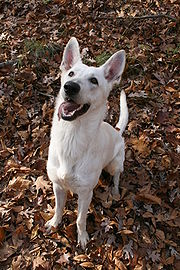 Certain breeds, such as Doberman Pinschers, German Shepherd
s, Border Collie
s, Labrador Retrievers and Golden Retriever
s, have reputations as being easier to train than others, such as some hound
s and sled dog
s. Dogs that have been bred to perform one task to the exclusion of all others (such as the Bloodhound
or Husky
), or who have been bred to work independently from their handler (such as terriers), may be particularly challenging to obedience train.
Dog intelligence
is exhibited in many different ways, and a dog who might not be easy to train might nonetheless be quite adept at figuring out how to open kitchen cabinets or to escape from the yard. Novice dog owners need to consider a dog's trainability as well as its energy level, exercise requirements, and other factors before choosing a new pet. Very high intelligence is not necessarily a good thing in a companion dog, as smart dogs can require extensive daily mental stimulation if they are not to become bored and destructive.
No breed is impossible to obedience train, but novice owners might find training some breeds quite difficult. The capacity to learn basic obedience—and even complicated behavior—is inherent in all dogs. Owners may need to be more patient, or creative, or both, with some breeds than with others.
and other non-correction-based training, such as puppy kindergarten. They are also effective in training small dogs, however they tend to lift the dog off the ground when giving corrections while the dog is distracted or in high adrenal mode. They are typically made of nylon or leather, and fasten with a buckle or quick-release connection.
Prong collars must never be turned inside out (with the prongs facing away from the dog's skin), as this may cause injury against the body and head. http://www.luvmydog.co.uk/acatalog/caps_pic.html Plastic tips are occasionally placed on the ends of the prongs to protect against tufts forming in the fur or, in the case of low quality manufactured collars with rough chisel cut ends, puncturing the skin. Like the slip collar, the prong collar is placed high on the dog's neck, just behind the ears, at the most sensitive point.http://www.leerburg.com/fit-prong.htm
Some dogs can free themselves from prong collars with large wire looped sides by shaking their head so that the links pop out, so some trainers have come to use a second collar (usually an oversize slip collar) in addition to the prong collar so when this happens the dog does not run loose.
a desired behavior. (See clicker training
for a more detailed discussion of this methodology.) It has gained popularity in recent years as being a means of training that does not involve physically correcting the dog, though it may be used in conjunction with these methods.
For dog owners who enjoy competition and relish the opportunity to work as a highly tuned team with their dogs, competitive obedience trial
s are available. Dogs can earn obedience titles, including an obedience championship.
In competition, merely sitting, lying down, or walking on a leash are insufficient. The dog and handler must perform the activities off leash and in a highly stylized and carefully defined manner. For example, on a recall, the dog must come directly to the handler, without sniffing or veering to one side, and must sit straight in front of the handler, not at an angle or off to one side or the other. Training for obedience competitions builds on basic obedience training.
The United Kennel Club
(UKC), the Australian National Kennel Council
(ANKC), the American Kennel Club
(AKC) and the Australian Shepherd Dog Club of America (ASCA) are some of the organizations which offer titles in Competition Obedience.
AKC obedience titles include: Companion Dog (CD), Companion Dog Excellent (CDX), Utility Dog (UD), Utility Dog Excellent (UDX), and Obedience Trial Champion (OTCH).
In recent years, a new form of Obedience competition, known as Rally Obedience
, has become very popular. It was originally devised by Charles L. "Bud" Kramer from the obedience practice of "doodling" - doing a variety of interesting warmup and freestyle exercises. Rally Obedience is designed to be a "bridge", or intermediate step, between the CGC certification and traditional Obedience competition.
Unlike regular obedience, instead of waiting for the judge's orders, the competitors proceed around a course of designated stations with the dog in heel position. The course consists of 10 to 20 signs that instruct the team what to do. Unlike traditional obedience, handlers are allowed to encourage their dogs during the course.
Recently, another dog performance competition has been gaining ground. Known as "Dock Dogs" this method of training has dogs jump off a "dock" and into the water. The dogs who can jump the furthest, on command, win the competition.
s must obey their "sit" and "down" commands perfectly at all times, but they do not have to conform to the rigid rules of competitive obedience.
Dogs competing in dog sports, such as flyball
, agility
or Schutzhund
, must be trusted in an open field, off leash and surrounded by other people, dogs, hot dog
s, and flying discs. This requires more focused attention on the owner and a better recall than that found in most household companion dogs, and more advanced training than that required for formal obedience.
American Kennel Club
The American Kennel Club is a registry of purebred dog pedigrees in the United States. Beyond maintaining its pedigree registry, this kennel club also promotes and sanctions events for purebred dogs, including the Westminster Kennel Club Dog Show, an annual event which predates the official...
, United Kennel Club
United Kennel Club
The United Kennel Club is the second oldest all-breed registry of purebred dog pedigrees in the United States and the second largest in the world. According to the website, the club records 250,000 registrations annually. The UKC is not part of the International Canine Organisation, Fédération...
and the Canadian Kennel Club
Canadian Kennel Club
The Canadian Kennel Club is the primary registry body for purebred dog pedigrees in Canada. Beyond maintaining the pedigree registry, the C.K.C...
, where additional commands, accuracy and performance are scored and judged.
Obedience implies compliance with the direction or command given by the handler. For a dog to be considered obedient rather than simply trained in obedience, it must respond reliably each time the command is given, by what is commonly known as its handler. A dog can go through Obedience training and not be obedient. If a dog is referred to as being Obedience Trained it should comply immediately with every command its handler gives. In the strictest sense an Obedience trained dog is an obedient dog.
Obedience training is often a prerequisite for or component of other training.
The actual training of the dog can be done by anyone, the trainer, owner, or a friend. Typically the individual who is caring for and living with the dog participates and trains the dog, as they will be the one who will be giving the commands. The relationship and trust between the dog and handler are important for success.
Basic or beginner's obedience is typically a short course ranging from six to ten weeks, where it is demonstrated to the handler how to communicate with and train the dog in a few simple commands. With most methods the dog is trained one command at a time. Though there may or may not be a specific word attached to it, walking properly on a leash, or leash control, is often the first training required prior to learning other commands.
History
Working dogWorking dog
A working dog refers to a canine working animal, i.e., a type of dog that is not merely a pet but learns and performs tasks to assist and/or entertain its human companions, or a breed of such origin...
s have always learned to obey commands related to the work that they historically performed, such as when a Herding dog
Herding dog
A herding dog, also known as a stock dog or working dog, is a type of pastoral dog that either has been trained in herding or belongs to breeds developed for herding...
moves a flock of animals in response to a shepherd
Shepherd
A shepherd is a person who tends, feeds or guards flocks of sheep.- Origins :Shepherding is one of the oldest occupations, beginning some 6,000 years ago in Asia Minor. Sheep were kept for their milk, meat and especially their wool...
's whistled directions, or a hunting dog searching for (or chasing down) quarry or leaving the treed quarry at the hunter's command.
In the twentieth century, formalized dog training
Dog training
Dog training is the process of teaching skills or behaviors to a dog. This can include teaching a dog to respond to certain commands, or helping the dog learn coping skills for stressful environments. Dog training often includes operant conditioning, classical conditioning, or non-associative...
originated in military
Military
A military is an organization authorized by its greater society to use lethal force, usually including use of weapons, in defending its country by combating actual or perceived threats. The military may have additional functions of use to its greater society, such as advancing a political agenda e.g...
and police
Police
The police is a personification of the state designated to put in practice the enforced law, protect property and reduce civil disorder in civilian matters. Their powers include the legitimized use of force...
applications, and the methods used largely reflected the military approach to training humans. In the middle and late part of the century, however, more research into operant conditioning
Operant conditioning
Operant conditioning is a form of psychological learning during which an individual modifies the occurrence and form of its own behavior due to the association of the behavior with a stimulus...
and positive reinforcement
Reinforcement
Reinforcement is a term in operant conditioning and behavior analysis for the process of increasing the rate or probability of a behavior in the form of a "response" by the delivery or emergence of a stimulus Reinforcement is a term in operant conditioning and behavior analysis for the process of...
occurred as wild animal shows became more popular. Aquatic mammal trainers used clickers
Clicker training
Clicker training is an operant conditioning method for training an animal using a clicker, or small mechanical noisemaker, as a marker for behavior. The method uses positive reinforcement - it is reward based...
(a small box that makes a loud click when pushed on) to "mark" desired behavior, giving food as a reward. The change in training methods spread gradually into the world of dog training
Dog training
Dog training is the process of teaching skills or behaviors to a dog. This can include teaching a dog to respond to certain commands, or helping the dog learn coping skills for stressful environments. Dog training often includes operant conditioning, classical conditioning, or non-associative...
. Today many dog trainers rely heavily on positive reinforcement to teach new behaviors.
At a basic level, owners want dogs with whom they can pleasantly share a house, a car, or a walk in the park. Some dogs need only a minimum amount of training to learn to eliminate outside (be housebroken
Housebreaking
Housebreaking is the process of training a domesticated animal that lives with its human owners in a house to excrete outdoors, or in a designated indoor area, rather than inside the house. The pet owner's desire is to break the habit of eliminating in the house, hence the term...
), to sit, to lie down, or to come on command (obey a recall). Many other dogs prove more challenging. New dog owners might find training difficult and fail to make progress, because they expect dogs to think and act like humans, and are surprised and baffled when the dogs don't.
Dogs who demonstrate the previously mentioned basic skills, as well as walking reasonably well on a leash
Leash
A leash is a rope or similar material attached to the neck or head of an animal for restraint or control...
and a few other minor tasks, can be tested for and earn the American Kennel Club
American Kennel Club
The American Kennel Club is a registry of purebred dog pedigrees in the United States. Beyond maintaining its pedigree registry, this kennel club also promotes and sanctions events for purebred dogs, including the Westminster Kennel Club Dog Show, an annual event which predates the official...
's (AKC) Canine Good Citizen
Canine Good Citizen
The Canine Good Citizen program, established in 1989, is an American Kennel Club program to promote responsible dog ownership and to encourage the training of well-mannered dogs...
certification. While not a competitive obedience title, a CGC certification demonstrates that the dog is sociable, well behaved and reliable in public settings. Some insurance companies will waive breed restrictions on dogs with CGCs, and many states have passed resolutions supporting and encouraging CGC certification as a yardstick for canine manners and responsible dog ownership.
Dog Intelligence and Training
German Shepherd Dog
The German Shepherd Dog , also known as an Alsatian or just the German Shepherd, is a breed of large-sized dog that originated in Germany. The German Shepherd is a relatively new breed of dog, with its origin dating to 1899. As part of the Herding Group, the German Shepherd is a working dog...
s, Border Collie
Border Collie
The Border Collie is a herding dog breed developed in the Anglo-Scottish border region for herding livestock, especially sheep. It is the most widespread of the collie breeds....
s, Labrador Retrievers and Golden Retriever
Golden Retriever
The Golden Retriever is a medium-sized breed of dog. They were historically developed as gundogs to retrieve shot waterfowl such as ducks and upland game birds during hunting and shooting parties. As such, they were bred to have a soft mouth to retrieve game undamaged and have an instinctive love...
s, have reputations as being easier to train than others, such as some hound
Hound
A hound is a type of dog that assists hunters by tracking or chasing the animal being hunted. It can be contrasted with the gun dog, which assists hunters by identifying the location of prey, and with the retriever, which recovers shot quarry...
s and sled dog
Sled dog
Sled dogs, known also as sleigh man dogs, sledge dogs, or sleddogs, are highly trained types of dogs that are used to pull a dog sled, a wheel-less vehicle on runners also called a sled or sleigh, over snow or ice, by means of harnesses and lines.Sled dogs have become a popular winter recreation...
s. Dogs that have been bred to perform one task to the exclusion of all others (such as the Bloodhound
Bloodhound
The Bloodhound is a large breed of dog which, while originally bred to hunt deer and wild boar, was later bred specifically to track human beings. It is a scenthound, tracking by smell, as opposed to a sighthound, which tracks using vision. It is famed for its ability to discern human odors even...
or Husky
Husky
Husky is a general name for a type of dog originally used to pull sleds in northern regions, differentiated from other sled dog types by their fast hard pulling style...
), or who have been bred to work independently from their handler (such as terriers), may be particularly challenging to obedience train.
Dog intelligence
Dog intelligence
Dog intelligence is the ability of a dog to learn, think, and solve problems. Dog trainers, owners, and researchers have as much difficulty agreeing on a method for testing canine intelligence as they do for human intelligence...
is exhibited in many different ways, and a dog who might not be easy to train might nonetheless be quite adept at figuring out how to open kitchen cabinets or to escape from the yard. Novice dog owners need to consider a dog's trainability as well as its energy level, exercise requirements, and other factors before choosing a new pet. Very high intelligence is not necessarily a good thing in a companion dog, as smart dogs can require extensive daily mental stimulation if they are not to become bored and destructive.
No breed is impossible to obedience train, but novice owners might find training some breeds quite difficult. The capacity to learn basic obedience—and even complicated behavior—is inherent in all dogs. Owners may need to be more patient, or creative, or both, with some breeds than with others.
Commands
The specific command word is not important, but consistency in usage is. There are certain commands that are accepted as standard and commonly used.Basic commands
- Sit: The dog is in a sitting position.
- Down: A dog is typically down when its elbows (front feet) and hocks (rear legs) are touching the ground or floor.
- Heel: The dog's head or shoulder is parallel to the handler's leg on the left side of the handler.
- Come or Here: (referred to as the recall) "Call your dog" equals "come" or "here".
- Stay: The dog must remain in the position (sit, down, stand) and location under which the command was given until it is released by the handler.
Advanced commands
- Stop – a dog that will simply stop whatever it is doing and lie down on command no matter how far it is from its keeper is a dog that can be taken anywhere.
- Back up – keepers of large dogs or dogs with a reputation for aggressiveness can make strangers more comfortable by teaching the dog to back up on command.
- Growl – the inverse of backing up. Some owners teach non-aggressive dogs to growl on a subtle command – not the word growl, usually a small hand gesture – as a way of letting strangers know that you and your dog value being left alone.
- Shake - Directs the dog to shake whole body. Generally used after bathing or swimming to prevent dog from soaking owner.
- Shake Hands or Shake - Directs dog to lift paw and place it in the hand of the owner as if shaking hands.
- Steady – keep near by. The dog can walk free, but not dash off.
- Stand – dog stands still. Useful for grooming. Many dogs are groomed frequently and need to stand quietly during the process.
- Go to bed, kennel, or get in: Directs the dog to go to its bed or its crateCrate trainingCrate training is the process of teaching a pet to accept a crate or cage as a familiar and safe location. Advocates claim that dogs are den-dwelling animals and that a crate can become a den substitute...
and to remain there until released. The dog has freedom of movement in that location to stand up, turn around, or lie down, unlike when placed in a Stay. Useful to keep a dog out from underfoot and safe in a busy or complicated situation. - Drop or drop it: Dogs pick up all sorts of things, some of which they shouldn't have. A dog that drops anything on command, no matter how attractive (and "attractive" to a dog can be "rotten and smelly" to a human), is a dog under control that the owner can prevent from eating dangerous items or from destroying valued personal property.
- Leave it: An adjunct to Drop, directing the dog to not touch an item. Also useful before the dog has picked anything up. Leave it is also used in conjunction with Take it.
- Take it: The dog leaves a desired object, such as a toy or treat, untouched until given this command. Alternatively, the dog takes and holds an object which it has no interest in. This can protect an owner's, visitor's, or child's fingers.
- Give: The dog has an object in its mouth and "gives" it to its owner by releasing the object into the owner's hand. Object of choice in training is usually a light-weight dumbbell or a glove. This is useful for when your dog has one of your belongings and you want it back before the dog hides it or chews it up.
- Speak: A dog, when taught this command, will bark once (or more) when told to do so.
- Roll Over: When taught this command a dog will lie down, roll over, and stand back up.
- Attack: A dog will attack something (or someone) when told to do so. Common commands are either "Attack" or "Sic'em".
- Fetch: A dog will retrieve a thrown object (usually a ball or a stick) and bring it back to the one who threw it.
- Place : The dog is trained to go to a certain place and stay there until released, usually a place in the house selected by owner.
- With me: used when walking your dog to keep them at your side and with your pace.
Flat collar
Flat collars are commonly used in clicker trainingClicker training
Clicker training is an operant conditioning method for training an animal using a clicker, or small mechanical noisemaker, as a marker for behavior. The method uses positive reinforcement - it is reward based...
and other non-correction-based training, such as puppy kindergarten. They are also effective in training small dogs, however they tend to lift the dog off the ground when giving corrections while the dog is distracted or in high adrenal mode. They are typically made of nylon or leather, and fasten with a buckle or quick-release connection.
Slip collar
Slip collars (commonly called choke chain or check chains) are made of metal links or rolled material such as nylon or leather. A metal ring is at each end. Historically, slip collars have been used as a matter of course, mostly in North America and the UK. In the last few decades use of these collars has declined. Correctly used, the collar should make a quick clicking not zipping sound when quickly snapped and released to startle or get the attention of the dog and indicate to the handler that the technique was a swift jerk not a choke. The idea is not to strangle the dog, though this can happen if the collar is improperly used.Martingale collar
Martingale collars (also called limited-slip collars) are usually made of flat nylon with a smaller fixed-length section (made of either nylon or a short length of chain) that, when pulled on by the leash, shortens up tightening the collar around the dog's neck, to a limited extent. When properly fitted, martingales are looser than flat-buckle collars when not tightened, and less severely corrective than slip collars when tightened.Prong collars
Prong collars (sometimes incorrectly termed 'pinch collars') are a series of chain links with blunted open ends turned towards the dog's neck. The design of the prong collar is such that it has a limited circumference unlike slip collars which do not have a limit on how far they can constrict on a dog's neck. The limited traction of the martingale chain combined with the angle of the prongs prevents the prongs moving close enough to pinch. The collar is designed to prevent the dog from pulling by applying pressure at each point against the dog's neck.Prong collars must never be turned inside out (with the prongs facing away from the dog's skin), as this may cause injury against the body and head. http://www.luvmydog.co.uk/acatalog/caps_pic.html Plastic tips are occasionally placed on the ends of the prongs to protect against tufts forming in the fur or, in the case of low quality manufactured collars with rough chisel cut ends, puncturing the skin. Like the slip collar, the prong collar is placed high on the dog's neck, just behind the ears, at the most sensitive point.http://www.leerburg.com/fit-prong.htm
Some dogs can free themselves from prong collars with large wire looped sides by shaking their head so that the links pop out, so some trainers have come to use a second collar (usually an oversize slip collar) in addition to the prong collar so when this happens the dog does not run loose.
Shock collars
Shock collars (also known as E-collars) transmit a remote signal from a control device the handler operates to the collar. An electrical shock is transmitted by the handler remotely, at varying degrees of intensity, from varying distances depending on range frequency. It is also done automatically in the bark electronic collar to stop excessive barking, and invisible fence collar when the dog strays outside its boundary. Shock collars are widely accepted in some areas of the world and by dog obedience professionals. Shock collars are also banned in some countries, and some dog training associations, veterinary associations and kennel clubs condemn their use.Leash
The leash or lead is used to connect the dog to the handler, lead the dog, as well as to control the dog in urban areas. Most communities have laws which prohibit dogs from running at large. They may be made of any material such as nylon, metal or leather. A six foot length is commonly used for walking and in training classes, though leashes come in lengths both shorter and longer. A long line (also called a lunge line) can be 3 meters (ten feet) or more in length, and are often used to train the dog to come when called from a distance.Clicker
The clicker is a small hand-held device that makes a distinct, short sound to markOperant conditioning
Operant conditioning is a form of psychological learning during which an individual modifies the occurrence and form of its own behavior due to the association of the behavior with a stimulus...
a desired behavior. (See clicker training
Clicker training
Clicker training is an operant conditioning method for training an animal using a clicker, or small mechanical noisemaker, as a marker for behavior. The method uses positive reinforcement - it is reward based...
for a more detailed discussion of this methodology.) It has gained popularity in recent years as being a means of training that does not involve physically correcting the dog, though it may be used in conjunction with these methods.
Head halter
Head halters are an alternative to collars that works similarly to a horse halter. The halter fits over the dog's snout and behind its head (leading it to sometimes be mistaken for a muzzle). Halters reduce the dog's ability to successfully pull on the leash, but do not eliminate it. If the halter is used with a sharp jerk on the leash, neck injury to the dog may result, but used correctly head halters have not been shown to cause harm.Competitive obedience
For dog owners who enjoy competition and relish the opportunity to work as a highly tuned team with their dogs, competitive obedience trial
Obedience trial
An obedience trial is a dog sport in which a dog must perfectly execute a predefined set of tasks when directed to do so by his handler. According the American Kennel Club obedience regulations...
s are available. Dogs can earn obedience titles, including an obedience championship.
In competition, merely sitting, lying down, or walking on a leash are insufficient. The dog and handler must perform the activities off leash and in a highly stylized and carefully defined manner. For example, on a recall, the dog must come directly to the handler, without sniffing or veering to one side, and must sit straight in front of the handler, not at an angle or off to one side or the other. Training for obedience competitions builds on basic obedience training.
The United Kennel Club
United Kennel Club
The United Kennel Club is the second oldest all-breed registry of purebred dog pedigrees in the United States and the second largest in the world. According to the website, the club records 250,000 registrations annually. The UKC is not part of the International Canine Organisation, Fédération...
(UKC), the Australian National Kennel Council
Australian National Kennel Council
The Australian National Kennel Council is the peak body in Australia responsible for promoting breeding, showing, trialling, obedience, and other canine-related activities and the ownership of temperamentally and physically sound purebred dogs by individuals across Australia. It was formed in...
(ANKC), the American Kennel Club
American Kennel Club
The American Kennel Club is a registry of purebred dog pedigrees in the United States. Beyond maintaining its pedigree registry, this kennel club also promotes and sanctions events for purebred dogs, including the Westminster Kennel Club Dog Show, an annual event which predates the official...
(AKC) and the Australian Shepherd Dog Club of America (ASCA) are some of the organizations which offer titles in Competition Obedience.
AKC obedience titles include: Companion Dog (CD), Companion Dog Excellent (CDX), Utility Dog (UD), Utility Dog Excellent (UDX), and Obedience Trial Champion (OTCH).
In recent years, a new form of Obedience competition, known as Rally Obedience
Rally obedience
Rally obedience is a dog sport based on obedience. It was originally devised by Charles L. "Bud" Kramer from the obedience practice of "doodling" - doing a variety of interesting warmup and freestyle exercises....
, has become very popular. It was originally devised by Charles L. "Bud" Kramer from the obedience practice of "doodling" - doing a variety of interesting warmup and freestyle exercises. Rally Obedience is designed to be a "bridge", or intermediate step, between the CGC certification and traditional Obedience competition.
Unlike regular obedience, instead of waiting for the judge's orders, the competitors proceed around a course of designated stations with the dog in heel position. The course consists of 10 to 20 signs that instruct the team what to do. Unlike traditional obedience, handlers are allowed to encourage their dogs during the course.
Recently, another dog performance competition has been gaining ground. Known as "Dock Dogs" this method of training has dogs jump off a "dock" and into the water. The dogs who can jump the furthest, on command, win the competition.
Obedience for Other Purposes
There are many reasons for training dogs beyond the level required for basic companionship. For example, assistance dogAssistance dog
An assistance dog is a dog trained to aid or assist a person with a disability. Many are trained by a specific organization, while others are trained by their handler .-Classification:...
s must obey their "sit" and "down" commands perfectly at all times, but they do not have to conform to the rigid rules of competitive obedience.
Dogs competing in dog sports, such as flyball
Flyball
Flyball is a dog sport in which teams of dogs race against each other from a start/finish line, over a line of hurdles, to a box that releases a tennis ball to be caught when the dog presses the spring-loaded pad, then back to their handlers while carrying the ball.Flyball is run in teams of four...
, agility
Dog agility
Dog agility is a dog sport in which a handler directs a dog through an obstacle course in a race for both time and accuracy. Dogs run off-leash with no food or toys as incentives, and the handler can touch neither dog nor obstacles...
or Schutzhund
Schutzhund
Schutzhund is a dog sport that was developed in Germany in the early 1900s as a breed suitability test for the German Shepherd Dog. The test would determine if the dog displayed the appropriate traits and characteristics of a proper working German Shepherd Dog...
, must be trusted in an open field, off leash and surrounded by other people, dogs, hot dog
Hot dog
A hot dog is a sausage served in a sliced bun. It is very often garnished with mustard, ketchup, onions, mayonnaise, relish and/or sauerkraut.-History:...
s, and flying discs. This requires more focused attention on the owner and a better recall than that found in most household companion dogs, and more advanced training than that required for formal obedience.
See also
- Clicker trainingClicker trainingClicker training is an operant conditioning method for training an animal using a clicker, or small mechanical noisemaker, as a marker for behavior. The method uses positive reinforcement - it is reward based...
- Dog sports
- Dog trainingDog trainingDog training is the process of teaching skills or behaviors to a dog. This can include teaching a dog to respond to certain commands, or helping the dog learn coping skills for stressful environments. Dog training often includes operant conditioning, classical conditioning, or non-associative...
- The Intelligence of DogsThe Intelligence of DogsThe Intelligence of Dogs is a book on dog intelligence by Stanley Coren, a professor of psychology at the University of British Columbia in Vancouver. Published in 1994, the book explains Coren's theories about the differences in intelligence between different breeds of dogs...
- Musical Canine FreestyleMusical Canine FreestyleMusical canine freestyle, also known as musical freestyle, freestyle dance, and canine freestyle, is a modern dog sport that is a mixture of obedience training, tricks, and dance that allows for creative interaction between dogs and their owners...
- Rally obedienceRally obedienceRally obedience is a dog sport based on obedience. It was originally devised by Charles L. "Bud" Kramer from the obedience practice of "doodling" - doing a variety of interesting warmup and freestyle exercises....
(Rally-O)