
Home      Discussion      Topics      Dictionary      Almanac
Signup       Login
Nuremberg Rally

Nuremberg Rally

Overview
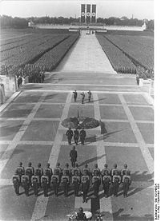
The Nuremberg Rally was the annual rally of the NSDAP (Nazi Party) in Germany
Germany
Germany , officially the Federal Republic of Germany , is a federal parliamentary republic in Europe. The country consists of 16 states while the capital and largest city is Berlin. Germany covers an area of 357,021 km2 and has a largely temperate seasonal climate...

, held from 1923 to 1938. Especially after Hitler's rise to power
Machtergreifung
Machtergreifung is a German word meaning "seizure of power". It is normally used specifically to refer to the Nazi takeover of power in the democratic Weimar Republic on 30 January 1933, the day Hitler was sworn in as Chancellor of Germany, turning it into the Nazi German dictatorship.-Term:The...

 in 1933, they were large Nazi propaganda
Nazi propaganda
Propaganda, the coordinated attempt to influence public opinion through the use of media, was skillfully used by the NSDAP in the years leading up to and during Adolf Hitler's leadership of Germany...

 events. The Reichsparteitage were held annually at the Nazi party rally grounds
Nazi party rally grounds
The Nazi party rally grounds consist of about 11 square kilometres in the southeast of Nuremberg, Germany...

 in Nuremberg
Nuremberg
Nuremberg[p] is a city in the German state of Bavaria, in the administrative region of Middle Franconia. Situated on the Pegnitz river and the Rhine–Main–Danube Canal, it is located about north of Munich and is Franconia's largest city. The population is 505,664...

 from 1933 to 1938 and are thus usually referred to in English as the Nuremberg Rallies.
Discussion
Ask a question about 'Nuremberg Rally'
Start a new discussion about 'Nuremberg Rally'
Answer questions from other users
Full Discussion Forum
 
Unanswered Questions
Encyclopedia
The Nuremberg Rally was the annual rally of the NSDAP (Nazi Party) in Germany
Germany
Germany , officially the Federal Republic of Germany , is a federal parliamentary republic in Europe. The country consists of 16 states while the capital and largest city is Berlin. Germany covers an area of 357,021 km2 and has a largely temperate seasonal climate...

, held from 1923 to 1938. Especially after Hitler's rise to power
Machtergreifung
Machtergreifung is a German word meaning "seizure of power". It is normally used specifically to refer to the Nazi takeover of power in the democratic Weimar Republic on 30 January 1933, the day Hitler was sworn in as Chancellor of Germany, turning it into the Nazi German dictatorship.-Term:The...

 in 1933, they were large Nazi propaganda
Nazi propaganda
Propaganda, the coordinated attempt to influence public opinion through the use of media, was skillfully used by the NSDAP in the years leading up to and during Adolf Hitler's leadership of Germany...

 events. The Reichsparteitage were held annually at the Nazi party rally grounds
Nazi party rally grounds
The Nazi party rally grounds consist of about 11 square kilometres in the southeast of Nuremberg, Germany...

 in Nuremberg
Nuremberg
Nuremberg[p] is a city in the German state of Bavaria, in the administrative region of Middle Franconia. Situated on the Pegnitz river and the Rhine–Main–Danube Canal, it is located about north of Munich and is Franconia's largest city. The population is 505,664...

 from 1933 to 1938 and are thus usually referred to in English as the Nuremberg Rallies.

History and purpose


The first rallies by the NSDAP took place in 1923 in Munich
Munich
Munich The city's motto is "" . Before 2006, it was "Weltstadt mit Herz" . Its native name, , is derived from the Old High German Munichen, meaning "by the monks' place". The city's name derives from the monks of the Benedictine order who founded the city; hence the monk depicted on the city's coat...

 and 1926 in Weimar
Weimar
Weimar is a city in Germany famous for its cultural heritage. It is located in the federal state of Thuringia , north of the Thüringer Wald, east of Erfurt, and southwest of Halle and Leipzig. Its current population is approximately 65,000. The oldest record of the city dates from the year 899...

. From 1927 on, they ran exclusively in Nuremberg
Nuremberg
Nuremberg[p] is a city in the German state of Bavaria, in the administrative region of Middle Franconia. Situated on the Pegnitz river and the Rhine–Main–Danube Canal, it is located about north of Munich and is Franconia's largest city. The population is 505,664...

. Nuremberg was selected for pragmatic reasons: It was situated in the center of the German Reich and the local Luitpoldhain was well suited as a venue. In addition, the NSDAP was able to rely on the well organized local strand of the party in Franconia
Franconia
Franconia is a region of Germany comprising the northern parts of the modern state of Bavaria, a small part of southern Thuringia, and a region in northeastern Baden-Württemberg called Tauberfranken...

, then led by Gauleiter
Gauleiter
A Gauleiter was the party leader of a regional branch of the NSDAP or the head of a Gau or of a Reichsgau.-Creation and Early Usage:...

 Julius Streicher
Julius Streicher
Julius Streicher was a prominent Nazi prior to World War II. He was the founder and publisher of Der Stürmer newspaper, which became a central element of the Nazi propaganda machine...

. The Nuremberg police were sympathetic to the event. Later, the location was justified by putting it into the tradition of the Reichstag
Reichstag (Holy Roman Empire)
The Imperial Diet was the Diet, or general assembly, of the Imperial Estates of the Holy Roman Empire.During the period of the Empire, which lasted formally until 1806, the Diet was not a parliament in today's sense; instead, it was an assembly of the various estates of the realm...

in the Holy Roman Empire
Holy Roman Empire
The Holy Roman Empire was a realm that existed from 962 to 1806 in Central Europe.It was ruled by the Holy Roman Emperor. Its character changed during the Middle Ages and the Early Modern period, when the power of the emperor gradually weakened in favour of the princes...

. After 1933, the rallies were held near the time of the Autumn equinox under the label of "Reichsparteitage des deutschen Volkes" ("National Congress of the Party of the German People"), which was meant to symbolize the solidarity between the German people and the Nazi Party. This point was further emphasized by the yearly growing number of participants, which finally reached over half a million from all sections of the party, the army and the state.

The Nuremberg Rallies


Each rally was given a programmatic title, which related to recent national events:
  • 1923 – The First Party Congress was held in Munich on January 27, 1923.
  • 1923 – The "German day rally" was held in Nuremberg on September 1, 1923.
  • 1926 – The 2nd Party Congress ("Refounding Congress") was held in Weimar on July 4, 1926.
  • 1927 – The 3rd Party Congress ("Day of Awakening") was held on August 20, 1927. The propaganda film Eine Symphonie des Kampfwillens
    Eine Symphonie des Kampfwillens
    Eine Symphonie des Kampfwillens is the first film documentary of a Nuremberg Rally.Made soon after the establishment of the Nazi Party film office, the film is a short record of the highlights of the conference, interspersed with newspaper descriptions of the rally...

    was made at this rally.
  • 1929 – The 4th Party Congress, known as the "Day of Composure", was held on August 2, 1929. The propaganda film Der Nürnberger Parteitag der NSDAP
    Der Nürnberger Parteitag der NSDAP
    Der Nürnberger Parteitag der NSDAP is a 1929 propaganda film about the 4th party convention of the Nazi Party.In 1928 financial difficulties forced the Nazi party to call off its annual congress at Nuremberg, so the next rally, the last to be held before the party took power, was held in August...

    was made at this rally.
  • 1933 – The 5th Party Congress was called the "Rally of Victory" (Reichsparteitag des Sieges). The term "victory" relates to the Nazi seizure of power
    Machtergreifung
    Machtergreifung is a German word meaning "seizure of power". It is normally used specifically to refer to the Nazi takeover of power in the democratic Weimar Republic on 30 January 1933, the day Hitler was sworn in as Chancellor of Germany, turning it into the Nazi German dictatorship.-Term:The...

     and the victory over the Weimar Republic
    Weimar Republic
    The Weimar Republic is the name given by historians to the parliamentary republic established in 1919 in Germany to replace the imperial form of government...

    . The Leni Riefenstahl
    Leni Riefenstahl
    Helene Bertha Amalie "Leni" Riefenstahl was a German film director, actress and dancer widely noted for her aesthetics and innovations as a filmmaker. Her most famous film was Triumph des Willens , a propaganda film made at the 1934 Nuremberg congress of the Nazi Party...

     film Der Sieg des Glaubens
    Der Sieg des Glaubens
    Der Sieg des Glaubens is the first documentary film directed by Leni Riefenstahl, who was hired despite opposition from Nazi officials that resented employing a woman — and a non-Party member too...

    was made at this rally.
  • 1934 – The 6th Party Congress initially did not have a theme. Later it was labeled the "Rally of Unity and Strength" (Reichsparteitag der Einheit und Stärke), "Rally of Power" (Reichsparteitag der Macht), or "Rally of Will" (Reichsparteitag des Willens). The Leni Riefenstahl film Triumph des Willens
    Triumph of the Will
    Triumph of the Will is a propaganda film made by Leni Riefenstahl. It chronicles the 1934 Nazi Party Congress in Nuremberg, which was attended by more than 700,000 Nazi supporters. The film contains excerpts from speeches given by various Nazi leaders at the Congress, including portions of...

    was made at this rally.
  • 1935 – The 7th Party Congress was called the "Rally of Freedom" (Reichsparteitag der Freiheit). "Freedom" referred to the reintroduced compulsory military service and thus the German "liberation" from the Treaty of Versailles
    Treaty of Versailles
    The Treaty of Versailles was one of the peace treaties at the end of World War I. It ended the state of war between Germany and the Allied Powers. It was signed on 28 June 1919, exactly five years after the assassination of Archduke Franz Ferdinand. The other Central Powers on the German side of...

    . The Leni Riefenstahl film Tag der Freiheit: Unsere Wehrmacht was made at this rally, and the Nuremberg Laws
    Nuremberg Laws
    The Nuremberg Laws of 1935 were antisemitic laws in Nazi Germany introduced at the annual Nuremberg Rally of the Nazi Party. After the takeover of power in 1933 by Hitler, Nazism became an official ideology incorporating scientific racism and antisemitism...

     were introduced.
  • 1936 – The 8th Party Congress was known as the "Rally of Honour" (Reichsparteitag der Ehre). The remilitarization
    Remilitarization of the Rhineland
    The Remilitarization of the Rhineland by the German Army took place on 7 March 1936 when German military forces entered the Rhineland. This was significant because it violated the terms of the Locarno Treaties and was the first time since the end of World War I that German troops had been in this...

     of the demilitarized Rhineland
    Rhineland
    Historically, the Rhinelands refers to a loosely-defined region embracing the land on either bank of the River Rhine in central Europe....

     in March 1936 constituted the restoration of German honour in the eyes of many Germans. The film Festliches Nürnberg
    Festliches Nürnberg
    Festliches Nürnberg is a short 1937 propaganda film chronicling the Nazi Party rallies in Nuremberg, Germany in 1936 and 1937. The film was directed by Hans Weidemann.-Synopsis:...

    incorporated footage shot at this rally, as well as the rally of 1937.
  • 1937 – The 9th Party Congress was called the "Rally of Labour" (Reichsparteitag der Arbeit). It celebrated the reduction of unemployment in Germany since the Nazi rise to power. This rally was particularly notable due to Albert Speer
    Albert Speer
    Albert Speer, born Berthold Konrad Hermann Albert Speer, was a German architect who was, for a part of World War II, Minister of Armaments and War Production for the Third Reich. Speer was Adolf Hitler's chief architect before assuming ministerial office...

    's Cathedral of light
    Cathedral of light
    The cathedral of light was a main aesthetic feature of the Nuremberg Rallies that consisted of 130 anti-aircraft searchlights, at intervals of 12 metres , aimed skyward to create a series of vertical bars surrounding the audience. The effect was a brilliant one, both from within the design and on...

    : 152 searchlights that cast vertical beams into the sky around the Zeppelin Field to symbolise the walls of a building and the attendance of Prince Chichibu
    Prince Chichibu
    , also known as Prince Yasuhito, was the second son of Emperor Taishō and a younger brother of the Emperor Shōwa. As a member of the Imperial House of Japan, he was the patron of several sporting, medical, and international exchange organizations...

    , a brother of the Emperor of Japan
    Hirohito
    , posthumously in Japan officially called Emperor Shōwa or , was the 124th Emperor of Japan according to the traditional order, reigning from December 25, 1926, until his death in 1989. Although better known outside of Japan by his personal name Hirohito, in Japan he is now referred to...

    , who had a personal meeting with Adolf Hitler
    Adolf Hitler
    Adolf Hitler was an Austrian-born German politician and the leader of the National Socialist German Workers Party , commonly referred to as the Nazi Party). He was Chancellor of Germany from 1933 to 1945, and head of state from 1934 to 1945...

     to boost relations between Japan
    Empire of Japan
    The Empire of Japan is the name of the state of Japan that existed from the Meiji Restoration on 3 January 1868 to the enactment of the post-World War II Constitution of...

     and Germany. Festliches Nürnberg
    Festliches Nürnberg
    Festliches Nürnberg is a short 1937 propaganda film chronicling the Nazi Party rallies in Nuremberg, Germany in 1936 and 1937. The film was directed by Hans Weidemann.-Synopsis:...

    incorporated footage made at this rally.
  • 1938 – The 10th Party Congress was named the "Rally of Greater Germany" (Reichsparteitag Großdeutschland). This was due to the annexation
    Anschluss
    The Anschluss , also known as the ', was the occupation and annexation of Austria into Nazi Germany in 1938....

     of Austria
    Austria
    Austria , officially the Republic of Austria , is a landlocked country of roughly 8.4 million people in Central Europe. It is bordered by the Czech Republic and Germany to the north, Slovakia and Hungary to the east, Slovenia and Italy to the south, and Switzerland and Liechtenstein to the...

     to Germany that had taken place earlier in the year.
  • 1939 – The 11th Party Congress was given the name "Rally of Peace" (Reichsparteitag des Friedens). It was meant to reiterate the German desire for peace, both to the German population and to other countries. It was cancelled on short notice, as one day before the planned date on September 1, Germany began its offensive against Poland (which ignited World War II
    World War II
    World War II, or the Second World War , was a global conflict lasting from 1939 to 1945, involving most of the world's nations—including all of the great powers—eventually forming two opposing military alliances: the Allies and the Axis...

    ).

Procedure


The primary aspect of the Nuremberg Rallies was to strengthen the personality cult of Adolf Hitler, portraying Hitler as Germany's saviour, chosen by providence. The gathered masses listened to the Führer's speeches, swore loyalty and marched before him. Representing the Volksgemeinschaft as a whole, the rallies served to demonstrate the might of the German people. The visitors of the rallies by their own free will were subordinate to the discipline and order in which they should be reborn as a new people.

Propaganda movies


Official films for the rallies began in 1927, with the establishment of the NSDAP film office. However the most famous films were the ones made by Leni Riefenstahl
Leni Riefenstahl
Helene Bertha Amalie "Leni" Riefenstahl was a German film director, actress and dancer widely noted for her aesthetics and innovations as a filmmaker. Her most famous film was Triumph des Willens , a propaganda film made at the 1934 Nuremberg congress of the Nazi Party...

 for the rallies between 1933 and 1935. Relating to the theme of the rally, she called her first movie "Victory of Faith" (Der Sieg des Glaubens
Der Sieg des Glaubens
Der Sieg des Glaubens is the first documentary film directed by Leni Riefenstahl, who was hired despite opposition from Nazi officials that resented employing a woman — and a non-Party member too...

). However this movie was taken out of circulation after the Röhm-Putsch
Night of the Long Knives
The Night of the Long Knives , sometimes called "Operation Hummingbird " or in Germany the "Röhm-Putsch," was a purge that took place in Nazi Germany between June 30 and July 2, 1934, when the Nazi regime carried out a series of political murders...

. The rally of 1934 became the setting for the award-winning documentary film Triumph of the Will
Triumph of the Will
Triumph of the Will is a propaganda film made by Leni Riefenstahl. It chronicles the 1934 Nazi Party Congress in Nuremberg, which was attended by more than 700,000 Nazi supporters. The film contains excerpts from speeches given by various Nazi leaders at the Congress, including portions of...

(Triumph des Willens). However, several generals in the Wehrmacht
Wehrmacht
The Wehrmacht – from , to defend and , the might/power) were the unified armed forces of Nazi Germany from 1935 to 1945. It consisted of the Heer , the Kriegsmarine and the Luftwaffe .-Origin and use of the term:...

protested over the minimal army presence in the film. Hitler apparently proposed modifying the film to placate the generals, but Riefenstahl refused his suggestion. She did agree to return to the 1935 rally and make a film exclusively about the Wehrmacht, which became Tag der Freiheit: Unsere Wehrmacht.

The rallies for 1936 and 1937 were covered in Festliches Nürnberg
Festliches Nürnberg
Festliches Nürnberg is a short 1937 propaganda film chronicling the Nazi Party rallies in Nuremberg, Germany in 1936 and 1937. The film was directed by Hans Weidemann.-Synopsis:...

, which was shorter than the others, only 21 minutes.

Books


There were two sets of official or semi-official books covering the rallies. The "red books" were officially published by the NSDAP and contained the proceedings of the "congress" as well as full texts of every speech given in chronological order.

The "blue books" were not published by the party press, but rather initially by Julius Streicher
Julius Streicher
Julius Streicher was a prominent Nazi prior to World War II. He was the founder and publisher of Der Stürmer newspaper, which became a central element of the Nazi propaganda machine...

, the Gauleiter
Gauleiter
A Gauleiter was the party leader of a regional branch of the NSDAP or the head of a Gau or of a Reichsgau.-Creation and Early Usage:...

 of Nuremberg
Nuremberg
Nuremberg[p] is a city in the German state of Bavaria, in the administrative region of Middle Franconia. Situated on the Pegnitz river and the Rhine–Main–Danube Canal, it is located about north of Munich and is Franconia's largest city. The population is 505,664...

, later by Hanns Kerrl
Hanns Kerrl
Hanns Kerrl was a German Nazi politician. His most prominent position, from July 1935, was that of Reichsminister of Church Affairs...

. These were larger scale books that included the text of speeches and proceedings, as well as larger photographs.

In addition to these, collections of Heinrich Hoffman's photographs were published to commemorate each Party congress, as well as pamphets of Hitler's speeches. Both series of books are much sought after collectors items.

See also


  • Nazi propaganda
    Nazi propaganda
    Propaganda, the coordinated attempt to influence public opinion through the use of media, was skillfully used by the NSDAP in the years leading up to and during Adolf Hitler's leadership of Germany...

  • Ruins of the Reich
    Ruins of the Reich
    Ruins of the Reich is a documentary series that traces the rise & fall of the Third Reich through its architecture. Written and directed by film maker R.J...


External links