


Nissan Cherry

Encyclopedia
The E10 generation featured four-wheel independent suspension
.
The E10 was fitted with two types of inline four-cylinder Nissan A-series
OHV engines:
The JDM Cherry X-1 model featured twin-carburetted A12T engine with dual-sidedraft Hitachi carburettors.
In Europe, E10 was called Datsun 100A (the Datsun
brand being used in place of Nissan in the European market at that time) (with A10 engine) or Datsun 120A (A12, but this engine was only available with the coupé
body style). Reportedly, market names of Cherry and Datsun 1000 were also used, however the Datsun 1000 name was associated with the early Nissan Sunny
and Nissan Bluebird
. The Cherry was introduced in Japan at a specially established dealership sales channel called Nissan Cherry Shop, whereas the Sunny was sold at Nissan Satio Shop, and the Bluebird was sold at the Nissan Shop.
In the early 1970s, as the British auto-industry faltered, Datsun led the charge of Japanese auto-manufacturers rapidly gaining market share in the UK. Britain's Motor magazine polled readers about their cars, including, in February 1973, those who owned E10 Cherrys. The question given greatest prominence was the final one which asked whether or not respondents would buy another car of the same model: 76% of Cherry owning respondents answered “yes”, which was the top score for this question achieved by any model to date, and beat even the 66% “yes” score given by owners of the previous leader, the Volkswagen Beetle, at the time well known in the UK for its owners’ ferocious brand loyalty.
The F10 was fitted with three types of inline four-cylinder Nissan A-series
OHV engines:
A two-pedal type semi-automatic transmission
was offered called the "Sportmatic", which used a torque converter
obviating the need for a clutch
.
In Europe, F10 was known as Datsun 100A F-II (with A10 engine) or 120A F-II (with A12 engine). The A12 powered 120A F-II was the most common model.
In New Zealand the 100A 4-door sedan (1.0L A10 motor) was assembled from CKD kits as a price leader for the Datsun range - due to the choice of engine, it was the smallest engined car assembled in New Zealand, the engine (988 cc) being smaller than the Mini
's 998 cc unit. Production continued well after the N10 model replaced it overseas, eventually being discontinued in late 1980, with the N10 5-door hatchback replacing it in 1981.
In North America, only the coupe and wagon were offered.
and Honda Civic
of the time. Engine choices were carried over from the previous model, consisting of Nissan's A-Series motor in 1.0 L, 1.2 L and 1.4 L forms. At some point, the A12 was replaced by the marginally larger A12A.
A unusual styling feature for the car was its long nose - which was due to Nissan envisaging that the car would also be built a with longitudinal rear-wheel-drive layout for developing markets - however only front-wheel-drive models were actually built.

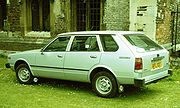 The N10 Cherry was available in a wide variety of bodystyles, which consisted of three and five-door hatchback
s, two and four-door fastback sedans (which utilized the same body profile as the hatchback models), a hatchback coupé introduced at the end of 1978, a three-door van and five-door wagon variant. The wagons first appeared in early 1979. Most markets outside Japan did not receive all versions: for instance, the three- and five-door hatchbacks and the coupé were the only models to be offered in the US. An interesting anomaly of the French automotive taxation system is that while the A12A-engined Cherry sedans were considered as "6CVs", the coupés with the same engine were markedly cheaper to own as they were classified as "5CVs".
Later in the car's production life, in 1981, the entire range was upgraded to Nissan's newly developed OHC E-series motors. At the same time, the car also received a facelift involving a new grille and rectangular headlamps.
In 1982 "Nissan" badges began to appear on the cars, due to Nissan phasing out the Datsun name at that time for its international markets. Production of the N10 series ceased in mid-1982, to be replaced by the all-new N12 Cherry/Pulsar.
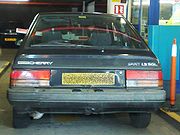
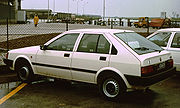 The Cherry name was still used in Europe on the model N12, an angular, hatchback
design.
Derivative of Cherry N12 was also built by Alfa Romeo at Pratola Serra, near Naples
, Italy. The Alfa-built version was badged as either the Nissan Cherry Europe or the Alfa Arna in Europe (depending on the dealer supplying it), and as the Nissan Pulsar Milano in Japan, and is distinguishable by slightly different rear light clusters and other minor changes. Under the skin it used Alfa Romeo Alfasud
-based components including the engine, transmission
, and front suspension
. Rear suspension and body panels came from Japan. Both Italian- and Japanese-built versions were available in European markets, but the Italian version helped to overcome strict import quotas imposed on Japanese cars at the time. Arna was an acronym meaning Alfa Romeo Nissan Autoveicoli. The Arna did not sell well and the partnership was not continued.
A high performance turbo
version of the Cherry was available for part of the N12 model's life.
After the end of Cherry production, the Sunny
was Nissan's only offering of this size in Europe. In America only the notchback coupe ("Pulsar NX") was offered for most of the N12's run although the 3- and 5-doors were sold in 1983 only.
name replaced the Cherry starting with the N13 Pulsar model. In certain markets such as Greece, however, the N13 Pulsar retained the "Cherry" nameplate.
In Japan and some Asian markets, the Pulsar name was used until N15 model. See the Pulsar
entry for more information.
Independent suspension
Independent suspension is a broad term for any automobile suspension system that allows each wheel on the same axle to move vertically independently of each other. This is contrasted with a beam axle, live axle or deDion axle system in which the wheels are linked – movement on one side affects...
.
The E10 was fitted with two types of inline four-cylinder Nissan A-series
Nissan A engine
The Nissan A series of internal combustion gasoline engines have been used in Datsun, Nissan and Premier brand vehicles. Displacements of this four-stroke engine family ranged from 1.0 liter to 1.5 liter and have been produced from 1967 to the present. It is a small-displacement four...
OHV engines:
- 988 cc A10
- 1171 cc A12
The JDM Cherry X-1 model featured twin-carburetted A12T engine with dual-sidedraft Hitachi carburettors.
In Europe, E10 was called Datsun 100A (the Datsun
Datsun
Datsun was an automobile marque. The name was created in 1931 by the DAT Motorcar Co. for a new car model, spelling it as "Datson" to indicate its smaller size when compared to the existing, larger DAT car. Later, in 1933 after Nissan Motor Co., Ltd...
brand being used in place of Nissan in the European market at that time) (with A10 engine) or Datsun 120A (A12, but this engine was only available with the coupé
Coupé
A coupé or coupe is a closed car body style , the precise definition of which varies from manufacturer to manufacturer, and over time...
body style). Reportedly, market names of Cherry and Datsun 1000 were also used, however the Datsun 1000 name was associated with the early Nissan Sunny
Nissan Sunny
The Nissan Sunny is a small car from Nissan. It was launched in 1966 as the Datsun 1000 and although production in Japan ended in 2004, it remains in production today for the African, American and Sri Lankan markets. In the US, the later models were known as the Nissan Sentra; in Mexico, the Sunny...
and Nissan Bluebird
Nissan Bluebird
Although Nissan's own materials indicate that the Bluebird name emerged in 1959, some records show that the name first adorned a 988 cc, four-door sedan in 1957, which was part of the company's 210 series...
. The Cherry was introduced in Japan at a specially established dealership sales channel called Nissan Cherry Shop, whereas the Sunny was sold at Nissan Satio Shop, and the Bluebird was sold at the Nissan Shop.
In the early 1970s, as the British auto-industry faltered, Datsun led the charge of Japanese auto-manufacturers rapidly gaining market share in the UK. Britain's Motor magazine polled readers about their cars, including, in February 1973, those who owned E10 Cherrys. The question given greatest prominence was the final one which asked whether or not respondents would buy another car of the same model: 76% of Cherry owning respondents answered “yes”, which was the top score for this question achieved by any model to date, and beat even the 66% “yes” score given by owners of the previous leader, the Volkswagen Beetle, at the time well known in the UK for its owners’ ferocious brand loyalty.
Timeline
- 1970 October: E10 goes on sale in Japan. At the beginning were setting only of four-door sedans and two-door sedans.
- With 1970: 17th Tokyo motor show, exhibiting the concept car "270X" which designates the Cherry as the base.
- 1971 end of September: coupé version added
- 1972 March: three-door van version added
- Cherry coupé debuts in 1972 April race Japan. As a Nissan works entry, it participated also in other domestic Japan races.
- 1972 June: minor model change
- 1973 March: debut of Cherry Coupé 1200X-1 R with "fender flares"
- 1973: Revised model with updated grill, rear lights and hubcaps released
- 1976: Acropolis Rally privateer entry
- 1977: E10 production ceases
2nd Generation F10 Series (1974–78)
The second-generation Cherry was known as F-II in Japan and "Datsun F10" in North America. It was Nissan's first front-wheel-drive model to be sold in North America. Four-wheel independent suspension continued to be used.The F10 was fitted with three types of inline four-cylinder Nissan A-series
Nissan A engine
The Nissan A series of internal combustion gasoline engines have been used in Datsun, Nissan and Premier brand vehicles. Displacements of this four-stroke engine family ranged from 1.0 liter to 1.5 liter and have been produced from 1967 to the present. It is a small-displacement four...
OHV engines:
- 988 cc A10
- 1,171 cc A12
- 1,397 cc A14
A two-pedal type semi-automatic transmission
Semi-automatic transmission
A semi-automatic transmission is an automobile transmission that does not change gears automatically, but rather facilitates manual gear changes by dispensing with the need to press...
was offered called the "Sportmatic", which used a torque converter
Torque converter
In modern usage, a torque converter is generally a type of hydrodynamic fluid coupling that is used to transfer rotating power from a prime mover, such as an internal combustion engine or electric motor, to a rotating driven load...
obviating the need for a clutch
Clutch
A clutch is a mechanical device which provides for the transmission of power from one component to another...
.
In Europe, F10 was known as Datsun 100A F-II (with A10 engine) or 120A F-II (with A12 engine). The A12 powered 120A F-II was the most common model.
In New Zealand the 100A 4-door sedan (1.0L A10 motor) was assembled from CKD kits as a price leader for the Datsun range - due to the choice of engine, it was the smallest engined car assembled in New Zealand, the engine (988 cc) being smaller than the Mini
Mini
The Mini is a small car that was made by the British Motor Corporation and its successors from 1959 until 2000. The original is considered a British icon of the 1960s, and its space-saving front-wheel-drive layout influenced a generation of car-makers...
's 998 cc unit. Production continued well after the N10 model replaced it overseas, eventually being discontinued in late 1980, with the N10 5-door hatchback replacing it in 1981.
In North America, only the coupe and wagon were offered.
Timeline
- 1974 September: Sale started in Japan. Body styles included 2 and 4 door sedans, a coupe, and a 3-door wagon.
- 1978: Swedish Rally privateer entry
- End of 1977: The 1978 Datsun Pulsar (N10 type) appeared as a successor model to the Cherry. At the time the Cherry name was discontinued on the Japan home market.
Nissan Pulsar (N10) generation
The N10 model Pulsar, introduced in late 1977 for the 1978 model year, was known as the Nissan Pulsar in Japan but was called Cherry in Europe and many other export markets. The body styling was more boxy, and influenced by designs coming out of Europe at that time, although in practice, particularly in wagon form, elements of the styling looked remarkably similar to the Toyota CorollaToyota Corolla
The Toyota Corolla is a line of subcompact and compact cars manufactured by the Japanese automaker Toyota, which has become very popular throughout the world since the nameplate was first introduced in 1966. In 1997, the Corolla became the best selling nameplate in the world, with over 35 million...
and Honda Civic
Honda Civic
The Honda Civic is a line of subcompact and subsequently compact cars made and manufactured by Honda. The Civic, along with the Accord and Prelude, comprised Honda's vehicles sold in North America until the 1990s, when the model lineup was expanded...
of the time. Engine choices were carried over from the previous model, consisting of Nissan's A-Series motor in 1.0 L, 1.2 L and 1.4 L forms. At some point, the A12 was replaced by the marginally larger A12A.
A unusual styling feature for the car was its long nose - which was due to Nissan envisaging that the car would also be built a with longitudinal rear-wheel-drive layout for developing markets - however only front-wheel-drive models were actually built.
Hatchback
A Hatchback is a car body style incorporating a shared passenger and cargo volume, with rearmost accessibility via a rear third or fifth door, typically a top-hinged liftgate—and features such as fold-down rear seats to enable flexibility within the shared passenger/cargo volume. As a two-box...
s, two and four-door fastback sedans (which utilized the same body profile as the hatchback models), a hatchback coupé introduced at the end of 1978, a three-door van and five-door wagon variant. The wagons first appeared in early 1979. Most markets outside Japan did not receive all versions: for instance, the three- and five-door hatchbacks and the coupé were the only models to be offered in the US. An interesting anomaly of the French automotive taxation system is that while the A12A-engined Cherry sedans were considered as "6CVs", the coupés with the same engine were markedly cheaper to own as they were classified as "5CVs".
Later in the car's production life, in 1981, the entire range was upgraded to Nissan's newly developed OHC E-series motors. At the same time, the car also received a facelift involving a new grille and rectangular headlamps.
In 1982 "Nissan" badges began to appear on the cars, due to Nissan phasing out the Datsun name at that time for its international markets. Production of the N10 series ceased in mid-1982, to be replaced by the all-new N12 Cherry/Pulsar.
Cherry (Pulsar N12 generation) and Cherry Europe
Hatchback
A Hatchback is a car body style incorporating a shared passenger and cargo volume, with rearmost accessibility via a rear third or fifth door, typically a top-hinged liftgate—and features such as fold-down rear seats to enable flexibility within the shared passenger/cargo volume. As a two-box...
design.
Derivative of Cherry N12 was also built by Alfa Romeo at Pratola Serra, near Naples
Naples
Naples is a city in Southern Italy, situated on the country's west coast by the Gulf of Naples. Lying between two notable volcanic regions, Mount Vesuvius and the Phlegraean Fields, it is the capital of the region of Campania and of the province of Naples...
, Italy. The Alfa-built version was badged as either the Nissan Cherry Europe or the Alfa Arna in Europe (depending on the dealer supplying it), and as the Nissan Pulsar Milano in Japan, and is distinguishable by slightly different rear light clusters and other minor changes. Under the skin it used Alfa Romeo Alfasud
Alfa Romeo Alfasud
The Alfa Romeo Alfasud is a compact car made by Alfa Romeo of Italy from 1971 to 1989. It was considered one of Alfa Romeo's most successful models, sold 893,719 examples from 1972 to 1983 plus 121,434 Sprint versions from 1976 to 1989. A common nickname for the car is ’Sud...
-based components including the engine, transmission
Transmission (mechanics)
A machine consists of a power source and a power transmission system, which provides controlled application of the power. Merriam-Webster defines transmission as: an assembly of parts including the speed-changing gears and the propeller shaft by which the power is transmitted from an engine to a...
, and front suspension
Suspension (vehicle)
Suspension is the term given to the system of springs, shock absorbers and linkages that connects a vehicle to its wheels. Suspension systems serve a dual purpose — contributing to the car's roadholding/handling and braking for good active safety and driving pleasure, and keeping vehicle occupants...
. Rear suspension and body panels came from Japan. Both Italian- and Japanese-built versions were available in European markets, but the Italian version helped to overcome strict import quotas imposed on Japanese cars at the time. Arna was an acronym meaning Alfa Romeo Nissan Autoveicoli. The Arna did not sell well and the partnership was not continued.
A high performance turbo
Turbocharger
A turbocharger, or turbo , from the Greek "τύρβη" is a centrifugal compressor powered by a turbine that is driven by an engine's exhaust gases. Its benefit lies with the compressor increasing the mass of air entering the engine , thereby resulting in greater performance...
version of the Cherry was available for part of the N12 model's life.
After the end of Cherry production, the Sunny
Nissan Sunny
The Nissan Sunny is a small car from Nissan. It was launched in 1966 as the Datsun 1000 and although production in Japan ended in 2004, it remains in production today for the African, American and Sri Lankan markets. In the US, the later models were known as the Nissan Sentra; in Mexico, the Sunny...
was Nissan's only offering of this size in Europe. In America only the notchback coupe ("Pulsar NX") was offered for most of the N12's run although the 3- and 5-doors were sold in 1983 only.
Replacement by Nissan Sunny
In most export markets, the Nissan SunnyNissan Sunny
The Nissan Sunny is a small car from Nissan. It was launched in 1966 as the Datsun 1000 and although production in Japan ended in 2004, it remains in production today for the African, American and Sri Lankan markets. In the US, the later models were known as the Nissan Sentra; in Mexico, the Sunny...
name replaced the Cherry starting with the N13 Pulsar model. In certain markets such as Greece, however, the N13 Pulsar retained the "Cherry" nameplate.
In Japan and some Asian markets, the Pulsar name was used until N15 model. See the Pulsar
Nissan Pulsar
The Nissan Pulsar is an automobile that was produced by the Japanese automaker Nissan from 1978, when it debuted as a subcompact car, to 2007, when it was replaced in all markets by the Nissan Tiida. It was originally conceived as a replacement for Nissan's first front-wheel drive platform, the...
entry for more information.
See also
- Nissan MotorsNissan Motors, usually shortened to Nissan , is a multinational automaker headquartered in Japan. It was a core member of the Nissan Group, but has become more independent after its restructuring under Carlos Ghosn ....
- Prince Motor CompanyPrince Motor CompanyPrince Motor Company was a Japanese automobile manufacturer from 1952 until its merger with Nissan in 1966. Prince began as the Tachikawa Aircraft Company, a producer of the famous Japanese Zero fighter planes used in WWII...
- Nissan PulsarNissan PulsarThe Nissan Pulsar is an automobile that was produced by the Japanese automaker Nissan from 1978, when it debuted as a subcompact car, to 2007, when it was replaced in all markets by the Nissan Tiida. It was originally conceived as a replacement for Nissan's first front-wheel drive platform, the...
- RatDat.com - paint colors, sales brochures, and model names
- Japan Wikipedia article "Nissan Cherry"