
A
polyphase system is a means of distributing
alternating currentIn alternating current the movement of electric charge periodically reverses direction. In direct current , the flow of electric charge is only in one direction....
electrical powerElectric power is the rate at which electric energy is transferred by an electric circuit. The SI unit of power is the watt.-Circuits:Electric power, like mechanical power, is represented by the letter P in electrical equations...
. Polyphase systems have three or more energized electrical conductors carrying alternating currents with a
definite time offsetPhase in waves is the fraction of a wave cycle which has elapsed relative to an arbitrary point.-Formula:The phase of an oscillation or wave refers to a sinusoidal function such as the following:...
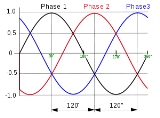
between the voltage waves in each conductor. Polyphase systems are particularly useful for transmitting power to electric motors. The most common example is the three-phase power system used for industrial applications and for power transmission. The most obvious advantage of three-phase power transmission using three wires, as compared to single-phase power transmission over two wires, is that the power transmitted in the three-phase system is the voltage multiplied by the current in each wire times the square root of three (approximately 1.73). The power transmitted by the single-phase system is simply the voltage multiplied by the current. Thus the three-phase system transmits 73% more power but uses only 50% more wire.
Phases
In the very early days of commercial electric power, some installations used two-phase four-wire systems for motors. The chief advantage of these was that the winding configuration was the same as for a single-phase capacitor-start motor and, by using a four-wire system, conceptually the phases were independent and easy to analyse with mathematical tools available at the time.
Two-phase systems can also be implemented using three wires (two "hot" plus a common neutral). However this introduces asymmetry; the voltage drop in the neutral makes the phases not exactly 90 degrees apart.
Two-phase systems have been replaced with three-phase systems. A two-phase supply with 90 degrees between phases can be derived from a three-phase system using a
Scott-connected transformerA Scott-T transformer is a type of circuit used to derive two-phase current from a three-phase source or vice-versa. The Scott connection evenly distributes a balanced load between the phases of the source....
.
A polyphase system must provide a defined direction of phase rotation, so mirror image voltages do not count towards the phase order. A 3-wire system with two phase conductors 180 degrees apart is still only single phase. Such systems are sometimes described as split-phase.
Motors
Polyphase power is particularly useful in
ACIn alternating current the movement of electric charge periodically reverses direction. In direct current , the flow of electric charge is only in one direction....
motors, such as the
induction motorAn induction or asynchronous motor is a type of AC motor where power is supplied to the rotor by means of electromagnetic induction. These motors are widely used in industrial drives, particularly polyphase induction motors, because they are robust and have no brushes...
, where it generates a rotating
magnetic fieldA magnetic field is a mathematical description of the magnetic influence of electric currents and magnetic materials. The magnetic field at any given point is specified by both a direction and a magnitude ; as such it is a vector field.Technically, a magnetic field is a pseudo vector;...
. When a three-phase supply completes one full cycle, the magnetic field of a two-pole motor has rotated through 360° in physical space; motors with more pairs of poles require more power supply cycles to complete one physical revolution of the magnetic field and so these motors run slower.
Nikola TeslaNikola Tesla was a Serbian-American inventor, mechanical engineer, and electrical engineer...
and
Michail Dolivo-DobrovolskyMikhail Osipovich Dolivo-Dobrovolsky , was a Russian engineer, electrician, and inventor. Born in a mixed family between a Polish noble family originating from Mazowsze, and a Russian noble family. Emigrated to Germany due to political persecution after the assassination of Alexander II of Russia...
invented the first practical induction motors using a rotating magnetic field - previously all commercial motors were DC, with expensive
commutatorsA commutator is a rotary electrical switch in certain types of electric motors or electrical generators that periodically reverses the current direction between the rotor and the external circuit. In a motor, it applies power to the best location on the rotor, and in a generator, picks off power...
, high-maintenance brushes and characteristics unsuitable for operation on an alternating current network. Polyphase motors are simple to construct, are self-starting and have little vibration compared with single-phase motors.
Higher phase order
Higher phase numbers than three have been used. A common practice for
rectifierA rectifier is an electrical device that converts alternating current , which periodically reverses direction, to direct current , which flows in only one direction. The process is known as rectification...
installations and in HVDC converters is to provide six phases, with 60 degree phase spacing, to reduce harmonic generation in the AC supply system and to provide smoother direct current. Experimental high-phase-order transmission lines have been built with up to 12 phases. These allow application of
Extra High Voltage (EHV)The definition of extra high tension or extra high voltage depends on the context of the discussion.In electric power transmission engineering this refers to equipment designed for more than 235,000 volts between conductors....
design rules at lower voltages and would permit increased power transfer in the same transmission line corridor width.
See also
- Symmetrical components
In electrical engineering, the method of symmetrical components is used to simplify analysis of unbalanced three phase power systems under both normal and abnormal conditions.-Description:...
- Alternating current
In alternating current the movement of electric charge periodically reverses direction. In direct current , the flow of electric charge is only in one direction....
- Delta-wye transformer
- Phase converter
A phase converter is a device that converts electric power provided as single phase to multiple phase or vice-versa. The majority of phase converters are used to produce three phase electric power from a single-phase source, thus allowing the operation of three-phase equipment at a site that only...
- Polyphase coil
Polyphase coils are electrical coils connected together in a polyphase system such as a generator or motor. In modern systems, the number of phases is usually three or a multiple of three. Each phase carries a sinusoidal alternating current whose phase is delayed relative to one of its neighbours...
- Charles Proteus Steinmetz
Charles Proteus Steinmetz was a German-American mathematician and electrical engineer. He fostered the development of alternating current that made possible the expansion of the electric power industry in the United States, formulating mathematical theories for engineers...
- John Hopkinson
John Hopkinson, FRS, was a British physicist, electrical engineer, Fellow of the Royal Society and President of the IEE twice in 1890 and 1896. He invented the three-wire system for the distribution of electrical power, for which he was granted a patent in 1882...
- Electric motor
An electric motor converts electrical energy into mechanical energy.Most electric motors operate through the interaction of magnetic fields and current-carrying conductors to generate force...
- Y-Δ transform
- Nikola Tesla
Nikola Tesla was a Serbian-American inventor, mechanical engineer, and electrical engineer...
- Jaruga - Hydroelectric Power Plant
Further reading