


New Mexico Rail Runner Express

Encyclopedia
The New Mexico Rail Runner Express is a commuter rail system serving the metropolitan areas of Albuquerque
and Santa Fe
, New Mexico
. It is administered by the New Mexico Department of Transportation
(NMDOT) and the Mid Region Council of Governments (MRCOG), a regional government planning association, while Herzog currently holds the contract for operation and maintnence of the line & equipment. Phase I of the system, operating on an existing right of way from Belen
to Bernalillo
that NMDOT purchased from BNSF Railway
, opened in July 2006. Phase II, the extension of the line to Santa Fe, opened in December 2008.
announced that his administration was going to pursue the implementation of commuter rail service, that a serious effort got under way. Later that same year, grants were given to NMDOT and MRCOG to begin the effort, and the New Mexico State Legislature passed Governor Richardson’s Investment Partnership (GRIP), a transportation improvement package with the Rail Runner included as one of the bill's projects.
Over the next few years, NMDOT and MRCOG developed a strategy for implementing rail service. In 2005, a name and a branding scheme was chosen. The name “Rail Runner” is a play on the name of New Mexico’s state bird, the roadrunner
. The cars and locomotives were received throughout the year of 2005 and groundbreaking for the first Rail Runner station took place on October 31, 2005. During this time the state also made negotiations with BNSF for usage of the railroad track. After assessing the needs of the track, the state of New Mexico committed to purchasing the railroad corridor from Belen to the New Mexico-Colorado border from BNSF (although, thus far only the portion between Belen and Lamy, NM have been purchased), to ensure that commuter trains would always get the right-of-way and have priority over freight trains in the corridor. While the engines are capable of 110 miles per hour (49.2 m/s), the track limits the maximum speed to 79 miles per hour (35.3 m/s).
The Rail Runner officially went into service on July 14, 2006, serving the Downtown Albuquerque, Los Ranchos, and Sandoval County stations. On December 11, 2006, the Los Lunas station opened, and on February 2, 2007, the Belen station opened, extending the line to its southern end. In April 2007, two more stations opened: Bernalillo County/International Sunport and Downtown Bernalillo. On December 17, 2008, the Isleta Pueblo station opened.
Phase II, the extension of the line to Santa Fe, opened for service on December 17, 2008. Using the existing Santa Fe Southern Railway track from Lamy to Santa Fe, which is filled with sharp curves, would have required the train to slow to 15 miles per hour (24 km/h) in some places, so new tracks were laid to produce travel times comparable to the automobile. The route uses previously existing track from Bernalillo to the base of La Bajada, a hill south of Santa Fe. It then runs on newly built track on new right-of-way from CP Madrid, for five miles and then in the I-25 median into Santa Fe, at CP Hondo, where it uses an improved Santa Fe Southern Railway track from I-25 to the terminal at the Santa Fe Railyard. Two of the planned stations for the Phase II extension opened on December 17: the South Capitol and the Santa Fe Depot stations. A third station at the NM 599/I-25 interchange in Santa Fe County opened on August 1, 2009.
On September 12, 2009, a special events platform opened for Lobo games service only.
Kewa Pueblo
station, serving Santo Domingo Pueblo
, opened on March 22, 2010. It is the first station beyond the original 13 planned stations to reach the construction stage and was built using stimulus
funds.
Sandia Pueblo
station, serving Sandia Pueblo
, opened on August 29, 2011.
are separated from Albuquerque by Isleta Pueblo
. Another four Native American pueblos are traversed by the Interstate Highway to Santa Fe, making the addition of new roadways or the expansion of current capacity financially and politically challenging.
The high real-estate prices in Santa Fe mean that many of the people who work there commute from the Albuquerque metro area. Furthermore, the capital is home to many of the state’s cultural institutions and tourist attractions, and most out-of-state visitors are forced to make the 60-mile journey from the Albuquerque International Sunport
by car. As the population of the region grows, commute times are expected to increase 80% on some routes by 2025, making the introduction of additional forms of transportation a priority to local governments.
Funding for operations of the system in its first few years was covered largely by federal Congestion Mitigation and Air Quality Improvement (CMAQ) Program funds, along with ticket revenues and some state and local funds. Operational costs were expected to rise from $10 million for the first phase to $20 million after completion of the second phase.
Federal funding for the Rail Runner is expected to stop in 2009, and without sufficient funds from other sources would leave funding for the operational and maintenance costs for the system up in the air. To prevent a funding shortfall, local and state governments began looking into possible taxes in the counties the Rail Runner serves. Two separate gross receipts taxes for regional transit were approved by voters in central and north-central New Mexico in November 2008 and will cover a large portion of the operational funds of the Rail Runner. Additional funds will also come from bond revenue and money appropriated by the New Mexico State Legislature.
In November, the free service ended on the Sandoval section of the line and ridership dropped to around 1,000 passengers a day. But when the Los Lunas and Belen stations opened ridership nearly doubled, bringing it up to around 1,800 passengers a day. The Rail Runner received its 300,000th passenger on February 22, 2007. Free service on the Belen section of the line ended April 1, 2007, and a new zone fare structure went into effect. During the summer of 2007, ridership was steady at around 2,500 passengers per day. The Rail Runner got its 400,000th passenger on May 10 and its 500,000th passenger on July 5, 2007. By April 2008, weekly ridership was 9,600. On June 26, 2008, the Rail Runner passed 1,000,000 passengers.
On December 17, 2008, service to Santa Fe
started with a three-month period of free service for Santa Fe County residents and three weekends of free service for everyone to attract new riders. The original 2005 projected ridership for a slightly different (but similar speed) Phase II route to Santa Fe was 2,954 daily riders. During the first full week of train service between the two cities, more than 33,000 passengers climbed aboard. On the second Saturday of service to Santa Fe, nearly 12,000 people boarded trains between Belen
and Santa Fe, which officials say marked the commuter train's biggest ridership day. Weekend service, which was to be discontinued after the first three weekends of service to Santa Fe, remained so popular that permanent Saturday service was established. Ridership for the first few weeks of Santa Fe service averaged about 5,000 riders a day, then dropped to an average of around 4,000 riders a day for the month of January 2009. In June 2009 ridership surpassed 2,000,000 total passengers, with a daily average ridership of 4,500 passengers.
March 2011 saw the highest number of Rail Runner riders for that month since the train service started, with 117,081 one-way trips.
Average weekday ridership increased 13 percent, from 3,948 in March 2010 to 4,471.
Average weekend ridership increased 32 percent, from 2,705 in March 2010 to 3,560.
For the first quarter of this year, ridership was up by two percent over last year, with 286,692 one-way trips.
, holiday season, etc.), including limited service to a "special events platform" on Commercial Avenue beneath Avenida Cesar Chavez for Lobos and Isotopes
athletic events.
Reduced fares for seniors, students, and the disabled are as follows:
diesel-electric locomotive
s that operate on diesel fuel. The use of biodiesel
fuel is under investigation. Passenger cars include thirteen Bombardier BiLevel Coach
es and nine Bombardier BiLevel Cab cars
. Coach cars have a seating capacity of 151 passengers while cab cars have a seating capacity of 141 passengers, with each type of car having standing room for an additional 60. Rail Runner trains operate in a push-pull
configuration, with the locomotive always facing south. When not in use, the vehicles are stored in a railyard in Downtown Albuquerque, located across the main rail line from the Alvarado Transportation Center
.
The AAR
reporting mark
for the Rail Runner Express is NMRX. Locomotives have three-digit road numbers beginning with the numeral 1 (e.g., 101). Coaches have four-digit road numbers beginning with the numeral 1 (e.g., 1001). Cab cars have four-digit road numbers beginning with 11 (e.g., 1101). Restrooms and water fountains are available in the cab cars. Bicycle and wheelchair locks are on the first level of all coaches.
The livery of the New Mexico Rail Runner depicts a stylistic roadrunner on the locomotive and trailing tailfeathers on the coaches. The door closing tones resemble the signature “Beep-Beep” of the Warner Bros. Road Runner
cartoon character.
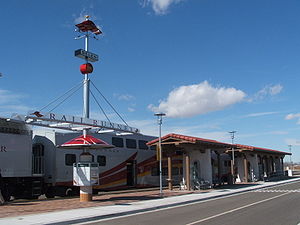 The Rail Runner connects with Amtrak
and Greyhound Lines
at Downtown Albuquerque. New Mexico Park and Ride shuttles connect the Downtown Albuquerque station to Moriarty
, the NM 599 station to Los Alamos and southern Santa Fe, and the South Capitol station in Santa Fe to the communities of Los Alamos
, Espanola
, and Las Vegas
. Park & Ride passengers with a monthly pass get to ride the Rail Runner for free.
There are connections to numerous ABQRide
routes (including Rapid Ride
) in Downtown Albuquerque as well as ABQRide routes at the Los Ranchos/Journal Center and Bernalillo County/International Sunport stations. ABQRide offers free service to anyone who shows their Rail Runner ticket. In Santa Fe, Santa Fe Trails
' bus routes, a city government shuttle, and a Department of Transportation shuttle provide local connections at the South Capitol and Santa Fe Depot stations on which Rail Runner passengers also receive free transfers.
There are also a number of smaller shuttle services serving the Rail Runner: a shuttle to Socorro
and through Belen serves the Belen station, Los Lunas Public Transportation serves the Los Lunas station, the Sandoval Easy Express serves the two stations in Bernalillo, the University of New Mexico
has a dedicated shuttle connecting its main campus to the Downtown Albuquerque station, a shuttle to Taos
serves the Santa Fe Depot and South Capitol stations, and Santa Ana Pueblo, Isleta Pueblo
, and Pojoaque Pueblo each operate shuttles connecting their casinos to the nearest Rail Runner station.
station, the last of the four planned stations for Phase II, is complete but the station has yet to open due to issues with the adjacent land.
. The Environmental Assessment for Phase II considered placement of a station between Cerrillos Road and Richards Avenue in the I-25 Median; it concluded that there was not yet enough demand, but recommended that it be considered for the future. Currently, a proposed station near the Las Soleras development has been approved and is now under study. MRCOG is looking into building a new station in Albuquerque on Montaño Road, which lies between the current Downtown Albuquerque and the Los Ranchos/Journal Center stations. The proposed station is included on MRCOG's 2030 Metropolitan Transportation Plan, an environmental review of the site has been completed, and funding has been secured for the station.
has been discussed, however a memorial to study the feasibility of doing so died in the New Mexico Legislature. There is now a shuttle service from Taos to the Santa Fe Rail Runner stations.
Extension of the Rail Runner south to Las Cruces
and El Paso
has also been discussed. A memorial to study the feasibility of such service was introduced and was amended to study Las Cruces-El Paso service, but failed to pass in the New Mexico Legislature. A house
resolution was introduced by Congressman Harry Teague in May 2009 to study the concept. However, this resolution never came out of committee and by default was cleared from the Congressional books.
reservation. No one was hurt and no equipment was damaged, but officials soon tried to find out why no one received notification of the blaze until the incident actually occurred. On the evening of August 24, a southbound train hit a vehicle at a private grade crossing south of Los Lunas. Two people in the vehicle were killed. No one aboard the train was injured. It appears that the Rail Runner personnel followed procedure. On the evening of September 19, a southbound train hit a vehicle at a private grade crossing between Belen and Los Lunas. One person in the vehicle was killed.
In 2008, during the early evening of May 14, in an apparent suicide
, a man was killed after being struck by the Rail Runner as he was sitting on the tracks. On the evening of December 17, the inaugural day of service to Santa Fe, a southbound Rail Runner train struck a cow near San Felipe Pueblo.
In 2009, on the morning of March 10, a southbound Rail Runner train struck an abandoned car in the South Valley. On August 18, a northbound train was struck by a car which drove into the side of the train; the driver was killed.
In 2010, on March 22, an unscheduled stop was made by a Rail Runner crew to pick up some food at a fast food restaurant. The train was not carrying passengers at the time. On December 17, a northbound Rail Runner struck and killed a man.
In 2011, on February 2 and 3 due to very cold temperatures (-18F) tracks cracked and needed to be repaired. This caused restricted speeds and significant delays.
Albuquerque, New Mexico
Albuquerque is the largest city in the state of New Mexico, United States. It is the county seat of Bernalillo County and is situated in the central part of the state, straddling the Rio Grande. The city population was 545,852 as of the 2010 Census and ranks as the 32nd-largest city in the U.S. As...
and Santa Fe
Santa Fe, New Mexico
Santa Fe is the capital of the U.S. state of New Mexico. It is the fourth-largest city in the state and is the seat of . Santa Fe had a population of 67,947 in the 2010 census...
, New Mexico
New Mexico
New Mexico is a state located in the southwest and western regions of the United States. New Mexico is also usually considered one of the Mountain States. With a population density of 16 per square mile, New Mexico is the sixth-most sparsely inhabited U.S...
. It is administered by the New Mexico Department of Transportation
New Mexico Department of Transportation
The New Mexico Department of Transportation is a state government organization which oversees transportation in the U.S. state of New Mexico...
(NMDOT) and the Mid Region Council of Governments (MRCOG), a regional government planning association, while Herzog currently holds the contract for operation and maintnence of the line & equipment. Phase I of the system, operating on an existing right of way from Belen
Belen, New Mexico
Belen is a city in Valencia County, New Mexico, United States. Belen is Spanish for Bethlehem, and over time has gained the nickname "Hub City" because of the Belen Cutoff of the Atchison, Topeka and Santa Fe Railway. The Cutoff made it possible for many more trains to travel east and west across...
to Bernalillo
Bernalillo, New Mexico
Bernalillo is a town in Sandoval County, New Mexico, in the United States. As of the 2000 census, the town population was 6,611. It is the county seat of Sandoval County.Bernalillo is part of the Albuquerque Metropolitan Statistical Area.-Geography:...
that NMDOT purchased from BNSF Railway
BNSF Railway
The BNSF Railway is a wholly owned subsidiary of Berkshire Hathaway Inc., and is headquartered in Fort Worth, Texas. It is one of seven North American Class I railroads and the second largest freight railroad network in North America, second only to the Union Pacific Railroad, its primary...
, opened in July 2006. Phase II, the extension of the line to Santa Fe, opened in December 2008.
History
The concept of passenger rail serving the Central New Mexico corridor had been discussed for decades, but it wasn’t until August 2003, when New Mexico governor Bill RichardsonBill Richardson (politician)
William Blaine "Bill" Richardson III is an American politician, who served as the 30th Governor of New Mexico from 2003 to 2011. Before being elected governor, Richardson served in the Clinton administration as U.S. Ambassador to the United Nations and Energy Secretary. Richardson has also served...
announced that his administration was going to pursue the implementation of commuter rail service, that a serious effort got under way. Later that same year, grants were given to NMDOT and MRCOG to begin the effort, and the New Mexico State Legislature passed Governor Richardson’s Investment Partnership (GRIP), a transportation improvement package with the Rail Runner included as one of the bill's projects.
Over the next few years, NMDOT and MRCOG developed a strategy for implementing rail service. In 2005, a name and a branding scheme was chosen. The name “Rail Runner” is a play on the name of New Mexico’s state bird, the roadrunner
Geococcyx
The roadrunners are two species of bird in the genus Geococcyx of the cuckoo family, Cuculidae, native to North and Central America...
. The cars and locomotives were received throughout the year of 2005 and groundbreaking for the first Rail Runner station took place on October 31, 2005. During this time the state also made negotiations with BNSF for usage of the railroad track. After assessing the needs of the track, the state of New Mexico committed to purchasing the railroad corridor from Belen to the New Mexico-Colorado border from BNSF (although, thus far only the portion between Belen and Lamy, NM have been purchased), to ensure that commuter trains would always get the right-of-way and have priority over freight trains in the corridor. While the engines are capable of 110 miles per hour (49.2 m/s), the track limits the maximum speed to 79 miles per hour (35.3 m/s).
The Rail Runner officially went into service on July 14, 2006, serving the Downtown Albuquerque, Los Ranchos, and Sandoval County stations. On December 11, 2006, the Los Lunas station opened, and on February 2, 2007, the Belen station opened, extending the line to its southern end. In April 2007, two more stations opened: Bernalillo County/International Sunport and Downtown Bernalillo. On December 17, 2008, the Isleta Pueblo station opened.
Phase II, the extension of the line to Santa Fe, opened for service on December 17, 2008. Using the existing Santa Fe Southern Railway track from Lamy to Santa Fe, which is filled with sharp curves, would have required the train to slow to 15 miles per hour (24 km/h) in some places, so new tracks were laid to produce travel times comparable to the automobile. The route uses previously existing track from Bernalillo to the base of La Bajada, a hill south of Santa Fe. It then runs on newly built track on new right-of-way from CP Madrid, for five miles and then in the I-25 median into Santa Fe, at CP Hondo, where it uses an improved Santa Fe Southern Railway track from I-25 to the terminal at the Santa Fe Railyard. Two of the planned stations for the Phase II extension opened on December 17: the South Capitol and the Santa Fe Depot stations. A third station at the NM 599/I-25 interchange in Santa Fe County opened on August 1, 2009.
On September 12, 2009, a special events platform opened for Lobo games service only.
Kewa Pueblo
Kewa Pueblo (Rail Runner station)
Kewa Pueblo is a station on the New Mexico Rail Runner Express commuter rail line, located in Kewa Pueblo on Indian Service Route 88. It opened on March 22, 2010.The station has free parking, with 40 spaces...
station, serving Santo Domingo Pueblo
Santo Domingo Pueblo, New Mexico
Santo Domingo Pueblo, also known as Kewa Pueblo , is an Indian pueblo and a census-designated place in Sandoval County, New Mexico, in the United States. The pueblo is located approximately southwest of Santa Fe west of Interstate 25. As of the 2000 census, the CDP population was 2,550...
, opened on March 22, 2010. It is the first station beyond the original 13 planned stations to reach the construction stage and was built using stimulus
American Recovery and Reinvestment Act of 2009
The American Recovery and Reinvestment Act of 2009, abbreviated ARRA and commonly referred to as the Stimulus or The Recovery Act, is an economic stimulus package enacted by the 111th United States Congress in February 2009 and signed into law on February 17, 2009, by President Barack Obama.To...
funds.
Sandia Pueblo
Sandia Pueblo (Rail Runner station)
Sandia Pueblo is a station on the New Mexico Rail Runner Express commuter rail line. The station opened on August 29, 2011.It is located near the Sandia Pueblo on NM Highway 313 just off Roy Avenue....
station, serving Sandia Pueblo
Sandia Pueblo
Sandia Pueblo is a tribe of Native American Pueblo people inhabiting a 101.114 km² reservation of the same name in the eastern Rio Grande Valley of central New Mexico, located three miles south of Bernalillo off Highway 85 in southern Sandoval County and northern Bernalillo County, at...
, opened on August 29, 2011.
Justification
The central New Mexico corridor, which is home to half the state’s population, contains Santa Fe, the state capital, and Albuquerque, the largest city and economic hub of New Mexico. The two cities are connected by I-25, an increasingly congested four-lane rural freeway that roughly parallels the route of the Rail Runner. Alternate routes are longer or otherwise constraining. Within Albuquerque's metropolitan area the heavily urbanized parts of Valencia countyValencia County, New Mexico
-2010:Whereas according to the 2010 U.S. Census Bureau:*73.2% White*1.4% Black*3.8% Native American*0.5% Asian*0.1% Native Hawaiian or Pacific Islander*4.0% Two or more races*17.0% Other races*58.3% Hispanic or Latino -2000:...
are separated from Albuquerque by Isleta Pueblo
Isleta Pueblo
Isleta Pueblo is an unincorporated Tanoan pueblo in Bernalillo County, New Mexico, United States, originally established around the 14th century.-Overview:...
. Another four Native American pueblos are traversed by the Interstate Highway to Santa Fe, making the addition of new roadways or the expansion of current capacity financially and politically challenging.
The high real-estate prices in Santa Fe mean that many of the people who work there commute from the Albuquerque metro area. Furthermore, the capital is home to many of the state’s cultural institutions and tourist attractions, and most out-of-state visitors are forced to make the 60-mile journey from the Albuquerque International Sunport
Albuquerque International Sunport
Albuquerque International Sunport is a public airport located 3 miles southeast of the central business district of Albuquerque, a city in Bernalillo County, New Mexico, United States. It is the largest commercial airport in the state, handling 5,888,811 passengers in 2009...
by car. As the population of the region grows, commute times are expected to increase 80% on some routes by 2025, making the introduction of additional forms of transportation a priority to local governments.
Criticism
The cost of the Rail Runner system was $135 million for the first phase and around $250 million for the second phase, Preliminary estimates indicate that the service will operate at a deficit, requiring up to $10 million in government funding annually. In late 2007, the Rail Runner was the subject of more criticism as a transportation funding shortfall left many state road projects stalled. State officials said the rising cost of construction materials and decreased federal support were the cause, but some lawmakers cited the cost of the Rail Runner as a contributing factor for the shortfall. Supporters of Rail Runner funding note that roadways and other infrastructure for passenger cars also operate at a deficit, requiring government funding for construction, operation, and maintenance.Funding
The capital costs of the Rail Runner project were covered by state and local funds. Phase I of the project was set to cost $135 million while Phase II was set to cost $250 million.Funding for operations of the system in its first few years was covered largely by federal Congestion Mitigation and Air Quality Improvement (CMAQ) Program funds, along with ticket revenues and some state and local funds. Operational costs were expected to rise from $10 million for the first phase to $20 million after completion of the second phase.
Federal funding for the Rail Runner is expected to stop in 2009, and without sufficient funds from other sources would leave funding for the operational and maintenance costs for the system up in the air. To prevent a funding shortfall, local and state governments began looking into possible taxes in the counties the Rail Runner serves. Two separate gross receipts taxes for regional transit were approved by voters in central and north-central New Mexico in November 2008 and will cover a large portion of the operational funds of the Rail Runner. Additional funds will also come from bond revenue and money appropriated by the New Mexico State Legislature.
Ridership
For the first few months of service between Albuquerque and Bernalillo the fares were free, to attract riders to the service. On the first day of service the Rail Runner carried 4,122 passengers, and ridership climbed through the first few weeks of operation, averaging at around 4,000 to 4,500 riders a day and once peaking at over 6,000 riders a day. On August 14, 2006, barely a month after the start of service, the Rail Runner received its 100,000th passenger. As many of the riders in the early weeks of service were not commuters, but people “trying out” the train because it was new, ridership gradually declined after the initial weeks of service. August ridership dropped to around 2,500 to 3,000 riders a day, and then down to 2,100 to 2,500 riders a day in September. Despite the drop, the Rail Runner received its 200,000th passenger on October 13, 2006.In November, the free service ended on the Sandoval section of the line and ridership dropped to around 1,000 passengers a day. But when the Los Lunas and Belen stations opened ridership nearly doubled, bringing it up to around 1,800 passengers a day. The Rail Runner received its 300,000th passenger on February 22, 2007. Free service on the Belen section of the line ended April 1, 2007, and a new zone fare structure went into effect. During the summer of 2007, ridership was steady at around 2,500 passengers per day. The Rail Runner got its 400,000th passenger on May 10 and its 500,000th passenger on July 5, 2007. By April 2008, weekly ridership was 9,600. On June 26, 2008, the Rail Runner passed 1,000,000 passengers.
On December 17, 2008, service to Santa Fe
Santa Fe, New Mexico
Santa Fe is the capital of the U.S. state of New Mexico. It is the fourth-largest city in the state and is the seat of . Santa Fe had a population of 67,947 in the 2010 census...
started with a three-month period of free service for Santa Fe County residents and three weekends of free service for everyone to attract new riders. The original 2005 projected ridership for a slightly different (but similar speed) Phase II route to Santa Fe was 2,954 daily riders. During the first full week of train service between the two cities, more than 33,000 passengers climbed aboard. On the second Saturday of service to Santa Fe, nearly 12,000 people boarded trains between Belen
Belen
-In places:*Belén, Catamarca, Argentina*Belén de Umbría, Risaraldam, Colombia*Belén, Honduras, Lempira, Honduras*Belen, Hatay, a town and district in Turkey*Belen, New Mexico, United States*Belen , rail station...
and Santa Fe, which officials say marked the commuter train's biggest ridership day. Weekend service, which was to be discontinued after the first three weekends of service to Santa Fe, remained so popular that permanent Saturday service was established. Ridership for the first few weeks of Santa Fe service averaged about 5,000 riders a day, then dropped to an average of around 4,000 riders a day for the month of January 2009. In June 2009 ridership surpassed 2,000,000 total passengers, with a daily average ridership of 4,500 passengers.
March 2011 saw the highest number of Rail Runner riders for that month since the train service started, with 117,081 one-way trips.
Average weekday ridership increased 13 percent, from 3,948 in March 2010 to 4,471.
Average weekend ridership increased 32 percent, from 2,705 in March 2010 to 3,560.
For the first quarter of this year, ridership was up by two percent over last year, with 286,692 one-way trips.
Service
Currently, the Rail Runner operates on weekdays with eight Albuquerque—Santa Fe roundtrips and five Belen-Albuquerque roundtrips, on Saturdays with four Belen-Santa Fe roundtrips and one Belen-Albuquerque roundtrip, and on Sundays with two Belen-Santa Fe roundtrips. On weekdays, most trains run during the peak commuting periods, with extra trains running mid-day and in the evening. There is also some additional service for special events (Balloon FiestaAlbuquerque International Balloon Fiesta
The Albuquerque International Balloon Fiesta is a yearly festival of hot air balloons that takes place in Albuquerque, New Mexico, USA during early October. The balloon fiesta is a nine day event, and has around 750 balloons...
, holiday season, etc.), including limited service to a "special events platform" on Commercial Avenue beneath Avenida Cesar Chavez for Lobos and Isotopes
Albuquerque Isotopes
The Albuquerque Isotopes are a minor league baseball team based in Albuquerque, New Mexico. The team, which plays in the Pacific Coast League, is the Triple-A affiliate of the Los Angeles Dodgers...
athletic events.
Ticketing
The cost of Rail Runner tickets is based upon the number of zones traveled. Tickets are purchased either online from the Rail Runner website or from attendants with hand-held devices on the train after boarding. Day, monthly, and annual passes are available. Children under the age of 10 ride for free. Regular one-way fares are as follows:- Within one zone: $2.00
- Within two zones: $2.00
- Within three zones: $4.00
- Within four zones: $6.00
- Within five zones: $7.00
- Within six zones: $8.00
Reduced fares for seniors, students, and the disabled are as follows:
- Within one zone: $1.00
- Within two zones: $1.00
- Within three zones: $2.00
- Within four zones: $3.00
- Within five zones: $3.00
- Within six zones: $4.00
Rolling stock
The Rail Runner power includes nine Motive Power MPI MP36PH-3CMPI MP36PH-3C
MPXpress is a series of diesel-electric passenger train locomotives designed for commuter rail service. The manufacturer, Motive Power , offers the locomotives with a number of customizable options such as different prime movers and traction motors, head end power generated by a separate engine or...
diesel-electric locomotive
Locomotive
A locomotive is a railway vehicle that provides the motive power for a train. The word originates from the Latin loco – "from a place", ablative of locus, "place" + Medieval Latin motivus, "causing motion", and is a shortened form of the term locomotive engine, first used in the early 19th...
s that operate on diesel fuel. The use of biodiesel
Biodiesel
Biodiesel refers to a vegetable oil- or animal fat-based diesel fuel consisting of long-chain alkyl esters. Biodiesel is typically made by chemically reacting lipids with an alcohol....
fuel is under investigation. Passenger cars include thirteen Bombardier BiLevel Coach
Bombardier BiLevel Coach
Bombardier BiLevel coaches are bilevel passenger cars designed to carry up to 360 passengers for regional railways. These carriages are easily identifiable; they are double-decked and are shaped like elongated octagons.-History:...
es and nine Bombardier BiLevel Cab cars
Control car (rail)
A control car is a generic term for a non-powered railroad vehicle that can control operation of a train from the end opposite to the position of the locomotive...
. Coach cars have a seating capacity of 151 passengers while cab cars have a seating capacity of 141 passengers, with each type of car having standing room for an additional 60. Rail Runner trains operate in a push-pull
Push-pull train
Push–pull is a mode of operation for locomotive-hauled trains allowing them to be driven from either end.A push–pull train has a locomotive at one end of the train, connected via some form of remote control, such as multiple-unit train control, to a vehicle equipped with a control cab at the other...
configuration, with the locomotive always facing south. When not in use, the vehicles are stored in a railyard in Downtown Albuquerque, located across the main rail line from the Alvarado Transportation Center
Alvarado Transportation Center
The Alvarado Transportation Center is a multimodal transit hub located at 100 1st Street SW in Downtown Albuquerque, New Mexico, USA.The complex was built as a hub for Albuquerque's regional transit system and as a replacement for Albuquerque's previous bus depot and train station...
.
The AAR
Association of American Railroads
The Association of American Railroads is an industry trade group representing primarily the major freight railroads of North America . Amtrak and some regional commuter railroads are also members...
reporting mark
Reporting mark
A reporting mark is a two-, three-, or four-letter alphabetic code used to identify owners or lessees of rolling stock and other equipment used on the North American railroad network. The marks are stenciled on each piece of equipment, along with a one-to-six-digit number, which together uniquely...
for the Rail Runner Express is NMRX. Locomotives have three-digit road numbers beginning with the numeral 1 (e.g., 101). Coaches have four-digit road numbers beginning with the numeral 1 (e.g., 1001). Cab cars have four-digit road numbers beginning with 11 (e.g., 1101). Restrooms and water fountains are available in the cab cars. Bicycle and wheelchair locks are on the first level of all coaches.
The livery of the New Mexico Rail Runner depicts a stylistic roadrunner on the locomotive and trailing tailfeathers on the coaches. The door closing tones resemble the signature “Beep-Beep” of the Warner Bros. Road Runner
Wile E. Coyote and Road Runner
Wile E. Coyote and The Road Runner are a duo of cartoon characters from a series of Looney Tunes and Merrie Melodies cartoons. The characters were created by animation director Chuck Jones in 1948 for Warner Bros., while the template for their adventures was the work of writer Michael Maltese...
cartoon character.
| Manufacturer | Model | Inventory | Numbers |
|---|---|---|---|
| Motive Power, Inc. | MPI MP36PH-3C MPI MP36PH-3C MPXpress is a series of diesel-electric passenger train locomotives designed for commuter rail service. The manufacturer, Motive Power , offers the locomotives with a number of customizable options such as different prime movers and traction motors, head end power generated by a separate engine or... diesel-electric locomotive Locomotive A locomotive is a railway vehicle that provides the motive power for a train. The word originates from the Latin loco – "from a place", ablative of locus, "place" + Medieval Latin motivus, "causing motion", and is a shortened form of the term locomotive engine, first used in the early 19th... |
9 | 101-109 |
| Bombardier Transportation Bombardier Transportation Bombardier Transportation is the rail equipment division of the Canadian firm, Bombardier Inc. Bombardier Transportation is one of the world's largest companies in the rail-equipment manufacturing and servicing industry. Its headquarters are in Berlin, Germany.... |
Bombardier BiLevel Coach Bombardier BiLevel Coach Bombardier BiLevel coaches are bilevel passenger cars designed to carry up to 360 passengers for regional railways. These carriages are easily identifiable; they are double-decked and are shaped like elongated octagons.-History:... |
13 | 1001–1013 |
| Bombardier Transportation Bombardier Transportation Bombardier Transportation is the rail equipment division of the Canadian firm, Bombardier Inc. Bombardier Transportation is one of the world's largest companies in the rail-equipment manufacturing and servicing industry. Its headquarters are in Berlin, Germany.... |
Bombardier BiLevel Cab cars Control car (rail) A control car is a generic term for a non-powered railroad vehicle that can control operation of a train from the end opposite to the position of the locomotive... |
9 | 1101–1109 |
Connections
Amtrak
The National Railroad Passenger Corporation, doing business as Amtrak , is a government-owned corporation that was organized on May 1, 1971, to provide intercity passenger train service in the United States. "Amtrak" is a portmanteau of the words "America" and "track". It is headquartered at Union...
and Greyhound Lines
Greyhound Lines
Greyhound Lines, Inc., based in Dallas, Texas, is an intercity common carrier of passengers by bus serving over 3,700 destinations in the United States, Canada and Mexico, operating under the well-known logo of a leaping greyhound. It was founded in Hibbing, Minnesota, USA, in 1914 and...
at Downtown Albuquerque. New Mexico Park and Ride shuttles connect the Downtown Albuquerque station to Moriarty
Moriarty, New Mexico
Moriarty is a city in Torrance County, New Mexico, United States. The population was 1,910 at the 2010 Census. It is part of the Albuquerque Metropolitan Statistical Area.-Geography:Moriarty is located at ....
, the NM 599 station to Los Alamos and southern Santa Fe, and the South Capitol station in Santa Fe to the communities of Los Alamos
Los Alamos, New Mexico
Los Alamos is a townsite and census-designated place in Los Alamos County, New Mexico, United States, built upon four mesas of the Pajarito Plateau and the adjoining White Rock Canyon. The population of the CDP was 12,019 at the 2010 Census. The townsite or "the hill" is one part of town while...
, Espanola
Española, New Mexico
Española also known as Espanola , is a city primarily in Rio Arriba County, New Mexico, in the United States. A portion of the central and eastern section of the city is in Santa Fe County. Española was founded in 1880 as a railroad village, incorporated as a city in 1925. The city is situated in...
, and Las Vegas
Las Vegas, New Mexico
Las Vegas is a city in San Miguel County, New Mexico, United States. Once two separate municipalities both named Las Vegas, west Las Vegas and east Las Vegas , divided by the Gallinas River, retain distinct characters and separate, rival school districts. The population was 14,565 at the 2000...
. Park & Ride passengers with a monthly pass get to ride the Rail Runner for free.
There are connections to numerous ABQRide
ABQRide
ABQ RIDE is the local transit agency serving Albuquerque, New Mexico. ABQ RIDE operates a variety of city bus routes including the Rapid Ride semi-BRT service. Serving 12 million passengers in 2010, it is the largest public transportation system in the state...
routes (including Rapid Ride
Rapid Ride
Rapid Ride is the name of an express bus service with some bus rapid transit features in Albuquerque, New Mexico. Inaugurated on December 21, 2004, Rapid Ride was intended to provide a faster and more efficient means of public transit in Albuquerque and to serve as a pilot project for a potential...
) in Downtown Albuquerque as well as ABQRide routes at the Los Ranchos/Journal Center and Bernalillo County/International Sunport stations. ABQRide offers free service to anyone who shows their Rail Runner ticket. In Santa Fe, Santa Fe Trails
Santa Fe Trails
Santa Fe Trails is the local transit agency in Santa Fe, New Mexico. Santa Fe Trails operates eight bus routes which serve most areas of the city...
' bus routes, a city government shuttle, and a Department of Transportation shuttle provide local connections at the South Capitol and Santa Fe Depot stations on which Rail Runner passengers also receive free transfers.
There are also a number of smaller shuttle services serving the Rail Runner: a shuttle to Socorro
Socorro, New Mexico
Socorro is a city in Socorro County in the U.S. state of New Mexico. It stands in the Rio Grande Valley at an elevation of . The population was 9,051 at the 2010 census...
and through Belen serves the Belen station, Los Lunas Public Transportation serves the Los Lunas station, the Sandoval Easy Express serves the two stations in Bernalillo, the University of New Mexico
University of New Mexico
The University of New Mexico at Albuquerque is a public research university located in Albuquerque, New Mexico, in the United States. It is the state's flagship research institution...
has a dedicated shuttle connecting its main campus to the Downtown Albuquerque station, a shuttle to Taos
Taos, New Mexico
Taos is a town in Taos County in the north-central region of New Mexico, incorporated in 1934. As of the 2000 census, its population was 4,700. Other nearby communities include Ranchos de Taos, Cañon, Taos Canyon, Ranchitos, and El Prado. The town is close to Taos Pueblo, the Native American...
serves the Santa Fe Depot and South Capitol stations, and Santa Ana Pueblo, Isleta Pueblo
Isleta Pueblo
Isleta Pueblo is an unincorporated Tanoan pueblo in Bernalillo County, New Mexico, United States, originally established around the 14th century.-Overview:...
, and Pojoaque Pueblo each operate shuttles connecting their casinos to the nearest Rail Runner station.
Stations under development
One additional station has proceeded to the construction stage. Construction of the platform at the Zia RoadZia Road (Rail Runner station)
Zia Road is a station-to-be on the New Mexico Rail Runner Express commuter rail line, located in Santa Fe, New Mexico. While the platform is completed, the station has yet to open due to land use issues with the adjacent land...
station, the last of the four planned stations for Phase II, is complete but the station has yet to open due to issues with the adjacent land.
Possible future stations
Other stations may be added in the future. A station has been proposed by tribal leaders and state government in San Felipe PuebloSan Felipe Pueblo, New Mexico
San Felipe Pueblo is a census-designated place in Sandoval County, New Mexico, United States and is located 10 miles north of Bernalillo. As of the 2000 census, the CDP population was 2,080. It is part of the Albuquerque Metropolitan Statistical Area...
. The Environmental Assessment for Phase II considered placement of a station between Cerrillos Road and Richards Avenue in the I-25 Median; it concluded that there was not yet enough demand, but recommended that it be considered for the future. Currently, a proposed station near the Las Soleras development has been approved and is now under study. MRCOG is looking into building a new station in Albuquerque on Montaño Road, which lies between the current Downtown Albuquerque and the Los Ranchos/Journal Center stations. The proposed station is included on MRCOG's 2030 Metropolitan Transportation Plan, an environmental review of the site has been completed, and funding has been secured for the station.
Possible expansion
An extension northward to TaosTaos, New Mexico
Taos is a town in Taos County in the north-central region of New Mexico, incorporated in 1934. As of the 2000 census, its population was 4,700. Other nearby communities include Ranchos de Taos, Cañon, Taos Canyon, Ranchitos, and El Prado. The town is close to Taos Pueblo, the Native American...
has been discussed, however a memorial to study the feasibility of doing so died in the New Mexico Legislature. There is now a shuttle service from Taos to the Santa Fe Rail Runner stations.
Extension of the Rail Runner south to Las Cruces
Las Cruces, New Mexico
Las Cruces, also known as "The City of the Crosses", is the county seat of Doña Ana County, New Mexico, United States. The population was 97,618 in 2010 according to the 2010 Census, making it the second largest city in the state....
and El Paso
El Paso, Texas
El Paso, is a city in and the county seat of El Paso County, Texas, United States, and lies in far West Texas. In the 2010 census, the city had a population of 649,121. It is the sixth largest city in Texas and the 19th largest city in the United States...
has also been discussed. A memorial to study the feasibility of such service was introduced and was amended to study Las Cruces-El Paso service, but failed to pass in the New Mexico Legislature. A house
United States House of Representatives
The United States House of Representatives is one of the two Houses of the United States Congress, the bicameral legislature which also includes the Senate.The composition and powers of the House are established in Article One of the Constitution...
resolution was introduced by Congressman Harry Teague in May 2009 to study the concept. However, this resolution never came out of committee and by default was cleared from the Congressional books.
Incidents
In 2007, on April 5, a northbound train ran through a wildfire on the Isleta PuebloIsleta Pueblo
Isleta Pueblo is an unincorporated Tanoan pueblo in Bernalillo County, New Mexico, United States, originally established around the 14th century.-Overview:...
reservation. No one was hurt and no equipment was damaged, but officials soon tried to find out why no one received notification of the blaze until the incident actually occurred. On the evening of August 24, a southbound train hit a vehicle at a private grade crossing south of Los Lunas. Two people in the vehicle were killed. No one aboard the train was injured. It appears that the Rail Runner personnel followed procedure. On the evening of September 19, a southbound train hit a vehicle at a private grade crossing between Belen and Los Lunas. One person in the vehicle was killed.
In 2008, during the early evening of May 14, in an apparent suicide
Suicide
Suicide is the act of intentionally causing one's own death. Suicide is often committed out of despair or attributed to some underlying mental disorder, such as depression, bipolar disorder, schizophrenia, alcoholism, or drug abuse...
, a man was killed after being struck by the Rail Runner as he was sitting on the tracks. On the evening of December 17, the inaugural day of service to Santa Fe, a southbound Rail Runner train struck a cow near San Felipe Pueblo.
In 2009, on the morning of March 10, a southbound Rail Runner train struck an abandoned car in the South Valley. On August 18, a northbound train was struck by a car which drove into the side of the train; the driver was killed.
In 2010, on March 22, an unscheduled stop was made by a Rail Runner crew to pick up some food at a fast food restaurant. The train was not carrying passengers at the time. On December 17, a northbound Rail Runner struck and killed a man.
In 2011, on February 2 and 3 due to very cold temperatures (-18F) tracks cracked and needed to be repaired. This caused restricted speeds and significant delays.