


New England English

Encyclopedia
New England English refers to the dialects of English
spoken in the New England
area. These include the Eastern New England dialect (ENE), the Western New England dialect (WNE), and some Subdialects within these two regions. While many people may think the New England dialects are disappearing or becoming less prevalent, recent research by William Labov
suggests that these dialects are growing more distinct and diverse from those elsewhere in the United States.
, while Western New England is historically rhotic. Eastern New England possesses the so-called cot–caught merger; the Providence
dialect does not possess the merger; and Western New England exhibits a continuum from full merger in northern Vermont
to full distinction in western Connecticut
. The Western New England accent is closely related to the Inland North
accent which prevails further west.
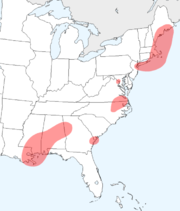 Within New England English exists a number of dialects.
to Providence.
There are several systems of pronouncing "short-a" (the /a/ in pack or bad) attested in the region, including the "nasal" system, remnants of the "broad-a" system, and "Northern breaking".
The Eastern New England dialect region includes much of Massachusetts, New Hampshire, Maine, and areas of south-western Nova Scotia, and is frequently said to include Rhode Island
and eastern Connecticut
. Characteristic phonological features include non-rhoticity
and a distinctive set of low vowels
.
The phrase park the car in Harvard Yard is commonly used to caricature the lack of rhoticity in eastern New England, which contrasts with the generally rhotic accents common elsewhere in North America.
Eastern New England maintains a distinction between the vowel [a] as in father or calm versus [ɒ] as in dog or hot, a pair that is merged in virtually all other North American accents. In contrast, the vowels of caught and cot are pronounced identically, as is the case in most of Canada and the western United States, but not in the southern United States, New York city, Philadelphia, or much of the US Great Lakes region. These vowels are not merged, however, in southeastern New England.
There is evidence that New Hampshire has been shifting over time away from other Eastern New England dialects. Younger speakers have begun to merge the vowels, mentioned above, in father ([a]) and dog ([ɒ]). New Hampshirites have also come to pronounce /r/ with greater frequency than speakers in Massachusetts, and have moved towards a system of "short-a" pronunciation that is distinct from Boston speakers.
As mentioned before, this dialect is traditionally non-rhotic.
A feature that the Southeastern New England accent shares with New York City and much of the Eastern Seaboard is resistance to the cot–caught merger. This also distinguishes the region from Northeastern New England.
A study of WNE found raising of /æ/ in all environments and tensing (as well as raising) before nasals (Boberg 2001: 17-19). A small sample of telephone survey data showed this to be the case across WNE with the exception of the very northern city of Burlington, Vermont
. Words like bad and stack are pronounced with [eə], and words like stand and can are pronounced [ɛə].
Labov (1991: 12) suggests that unified raising of TRAP/BATH/DANCE is a pivot point for the NCVS (the Northern Cities Vowel Shift). Boberg (2001: 11) further argues that the NCVS may thus have had its beginnings in northwestern NE. The existence of this raising pattern is surprising if one accepts the lack of BATH-raising in the LANE data (Kurath 1939-43), especially given that Labov, Ash and Boberg does not show this to be an incipient vigorous change: older speakers show more raising than younger speakers in Hartford, CT, Springfield, MA, and Rutland, VT (Boberg 2001: 19).
Recent data from Labov, Ash and Boberg has all western Connecticut speakers keeping cot and caught distinct, resembling the Inland North pattern. However, seven of the eight Vermont speakers have completely merged the two vowels.
As was mentioned earlier, the northern half of this region shows the cot–caught merger, along with consistent fronting of /ɑː/ before /r/.
Southwestern New England shows the basic tendency of the Northern Cities Shift to back /ɛ/ and front /ɑː/.
Some speakers of the Western New England dialect may replace "t" with a glottal stop
and replace "-ing" with "in'". This would mean that those who do such would pronounce (for example) "sitting" as "sih-in'", New Britain as "New Bri-in", and so on. T-glotallising is found in other parts of the country as well, in varying amounts. Even the "t" in "Vermont" is often replaced with a glottal stop by native Vermonters.
Some local dialects in working class areas of southwestern Connecticut (especially Greater New Haven and Greater Bridgeport) are strongly influenced by the neighboring New York dialect.
English language
English is a West Germanic language that arose in the Anglo-Saxon kingdoms of England and spread into what was to become south-east Scotland under the influence of the Anglian medieval kingdom of Northumbria...
spoken in the New England
New England
New England is a region in the northeastern corner of the United States consisting of the six states of Maine, New Hampshire, Vermont, Massachusetts, Rhode Island, and Connecticut...
area. These include the Eastern New England dialect (ENE), the Western New England dialect (WNE), and some Subdialects within these two regions. While many people may think the New England dialects are disappearing or becoming less prevalent, recent research by William Labov
William Labov
William Labov born December 4, 1927) is an American linguist, widely regarded as the founder of the discipline of variationist sociolinguistics. He has been described as "an enormously original and influential figure who has created much of the methodology" of sociolinguistics...
suggests that these dialects are growing more distinct and diverse from those elsewhere in the United States.
Features
Eastern New England speech is historically non-rhoticRhotic and non-rhotic accents
English pronunciation can be divided into two main accent groups: a rhotic speaker pronounces a rhotic consonant in words like hard; a non-rhotic speaker does not...
, while Western New England is historically rhotic. Eastern New England possesses the so-called cot–caught merger; the Providence
Providence, Rhode Island
Providence is the capital and most populous city of Rhode Island and was one of the first cities established in the United States. Located in Providence County, it is the third largest city in the New England region...
dialect does not possess the merger; and Western New England exhibits a continuum from full merger in northern Vermont
Vermont
Vermont is a state in the New England region of the northeastern United States of America. The state ranks 43rd in land area, , and 45th in total area. Its population according to the 2010 census, 630,337, is the second smallest in the country, larger only than Wyoming. It is the only New England...
to full distinction in western Connecticut
Connecticut
Connecticut is a state in the New England region of the northeastern United States. It is bordered by Rhode Island to the east, Massachusetts to the north, and the state of New York to the west and the south .Connecticut is named for the Connecticut River, the major U.S. river that approximately...
. The Western New England accent is closely related to the Inland North
Inland Northern American English
The Inland North dialect of American English is spoken in a region that includes most of the cities along the Erie Canal and on the U.S. side of Great Lakes region, reaching approximately from Utica, New York to Green Bay, Wisconsin, as well as a corridor extending down across central Illinois from...
accent which prevails further west.
Regional variances
Eastern New England
Eastern New England was originally marked by non-rhoticity in car, card, fear, etc. Though this feature is receding, it is still strong in the area ranging from Bangor, MaineBangor, Maine
Bangor is a city in and the county seat of Penobscot County, Maine, United States, and the major commercial and cultural center for eastern and northern Maine...
to Providence.
There are several systems of pronouncing "short-a" (the /a/ in pack or bad) attested in the region, including the "nasal" system, remnants of the "broad-a" system, and "Northern breaking".
The Eastern New England dialect region includes much of Massachusetts, New Hampshire, Maine, and areas of south-western Nova Scotia, and is frequently said to include Rhode Island
Rhode Island
The state of Rhode Island and Providence Plantations, more commonly referred to as Rhode Island , is a state in the New England region of the United States. It is the smallest U.S. state by area...
and eastern Connecticut
Connecticut
Connecticut is a state in the New England region of the northeastern United States. It is bordered by Rhode Island to the east, Massachusetts to the north, and the state of New York to the west and the south .Connecticut is named for the Connecticut River, the major U.S. river that approximately...
. Characteristic phonological features include non-rhoticity
Rhotic and non-rhotic accents
English pronunciation can be divided into two main accent groups: a rhotic speaker pronounces a rhotic consonant in words like hard; a non-rhotic speaker does not...
and a distinctive set of low vowels
Open vowel
An open vowel is defined as a vowel sound in which the tongue is positioned as far as possible from the roof of the mouth. Open vowels are sometimes also called low vowels in reference to the low position of the tongue...
.
The phrase park the car in Harvard Yard is commonly used to caricature the lack of rhoticity in eastern New England, which contrasts with the generally rhotic accents common elsewhere in North America.
Eastern New England maintains a distinction between the vowel [a] as in father or calm versus [ɒ] as in dog or hot, a pair that is merged in virtually all other North American accents. In contrast, the vowels of caught and cot are pronounced identically, as is the case in most of Canada and the western United States, but not in the southern United States, New York city, Philadelphia, or much of the US Great Lakes region. These vowels are not merged, however, in southeastern New England.
There is evidence that New Hampshire has been shifting over time away from other Eastern New England dialects. Younger speakers have begun to merge the vowels, mentioned above, in father ([a]) and dog ([ɒ]). New Hampshirites have also come to pronounce /r/ with greater frequency than speakers in Massachusetts, and have moved towards a system of "short-a" pronunciation that is distinct from Boston speakers.
Southeastern New England
Southeastern New England includes Rhode Island and areas nearby it in neighboring states such as eastern Connecticut.As mentioned before, this dialect is traditionally non-rhotic.
A feature that the Southeastern New England accent shares with New York City and much of the Eastern Seaboard is resistance to the cot–caught merger. This also distinguishes the region from Northeastern New England.
Western New England
Western New England is r-pronouncing.A study of WNE found raising of /æ/ in all environments and tensing (as well as raising) before nasals (Boberg 2001: 17-19). A small sample of telephone survey data showed this to be the case across WNE with the exception of the very northern city of Burlington, Vermont
Burlington, Vermont
Burlington is the largest city in the U.S. state of Vermont and the shire town of Chittenden County. Burlington lies south of the U.S.-Canadian border and some south of Montreal....
. Words like bad and stack are pronounced with [eə], and words like stand and can are pronounced [ɛə].
Labov (1991: 12) suggests that unified raising of TRAP/BATH/DANCE is a pivot point for the NCVS (the Northern Cities Vowel Shift). Boberg (2001: 11) further argues that the NCVS may thus have had its beginnings in northwestern NE. The existence of this raising pattern is surprising if one accepts the lack of BATH-raising in the LANE data (Kurath 1939-43), especially given that Labov, Ash and Boberg does not show this to be an incipient vigorous change: older speakers show more raising than younger speakers in Hartford, CT, Springfield, MA, and Rutland, VT (Boberg 2001: 19).
Recent data from Labov, Ash and Boberg has all western Connecticut speakers keeping cot and caught distinct, resembling the Inland North pattern. However, seven of the eight Vermont speakers have completely merged the two vowels.
As was mentioned earlier, the northern half of this region shows the cot–caught merger, along with consistent fronting of /ɑː/ before /r/.
Southwestern New England shows the basic tendency of the Northern Cities Shift to back /ɛ/ and front /ɑː/.
Some speakers of the Western New England dialect may replace "t" with a glottal stop
Glottal stop
The glottal stop, or more fully, the voiceless glottal plosive, is a type of consonantal sound used in many spoken languages. In English, the feature is represented, for example, by the hyphen in uh-oh! and by the apostrophe or [[ʻokina]] in Hawaii among those using a preservative pronunciation of...
and replace "-ing" with "in'". This would mean that those who do such would pronounce (for example) "sitting" as "sih-in'", New Britain as "New Bri-in", and so on. T-glotallising is found in other parts of the country as well, in varying amounts. Even the "t" in "Vermont" is often replaced with a glottal stop by native Vermonters.
Some local dialects in working class areas of southwestern Connecticut (especially Greater New Haven and Greater Bridgeport) are strongly influenced by the neighboring New York dialect.
See also
- New EnglandNew EnglandNew England is a region in the northeastern corner of the United States consisting of the six states of Maine, New Hampshire, Vermont, Massachusetts, Rhode Island, and Connecticut...
- Regional accents of English speakersRegional accents of English speakersThe regional accents of English speakers show great variation across the areas where English is spoken as a first language. This article provides an overview of the many identifiable variations in pronunciation, usually deriving from the phoneme inventory of the local dialect, of the local variety...
- Boston EnglishBoston accentThe Boston dialect is the dialect characteristic of English spoken in the city of Boston and much of eastern Massachusetts. The accent and closely related accents can be heard commonly in an area stretching into much of Massachusetts, New Hampshire, Maine, and areas of south-western Nova Scotia...
- Vermont EnglishVermont EnglishVermont English is a dialect of English Language spoken in the U.S. state of Vermont. Although a New England state, the variety of English spoken in most parts of the state generally has more in common with the accent spoken in nearby New York State and parts of the Midwest...
- North American English regional phonology #Northeastern dialects
- Regional vocabularies of American EnglishRegional vocabularies of American EnglishRegional vocabularies of American English vary. Below is a list of lexical differences in vocabulary that are generally associated with a region. A term featured on a list may or may not be found throughout the region concerned, and may or may not be recognized by speakers outside that region...