

National Park of American Samoa

Encyclopedia
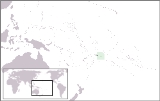
The National Park of American Samoa is a national park on the American territory of American Samoa
, distributed across three separate islands: Tutuila
, Ofu-Olosega
, and Ta‘ū. The park includes coral reef
s and rain forest and is popular for hiking, snorkeling, and scuba diving
, although the primary purpose of the park is that of preservation of Samoa's unique natural resources. Of the park's 10500 acres (4,249.2 ha), 7970 acres (3,225.3 ha) is land and 2550 acres (1,031.9 ha) is water. It is the only American national park south of the equator.
) are endemic to the archipelago.
are the only native mammals: two large fruit bats (Samoa Flying-fox
and Insular Flying-fox
) and a small insectivore
, the Pacific Sheath-Tailed Bat
. They serve an important role in pollinating the island's plants. The sheath-tailed bat was nearly eliminated by Cyclone Val
in 1991. Native reptiles include the Pelagic Gecko, Polynesian Gecko
, Mourning gecko
, Stump-toed Gecko, Pacific Boa
and seven skink
species.
A major role for the park is to control and eradicate invasive plant and animal species
such as feral pigs and rats, which threaten the park's ecosystem. There are several bird species, the most predominant being the Wattled Honeyeater
, Samoan Starling
, and Pacific Imperial-pigeon
. Other unusual birds include the Tahiti Petrel
, the Spotless Crake
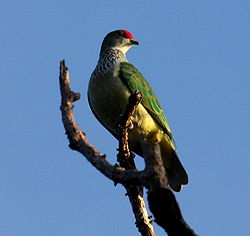
, and the rare (in this locality) Many-coloured Fruit-dove
.
, including cloud forest
on Tau and lowland ridge forest on Tutuila. Most plants arrived by chance from Southeast Asia
. There are 487 native flowering plants and ferns and over 100 endemic plant species.
) in the world are at Tau Island.
entered into a 50-year lease for the park land from the Samoan village councils. In 2002, Congress approved a thirty percent expansion on Olosega and Ofu islands.
In 2009 an earthquake
and tsunami produced several large waves, resulting in 32 confirmed deaths, more than a hundred injuries and the destruction of about 200 homes and businesses. The park encountered major damage. The visitor center and main office were destroyed but there was only one reported injury among the NPS staff and volunteers.
concentration, as well as sea level rise. As a result of these and other stresses, the corals that form the reefs are projected to be lost by mid-century if carbon dioxide concentrations continue to rise at their
current rate.
American Samoa
American Samoa is an unincorporated territory of the United States located in the South Pacific Ocean, southeast of the sovereign state of Samoa...
, distributed across three separate islands: Tutuila
Tutuila
Tutuila is the largest and the main island of American Samoa in the archipelago of Samoan Islands. It is the third largest island in the Samoan Islands chain of the Central Pacific located roughly northeast of Brisbane, Australia and over northeast of Fiji. It contains a large, natural harbor,...
, Ofu-Olosega
Ofu-Olosega
Ofu and Olosega are parts of a volcanic doublet in the Manu‘a Group of the Samoan Islands—part of American Samoa. The twin islands, formed from shield volcanoes, have a combined length of 6km. They are geographic volcanic remnants separated by the narrow 137m wide Asaga strait, a natural...
, and Ta‘ū. The park includes coral reef
Coral reef
Coral reefs are underwater structures made from calcium carbonate secreted by corals. Coral reefs are colonies of tiny living animals found in marine waters that contain few nutrients. Most coral reefs are built from stony corals, which in turn consist of polyps that cluster in groups. The polyps...
s and rain forest and is popular for hiking, snorkeling, and scuba diving
Scuba diving
Scuba diving is a form of underwater diving in which a diver uses a scuba set to breathe underwater....
, although the primary purpose of the park is that of preservation of Samoa's unique natural resources. Of the park's 10500 acres (4,249.2 ha), 7970 acres (3,225.3 ha) is land and 2550 acres (1,031.9 ha) is water. It is the only American national park south of the equator.
Tutuila
The Tutuila unit of the park is on the north end of the island near Pago Pago. It is separated by Mount Alava (1610 feet (490.7 m)) and the Maugaloa Ridge and includes the Amalau Valley, Craggy Point, Tafeu Cove, and the islands of Pola and Manofa. It is the only part of the park accessible by car and attracts the vast majority of people. The park lands include a trail to the top of Mount Alava and historic World War II gun emplacement sites at Breakers Point and Blunt's Point. The trail runs along the ridge in dense forest, north of which the land slopes steeply away to the ocean.Ofu and Olosega
Ofu and Olosega can be accessed by small plane from the airport on Tutuila to Ofu. Accommodations are available on Ofu at the airport and at Asaga.Ta‘ū
Ta‘ū can be reached by a flight from Tutuila to Fiti‘uta on Ta‘ū. Accommodations are available on Ta‘ū. A trail runs from Saua around Si’u Point to the southern coastline and stairs to the 3000 feet (914.4 m) summit of Lata Mountain.Biodiversity
Because of its remote location, diversity among the terrestrial species is low. Approximately 30% of the plants and one bird species (the Samoan StarlingSamoan Starling
The Samoan Starling is a large starling of the family Sturnidae. It is found in American Samoa and Samoa. The species has a dark brown, glossy appearance, with a long bill. Its natural habitat is tropical moist forest on volcanic islands, where it is common and more conspicuous than the...
) are endemic to the archipelago.
Fauna
Three species of batBat
Bats are mammals of the order Chiroptera "hand" and pteron "wing") whose forelimbs form webbed wings, making them the only mammals naturally capable of true and sustained flight. By contrast, other mammals said to fly, such as flying squirrels, gliding possums, and colugos, glide rather than fly,...
are the only native mammals: two large fruit bats (Samoa Flying-fox
Samoa Flying-fox
The Samoa Flying Fox or Samoan Flying Fox is a species of megabat in the Pteropodidae family. It is found in American Samoa, Fiji, and Samoa. Its natural habitat is subtropical or tropical dry forests...
and Insular Flying-fox
Insular Flying-fox
The Insular Flying Fox or Pacific Flying Fox is a species of megabat in the Pteropodidae family. It is found in American Samoa, the Cook Islands, Fiji, New Caledonia, Niue, Papua New Guinea, Samoa, the Solomon Islands, Tonga, and Vanuatu.-References:* Hamilton, S. & Helgen, K. 2008. . Downloaded...
) and a small insectivore
Insectivore
An insectivore is a type of carnivore with a diet that consists chiefly of insects and similar small creatures. An alternate term is entomophage, which also refers to the human practice of eating insects....
, the Pacific Sheath-Tailed Bat
Pacific Sheath-Tailed Bat
The Pacific Sheath-tailed Bat or Polynesian Sheath-tailed Bat is a species of sac-winged bat in the family Emballonuridae.It is found in American Samoa, Fiji, Guam, Micronesia, Palau, Samoa, Tonga, and Vanuatu....
. They serve an important role in pollinating the island's plants. The sheath-tailed bat was nearly eliminated by Cyclone Val
Cyclone Val
Severe Tropical Cyclone Val, also known as Cyclone Val, was a cyclone that struck Western Samoa and American Samoa on December 4, 1991. Lasting until December 13, the cyclone moved in a west-to-east trajectory. The cyclone lasted for five days in American Samoa and was designated by the United...
in 1991. Native reptiles include the Pelagic Gecko, Polynesian Gecko
Gehyra oceanica
The Oceanic Gecko, Gehyra oceanica, is a species of gecko in the genus Gehyra. It is also known as the Pacific Dtella or the Big Tree Gecko...
, Mourning gecko
Lepidodactylus lugubris
The Mourning Gecko or Common Smooth-Scaled Gecko is a species of gecko. This small , nocturnal gecko feeds on small insects and flower nectar. This species is notable because it is parthenogenic, and there are no remaining males that have been found...
, Stump-toed Gecko, Pacific Boa
Candoia carinata
Candoia carinata, known commonly as the Pacific Ground Boa or the Pacific Keel-scaled Boa, is a species of snake in the Boidae family. It is found in Indonesia, New Guinea, and the Bismarck Archipelago....
and seven skink
Skink
Skinks are lizards belonging to the family Scincidae. Together with several other lizard families, including Lacertidae , they comprise the superfamily or infraorder Scincomorpha...
species.
A major role for the park is to control and eradicate invasive plant and animal species
Invasive species
"Invasive species", or invasive exotics, is a nomenclature term and categorization phrase used for flora and fauna, and for specific restoration-preservation processes in native habitats, with several definitions....
such as feral pigs and rats, which threaten the park's ecosystem. There are several bird species, the most predominant being the Wattled Honeyeater
Wattled Honeyeater
The Wattled Honeyeater is a species of bird in the honeyeater family Meliphagidae. It is the only species in the genus Foulehaio....
, Samoan Starling
Samoan Starling
The Samoan Starling is a large starling of the family Sturnidae. It is found in American Samoa and Samoa. The species has a dark brown, glossy appearance, with a long bill. Its natural habitat is tropical moist forest on volcanic islands, where it is common and more conspicuous than the...
, and Pacific Imperial-pigeon
Pacific Imperial-pigeon
The Pacific Imperial Pigeon is a widespread species of pigeon in the family Columbidae.It is found in American Samoa, the Cook Islands, the smaller islands of eastern Fiji, Kiribati, Niue, the smaller satellite islands of Papua New Guinea, Samoa, Solomon Islands, Tokelau, Tonga, Tuvalu, Vanuatu,...
. Other unusual birds include the Tahiti Petrel
Tahiti Petrel
The Tahiti Petrel, Pétrel De Tahiti, or Petrel De Tahití is a species of seabird in the Procellariidae family....
, the Spotless Crake
Spotless Crake
The Spotless Crake is a species of bird in the rail family, Rallidae.It is found in American Samoa, Australia, the Cook Islands, Fiji, French Polynesia, Indonesia, Micronesia, New Zealand, Niue, Papua New Guinea, the Philippines, Pitcairn, Samoa, Solomon Islands, and Tonga.-References:* BirdLife...
, and the rare (in this locality) Many-coloured Fruit-dove
Many-coloured Fruit-dove
The Many-coloured Fruit Dove is a species of bird in the Columbidae family. It occurs on islands in the south-west Pacific Ocean where it is found in Fiji, the Samoan Islands, and Tonga. Its natural habitat is subtropical or tropical moist lowland forests. It usually feeds high in the canopy on...
.
Flora
The islands are mostly covered by tropical rainforestTropical rainforest
A tropical rainforest is an ecosystem type that occurs roughly within the latitudes 28 degrees north or south of the equator . This ecosystem experiences high average temperatures and a significant amount of rainfall...
, including cloud forest
Cloud forest
A cloud forest, also called a fog forest, is a generally tropical or subtropical evergreen montane moist forest characterized by a persistent, frequent or seasonal low-level cloud cover, usually at the canopy level. Cloud forests often exhibit an abundance of mosses covering the ground and...
on Tau and lowland ridge forest on Tutuila. Most plants arrived by chance from Southeast Asia
Southeast Asia
Southeast Asia, South-East Asia, South East Asia or Southeastern Asia is a subregion of Asia, consisting of the countries that are geographically south of China, east of India, west of New Guinea and north of Australia. The region lies on the intersection of geological plates, with heavy seismic...
. There are 487 native flowering plants and ferns and over 100 endemic plant species.
Marine
The surrounding waters are filled with a diversity of marine life, including sea turtles, humpback whales, about 890 species of fish, and 200 coral species. Some of the largest living coral colonies (PoritesPorites
Porites is a genus of scleractinian coral which is characterised by a finger-like morphology. Members of this genus have widely spaced calices, a well-developed wall reticulum and are bilaterally symmetrical...
) in the world are at Tau Island.
History
The National Park of American Samoa was established on October 31, 1988 by Public Law 100-571 but the NPS could not buy the land because of traditional communal land system. This was resolved on September 9, 1993, when the National Park ServiceNational Park Service
The National Park Service is the U.S. federal agency that manages all national parks, many national monuments, and other conservation and historical properties with various title designations...
entered into a 50-year lease for the park land from the Samoan village councils. In 2002, Congress approved a thirty percent expansion on Olosega and Ofu islands.
In 2009 an earthquake
2009 Samoa earthquake
The 2009 Samoa earthquake was an 8.1 Mw submarine earthquake that took place in the Samoan Islands region at 06:48:11 local time on September 29, 2009 . At a magnitude of 8.1, it was the largest earthquake of 2009....
and tsunami produced several large waves, resulting in 32 confirmed deaths, more than a hundred injuries and the destruction of about 200 homes and businesses. The park encountered major damage. The visitor center and main office were destroyed but there was only one reported injury among the NPS staff and volunteers.
Threats
The coral reefs are under significant threat due to rising ocean temperatures and carbon dioxideCarbon dioxide
Carbon dioxide is a naturally occurring chemical compound composed of two oxygen atoms covalently bonded to a single carbon atom...
concentration, as well as sea level rise. As a result of these and other stresses, the corals that form the reefs are projected to be lost by mid-century if carbon dioxide concentrations continue to rise at their
current rate.
External links
- National Park Service: National Park of American Samoa
- National Park Service map of the Manu‘a Islands showing the present park boundaries (pdf).
- Seacology National Park of American Samoa projects SeacologySeacologySeacology is a nonprofit 501 charitable organization headquartered in Berkeley, California that focuses on preserving island ecosystems and cultures around the globe. Founded in 1991, it began with the work of ethnobotanist Paul Alan Cox, who researched tropical plants and their medicinal value in...
- Birds of the National Park of American Samoa