

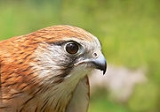
Nankeen Kestrel

Encyclopedia
The Australian Kestrel or Nankeen Kestrel (Falco cenchroides) is one of the smallest falcon
s, and unlike many, does not rely on speed to catch its prey. Instead, it simply perches in an exposed position, but it also has a distinctive technique of hovering over crop and grasslands. This bird is thought to be a very close relative of the Common Kestrel
, and probably also the Spotted Kestrel
. It seems to have evolved of ancestral Common Kestrels dispersing to the Australian region in the Middle Pleistocene
—less than years ago—and adapting
to local conditions.
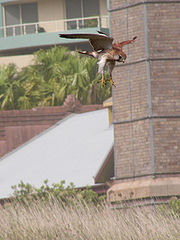 A very common and easily seen raptor, the Nankeen Kestrel is found in Australia
, New Guinea
, and nearby islands, and is an irregular visitor to New Zealand
. It occupies any type of land that is not too densely vegetated, but in particular temperate grasslands and open woodlands. In the tropical north and the sandy deserts of the west, it has a patchy and seasonal distribution.
Like many Australian birds, it has no clear migratory
pattern: in the grasslands of the south, established pairs are resident year round, but many other birds migrate north during the austral winter, or roam the arid interior following food supplies.
A small, slim falcon (about 31 to 35 cm (12.2 to 13.8 in) long), the Nankeen Kestrel is rufous or brown above and white or off-white below, with a black tail tip. Plumage varies considerably in detail, and some birds can look very scruffy, but the slim build, small size and distinctive straight-winged hovering habit make identification easy. (The only other Australasian raptors to hover are the elanid kite
s which are much lighter in colour and a little larger, and the Brown Falcon
, which is much larger and more heavily built, and hovers only with difficulty). Altogether, it looks just like a pale, less patterned, and smaller derivate of the Common Kestrel
, which it indeed is (see Gloger's Rule
, Bergmann's Rule
).
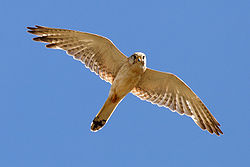 Diet is varied, with a large number of insects, but also small birds and reptiles, and in particular, small rodents, mostly mice. Nankeen Kestrels are adaptable and hunt in a number of different ways: of these, simply perching in an exposed position (such as on a dead tree or a telephone pole) and watching for prey is the most common, but it is their habit of hovering motionless over crop and grasslands that is most distinctive.
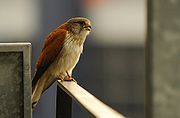 Typically seen singly or in pairs, they can aggregate into loose flocks of up to 30 when conditions are right. Pairs are typically monogamous and may or may not disperse to different areas during the non-breeding season. The nest is any convenient structure: a tree hollow, cliff ledge or disused corvid's nest, for example, and is not modified or added to by the kestrels.
Three to seven eggs are laid in late winter (usually about four) and incubated by the female alone. Hatching takes place after 26 to 28 days, and the male brings food while the female continues to incubate until the young are close to fledging, at which time the female leaves the nest to hunt for them too. Multiple broods are raised in good seasons.
Falcon
A falcon is any species of raptor in the genus Falco. The genus contains 37 species, widely distributed throughout Europe, Asia, and North America....
s, and unlike many, does not rely on speed to catch its prey. Instead, it simply perches in an exposed position, but it also has a distinctive technique of hovering over crop and grasslands. This bird is thought to be a very close relative of the Common Kestrel
Common Kestrel
The Common Kestrel is a bird of prey species belonging to the kestrel group of the falcon family Falconidae. It is also known as the European Kestrel, Eurasian Kestrel, or Old World Kestrel. In Britain, where no other brown falcon occurs, it is generally just called "the kestrel".This species...
, and probably also the Spotted Kestrel
Spotted Kestrel
The Spotted Kestrel is also known as the Moluccan Kestrel.-Distribution and habitat:Spread throughout Australasia, Indomalaya, and most of Wallacea, the Spotted Kestrel inhabits grasslands with scattered trees, lightly wooded cultivation, and the edges of primary and tall secondary forest...
. It seems to have evolved of ancestral Common Kestrels dispersing to the Australian region in the Middle Pleistocene
Middle Pleistocene
The Middle Pleistocene, more specifically referred to as the Ionian stage, is a period of geologic time from ca. 781 to 126 thousand years ago....
—less than years ago—and adapting
Adaptation
An adaptation in biology is a trait with a current functional role in the life history of an organism that is maintained and evolved by means of natural selection. An adaptation refers to both the current state of being adapted and to the dynamic evolutionary process that leads to the adaptation....
to local conditions.
Australia
Australia , officially the Commonwealth of Australia, is a country in the Southern Hemisphere comprising the mainland of the Australian continent, the island of Tasmania, and numerous smaller islands in the Indian and Pacific Oceans. It is the world's sixth-largest country by total area...
, New Guinea
New Guinea
New Guinea is the world's second largest island, after Greenland, covering a land area of 786,000 km2. Located in the southwest Pacific Ocean, it lies geographically to the east of the Malay Archipelago, with which it is sometimes included as part of a greater Indo-Australian Archipelago...
, and nearby islands, and is an irregular visitor to New Zealand
New Zealand
New Zealand is an island country in the south-western Pacific Ocean comprising two main landmasses and numerous smaller islands. The country is situated some east of Australia across the Tasman Sea, and roughly south of the Pacific island nations of New Caledonia, Fiji, and Tonga...
. It occupies any type of land that is not too densely vegetated, but in particular temperate grasslands and open woodlands. In the tropical north and the sandy deserts of the west, it has a patchy and seasonal distribution.
Like many Australian birds, it has no clear migratory
Bird migration
Bird migration is the regular seasonal journey undertaken by many species of birds. Bird movements include those made in response to changes in food availability, habitat or weather. Sometimes, journeys are not termed "true migration" because they are irregular or in only one direction...
pattern: in the grasslands of the south, established pairs are resident year round, but many other birds migrate north during the austral winter, or roam the arid interior following food supplies.
A small, slim falcon (about 31 to 35 cm (12.2 to 13.8 in) long), the Nankeen Kestrel is rufous or brown above and white or off-white below, with a black tail tip. Plumage varies considerably in detail, and some birds can look very scruffy, but the slim build, small size and distinctive straight-winged hovering habit make identification easy. (The only other Australasian raptors to hover are the elanid kite
Elanid kite
An elanid kite, sometimes white-tailed kite, is any of several small, long-winged, hovering raptors. All are specialist rodent hunters and most are members of the genus Elanus. Some authorities list the group as a formal subfamily, Elaninae...
s which are much lighter in colour and a little larger, and the Brown Falcon
Brown Falcon
The Brown Falcon , also known as the Brown Hawk, is a member of the falcon genus found in the drier regions of Australia. Its specific name berigora is derived from an aboriginal name for the bird....
, which is much larger and more heavily built, and hovers only with difficulty). Altogether, it looks just like a pale, less patterned, and smaller derivate of the Common Kestrel
Common Kestrel
The Common Kestrel is a bird of prey species belonging to the kestrel group of the falcon family Falconidae. It is also known as the European Kestrel, Eurasian Kestrel, or Old World Kestrel. In Britain, where no other brown falcon occurs, it is generally just called "the kestrel".This species...
, which it indeed is (see Gloger's Rule
Gloger's rule
Gloger's Rule is a zoological rule which states that within a species of endotherms, more heavily pigmented forms tend to be found in more humid environments, e.g. near the equator. It was named after the zoologist Constantin Wilhelm Lambert Gloger, who first remarked upon this phenomenon in 1833...
, Bergmann's Rule
Bergmann's Rule
Bergmann's rule is an ecogeographic principle that states that within a broadly distributed genus, species of larger size are found in colder environments, and species of smaller size are found in warmer regions. Although originally formulated in terms of species within a genus, it has often been...
).
Three to seven eggs are laid in late winter (usually about four) and incubated by the female alone. Hatching takes place after 26 to 28 days, and the male brings food while the female continues to incubate until the young are close to fledging, at which time the female leaves the nest to hunt for them too. Multiple broods are raised in good seasons.