


Multi-Chip Module

Encyclopedia
Integrated circuit
An integrated circuit or monolithic integrated circuit is an electronic circuit manufactured by the patterned diffusion of trace elements into the surface of a thin substrate of semiconductor material...
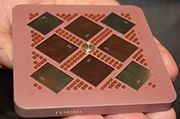
s (ICs), semiconductor dies or other discrete components are packaged onto a unifying substrate, facilitating their use as a single component (as though a larger IC). The MCM itself will often be referred to as a "chip" in designs, thus illustrating its integrated nature.
Overview
Multi-Chip Modules come in a variety of forms depending on the complexity and development philosophies of their designers. These can range from using pre-packaged ICs on a small printed circuit boardPrinted circuit board
A printed circuit board, or PCB, is used to mechanically support and electrically connect electronic components using conductive pathways, tracks or signal traces etched from copper sheets laminated onto a non-conductive substrate. It is also referred to as printed wiring board or etched wiring...
(PCB) meant to mimic the package footprint of an existing chip package to fully custom chip packages integrating many chip dies on a High Density Interconnection (HDI) substrate.
Multi-Chip Module packaging is an important facet of modern electronic miniaturization and micro-electronic systems. MCMs are classified according to the technology used to create the HDI (High Density Interconnection) substrate.
- MCM-L - laminated MCM. The substrate is a multi-layer laminated PCB (Printed circuit boardPrinted circuit boardA printed circuit board, or PCB, is used to mechanically support and electrically connect electronic components using conductive pathways, tracks or signal traces etched from copper sheets laminated onto a non-conductive substrate. It is also referred to as printed wiring board or etched wiring...
). - MCM-D - deposited MCM. The modules are deposited on the base substrate using thin film technology.
- MCM-C - ceramic substrate MCMs, such as LTCCLow temperature co-fired ceramicLow temperature co-fired ceramic devices are monolithic, ceramic microelectronic devices. In this context ‘co-fired ceramic’ means that the ceramic support structure and any conductive, resistive, and dielectric materials are fired in a kiln at the same time, and ‘Low temperature’ means that the...
.
Chip stack MCMs
A relatively new development in MCM technology is the so-called "chip-stack" package. Certain ICs, memories in particular, have very similar or identical pinouts when used multiple times within systems. A carefully designed substrate can allow these dies to be stacked in a vertical configuration making the resultant MCM's footprint much smaller (albeit at the cost of a thicker or taller chip). Since area is more often at a premium in miniature electronics designs, the chip-stack is an attractive option in many applications such as cell phones and personal digital assistantPersonal digital assistant
A personal digital assistant , also known as a palmtop computer, or personal data assistant, is a mobile device that functions as a personal information manager. Current PDAs often have the ability to connect to the Internet...
s (PDAs). After a thinning process, as many as ten dies can be stacked to create a high capacity SD memory card.
Examples of MCM technologies
- IBMIBMInternational Business Machines Corporation or IBM is an American multinational technology and consulting corporation headquartered in Armonk, New York, United States. IBM manufactures and sells computer hardware and software, and it offers infrastructure, hosting and consulting services in areas...
Bubble memoryBubble memoryBubble memory is a type of non-volatile computer memory that uses a thin film of a magnetic material to hold small magnetized areas, known as bubbles or domains, each storing one bit of data...
MCMs (1970s) - IBM 3081IBM 3081The IBM Model 3081 Processor Complex was a mainframe computer which was announced November 12, 1980 and withdrawn August 4, 1987. It introduced the System/370 Extended Architecture. It consisted of a 3081 Processor Unit and supporting units; the 3083 and 3084 were in the same family...
mainframe's thermal conduction module (1980s) - Intel Pentium ProPentium ProThe Pentium Pro is a sixth-generation x86 microprocessor developed and manufactured by Intel introduced in November 1, 1995 . It introduced the P6 microarchitecture and was originally intended to replace the original Pentium in a full range of applications...
, Pentium DPentium DThe Pentium D brand refers to two series of desktop dual-core 64-bit x86-64 microprocessors with the NetBurst microarchitecture manufactured by Intel. Each CPU comprised two dies, each containing a single core, residing next to each other on a multi-chip module package. The brand's first processor,...
Presler http://www.theinquirer.org/?article=25746, XeonXeonThe Xeon is a brand of multiprocessing- or multi-socket-capable x86 microprocessors from Intel Corporation targeted at the non-consumer server, workstation and embedded system markets.-Overview:...
Dempsey and Clovertown, Core 2 Quad (Kentsfield and Yorkfield) and ClarkdaleClarkdale (microprocessor)Clarkdale is the code name for an Intel processor, initially sold as desktop Intel Core i5 and Core i3 and Pentium. It is closely related to themobile Arrandale processor; both use dual-core dies based on the 32 nm... - SonySony, commonly referred to as Sony, is a Japanese multinational conglomerate corporation headquartered in Minato, Tokyo, Japan and the world's fifth largest media conglomerate measured by revenues....
memory stickMemory StickMemory Stick is a removable flash memory card format, launched by Sony in October 1998, and is also used in general to describe the whole family of Memory Sticks...
s - Xenos, a GPUGraphics processing unitA graphics processing unit or GPU is a specialized circuit designed to rapidly manipulate and alter memory in such a way so as to accelerate the building of images in a frame buffer intended for output to a display...
designed by ATI TechnologiesATI TechnologiesATI Technologies Inc. was a semiconductor technology corporation based in Markham, Ontario, Canada, that specialized in the development of graphics processing units and chipsets. Founded in 1985 as Array Technologies Inc., the company was listed publicly in 1993 and was acquired by Advanced Micro...
for the Xbox 360Xbox 360The Xbox 360 is the second video game console produced by Microsoft and the successor to the Xbox. The Xbox 360 competes with Sony's PlayStation 3 and Nintendo's Wii as part of the seventh generation of video game consoles...
, with eDRAMEDRAMeDRAM stands for "embedded DRAM", a capacitor-based dynamic random access memory integrated on the same die as an ASIC or processor. The cost-per-bit is higher than for stand-alone DRAM chips but in many applications the performance advantages of placing the eDRAM on the same chip as the processor... - POWER2POWER2The POWER2, originally named RIOS2, is a processor designed by IBM that implemented the POWER instruction set architecture. The POWER2 was the successor of the POWER1, debuting in September 1993 within IBM's RS/6000 systems. When introduced, the POWER2 was the fastest microprocessor, surpassing the...
, POWER4POWER4The POWER4 is a microprocessor developed by International Business Machines that implemented the 64-bit PowerPC and PowerPC AS instruction set architectures. Released in 2001, the POWER4 succeeded the POWER3 and RS64 microprocessors, and was used in RS/6000 and AS/400 computers, ending a separate...
and POWER5POWER5The POWER5 is a microprocessor developed and fabricated by IBM. It is an improved version of the highly successful POWER4. The principal improvements are support for simultaneous multithreading and an on-die memory controller...
from IBMIBMInternational Business Machines Corporation or IBM is an American multinational technology and consulting corporation headquartered in Armonk, New York, United States. IBM manufactures and sells computer hardware and software, and it offers infrastructure, hosting and consulting services in areas... - AMD processors for Socket G34Socket G34Socket G34 is a CPU socket designed by AMD to support AMD's multi-chip module Opteron 6000-series server processors. G34 was launched on March 29, 2010, alongside the initial grouping of Opteron 6100 processors designed for it. Socket G34 supports four DDR3 SDRAM channels, two for each die in the...
See also
- System in packageSystem in packageA system-in-a-package or system in package , also known as a Chip Stack MCM, is a number of integrated circuits enclosed in a single package or module. The SiP performs all or most of the functions of an electronic system, and are typically used inside a mobile phone, digital music player, etc...
(SIP) - Hybrid integrated circuit
- Chip carrierChip carrierA chip carrier, also known as a chip container or chip package, is a container for a transistor or an integrated circuit. The carrier usually provides metal leads, or "pins", which are sturdy enough to electrically and mechanically connect the fragile chip to a circuit board. This connection may be...
Chip packaging and package types list