


Chip carrier

Encyclopedia
Transistor
A transistor is a semiconductor device used to amplify and switch electronic signals and power. It is composed of a semiconductor material with at least three terminals for connection to an external circuit. A voltage or current applied to one pair of the transistor's terminals changes the current...
or an integrated circuit
Integrated circuit
An integrated circuit or monolithic integrated circuit is an electronic circuit manufactured by the patterned diffusion of trace elements into the surface of a thin substrate of semiconductor material...
. The carrier usually provides metal
Metal
A metal , is an element, compound, or alloy that is a good conductor of both electricity and heat. Metals are usually malleable and shiny, that is they reflect most of incident light...
lead
Lead (electronics)
In electronics, a lead is an electrical connection consisting of a length of wire or soldering pad that comes from a device. Leads are used for physical support, to transfer power, to probe circuits , and to transmit information...
s, or "pins", which are sturdy enough to electrically and mechanically connect the fragile chip to a circuit board. This connection may be made by soldering
Soldering
Soldering is a process in which two or more metal items are joined together by melting and flowing a filler metal into the joint, the filler metal having a lower melting point than the workpiece...
or by mechanical force
Force
In physics, a force is any influence that causes an object to undergo a change in speed, a change in direction, or a change in shape. In other words, a force is that which can cause an object with mass to change its velocity , i.e., to accelerate, or which can cause a flexible object to deform...
applied by spring
Spring (device)
A spring is an elastic object used to store mechanical energy. Springs are usually made out of spring steel. Small springs can be wound from pre-hardened stock, while larger ones are made from annealed steel and hardened after fabrication...
s or a ZIF socket. Most circuit boards today mount the chips on the surface
Surface-mount technology
Surface mount technology is a method for constructing electronic circuits in which the components are mounted directly onto the surface of printed circuit boards . An electronic device so made is called a surface mount device...
of the board, although previously it was common to place the pins in through-holes
Through-hole technology
Through-hole technology, also spelled "thru-hole", refers to the mounting scheme used for electronic components that involves the use of leads on the components that are inserted into holes drilled in printed circuit boards and soldered to pads on the opposite side either by manual assembly by...
punched into the board. As smaller packages are cheaper, most modern chip carriers are too small for practical installation by humans. Modern microprocessors may have over 1000 pins, so the integrated circuit packaging
Integrated circuit packaging
Integrated circuit packaging is the final stage of semiconductor device fabrication per se, followed by IC testing.Packaging in ceramic or plastic prevents physical damage and corrosion and supports the electrical contacts required to assemble the integrated circuit into a system.In the integrated...
technology to manufacture and install the carrier must be extremely reliable.
Types of chip carriers
- BCC: Bump Chip Carrier
- BGABall grid arrayA ball grid array is a type of surface-mount packaging used for integrated circuits.- Description :The BGA is descended from the pin grid array , which is a package with one face covered with pins in a grid pattern. These pins conduct electrical signals from the integrated circuit to the printed...
: Ball Grid Array (also CBGA, PBGA, FBGA, UFBGA, UBGA, MBGA) - BQFP: Bumpered Quad Flat Pack
- CBGA: Ceramic Ball Grid Array
- CCGA: ceramic column grid array (CGA)
- CDIP: Ceramic DIPDual in-line packageIn microelectronics, a dual in-line package is an electronic device package with a rectangular housing and two parallel rows of electrical connecting pins. The package may be through-hole mounted to a printed circuit board or inserted in a socket.A DIP is usually referred to as a DIPn, where n is...
- CERDIP: glass sealed ceramic DIPDual in-line packageIn microelectronics, a dual in-line package is an electronic device package with a rectangular housing and two parallel rows of electrical connecting pins. The package may be through-hole mounted to a printed circuit board or inserted in a socket.A DIP is usually referred to as a DIPn, where n is...
- CERPACK: ceramic package
- CFP: Ceramic Flat Pack
- CGA: column grid array
- CLCC: Ceramic Leadless Chip Carrier
- COB: chip-on-board; a bare silicon chip, that is usually an integrated circuit, is supplied without a package.
- COF: chip-on-flex; a variation of COB, where a chip is mounted directly to a flex circuit.
- COG: chip-on-glass; a variation of COB, where a chip is mounted directly to a piece of glass - typically an LCD.
- CPGA: Ceramic Pin Grid Array
- CQFP: ceramic quad flat-pack, similar to PQFP
- CQGP:
- CSOP: ceramic SOP
- CSPChip scale packageA chip scale package is a type of integrated circuit chip carrier.Originally, CSP was the acronym for chip-size packaging. Since only a few packages are chip size, the meaning of the acronym was adapted to chip-scale packaging...
: Chip Scale Package (package no more than 1.2x the size of the silicon chip) - DILDual in-line packageIn microelectronics, a dual in-line package is an electronic device package with a rectangular housing and two parallel rows of electrical connecting pins. The package may be through-hole mounted to a printed circuit board or inserted in a socket.A DIP is usually referred to as a DIPn, where n is...
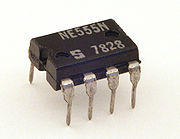
: Dual Inline Package (synonym for DIP) - DIPDual in-line packageIn microelectronics, a dual in-line package is an electronic device package with a rectangular housing and two parallel rows of electrical connecting pins. The package may be through-hole mounted to a printed circuit board or inserted in a socket.A DIP is usually referred to as a DIPn, where n is...
: Dual Inline Package (.1" pin spacing, rows .3" or .6" apart) - DFN: Dual Flat Pack, No Lead
- DLCC: Dual Lead-Less Chip Carrier (Ceramic)
- ETQFP: Exposed Thin Quad Flat Package
- FBGABall grid arrayA ball grid array is a type of surface-mount packaging used for integrated circuits.- Description :The BGA is descended from the pin grid array , which is a package with one face covered with pins in a grid pattern. These pins conduct electrical signals from the integrated circuit to the printed...
: fine pitch ball grid array, with a square or rectangular array of solder balls on one surface - FCPGA: Flip-chip Pin Grid Array
- HVQFNHVQFNA Heatsink Very-thin Quad Flat-pack No-leads is a surface mount integrated circuit package format with no component leads extending from the IC. Pads are spaced along the sides of the IC with an exposed DIE that can be used as ground....
: Heat-sink very-thin quad flat-pack no-leads - LBGA : Low Profile Ball Grid Array (see BGABall grid arrayA ball grid array is a type of surface-mount packaging used for integrated circuits.- Description :The BGA is descended from the pin grid array , which is a package with one face covered with pins in a grid pattern. These pins conduct electrical signals from the integrated circuit to the printed...
) (also Laminate Ball Grid Array) - LCCLeadless chip carrierA leadless chip carrier is a type of packaging for integrated circuits that has no "leads", but instead has rounded pins through the edges of the ceramic or molded plastic package....
: Leadless Chip Carrier, contacts are recessed vertically. - LCC: Leaded Chip Carrier
- LCCC: Leaded Ceramic Chip Carrier
- LLP: Lead Less lead frame Package, a package with metric pin distribution (0.5 mm - 0.8 mm pitch)
- LFBGA - low profile fine pitch ball grid array
- LGALand grid arrayThe land grid array is a type of surface-mount packaging for integrated circuits that is notable for having the pins on the socket rather than the integrated circuit...
: Land Grid Array - LQFPLQFPA Low-profile Quad Flat Package is a surface mount integrated circuit package format with component leads extending from each of the four sides. Pins are numbered counter-clockwise from the index dot. Spacing between pins can vary; common spacings are 0.4, 0.5, 0.65 and 0.80 mm intervals....
: Low-profile Quad Flat Package - LTCCLow temperature co-fired ceramicLow temperature co-fired ceramic devices are monolithic, ceramic microelectronic devices. In this context ‘co-fired ceramic’ means that the ceramic support structure and any conductive, resistive, and dielectric materials are fired in a kiln at the same time, and ‘Low temperature’ means that the...
: Low temperature co-fired ceramic - MCMMulti-Chip ModuleA multi-chip module is a specialized electronic package where multiple integrated circuits , semiconductor dies or other discrete components are packaged onto a unifying substrate, facilitating their use as a single component...
: Multi-Chip Module - MDIP: Molded DIPDual in-line packageIn microelectronics, a dual in-line package is an electronic device package with a rectangular housing and two parallel rows of electrical connecting pins. The package may be through-hole mounted to a printed circuit board or inserted in a socket.A DIP is usually referred to as a DIPn, where n is...
- MELF: Metal Electrode Leadless Face (usually for resistors and diodes)
- MICRO SMD: a chip-size package (CSP) developed by National Semiconductor
- MICRO SMDXT: micro Surface Mount Device extended technology
- MICROARRAY: Usually refers to a chip for testing DNA
- MLFMicroLeadFrameAmkor's MicroLeadFrame is a near CSP plastic encapsulated package with a copper leadframe substrate. This package uses perimeter lands on the bottom of the package to provide electrical contact to the...
Micro Lead Frame (also called QFNQFNFlat no-leads packages such as QFN and DFN physically and electrically connect integrated circuits to printed circuit boards. Flat no-leads, also known as MicroLeadFrame, is a surface-mount technology, one of several package technologies that connect ICs to the surfaces of PCBs without...
) - MLPMicro Leadframe PackageMicro leadframe package is a family of integrated circuit QFN packages, used in surface mounted electronic circuits designs. It is available in 3 versions which are MLPQ , MLPM , and MLPD . These package generally have an exposed die attach pad to improve thermal performance...
: Micro Leadframe Package with a 0.5 mm contact pitch, no leads - MQFP - Metric Quad Flat Pack, a QFP package with metric pin distribution
- MSOP: Mini Small-Outline Package
- OBGA: Organic Ball Grid Array
- OPGAOPGAThe Organic Pin Grid Array is a type of connection for integrated circuits, and especially CPUs, where the silicon die is attached to a plate out of an organic plastic which is pierced by an array of pins which make the requisite connections to the socket.A popular type of CPU to employ the OPGA...
: Organic Pin Grid Array - PAC: Pin Array Cartridge
- PBGA: Plastic Ball Grid Array
- PDIP: Plastic DIPDual in-line packageIn microelectronics, a dual in-line package is an electronic device package with a rectangular housing and two parallel rows of electrical connecting pins. The package may be through-hole mounted to a printed circuit board or inserted in a socket.A DIP is usually referred to as a DIPn, where n is...
- PGAPin grid arrayA pin grid array, often abbreviated PGA, is a type of integrated circuit packaging. In a PGA, the package is square or roughly square, and the pins are arranged in a regular array on the underside of the package...
: Pin Grid Array (also known as PPGA) - PLCCPlastic leaded chip carrierA plastic leaded chip carrier is a chip carrier with a equiangular plastic housing. It is a reduced cost evolution of the ceramic leadless chip carrier ....
: Plastic Leaded Chip Carrier - PQFN: power quad flat-pack, no-leads, with exposed die-pad[s] for heatsinking
- PQFP: Plastic Quad Flat Pack QFP
- PSOP: Plastic small-outline package
- QFNQFNFlat no-leads packages such as QFN and DFN physically and electrically connect integrated circuits to printed circuit boards. Flat no-leads, also known as MicroLeadFrame, is a surface-mount technology, one of several package technologies that connect ICs to the surfaces of PCBs without...
: Quad Flat No Leads, also called micro lead frame (MLFMicroLeadFrameAmkor's MicroLeadFrame is a near CSP plastic encapsulated package with a copper leadframe substrate. This package uses perimeter lands on the bottom of the package to provide electrical contact to the...
). - QFP: Quad Flat Package
- QIPQuadruple in-line packageIn microelectronics, a quadruple in-line package , sometimes called a QIL package, is an device package for electronic integrated circuits. The plastic package has the same dimensions as a DIL package, but the leads on each side are bent into an alternating zigzag configuration so as to fit 4 lines...
: Quadruple in-line package, like DIP but with staggered (zig-zag) pins. - QSOP: Quarter-Size Small-Outline package, with pin spacing of 0.635 mm.
- SBGA: Super BGA - above 500 Pin count
- SDIP: Skinny DIPDual in-line packageIn microelectronics, a dual in-line package is an electronic device package with a rectangular housing and two parallel rows of electrical connecting pins. The package may be through-hole mounted to a printed circuit board or inserted in a socket.A DIP is usually referred to as a DIPn, where n is...
(standard DIP with .1" pin spacing, rows .3" apart) - SDIP: Shrink DIPDual in-line packageIn microelectronics, a dual in-line package is an electronic device package with a rectangular housing and two parallel rows of electrical connecting pins. The package may be through-hole mounted to a printed circuit board or inserted in a socket.A DIP is usually referred to as a DIPn, where n is...
(smaller pin spacing than regular DIP) - SIDEBRAZE:
- SOD: Small Outline Diode.
- SOICSmall-Outline Integrated CircuitA small-outline integrated circuit is a surface-mounted integrated circuit package which occupies an area about 30–50% less than an equivalent DIP, with a typical thickness that is 70% less. They are generally available in the same pinouts as their counterpart DIP ICs...
: Small Outline Integrated Circuit (Also SOIC NARROW and SOIC WIDE). - SOP: Small Outline Package (also PSOP, TSOPThin small-outline packageThin small-outline packages, or TSOPs are a type of surface mount IC package. They are notably very low-profile and have tight lead spacing ....
, SSOPShrink Small-Outline PackageShrink small-outline package is a microchip package for surface-mount technology. SSOP chips have "gull wing" leads protruding from the two long sides, and a lead spacing of 0.025 inches ....
, TSSOPTSSOPA TSSOP is a rectangular, thin body size surface mount component. A Type I TSSOP has legs protruding from the width portion of the package. A Type II TSSOP has the legs protruding from the length portion of the package...
) - SOT: Small Outline Transistor (also SOT-23, SOT-223, SOT-323).
- SSOPShrink Small-Outline PackageShrink small-outline package is a microchip package for surface-mount technology. SSOP chips have "gull wing" leads protruding from the two long sides, and a lead spacing of 0.025 inches ....
: Shrink Small-Outline Package - SIPSingle in-line packageA single in-line package is an electronic device package which has one row of connecting pins. It is not as popular as the dual in-line package which contain two rows of pins, but has been used for packaging RAM chips and multiple resistors with a common pin. SIPs group RAM chips together on a...
: Single in-line package - TBGA: Thin Ball Grid Array
- TCSP: True Chip Size Package (package is same size as silicon)
- TDSP: True Die Size Package (same as TCSP) h
- TEPBGA: Thermally Enhanced Plastic BGABall grid arrayA ball grid array is a type of surface-mount packaging used for integrated circuits.- Description :The BGA is descended from the pin grid array , which is a package with one face covered with pins in a grid pattern. These pins conduct electrical signals from the integrated circuit to the printed...
. - TFBGA - thin fine pitch BGABall grid arrayA ball grid array is a type of surface-mount packaging used for integrated circuits.- Description :The BGA is descended from the pin grid array , which is a package with one face covered with pins in a grid pattern. These pins conduct electrical signals from the integrated circuit to the printed...
. - TO-XX: wide range of small pin count packages often used for discrete parts like transistors or diodes.
- TO-3
- TO-5
- TO-18TO-18In electronics, TO-18 is a designation for a style of transistor metal case. The case is made of metal and is therefore more expensive than the similarly sized plastic TO-92 package used for other transistors. The name is from JEDEC, signifying Transistor Outline Package, Case Style...
: metal can package with radial leads - TO-39
- TO-46
- TO-92: plastic encapsulated package with three leads
- TO-99
- TO-100
- TO-220: plastic package with a (usually) metal heat sink tab and three leads
- TO-252
- TO-263
- TO-263 THIN:
- TQFN: Thin Quad Flat No-Lead
- TQFPTQFPA thin quad flat pack is a type of surface-mounted package. TQFPs provide the same benefits of the metric QFP, but are thinner and have a standard lead-frame footprint ....
: Thin Quad Flat Pack - TSOPThin small-outline packageThin small-outline packages, or TSOPs are a type of surface mount IC package. They are notably very low-profile and have tight lead spacing ....
: Thin Small-outline Package - TSSOP: Thin Shrink Small Outline Package
- TVSOP: Thin Very Small-Outline Package
- UCSP: Similar to a BGABall grid arrayA ball grid array is a type of surface-mount packaging used for integrated circuits.- Description :The BGA is descended from the pin grid array , which is a package with one face covered with pins in a grid pattern. These pins conduct electrical signals from the integrated circuit to the printed...
(A Maxim trademark example) - μBGA - micro-BGA (Ball grid arrayBall grid arrayA ball grid array is a type of surface-mount packaging used for integrated circuits.- Description :The BGA is descended from the pin grid array , which is a package with one face covered with pins in a grid pattern. These pins conduct electrical signals from the integrated circuit to the printed...
), with ball spacing less than 1 mm - μMAX: Similar to a SOICSmall-Outline Integrated CircuitA small-outline integrated circuit is a surface-mounted integrated circuit package which occupies an area about 30–50% less than an equivalent DIP, with a typical thickness that is 70% less. They are generally available in the same pinouts as their counterpart DIP ICs...
. (A Maxim trademark example) - UFBGA: Ultra Fine BGABall grid arrayA ball grid array is a type of surface-mount packaging used for integrated circuits.- Description :The BGA is descended from the pin grid array , which is a package with one face covered with pins in a grid pattern. These pins conduct electrical signals from the integrated circuit to the printed...
- VQFB: Very-thin Quad Flat Pack
- WSON: Very Very Thin Small Outline No Lead Package
- ZIPZig-zag in-line packageThe zig-zag in-line package or ZIP was a short-lived packaging technology for integrated circuits, particularly dynamic RAM chips. It was intended as a replacement for dual in-line packaging . A ZIP is an integrated circuit encapsulated in a slab of plastic, measuring about 3 mm x 30 mm...
: Zig-zag in-line package
See also
- Integrated circuit packagingIntegrated circuit packagingIntegrated circuit packaging is the final stage of semiconductor device fabrication per se, followed by IC testing.Packaging in ceramic or plastic prevents physical damage and corrosion and supports the electrical contacts required to assemble the integrated circuit into a system.In the integrated...
- List of chip carriers
- Surface-mounted package sizes
- List of electronics package dimensions