

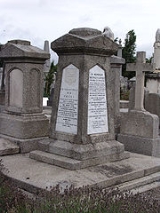
Mount Jerome Cemetery

Encyclopedia
Mount Jerome Cemetery is situated in Harold's Cross on the south side of Dublin, Ireland
. Since its foundation in 1836, it has witnessed over 300,000 burials. Originally an exclusively Protestant
cemetery, Roman Catholics
have also been buried there since the 1920s.
, who in turn leased plots to prominent Dublin families. A house, Mount Jerome House, was constructed in one of these plots, and leased to John Keogh
. In 1834, after an aborted attempt to set up a cemetery in the Phoenix Park
, the General Cemetery Company of Dublin bought the Mount Jerome property, "for establishing a general cemetery in the neighbourhood of the city of Dublin".
The Funerary Chapel in the cemetery was the first Puginian Gothic church in Dublin. It was designed by William Atkins
.
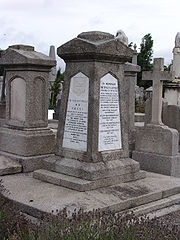 Notable people buried here include:
There is a large plot to the deceased members of the Royal Irish Constabulary
and the Dublin Metropolitan Police
. The remains of French Huguenots from St. Peter's Churchyard, Peter's Row (now the location of the Dublin YMCA), which was demolished in the 1980s, and from St. Brigid's and St. Thomas's churchyards are interred in the cemetery.
Over 200 children of unmarried mothers who died in the Bethany Home
were buried in unmarked graves in the cemetery.
Recent burials include the notorious Martin Cahill
(1949–1994) (known as "The General"). His gravestone has been vandalised on numerous occasions and is currently broken in two with the top half missing. His body has since been removed to an unmarked grave in the cemetery.
in Ireland (the other is in the Botanic Gardens).
Ireland
Ireland is an island to the northwest of continental Europe. It is the third-largest island in Europe and the twentieth-largest island on Earth...
. Since its foundation in 1836, it has witnessed over 300,000 burials. Originally an exclusively Protestant
Church of Ireland
The Church of Ireland is an autonomous province of the Anglican Communion. The church operates in all parts of Ireland and is the second largest religious body on the island after the Roman Catholic Church...
cemetery, Roman Catholics
Roman Catholic Church
The Catholic Church, also known as the Roman Catholic Church, is the world's largest Christian church, with over a billion members. Led by the Pope, it defines its mission as spreading the gospel of Jesus Christ, administering the sacraments and exercising charity...
have also been buried there since the 1920s.
History
The name of the cemetery comes from an estate established there by the Reverend Stephen Jerome, who in 1639 was vicar of St. Kevin's Parish. At that time Harold's Cross was part of St. Kevin's Parish. In the latter half of the 17th century, the land passed into the ownership of the Earl of MeathEarl of Meath
Earl of Meath is a title in the Peerage of Ireland created in 1627 and held by the head of the Brabazon family. This family descends from Sir Edward Brabazon, who represented County Wicklow in the Irish House of Commons and served as High Sheriff of Staffordshire in 1606. In 1616 he was raised to...
, who in turn leased plots to prominent Dublin families. A house, Mount Jerome House, was constructed in one of these plots, and leased to John Keogh
John Keogh
-Biography:Keogh was a leading Irish campaigner who struggled to get Irish Roman Catholics the right to vote and the repeal of the Penal Laws. He was of an obscure family and made his considerable fortune in land speculation, brewing, and silk trading...
. In 1834, after an aborted attempt to set up a cemetery in the Phoenix Park
Phoenix Park
Phoenix Park is an urban park in Dublin, Ireland, lying 2–4 km west of the city centre, north of the River Liffey. Its 16 km perimeter wall encloses , one of the largest walled city parks in Europe. It includes large areas of grassland and tree-lined avenues, and since the seventeenth...
, the General Cemetery Company of Dublin bought the Mount Jerome property, "for establishing a general cemetery in the neighbourhood of the city of Dublin".
The Funerary Chapel in the cemetery was the first Puginian Gothic church in Dublin. It was designed by William Atkins
William Atkins (architect)
William Atkins was an Irish architect of the Victorian era.A native of Cork, William Atkins is an architect whose fame has been lost to posterity, although in 1846 he received one of the largest public commissions in Cork city, to build the city and county asylum...
.
Notable burials
- Robert AdamsRobert Adams (physician)-Life:He was born in Ireland, studied at Trinity College, Dublin between 1810 and 1814 and received his B.A. in 1814. He began his medical training under William Hartigan and George Stewart, leading Dublin surgeons...
(1791–1875), physician and professor of surgery - Edward BuntingEdward BuntingEdward Bunting was an Irish musician and folk music collector.-Life:Bunting was born in County Armagh, Ireland. At the age of seven he was sent to study music at Drogheda and at eleven he was apprenticed to William Ware, organist at St. Anne's church in Belfast and lived with the family of Henry...
(1773–1843), musician, music-collector - Frederick William BurtonFrederick William BurtonSir Frederic William Burton RHA was an Irish painter born in Corofin, County Clare. He was the third director of the National Gallery, London.-Artistic career:...
(1816–1900), painter and director of the National Gallery - Peter CaffreyPeter CaffreyPeter Caffrey was an Irish actor best known for playing Padraig O'Kelly on Series 1-4 of Ballykissangel, but also well regarded for his role as a transvestite in the film , and ....
(1949–2008), actor (BallykissangelBallykissangelBallykissangel is a BBC television drama set in Ireland, produced in-house by BBC Northern Ireland. The original story revolved around a young English Roman Catholic priest as he became part of a rural community. It ran for six series, which were first broadcast on BBC One in the UK from 1996 to 2001...
) - Sir Charles Cameron (1830–1921), for 50 years head of the Public Health Department of Dublin Corporation, along with two of his sons, Charles J. and Ewen Henry
- James Campbell, 1st Baron GlenavyJames Campbell, 1st Baron GlenavyJames Henry Mussen Campbell, 1st Baron Glenavy PC was an Irish lawyer, politician in the Parliament of the United Kingdom of Great Britain and Ireland and later in the Oireachtas of the Irish Free State...
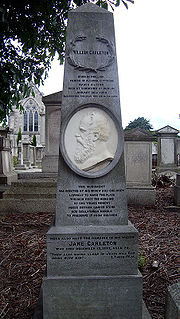
(1851–1931), lawyer, politician and Lord Chancellor of Ireland - William CarletonWilliam CarletonWilliam Carleton was an Irish novelist.Carleton's father was a Roman Catholic tenant farmer, who supported fourteen children on as many acres, and young Carleton passed his early life among scenes similar to those he later described in his books...
(1794–1869), writer - Thomas Caulfield IrwinThomas Caulfield IrwinThomas Caulfield Irwin was an Irish poet, writer, and classical scholar.He was born in Warrenpoint, County Down,...
(1823–1892), poet, writer, scholar - Abraham CollesAbraham CollesAbraham Colles was professor of Anatomy, Surgery and Physiology at the Royal College of Surgeons in Ireland. Descended from a Worcestershire family, some of whom had sat in Parliament, he was born to William Colles and Mary Anne Bates of Woodbroak, Co. Wexford...
(1773–1843), surgeon, professor of medicine - John Augustus ConollyJohn Augustus ConollyLieutenant Colonel John Augustus Conolly VC , born in Celbridge, County Kildare, Ireland, was an Irish recipient of the Victoria Cross, the highest and most prestigious award for gallantry in the face of the enemy that can be awarded to British and Commonwealth forces.-Details:He was 25 years old,...
VCVictoria CrossThe Victoria Cross is the highest military decoration awarded for valour "in the face of the enemy" to members of the armed forces of various Commonwealth countries, and previous British Empire territories....
(1829–1888), soldier - Paddy DalyPaddy DalyPaddy Daly sometimes referred to as Paddy O'Daly, served in the Irish Republican Army during the Irish War of Independence and subsequently held the rank of Major-General in the Irish National Army in the period 1922 to 1924.-Easter Rising:...
(1888-1957), member of the IRAIrish Republican ArmyThe Irish Republican Army was an Irish republican revolutionary military organisation. It was descended from the Irish Volunteers, an organisation established on 25 November 1913 that staged the Easter Rising in April 1916...
during the War of IndependenceIrish War of IndependenceThe Irish War of Independence , Anglo-Irish War, Black and Tan War, or Tan War was a guerrilla war mounted by the Irish Republican Army against the British government and its forces in Ireland. It began in January 1919, following the Irish Republic's declaration of independence. Both sides agreed...
and later Major-General in the Irish ArmyIrish ArmyThe Irish Army, officially named simply the Army is the main branch of the Defence Forces of Ireland. Approximately 8,500 men and women serve in the Irish Army, divided into three infantry Brigades... - Achilles DauntAchilles DauntAchilles Daunt was a noted Irish preacher and homilist, and Anglican dean of Cork.-Early life and education:Achilles Daunt descended from a cadet branch of the Daunt family of Owlpen, Gloucestershire, settled since 1575 at Tracton Abbey, County Cork. He was the eldest son of Achilles Daunt who...
(1832–1878), preacher and homilist - Thomas DavisThomas Osborne Davis (Irish politician)Thomas Osborne Davis was a revolutionary Irish writer who was the chief organizer and poet of the Young Ireland movement.-Early life:...
, (1814–1845), journalist, politician, founder of The NationThe Nation (Irish newspaper)The Nation was an Irish nationalist weekly newspaper, published in the 19th century. The Nation was printed first at 12 Trinity Street, Dublin, on 15 October 1842, until 6 January 1844...
newspaper - Thomas DrummondThomas DrummondCaptain Thomas Drummond , from Edinburgh, Scotland, was an army officer, civil engineer and senior public official. Drummond used the Drummond light which was employed in the trigonometrical survey of Great Britain and Ireland. He is sometimes mistakenly given credit for the invention of limelight,...
(1797–1840), surveyor, Under-Secretary for Ireland - James Fitzgerald (1899–1971), American painter
- Ethel Kathleen French (née Moore, 1871-1891), artist and illustrator, first wife of Percy French. She died in childbirth with their first child.
- Edward Gibson, 1st Baron AshbourneEdward Gibson, 1st Baron AshbourneEdward Gibson, 1st Baron Ashbourne PC, QC was an Irish lawyer and Lord Chancellor of Ireland.-Background and education:...
(1837–1913), lawyer and Lord Chancellor of IrelandLord Chancellor of IrelandThe office of Lord Chancellor of Ireland was the highest judicial office in Ireland until the establishment of the Irish Free State in 1922. From 1721 to 1801 it was also the highest political office of the Irish Parliament.-13th century:... - Robert GravesRobert James GravesRobert James Graves, M.D., F.R.C.S. was an eminent Irish surgeon after whom Graves' disease takes its name. He was President of the Royal College of Physicians of Ireland, Fellow of the Royal Society of London and the founder of the Dublin Journal of Medical Science...
(1796–1853), professor of medicine and writer - Sir Richard John Griffith (1784–1878), geologist, mining engineer, chairman of the Board of Works, author of Griffith's ValuationGriffith's valuationGriffith's Valuation was a survey of Ireland completed in 1868. -Griffith's background:Richard John Griffith started to value land in Scotland, where he spent two years in 1806-1807 valuing terrain through the examination of its soils...
- Thomas GrubbThomas GrubbThomas Grubb was an Irish optician and founder of the Grubb Telescope Company.He was born probably near Portlaw, County Waterford, Ireland, the son of William and Eleanor Grubb....
(1800–1878), optician, telescope-maker - Benjamin GuinnessBenjamin GuinnessSir Benjamin Lee Guinness, 1st Baronet was an Irish brewer and philanthropist.-Brewer:Born in Dublin, he was the third son of the second Arthur Guinness , and his wife Anne Lee, and a grandson of the latter's namesake who founded the Guinness brewery in 1759...
(1798–1868), brewer, philanthropist, and other members of the GuinnessGuinnessGuinness is a popular Irish dry stout that originated in the brewery of Arthur Guinness at St. James's Gate, Dublin. Guinness is directly descended from the porter style that originated in London in the early 18th century and is one of the most successful beer brands worldwide, brewed in almost...
family - George HalpinGeorge HalpinGeorge Halpin , was a prominent civil engineer and lighthouse builder, responsible for the construction of much of the Port of Dublin, several of Dublin's bridges, and a number of lighthouses; he is considered the founding father of the Irish lighthouse service...
(Sr.) (1779–1854), civil engineer and lighthouse builder - William Rowan HamiltonWilliam Rowan HamiltonSir William Rowan Hamilton was an Irish physicist, astronomer, and mathematician, who made important contributions to classical mechanics, optics, and algebra. His studies of mechanical and optical systems led him to discover new mathematical concepts and techniques...
(1805–1865), mathematician and astronomer - James HaughtonJames HaughtonJames Haughton was an Irish social reformer and temperance activist.-Life:Haughton, son of Samuel Pearson Haughton , by Mary, daughter of James Pim of Rushin, Queen's County , Ireland, was born in Carlow and educated at Ballitor, County Kildare, from 1807 to 1810, under James White, a quaker...
(1795–1873), social reformer - John Kells IngramJohn Kells IngramJohn Kells Ingram was an economist, Irish patriot and poet.-Academic contributions:Ingram was remarkable for his versatility....
(1823–1907), politician, scholar, poet ("The Memory of the Dead") - John Hewitt JellettJohn Hewitt JellettJohn Hewitt Jellett was a college head, provost of Trinity College, Dublin. He was also a priest in the Church of Ireland during the Victorian Era....
(1817–1888), Provost of Trinity College - John Edward JonesJohn Edward JonesJohn Edward Jones was a noted Irish civil engineer and sculptor, active in Dublin and London.-Biography:Jones was born in Dublin, the son of miniature painter Edward Jones. As 'J...
(1806–1862), civil engineer and sculptor - Joseph Robinson KirkJoseph Robinson KirkJoseph Robinson Kirk was a noted Irish sculptor.He was born in Dublin, the eldest son of Thomas Kirk. He lived in Jervis Street and studied with his father and at the Dublin Society's School.He became master of the RDS modelling school in 1852 and in 1854 he became a member of the Royal Hibernian...
(1821-1894), sculptor, who also executed the figure over the memorial of his father, ThomasThomas Kirk (sculptor)Thomas Kirk was a noted Irish sculptor.He was born in Cork. He studied at the Dublin Society's School where he won prizes in 1797 and 1800. He later worked for Henry Darley, a skillful builder and stone-cutter from Meath, based in Abbey Street, Dublin. Kirk was acclaimed for his fine relief work... - Thomas KirkThomas Kirk (sculptor)Thomas Kirk was a noted Irish sculptor.He was born in Cork. He studied at the Dublin Society's School where he won prizes in 1797 and 1800. He later worked for Henry Darley, a skillful builder and stone-cutter from Meath, based in Abbey Street, Dublin. Kirk was acclaimed for his fine relief work...
(1781–1845), sculptor, who also designed the Butler mausoleum in this cemetery - John Mitchell KembleJohn Mitchell KembleJohn Mitchell Kemble , English scholar and historian, was the eldest son of Charles Kemble the actor and Maria Theresa Kemble....
, scholar - Joseph Sheridan Le Fanu (1814–1873), writer and editor, along with his wife, Susanna Bennett, her father and two brothers, in the same vault.
- Thomas Hawkesworth LedwichThomas Hawkesworth LedwichThomas Hawkesworth Ledwich was an eminent Irish anatomist and surgeon.-Life:He was born in Waterford, where his father practiced law, son of Edward Ledwich and Catherine Hawkesworth, both of Queen's County...
(1823–1858), surgeon and anatomist - Thomas Langlois LefroyThomas Langlois LefroyThomas Langlois Lefroy was an Irish-Huguenot politician and judge. He served as an MP for the constituency of Dublin University 1830–1841, Privy Councillor of Ireland 1835–1869 and Lord Chief Justice of Ireland 1852–1866....
(1776–1869), politician and judge - David MarcusDavid MarcusDavid Marcus was an Irish Jewish editor and writer who was a lifelong advocate and editor of Irish fiction.- Life and times :...
(1924–2009), Irish Jewish writer, editor - Sir Henry MarshSir Henry Marsh, 1st BaronetSir Henry Marsh, 1st Baronet was an Irish physician and surgeon.He was born in Loughrea, County Galway in Ireland. He was one of the medical doctors associated with Basedow's syndrome, which is also known as Marsh's disease and currently as Graves' disease.-Biography:Marsh originally wanted to...
(1770–1860), physician - William Fetherstone MontgomeryWilliam Fetherstone MontgomeryWilliam Fetherstone Montgomery was an Irish obstetrician credited for first describing the Glands of Montgomery.Montgomery was born, raised and educated in Dublin, Ireland. He attended medical school at Trinity College, Dublin...
(1797-1859), obstetrican - Hans Garrett MooreHans Garrett MooreHans Garrett Moore VC CB , born in Carlingford, County Louth, Ireland, was an Irish recipient of the Victoria Cross, the highest and most prestigious award for gallantry in the face of the enemy that can be awarded to British and Commonwealth forces.-Details:He was 43 years old, and a Major in the...
VCVictoria CrossThe Victoria Cross is the highest military decoration awarded for valour "in the face of the enemy" to members of the armed forces of various Commonwealth countries, and previous British Empire territories....
(1830–1889), soldier - Arthur Thomas MooreArthur Thomas MooreArthur Thomas Moore VC CB was born in Carlingford, County Louth and educated at the East India Company College...
VCVictoria CrossThe Victoria Cross is the highest military decoration awarded for valour "in the face of the enemy" to members of the armed forces of various Commonwealth countries, and previous British Empire territories....
(1830–1912), soldier
- Sir Richard MorrisonSir Richard Morrison-Life:He was born at Midleton, County Cork, the son of John Morrison, also an architect. Originally intended for the church, he was eventually placed as pupil with James Gandon, the architect, in Dublin...
(1767–1849), architect (Pro-CathedralPro-cathedralA pro-cathedral is a parish church that is temporarily serving as the cathedral or co-cathedral of a diocese.-Usage:In Ireland, the term is used to specifically refer to St Mary's Pro-Cathedral in Dublin, the seat of the Roman Catholic Archbishop of Dublin since the Reformation, when Christ Church...
, Trinity CollegeTrinity College, DublinTrinity College, Dublin , formally known as the College of the Holy and Undivided Trinity of Queen Elizabeth near Dublin, was founded in 1592 by letters patent from Queen Elizabeth I as the "mother of a university", Extracts from Letters Patent of Elizabeth I, 1592: "...we...found and...
, etc.) - William Vitruvius MorrisonWilliam Vitruvius MorrisonWilliam Vitruvius Morrison was an Irish architect, son and collaborator of Sir Richard Morrison.-Life:He was born at Clonmel, County Tipperary, second son of Sir Richard Morrison . His middle name derives from the first century B.C. Roman architect Marcus Vitruvius Pollio...
(1794–1838), architect; son and partner of Richard Morrison. - John Skipton MulvanyJohn Skipton MulvanyJohn Skipton Mulvany was a notable Irish architect. He was the fourth son of Thomas James Mulvany, one of the founder members, with his own brother John George, of the Royal Hibernian Academy...
(1813–1870), architect who also designed a number of monuments in this cemetery, including the Mahony monument and Perry and West vaults - Máirtín Ó CadhainMáirtín Ó CadhainMáirtín Ó Cadhain was one of the most prominent Irish language writers of the twentieth century.-Career:Born in Connemara, he became a schoolteacher but was dismissed due to his IRA membership. In the 1930s he served as an IRA recruiting officer, enlisting fellow writer Brendan Behan...
(1906–1970), Irish-language writer - Walter OsborneWalter OsborneWalter Frederick Osborne was an Irish impressionist landscape and portrait painter. Most of his paintings featured women, children, and the elderly as well as rural scenes.-Career:...
(1859–1903), artist - Peter Marshall (died 1890), prominent member of the Masonic and Orange Orders
- William McFadden OrrWilliam McFadden OrrWilliam McFadden Orr, FRS was a British and Irish mathematician.He was born in Comber, County Down and educated at Methodist College Belfast and Queen's College, Belfast before entering St John's College, Cambridge and graduating as Senior Wrangler in 1888...
(1866–1934), mathematician - George PapworthGeorge PapworthGeorge Papworth was an English architect who practised mainly in Ireland during the nineteenth century.-Early life and career:Papworth was born in London in 1781 and was the third son of the English stuccoist John Papworth...
(1781–1855), architect - Jacob Owen (1778–1870), architect and engineer to the Board of Works
- Edward Arthur Henry Pakenham, 6th Earl of Longford (1902–1961) was an Irish peer, politician, and littérateur
- George Petrie (1790–1886), artist, archaeologist, musician
- William Plunket, 4th Baron Plunket (1828–1897), Archbishop of Dublin
- Sarah PurserSarah Purser-Early life:She was born in Kingstown in County Dublin, and raised in Dungarvan, County Waterford. She was educated in Switzerland and afterwards studied at the Metropolitan School of Art in Dublin and in Paris at the Académie Julian.-Artist:...
(1848–1943), artist - George RussellGeorge William RussellGeorge William Russell who wrote under the pseudonym Æ , was an Irish nationalist, writer, editor, critic, poet, and painter. He was also a mystical writer, and centre of a group of followers of theosophy in Dublin, for many years.-Organisor:Russell was born in Lurgan, County Armagh...
(1867–1935), writer, artist - Cecil SheridanCecil SheridanCecil Sheridan was an Irish comedian and actor who performed in variety shows and pantomimes in Ireland and Great Britain during a versatile career spanning over forty years.-Early life:...
(1910–1980), comedian and actor - John SkeltonJohn Skelton (Irish Artist)John Skelton was an Irish artist.-Biography:He started his professional career in London, where he came under influence of Euston Road School in the late 1940s....
(1924-2009), artist and illustrator. - Ellen SmylyEllen SmylyEllen Smyly was born on 14 November 1815, the daughter of Matthew Franks. She became a prominent philanthropist, fund-raising and setting up homes and schools for the poor. The Smyly Homes and subsequent Smyly Trust are named after her and her family.At the age of 19 she married the Dublin surgeon...
(1815-1901) founder of the Smyly Homes. - Robert William Smith (1807–1873), pathologist
- John Millington SyngeJohn Millington SyngeEdmund John Millington Synge was an Irish playwright, poet, prose writer, and collector of folklore. He was a key figure in the Irish Literary Revival and was one of the cofounders of the Abbey Theatre...
(1871–1909), playwright - Isaac WeldIsaac WeldIsaac Weld was an Irish topographical writer, explorer, and artist.He was born on 15 March 1774 on Fleet Street, Dublin, Ireland....
(1774–1856), topographical writer, explorer and artist. - William WildeWilliam WildeSir William Robert Wills Wilde MD, FRCSI, was an Irish eye and ear surgeon, as well as an author of significant works on medicine, archaeology and folklore, particularly concerning his native Ireland...
, father of Oscar WildeOscar WildeOscar Fingal O'Flahertie Wills Wilde was an Irish writer and poet. After writing in different forms throughout the 1880s, he became one of London's most popular playwrights in the early 1890s...
. His wife, Jane Francesca ElgeeJane WildeJane Francesca Agnes, Lady Wilde was an Irish poet under the pen name "Speranza" and supporter of the nationalist movement; had a special interest on Irish Fairy Tales, which she helped to gather...
, is commemorated on Sir William's monument, but she was buried in Kensal Green CemeteryKensal Green CemeteryKensal Green Cemetery is a cemetery in Kensal Green, in the west of London, England. It was immortalised in the lines of G. K. Chesterton's poem The Rolling English Road from his book The Flying Inn: "For there is good news yet to hear and fine things to be seen; Before we go to Paradise by way of...
in LondonLondonLondon is the capital city of :England and the :United Kingdom, the largest metropolitan area in the United Kingdom, and the largest urban zone in the European Union by most measures. Located on the River Thames, London has been a major settlement for two millennia, its history going back to its...
. - S. Allen Windle (1828–1880), Chaplain of the Mariners' Church, Dún LaoghaireMariners' Church, Dún LaoghaireThe Mariners' Church is a former Church of Ireland church located in Haigh Terrace, near the centre of Dún Laoghaire town, southeast of Dublin city...
- Edward Perceval WrightEdward Perceval WrightEdward Percival Wright was an Irish ophthalmic surgeon, botanist and zoologist.-Family, education and career:He was the eldest son of barrister, Edward Wright and Charlott Wright. Edward was educated by a private tutor, and was taught natural history by George James Allman. From 1852 he studied at...
(1834–1910), ophthalmic surgeon, botanist and zoologist - Jack Butler YeatsJack Butler YeatsJohn "Jack" Butler Yeats was an Irish artist. His early style was that of an illustrator; he only began to work regularly in oils in 1906. His early pictures are simple lyrical depictions of landscapes and figures, predominantly from the west of Ireland—especially of his boyhood home of...
(1871–1957), artist
There is a large plot to the deceased members of the Royal Irish Constabulary
Royal Irish Constabulary
The armed Royal Irish Constabulary was Ireland's major police force for most of the nineteenth and the early twentieth centuries. A separate civic police force, the unarmed Dublin Metropolitan Police controlled the capital, and the cities of Derry and Belfast, originally with their own police...
and the Dublin Metropolitan Police
Dublin Metropolitan Police
The Dublin Metropolitan Police was the police force of Dublin, Ireland, from 1836 to 1925, when it amalgamated into the new Garda Síochána.-19th century:...
. The remains of French Huguenots from St. Peter's Churchyard, Peter's Row (now the location of the Dublin YMCA), which was demolished in the 1980s, and from St. Brigid's and St. Thomas's churchyards are interred in the cemetery.
Over 200 children of unmarried mothers who died in the Bethany Home
Bethany Home
Bethany Home was a residential home in Dublin for women of the Protestant faith, convicted of petty theft, prostitution, infanticide, as well as for women who were pregnant out of wedlock, and the children of these women...
were buried in unmarked graves in the cemetery.
Recent burials include the notorious Martin Cahill
Martin Cahill
Martin "The General" Cahill was a prominent Irish criminal from Dublin.Cahill generated a certain notoriety in the media, which referred to him by the sobriquet "The General". The name was also used by the media in order to discuss Cahill's activities while avoiding legal problems with libel...
(1949–1994) (known as "The General"). His gravestone has been vandalised on numerous occasions and is currently broken in two with the top half missing. His body has since been removed to an unmarked grave in the cemetery.
Flora
The cemetery has one of only two Christ-thorn bushesPaliurus spina-christi
Paliurus spina-christi, commonly known as Jerusalem Thorn, Garland Thorn, Christ's Thorn, or Crown of Thorns, is a species of Paliurus native to the Mediterranean region and southwest and central Asia, from Morocco and Spain east to Iran and Tajikistan.It is a deciduous shrub or small tree growing...
in Ireland (the other is in the Botanic Gardens).
Literary references
- Then Mount Jerome for the protestants. Funerals all over the world everywhere every minute. Shovelling them under by the cartload doublequick. Thousands every hour. Too many in the world. UlyssesUlysses (novel)Ulysses is a novel by the Irish author James Joyce. It was first serialised in parts in the American journal The Little Review from March 1918 to December 1920, and then published in its entirety by Sylvia Beach on 2 February 1922, in Paris. One of the most important works of Modernist literature,...
, Chapter 6, Hades episode, James JoyceJames JoyceJames Augustine Aloysius Joyce was an Irish novelist and poet, considered to be one of the most influential writers in the modernist avant-garde of the early 20th century...
.