


Motorcycle safety clothing

Encyclopedia
To improve motorcycle safety
many countries mandate the wearing of personal protective equipment such as protective clothing and helmet
s. Protective clothing may include certain types of jacket
s, glove
s, boots, and pants
. Jackets meant for motorcyclists are typically made of nylon, leather, or Kevlar
. These jackets typically include heavy padding on the elbow, spine, and shoulder regions. Gloves are generally made of leather
or Kevlar and some include carbon fiber
knuckle protection. Boots, especially those for sport riding, include reinforcement and plastic
caps on the ankle and toe areas. Pants are usually leather, nylon
, or Kevlar. Except for helmets, none of these items are required by law in any state in the USA but are recommended by many of those who ride.
"Off road" riders wear a range of plastic armour to protect against injury from falling off, hitting other riders and bikes, debris kicked up from the rear wheel
of leading bikes, and from running into track barriers protecting the public. This armour protects the extremities from breakage and dislocation
and the back and chest from strain and broken bones. Although fairly efficient, it is of course not always completely effective. Many riders wear "roost protectors" designed specifically to protect against painful debris from other bikes, but are of no use in a fall or collision.
Both leathers and joins (seams and zips) should be officially tested for ergonomics and impact abrasion, cut, tear and burst resistance.
Kangaroo leather
is becoming popular for its suppleness, light weight and strength compared with cowhide. The one-piece racing leather suit, usually referred to as 'racing leathers' was first used by world champion motorcycle racer Geoff Duke
. His suits, like the majority of those used in the 1950s, were made from horse hide.
Originally, motorcycle leathers were adapted from tank corps gear immediately following World War I. Duster coats
, which tended to catch in the wheels, were switched for short coats. Wide-pegged breeches
were worn by some motorcycle police and by dispatch riders in World War II
, but were largely abandoned in the post-war years because of their association with certain Nazi
uniforms.
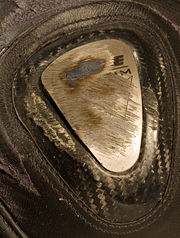 Currently there are two major styles of motorcycle leathers: the tight fitting and sometimes colorful one or two piece suits based on motorcycle racing leathers; and the somewhat looser fitting leather trousers and jackets, usually black and occasionally decorated with metal studs and tassels. The latter style, the jackets in particular, are also worn by people who are fond of the style but do not ride motorcycles. The classic American Perfecto motorcycle jacket
with epaulets and diagonal zipper, made famous by Marlon Brando
in The Wild One
, (1954) was invented in 1928 by Irving Schott, of Schott NYC
in New York City
. Leather chaps
, adapted from cowboy gear, were used by American bikers starting in the early 1960s.
Many modern leathers have armour
on the inside at major impact regions such as shoulders, elbows, hips, knees and back. The European Standards for these protectors are EN 1621-1:2007 and EN 1621-2:2003. The energy absorbers and load spreaders range from high density foam to foam backed hard polymers and carbon fiber. It is designed to spread the impact load and shear strains to prevent and reduce harm levels of injury and disablement. In Europe, by law, it has to have a CE mark
. A number of companies have passed the requirements of the standards with both textile and leather garments and a number of approved boots are available from several major brands. There are also motorcycle jackets that use an airbag system, which deploys in the event of an accident, inflating to protect the riders neck, torso, and lower back (see also Airbag).
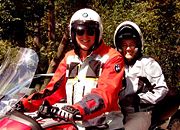 An alternative to leather is clothing constructed of man-made textiles. These can offer improved weather protection from heat, cold, and water, and the increased utility these garments tend to provide in terms of pockets and vents. Common materials include high density (600–1000 Denier) ballistic nylon
(e.g., Cordura
) and Kevlar
, or blends of Kevlar, Cordura, and Lycra; and often include waterproof liners made from materials such as Gore-Tex
. In both CE marked (meets European Standards) and non-protective garments, localised protection may be provided by armour (which by law must be CE approved) and airbag systems.
Not all textile clothing is made from synthetic materials. Heavy weight waxed cotton
was used for many years before the development of modern materials, typified by the jackets made by companies such as Belstaff
.
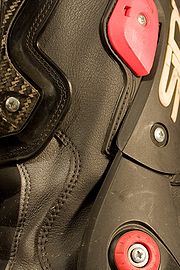 Boots are worn by motorcycle riders and passengers to prevent or reduce harm to their feet and ankles while riding and in the event of a crash. They are designed using materials and seam construction that are impact, abrasion, cut, tear and burst resistant. Tough, strong, moderately flexible boots with stiff soles provide the rider protection from a number of risks. Boots with oil-resistant, rubber-based composite soles give a grip on the pavement and help keep the rider's feet on the pegs. Boots may also have energy absorbers and load spreaders on the shin, inside and outside of each ankle. A stiff sole working laterally helps prevent or decrease crash injuries caused by crushing and shear strain. For boots, the European Standard is EN 13634:2002.
Helmets are made in 2 main layers: hard and energy-absorbing. The hard shell spreads an impact over a larger area, while the liner (often polystyrene
foam) absorbs energy so less is transferred to the skull & brain.
There are 3 main styles: flip-face, open-face and full-face. An open-face helmet will protect everything but the face. Full-face helmets protect the skull, plus providing protection for the lower jaw as well as the face itself. Full-face helmets offer much more protection than open-face helmets.
Several manufacturers have introduced full-face helmets with a flip-up front, combining the protection of a full-face with the ease of communication and donning / doffing that an open-face gives.
Studies have consistently shown that wearing a helmet:
As with other protective gear, a brightly colored helmet improves the user's visibility.
to protect the rider's wrists from injury, and help reduce drafts while riding in colder climates. Motorcycling gloves typically have reinforced palms intended to protect the rider from abrasion injuries in case of an accident. Again, if the manufacturer claims the gloves are protective, then they must be CE marked. European Standard EN 13594:2002 is available for this purpose.
Optional features include additional protection or weatherproofing. For touring gloves, such additional features may include advanced insulating materials and waterproof breathable fabric
, although touring gloves may still lack advanced armouring features used in motorcycle racing gloves.
Gloves intended for motorcycle racing typically incorporate pre-curved finger sections and the best available protection, obtained through additional armour incorporated within the glove. Although maximum tactility is an obvious starting point for racing gloves, additional protection should not be discarded. Additional protection may involve titanium or carbon panels for knuckles and the joints of the fingers. Furthermore, racing gloves may and often do incorporate additional wrist and other protection panels to protect the heel of the hand, back of the hand and other easily injured parts of the hand.
Motorcycle safety
Motorcycle safety concerns many aspects of vehicle and equipment design as well as operator skill and training that are unique to motorcycle riding.-Accident rates:...
many countries mandate the wearing of personal protective equipment such as protective clothing and helmet
Motorcycle helmet
A motorcycle helmet is a type of protective headgear used by motorcycle riders. The primary goal of a motorcycle helmet is motorcycle safety - to protect the rider's head during impact, thus preventing or reducing head injury or saving the rider's life...
s. Protective clothing may include certain types of jacket
Jacket
A jacket is a hip- or waist-length garment for the upper body. A jacket typically has sleeves, and fastens in the front. A jacket is generally lighter, tighter-fitting, and less insulating than a coat, which is outerwear...
s, glove
Glove
A glove is a garment covering the hand. Gloves have separate sheaths or openings for each finger and the thumb; if there is an opening but no covering sheath for each finger they are called "fingerless gloves". Fingerless gloves with one large opening rather than individual openings for each...
s, boots, and pants
Trousers
Trousers are an item of clothing worn on the lower part of the body from the waist to the ankles, covering both legs separately...
. Jackets meant for motorcyclists are typically made of nylon, leather, or Kevlar
Kevlar
Kevlar is the registered trademark for a para-aramid synthetic fiber, related to other aramids such as Nomex and Technora. Developed at DuPont in 1965, this high strength material was first commercially used in the early 1970s as a replacement for steel in racing tires...
. These jackets typically include heavy padding on the elbow, spine, and shoulder regions. Gloves are generally made of leather
Leather
Leather is a durable and flexible material created via the tanning of putrescible animal rawhide and skin, primarily cattlehide. It can be produced through different manufacturing processes, ranging from cottage industry to heavy industry.-Forms:...
or Kevlar and some include carbon fiber
Carbon fiber
Carbon fiber, alternatively graphite fiber, carbon graphite or CF, is a material consisting of fibers about 5–10 μm in diameter and composed mostly of carbon atoms. The carbon atoms are bonded together in crystals that are more or less aligned parallel to the long axis of the fiber...
knuckle protection. Boots, especially those for sport riding, include reinforcement and plastic
Plastic
A plastic material is any of a wide range of synthetic or semi-synthetic organic solids used in the manufacture of industrial products. Plastics are typically polymers of high molecular mass, and may contain other substances to improve performance and/or reduce production costs...
caps on the ankle and toe areas. Pants are usually leather, nylon
Nylon
Nylon is a generic designation for a family of synthetic polymers known generically as polyamides, first produced on February 28, 1935, by Wallace Carothers at DuPont's research facility at the DuPont Experimental Station...
, or Kevlar. Except for helmets, none of these items are required by law in any state in the USA but are recommended by many of those who ride.
"Off road" riders wear a range of plastic armour to protect against injury from falling off, hitting other riders and bikes, debris kicked up from the rear wheel
Road debris
Road debris, a form of road hazard, is debris on or off a road. Road debris includes substances, materials, and objects that are foreign to the normal roadway environment...
of leading bikes, and from running into track barriers protecting the public. This armour protects the extremities from breakage and dislocation
Dislocation (medicine)
Joint dislocation, or luxation , occurs when bones in a joint become displaced or misaligned. It is often caused by a sudden impact to the joint. The ligaments always become damaged as a result of a dislocation...
and the back and chest from strain and broken bones. Although fairly efficient, it is of course not always completely effective. Many riders wear "roost protectors" designed specifically to protect against painful debris from other bikes, but are of no use in a fall or collision.
Leathers
Leathers are one-piece suits, or two-piece jackets and trousers worn by motorcyclists mainly for protection in a crash. The leather used is not fashion leather but protective leather which is stronger, moderately flexible and much tougher.Both leathers and joins (seams and zips) should be officially tested for ergonomics and impact abrasion, cut, tear and burst resistance.
Kangaroo leather
Kangaroo leather
Kangaroo leather is a strong light weight leather derived from the hide of kangaroo.Kangaroo is produced only from free ranging wild animals; it is not farmed. Both the meat and the hides are sold. Although most species of macropod are protected from hunting by law, a small number of the...
is becoming popular for its suppleness, light weight and strength compared with cowhide. The one-piece racing leather suit, usually referred to as 'racing leathers' was first used by world champion motorcycle racer Geoff Duke
Geoff Duke
Geoffrey Ernest Duke OBE is a British multi-time motorcycle Grand Prix road racing world champion.Geoff Duke dominated motorcycle racing in the 1950s, winning six world championships and six Isle of Man TT races...
. His suits, like the majority of those used in the 1950s, were made from horse hide.
Originally, motorcycle leathers were adapted from tank corps gear immediately following World War I. Duster coats
Duster (clothing)
A duster is a light, loose-fitting long coat.The original dusters were full-length, light-colored canvas or linen coats worn by horsemen to protect their clothing from trail dust. These dusters were typically slit up the back to hip level for ease of wear on horseback and were the recommended...
, which tended to catch in the wheels, were switched for short coats. Wide-pegged breeches
Breeches
Breeches are an item of clothing covering the body from the waist down, with separate coverings for each leg, usually stopping just below the knee, though in some cases reaching to the ankles...
were worn by some motorcycle police and by dispatch riders in World War II
World War II
World War II, or the Second World War , was a global conflict lasting from 1939 to 1945, involving most of the world's nations—including all of the great powers—eventually forming two opposing military alliances: the Allies and the Axis...
, but were largely abandoned in the post-war years because of their association with certain Nazi
Nazism
Nazism, the common short form name of National Socialism was the ideology and practice of the Nazi Party and of Nazi Germany...
uniforms.
Perfecto motorcycle jacket
Perfecto is a brand of double style leather motorcycle jackets manufactured by American clothing company Schott NYC. The first jacket was introduced in 1928, making it the first ever double style leather motorcycle jacket. Marlon Brando wore a Perfecto #613 in the 1953 movie The Wild One...
with epaulets and diagonal zipper, made famous by Marlon Brando
Marlon Brando
Marlon Brando, Jr. was an American movie star and political activist. "Unchallenged as the most important actor in modern American Cinema" according to the St...
in The Wild One
The Wild One
The Wild One is a 1953 outlaw biker film directed by László Benedek and produced by Stanley Kramer. It is famed for Marlon Brando's iconic portrayal of the gang leader Johnny Strabler.-Basis:...
, (1954) was invented in 1928 by Irving Schott, of Schott NYC
Schott NYC
Schott NYC is an American clothing manufacturing company located in New York City. The company was founded in 1913 by brothers Irving and Jack Schott. Schott NYC was the first company to put a zipper on a jacket and they created the classic Perfecto motorcycle jacket, made popular in movies like...
in New York City
New York City
New York is the most populous city in the United States and the center of the New York Metropolitan Area, one of the most populous metropolitan areas in the world. New York exerts a significant impact upon global commerce, finance, media, art, fashion, research, technology, education, and...
. Leather chaps
Chaps
Chaps are sturdy coverings for the legs consisting of leggings and a belt. They are buckled on over trousers with the chaps' integrated belt, but unlike trousers they have no seat and are not joined at the crotch. They are designed to provide protection for the legs and are usually made of leather...
, adapted from cowboy gear, were used by American bikers starting in the early 1960s.
Many modern leathers have armour
Motorcycle armor
Motorcycle armor comes in a variety of forms, from traditional yellow foam to high-tech compounds capable of absorbing large amounts of energy. In its basic form an armored jacket will include shoulder and elbow armor. Pants will include hip and knee protection.- Foam armor :This armor is the...
on the inside at major impact regions such as shoulders, elbows, hips, knees and back. The European Standards for these protectors are EN 1621-1:2007 and EN 1621-2:2003. The energy absorbers and load spreaders range from high density foam to foam backed hard polymers and carbon fiber. It is designed to spread the impact load and shear strains to prevent and reduce harm levels of injury and disablement. In Europe, by law, it has to have a CE mark
CE mark
CE marking is a mandatory conformity mark for products placed on the market in the European Economic Area . With the CE marking on a product the manufacturer ensures that the product conforms with the essential requirements of the applicable EC directives...
. A number of companies have passed the requirements of the standards with both textile and leather garments and a number of approved boots are available from several major brands. There are also motorcycle jackets that use an airbag system, which deploys in the event of an accident, inflating to protect the riders neck, torso, and lower back (see also Airbag).
Textiles
Ballistic nylon
Ballistic nylon is a thick, tough, synthetic nylon fabric used for a variety of applications. Ballistic nylon was originally developed by the DuPont corporation as a material for flak jackets to be worn by World War II airmen...
(e.g., Cordura
Cordura
Cordura is the brand name for a collection of fabrics used in a wide array of products including luggage, backpacks, pants, military wear and performance apparel. Cordura fabrics are known for their durability and resistance to abrasions, tears and scuffs....
) and Kevlar
Kevlar
Kevlar is the registered trademark for a para-aramid synthetic fiber, related to other aramids such as Nomex and Technora. Developed at DuPont in 1965, this high strength material was first commercially used in the early 1970s as a replacement for steel in racing tires...
, or blends of Kevlar, Cordura, and Lycra; and often include waterproof liners made from materials such as Gore-Tex
Gore-Tex
Gore-Tex is a waterproof/breathable fabric, and a registered trademark of W. L. Gore and Associates. It was co-invented by Wilbert L. Gore, Rowena Taylor, and Gore's son, Robert W. Gore. Robert Gore was granted on April 27, 1976, for a porous form of polytetrafluoroethylene with a...
. In both CE marked (meets European Standards) and non-protective garments, localised protection may be provided by armour (which by law must be CE approved) and airbag systems.
Not all textile clothing is made from synthetic materials. Heavy weight waxed cotton
Waxed cotton
Waxed cotton is as the name suggests, is cotton impregnated with a paraffin based wax, woven into a cloth. Widely used from the mid-19th century to the mid-1950s, the product which originated in the sailing industry in Scotland, became widely used by many to make themselves waterproof...
was used for many years before the development of modern materials, typified by the jackets made by companies such as Belstaff
Belstaff
Belstaff, an English brand, founded in Longton, Staffordshire in 1924, is a garment manufacturer best known for producing high-performance waterproof jackets...
.
Boots
Armor
Armor increases the chances of a motorcyclist surviving an accident. The most common form of armor is high density foam panels fitted into the shoulders, elbows, back, hips and knees of motorcycle PPE clothing. Separate protectors are also available, typically for the chest and back, which are worn under other items of clothing.Helmet
A motorcycle helmet is protective headgear used by motorcycle riders. The primary goal of a motorcycle helmet is to protect the rider's head during impact, although many helmets provide additional protection such as a face shield. In many countries the wearing of motorcycle helmets is mandatory.Helmets are made in 2 main layers: hard and energy-absorbing. The hard shell spreads an impact over a larger area, while the liner (often polystyrene
Polystyrene
Polystyrene ) also known as Thermocole, abbreviated following ISO Standard PS, is an aromatic polymer made from the monomer styrene, a liquid hydrocarbon that is manufactured from petroleum by the chemical industry...
foam) absorbs energy so less is transferred to the skull & brain.
There are 3 main styles: flip-face, open-face and full-face. An open-face helmet will protect everything but the face. Full-face helmets protect the skull, plus providing protection for the lower jaw as well as the face itself. Full-face helmets offer much more protection than open-face helmets.
Several manufacturers have introduced full-face helmets with a flip-up front, combining the protection of a full-face with the ease of communication and donning / doffing that an open-face gives.
Studies have consistently shown that wearing a helmet:
- Reduces injury & increases a rider's chance of surviving a crash
- Does not contribute to neck injuries
- Does not impair vision or hearing
As with other protective gear, a brightly colored helmet improves the user's visibility.
Gloves
Motorcycling gloves are typically gloves made of leather. They may have gauntletsGauntlet (gloves)
Gauntlet is a name for several different styles of glove, particularly those with an extended cuff covering part of the forearm. Gauntlets exist in many forms, ranging from flexible fabric and leather gloves, to mail and fully articulated plate armour....
to protect the rider's wrists from injury, and help reduce drafts while riding in colder climates. Motorcycling gloves typically have reinforced palms intended to protect the rider from abrasion injuries in case of an accident. Again, if the manufacturer claims the gloves are protective, then they must be CE marked. European Standard EN 13594:2002 is available for this purpose.
Optional features include additional protection or weatherproofing. For touring gloves, such additional features may include advanced insulating materials and waterproof breathable fabric
Waterproof fabric
Waterproof fabrics are fabrics that are inherently, or have been treated to become, resistant to penetration by water and wetting. They are usually natural or synthetic fabrics that are laminated to or coated with a waterproofing material such as rubber, polyvinyl chloride , polyurethane , silicone...
, although touring gloves may still lack advanced armouring features used in motorcycle racing gloves.
Gloves intended for motorcycle racing typically incorporate pre-curved finger sections and the best available protection, obtained through additional armour incorporated within the glove. Although maximum tactility is an obvious starting point for racing gloves, additional protection should not be discarded. Additional protection may involve titanium or carbon panels for knuckles and the joints of the fingers. Furthermore, racing gloves may and often do incorporate additional wrist and other protection panels to protect the heel of the hand, back of the hand and other easily injured parts of the hand.